
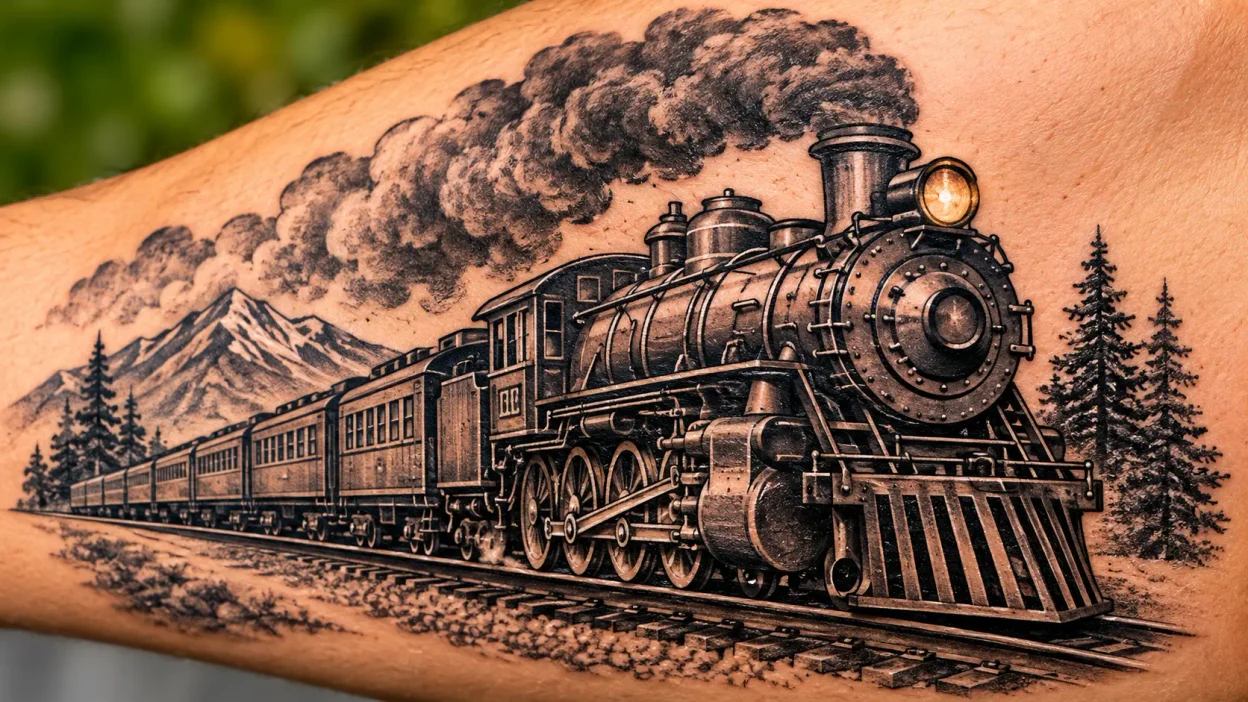
Train tattoo symbolism is closely connected to freedom, personal journeys, determination, and the passage of time. Trains have carried people across countries, connected distant communities, and represented opportunities for a different life. When someone chooses a train as a tattoo, the image can express a love of travel, respect for history, family memories, or the determination to keep moving forward.
In the United States, trains have a particularly recognizable place in cultural history. They helped connect the East and West Coasts, supported industrial growth, transported generations of families, and became part of American music, literature, and folklore. Steam locomotives, railroad tracks, and vintage passenger trains still carry associations with exploration, independence, and a changing country.
A train tattoo can be highly personal. One person might choose a locomotive to honor a railroad worker in the family, while another sees railroad tracks as a reminder of a difficult journey they survived. Understanding the design’s history and visual details helps explain why this seemingly simple subject can communicate so many different ideas.
Quick Answer
Train tattoo symbolism commonly represents life’s journey, freedom, perseverance, and moving forward in modern American tattoo culture. Historically, trains have also represented industrial progress, migration, exploration, working-class identity, and the connection between distant places and communities.
TL;DR
- Life journey: Train tracks represent personal direction and important life transitions.
- Freedom: Trains can symbolize independence, travel, and new opportunities.
- Perseverance: A moving locomotive represents determination through difficult circumstances.
- American history: Vintage trains connect tattoos with railroad heritage and industrial development.
- Family heritage: Railroad imagery can honor relatives who worked on the railways.
- Nostalgia: Steam locomotives evoke childhood memories and earlier generations.
1. What a Train Tattoo Looks Like
A train tattoo can feature anything from a detailed steam locomotive to a simple pair of railroad tracks disappearing toward the horizon. The design may include individual train cars, railway stations, tunnels, bridges, signals, or surrounding landscapes.
Different train styles create different visual impressions.
Steam locomotive
An older engine with a smokestack, large wheels, and visible mechanical details. It often represents history, nostalgia, hard work, and perseverance.
Railroad tracks
Parallel lines stretching into the distance. They commonly represent direction, life choices, destiny, and an unfolding personal journey.
Passenger train
A locomotive with passenger cars can represent travel, family connections, shared experiences, and the movement between different stages of life.
Minimalist train
A simplified engine or railway illustration often communicates a personal connection to trains without requiring an elaborate historical scene.
The design’s appearance matters because a modern electric train, a nineteenth-century steam engine, and an empty railway track can communicate very different ideas.
2. The Core Meanings of Train Tattoos
Train tattoos have no single universally accepted definition. Their meanings usually develop from the train’s movement, its practical purpose, and the cultural associations attached to railways.
Life’s journey is one of the most recognizable interpretations. A train travels along a route, passes through different environments, and reaches destinations along the way. This makes it a natural image for representing personal development and the stages of life.
Freedom and independence come from the train’s association with travel and leaving familiar surroundings. A train tattoo may represent someone’s desire to explore, relocate, or build a different future.
Perseverance and determination are connected to the locomotive’s ability to pull heavy loads across long distances. The image can serve as a reminder to continue working toward a goal despite obstacles.
Connection and belonging reflect the railway’s original purpose of bringing people and places together. A train tattoo may honor family relationships, shared experiences, or a community built around railroad work.
Nostalgia and heritage are particularly relevant to vintage train designs. Older locomotives can remind people of childhood trips, historical railways, or relatives who worked in the railroad industry.
The meaning ultimately depends on why the person chooses the image and which details they include.
3. Historical Origins of Train Symbolism
Train symbolism developed alongside the growth of railway transportation during the nineteenth century. Before railways became widespread, long-distance travel depended heavily on horses, stagecoaches, canals, and sailing vessels.
The development of steam-powered railways changed how people and goods moved. Britain’s early railway expansion helped establish the technology, while the United States rapidly adopted rail transportation as its territory and economy expanded.
The first major American railroad developments transformed commerce and settlement. Trains connected agricultural regions with industrial centers, carried manufactured goods, and made journeys that once required considerable time much more accessible.
The completion of the First Transcontinental Railroad in 1869 was a particularly important event in American history. It connected existing railway networks across the country, creating a continuous rail connection between the eastern and western parts of the United States.
This achievement became associated with national expansion, engineering, industrial ambition, and economic opportunity. It also involved serious consequences for Indigenous communities, whose lands and ways of life were disrupted by railroad construction and the settlement that followed.
As trains became part of everyday life, they acquired meanings beyond transportation. They represented opportunity for some people, separation for others, and the changing pace of modern society.
These historical associations provide much of the background behind today’s vintage locomotive tattoos.
4. Train Tattoos and the American Railroad Legacy
Few transportation symbols are as closely connected to American industrial history as the locomotive.
During the nineteenth and early twentieth centuries, railroads influenced where cities developed, how agricultural products reached markets, and where people could find employment. Railroad stations became important public spaces where families reunited, travelers departed, and communities exchanged goods.
Railroad workers also developed a distinct occupational identity. Engineers, conductors, brakemen, track workers, and maintenance crews performed demanding jobs that required technical knowledge and coordination.
For Americans with railroad connections in their families, a train tattoo can honor this history. A person might choose a steam locomotive to remember a grandfather who worked as an engineer or a parent who spent years maintaining railway infrastructure.
The tattoo can also recognize the contribution of working people whose labor helped build and operate transportation networks.
There is another side to this history. Railroad expansion contributed to Indigenous dispossession, dangerous working conditions, and discriminatory labor systems. Chinese immigrant workers, for example, played an essential role in building the western portion of the transcontinental railroad while facing dangerous conditions and unequal treatment.
Recognizing these historical realities makes railroad imagery more meaningful than treating the locomotive only as a symbol of adventure and progress.
5. What Railroad Tracks Represent in Tattoos
Railroad tracks are among the most adaptable elements of train tattoo design.
Two parallel lines stretching toward a distant horizon can represent a person’s direction in life. The tracks suggest that experiences unfold over time, with each stage leading toward another destination.
For some people, the image communicates commitment to a chosen path. It can represent a decision to continue despite uncertainty or to remain focused after experiencing setbacks.
Tracks can also represent important transitions:
- Leaving childhood and entering adulthood.
- Moving away from a familiar home.
- Recovering after a difficult experience.
- Starting a new career or relationship.
- Accepting that life continues to change.
A railway track that disappears into the horizon may emphasize uncertainty and possibility. The destination is not visible, but the journey continues.
Some people interpret railroad tracks as a symbol of destiny or a predetermined direction. Others see them as a reminder that individuals make choices about where their lives go.
Neither interpretation is universal. The design becomes meaningful through the experiences and beliefs of the person wearing it.
6. Train Tattoos as Symbols of Freedom and Adventure
Trains have long represented the possibility of going somewhere new. Their ability to cross large distances made them important symbols of mobility and exploration.
In American culture, trains appear in stories about travelers, wandering musicians, workers searching for employment, and people leaving difficult circumstances behind.
This association became especially visible in traditional American folk and blues music. Railroad imagery frequently appeared in songs about travel, separation, work, and longing.
The train could represent an escape from an unsatisfactory situation or the excitement of an unfamiliar destination.
A person who chooses a train tattoo for this reason may value independence, exploration, and the freedom to make personal decisions.
A moving locomotive can communicate action rather than simply a desire for change. It suggests someone who is actively traveling toward something rather than waiting for circumstances to improve.
For people who enjoy road trips, railway travel, or exploring different parts of the country, the tattoo may also express a straightforward love of transportation and adventure.
7. The Connection Between Trains and Perseverance
A locomotive is designed to move heavy loads across long distances. This practical characteristic has helped make it an effective image of endurance.
The engine represents the force that keeps the train moving, while the cars behind it represent the weight being carried.
As a tattoo, this image can reflect the experience of handling responsibilities, overcoming obstacles, or continuing toward a goal when progress feels slow.
A steam locomotive is particularly suitable for this interpretation because its mechanical construction makes its effort visible. The wheels, pistons, smoke, and movement communicate physical work.
Some people choose this design after recovering from a difficult period, completing a major life goal, or making a significant personal change.
The message is not necessarily that life must always move quickly. Instead, the locomotive can represent steady progress and the ability to keep going even when the journey requires considerable effort.
8. Train Tattoos and Family Heritage
For some tattoo enthusiasts, trains are less about abstract symbolism and more about family history.
Railroad employment once provided livelihoods for generations of American families. In certain communities, working for a railway company became part of a family’s identity.
A train tattoo can commemorate a relative who worked as an engineer, conductor, station employee, or track laborer. It may also honor a family member who regularly traveled by train or lived near a railway station.
Personal details can make these designs especially meaningful:
- A relative’s name or initials.
- The number of a locomotive associated with a family story.
- A railroad company emblem, where historically appropriate.
- A meaningful year or employment date.
- A railway station connected to childhood memories.
These details transform a general transportation image into a personal memorial.
Railroad tattoos can also represent pride in a working-class background. They recognize practical skills, physical labor, and the contribution of ordinary workers to the development of communities.
9. Different Train Tattoo Styles and Their Meanings
The artistic style can influence the message of a train tattoo just as much as the subject itself.
Traditional American style
Bold outlines and strong colors give the locomotive a classic appearance. This approach can emphasize railroad heritage, adventure, and working-class pride.
Realistic style
Detailed mechanical features create a historical or personal tribute. This style works well for memorials and family-related designs.
Geometric and minimalist style
Clean lines and simplified shapes focus on direction, movement, and personal journeys.
Vintage engraving style
An old-fashioned illustration can emphasize historical appreciation, nostalgia, and a connection to earlier generations.
A realistic locomotive may be chosen for its historical detail, while a minimalist track design can communicate a personal journey without depicting a specific train.
10. The Meaning of Train Tattoo Colors
Color can add emotional and visual associations to railroad imagery.
| ColorCommon AssociationPossible Tattoo Meaning | ||
|---|---|---|
| Black and gray | History, seriousness, remembrance | Family heritage and perseverance |
| Red | Energy, courage, movement | Determination and ambition |
| Blue | Stability, calm, trust | Personal direction and confidence |
| Green | Growth, renewal, nature | New beginnings and progress |
| Brown | Earthiness, tradition, age | Railroad heritage and nostalgia |
Black-and-gray designs are particularly popular for historical locomotive imagery because shading can reproduce the appearance of old photographs and mechanical illustrations.
Red can make a traditional locomotive stand out, while blue and green can create a landscape surrounding the railway.
These associations are not fixed rules. A person may choose colors simply because they complement their skin tone, preferred tattoo style, or existing body art.
11. Train Tattoos in Modern American Tattoo Culture
Train tattoos continue to appeal to people who appreciate traditional American imagery, transportation history, and personal storytelling.
In modern tattoo culture, railway designs can appear in several forms:
Memorial tattoos: A locomotive may honor a deceased relative or preserve the memory of someone who worked on the railways.
Travel-inspired tattoos: People who enjoy railway journeys may choose train imagery to represent exploration and independence.
Career-related tattoos: Railroad employees and transportation enthusiasts may use locomotive designs to express professional pride.
Personal transformation tattoos: Railroad tracks can represent a period of recovery, a new direction, or the decision to move forward.
Historical tattoos: Vintage engines can demonstrate an interest in American industrial history and traditional machinery.
Train imagery also fits naturally into larger tattoo compositions. A locomotive can be combined with mountains, forests, bridges, clocks, maps, or landscapes.
These additions help establish a particular story. A train crossing a mountain bridge may emphasize adventure, while an old locomotive surrounded by dates and names may function as a family memorial.
12. Religious and Spiritual Interpretations of Train Tattoos
Trains do not have one established religious meaning in major world religions. However, some people interpret their movement through spiritual ideas about life’s direction, purpose, and personal transformation.
In a Christian-inspired tattoo, a train traveling toward a distant light might represent faith, hope, or the belief that life has a greater destination. A railway extending toward the horizon can also symbolize trust during uncertain periods.
Some people connect the train with the idea of a spiritual journey, where experiences and challenges contribute to personal development.
In broader spiritual interpretations, the train may represent the passage of time and the movement from one stage of existence to another.
These are personal symbolic readings rather than universal religious teachings. A train tattoo does not automatically communicate a particular faith or belief system.
If a design includes religious elements, such as a cross, scripture, or angel imagery, those additional details help establish the intended interpretation.
13. Common Misunderstandings About Train Tattoos
Train tattoos are generally associated with positive themes, but some interpretations require additional context.
A train tattoo does not always represent running away. Although trains can symbolize escape and freedom, they can equally represent responsibility, family history, or professional pride.
Railroad tracks do not necessarily mean destiny. Some people associate them with a predetermined life path, while others interpret them as a reminder to make deliberate choices.
A vintage locomotive is not automatically a symbol of nostalgia. It may reflect an interest in engineering, American industrial history, or a family connection to railroad work.
Train imagery is not exclusively American. Railways developed across Europe, Asia, Africa, and other regions, and different communities have their own historical relationships with trains.
It is also important to recognize that railroad expansion had complicated consequences. Celebrating engineering achievements should not erase the labor exploitation, racial discrimination, Indigenous displacement, and environmental changes associated with railway development.
Understanding these distinctions helps prevent a personal tattoo from being reduced to a simplistic historical message.
14. How Train Tattoo Symbolism Has Changed Over Time
The meaning of trains has changed considerably since steam locomotives first transformed transportation.
During the nineteenth century, trains were closely associated with technological progress, economic opportunity, and the expansion of transportation networks. They represented a changing world in which distant places became more accessible.
During the twentieth century, trains developed additional cultural associations. Passenger rail travel became part of family vacations and everyday commuting, while freight railways remained essential to American industry.
As automobiles and airplanes became increasingly common, older steam locomotives gradually acquired a stronger association with nostalgia and historical preservation.
Modern train tattoos reflect all these layers. Some celebrate the mechanical beauty of vintage engines, while others emphasize movement, independence, or the importance of family history.
The symbol has not lost its connection to progress. Instead, it has expanded to represent both the excitement of moving forward and the value of remembering where a person came from.
Frequently Asked Questions
1. What does a train tattoo symbolize spiritually?
A train tattoo can represent a spiritual journey, personal direction, faith, and transformation. Some people view its movement toward a destination as a reminder to remain committed to their beliefs during uncertain times.
2. What does a railroad track tattoo mean?
Railroad tracks commonly symbolize life’s journey, direction, choices, and future possibilities. Tracks disappearing into the distance can represent an unknown future or confidence in continuing forward.
3. Does a train tattoo symbolize freedom?
Yes, trains can represent freedom, exploration, and independence because they allow people to travel beyond familiar surroundings. For some individuals, the design also represents leaving a difficult chapter behind.
4. What does a steam locomotive tattoo represent?
A steam locomotive often represents perseverance, industrial history, hard work, and nostalgia. It can also honor family members who worked in the railroad industry.
5. Is a train tattoo a good memorial tattoo?
A train can be a meaningful memorial design, especially when the person being remembered had a connection to railroads or transportation. Adding a name, date, locomotive number, or meaningful location can make the tribute more personal.
6. What does a train tattoo mean for someone who loves traveling?
For a travel enthusiast, a train tattoo may express curiosity, adventure, independence, and appreciation for discovering new places. It can also preserve memories of a particular railway journey or destination.
7. Are train tattoos associated with American culture?
Yes, train tattoos have strong connections to American railroad history, industrial development, migration, and working-class heritage. However, railways also have important cultural histories in many other countries.
Conclusion
Train tattoo symbolism brings together ideas of freedom, perseverance, personal journeys, family heritage, and historical progress. Its meaning comes from the practical role trains have played in connecting communities and transporting people through different stages of life.
In American tattoo culture, a locomotive can honor railroad workers, celebrate industrial history, or represent the determination to overcome personal obstacles. Railroad tracks can communicate a different but related message: life continues, choices matter, and the destination is not always visible from the beginning.
Ultimately, a train tattoo tells a story about movement and connection. Whether it honors someone from the past or represents a new direction, its meaning becomes most significant when it reflects the journey of the person wearing it.


