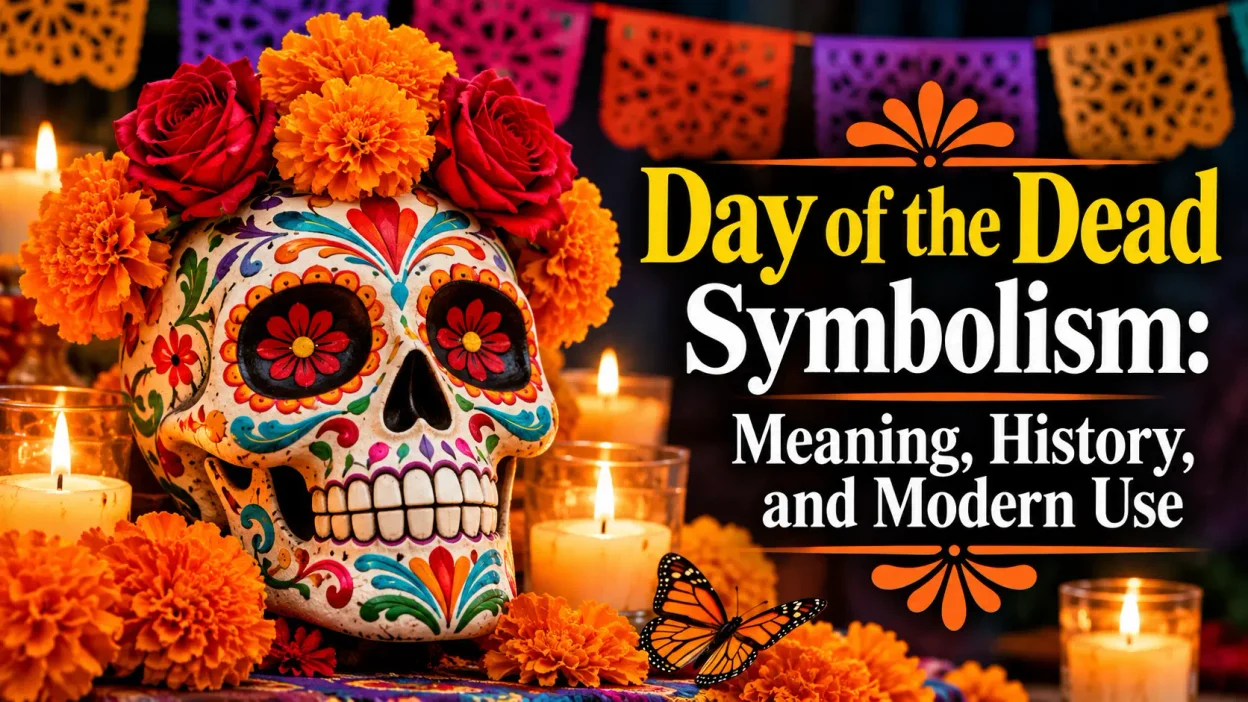
Day of the Dead symbolism represents remembrance, the connection between life and death, family bonds, and the belief that loved ones who have passed remain part of the living community. Known in Spanish as Día de los Muertos, this Mexican tradition transforms mourning into an occasion for remembering the personalities, stories, and everyday lives of deceased family members.
Celebrated primarily on November 1 and 2, the holiday is recognized through colorful altars, marigold flowers, decorated skulls, candles, photographs, traditional foods, and gatherings at cemeteries. These objects are not simply decorations. Each carries a meaning connected to welcoming the departed, honoring their memory, and acknowledging that death is a natural part of existence.
In the United States, Day of the Dead has become increasingly visible in Mexican American communities, museums, schools, art galleries, and public festivals. Although some people encounter its imagery through costumes or decorative skulls, the tradition has a more personal and spiritual purpose rooted in family remembrance and cultural identity.
Quick Answer
Day of the Dead symbolism commonly represents remembrance, love for deceased family members, the continuity of life, and the acceptance of death as a natural part of existence. Historically rooted in Indigenous Mesoamerican traditions and blended with Catholic observances, it symbolizes a temporary reunion between the living and the dead through offerings, food, flowers, and family rituals.
TL;DR
- Day of the Dead honors deceased loved ones through remembrance and celebration.
- Its traditions combine Indigenous Mesoamerican beliefs with Catholic observances.
- Skulls symbolize mortality, equality, and the cycle of life.
- Marigolds, candles, and photographs help welcome and guide departed spirits.
- Mexican American communities use the holiday to preserve cultural identity.
- Modern celebrations emphasize family, memory, art, and connection.
1. What Day of the Dead Represents
At its center, Day of the Dead symbolizes the relationship between memory and love. The holiday recognizes that although a person’s physical life ends, their influence continues through family relationships, shared experiences, traditions, stories, and the memories carried by those who remain.
Rather than treating death as something that must be avoided in conversation, Día de los Muertos creates a space where people can acknowledge it openly. Families may speak about deceased relatives, prepare their favorite meals, share humorous stories, and remember personal habits that made them recognizable.
The holiday also represents the idea that remembering someone is an active expression of love. Photographs, favorite belongings, and carefully prepared food make remembrance tangible. These objects help families feel connected to people who are no longer physically present.
For many participants, the symbolism is spiritual as well as emotional. The departed are welcomed as honored visitors, and the household altar becomes a place where the living express hospitality toward those they believe may return during the celebration.
2. Ancient Indigenous Roots of the Celebration
The traditions associated with Día de los Muertos have roots in ancient Mesoamerican cultures, including Mexica, Maya, Mixtec, Zapotec, and other Indigenous communities. These societies held varied beliefs about death, the afterlife, ancestors, and the relationship between the living and the spiritual world.
Death was not always understood as a complete separation from existence. In many traditions, deceased people continued on a spiritual journey, and the living had responsibilities involving remembrance, ritual, and offerings.
The Aztecs, for example, recognized particular periods for honoring the dead. Their rituals involved offerings, food, incense, and ceremonial practices connected to their understanding of the spiritual world. These traditions existed long before Spanish colonization.
It is important to avoid treating all Indigenous beliefs as identical. The ancient cultures of Mesoamerica had distinct religious systems, regional customs, and understandings of death. Today’s Day of the Dead reflects centuries of cultural transformation rather than a single unchanged ancient ceremony.
3. The Influence of Catholicism
When Spanish colonizers arrived in Mexico during the sixteenth century, they introduced Catholic religious observances, including All Saints’ Day on November 1 and All Souls’ Day on November 2.
Indigenous commemorations of the dead gradually became intertwined with these Christian calendar dates. The result was a cultural and religious tradition that incorporates elements from both Indigenous and Catholic practices.
For Catholics, these dates are associated with honoring saints and praying for deceased souls. Within Día de los Muertos celebrations, Catholic influences can appear through crosses, prayers, religious images, church services, and the blessing of graves.
However, the holiday is not practiced identically by every family. Some celebrations are strongly Catholic, others emphasize Indigenous cultural traditions, and some focus primarily on family remembrance without formal religious participation.
The blending of traditions is one reason the holiday has remained meaningful across generations. It reflects the historical experiences of Mexican communities and their ability to preserve, adapt, and reinterpret cultural practices.
4. What the Ofrenda Symbolizes
An ofrenda, or offering, is one of the most recognizable elements of Día de los Muertos. Families create altars to honor deceased loved ones and welcome their spirits.
An ofrenda is not necessarily an altar for worship. It is generally a place of remembrance, hospitality, and connection. Families arrange objects that reflect the identity and preferences of the people being honored.
Common items include:
- Photographs of deceased family members
- Candles to illuminate the way
- Marigolds to guide spirits
- Water to refresh visitors
- Favorite foods and beverages
- Personal possessions and meaningful objects
- Religious images or crosses
- Papel picado and other decorations
Each altar is personal. One might feature a grandfather’s hat, a grandmother’s favorite perfume, a child’s toy, a musician’s instrument, or a family recipe.
The symbolism of an ofrenda is especially meaningful because it treats remembrance as an act of hospitality. Instead of simply thinking about the dead, families prepare a place for them as if they were expected guests.
5. Sugar Skulls and the Meaning of Calaveras
Skulls, or calaveras, are among the most recognizable symbols of Day of the Dead. In many cultures, skulls represent danger, mortality, or the frightening aspects of death. Within this celebration, decorated skulls often carry a different message.
Sugar skulls, known as calaveritas de azúcar, are decorated with bright colors, icing, flowers, and sometimes the names of people. They can represent the deceased, the inevitability of death, and the idea that mortality is shared by everyone.
Their sweet appearance contrasts with the subject of death. This contrast reflects a cultural approach in which death can be acknowledged through humor, art, affection, and celebration rather than only fear or sorrow.
Skull imagery also appears in satirical poems called calaveras literarias. These poems often imagine death visiting living people, sometimes poking fun at politicians, celebrities, coworkers, or social conventions.
The skull therefore carries several meanings at once: mortality, remembrance, humor, social equality, and the recognition that death is part of the human experience.
6. La Catrina and Social Equality
La Catrina is one of the most famous figures associated with Día de los Muertos. She is typically depicted as an elegantly dressed skeleton wearing an elaborate hat, often decorated with flowers, feathers, or other fashionable details.
Her origins are connected to Mexican printmaker José Guadalupe Posada, whose early twentieth-century skeletal illustrations satirized social class and the adoption of European fashions among Mexican elites. The skeleton’s elegant appearance suggested that wealth, status, and fashionable clothing cannot protect anyone from death.
La Catrina became a lasting cultural image through Mexican art, especially the work of artists who expanded and reinterpreted Posada’s imagery.
Today, La Catrina can symbolize:
- The equality of all people in death
- Mexican cultural identity
- Artistic creativity
- Satire and social criticism
- The combination of beauty and mortality
Her popularity in face painting, festivals, murals, and fashion has made her an important visual representation of the holiday, although her original social commentary is sometimes overlooked.
7. Marigolds and the Path Between Worlds
The marigold, especially the Mexican marigold known as cempasúchil, is closely associated with Day of the Dead. Its bright orange and yellow colors make it one of the most prominent flowers used in altars and cemetery decorations.
Traditionally, marigolds are believed to help guide the spirits of the deceased toward their families. Their strong scent and vivid appearance make them suitable for creating pathways from gravesites to homes or around an ofrenda.
The flower also represents beauty, the temporary nature of life, and the connection between the natural world and human memory.
Its seasonal blooming around the holiday reinforces the association with autumn, harvest, and the changing cycles of nature. The marigold’s presence is therefore not merely decorative. It helps transform the celebration into a sensory experience involving color, fragrance, and the welcoming of loved ones.
8. Candles, Water, Food, and the Four Elements
Traditional ofrendas frequently include objects associated with the natural elements. These items have practical and symbolic roles in welcoming the departed.
| Symbol | Meaning in Day of the Dead traditions | Common association |
|---|---|---|
| Candles | Light and guidance | Helping spirits find their way |
| Water | Refreshment and purification | Quenching the spirits’ thirst |
| Food and bread | Nourishment and hospitality | Sharing meals with loved ones |
| Papel picado | Wind and movement | Representing the air |
| Flowers | Guidance and beauty | Welcoming the departed |
| Earth or seeds | Life and renewal | The natural cycle of existence |
Candles are often arranged to illuminate the altar. Their light symbolizes guidance and remembrance, while water is placed to refresh spirits after their journey.
Food is one of the most personal offerings. Families may prepare traditional dishes or meals that deceased relatives particularly enjoyed. The food symbolizes hospitality, family continuity, and the idea that memories can be preserved through familiar tastes and recipes.
Papel picado, colorful perforated paper, is often associated with the wind. Its movement helps make the altar feel alive, while its delicate patterns contribute to the celebratory atmosphere.
Together, these objects express the idea that the departed are welcomed through the same gestures used to care for living guests.
9. Pan de Muerto and the Symbolism of Food
Pan de muerto, or bread of the dead, is a traditional sweet bread prepared for the holiday. Its shape and decorations vary by region, but many versions include rounded pieces of dough arranged to resemble bones.
The bread symbolizes nourishment, generosity, and the connection between food and family remembrance. Sharing it is an important part of the celebration because eating together preserves the familiar rituals that bring families closer.
In some interpretations, the bread’s circular shape represents the cycle of life and death. The bone-shaped decorations remind participants of mortality, while the sweet flavor turns the reminder into an expression of affection rather than fear.
Food offerings also communicate something deeply personal. A deceased relative’s favorite dish may mean more than a traditional holiday recipe because it brings back memories of that person’s habits, personality, and place within the family.
10. Photographs and Personal Belongings
Photographs are often placed at the center or upper portion of an ofrenda. They identify the individuals being remembered and make the altar a personal tribute rather than a general symbol of death.
A photograph might show a person during childhood, at a wedding, celebrating a birthday, or enjoying an ordinary family moment. These images emphasize that the deceased had a complete life beyond the moment of death.
Personal belongings deepen this connection. A pair of glasses, a favorite book, a musical instrument, a recipe card, or a piece of clothing may be included because it captures something distinctive about the individual.
This symbolism reflects the importance of individual memory within a shared family tradition. The holiday does not simply honor ancestors as an abstract group; it recognizes specific people, their personalities, their accomplishments, and the relationships they left behind.
11. Day of the Dead Symbolism in the United States
In the United States, Día de los Muertos has become an important expression of Mexican American heritage, particularly in communities with long-standing Mexican cultural traditions.
Historically, Mexican immigrants brought family remembrance practices with them, including visits to cemeteries, religious services, and gatherings honoring deceased relatives. Over time, cultural organizations and artists developed larger public celebrations.
Chicano artists and activists played a significant role in expanding public awareness of the holiday. Community altars, exhibitions, murals, performances, and festivals became ways to celebrate Mexican identity, preserve cultural traditions, and create visibility for Mexican American communities.
Today, American celebrations may take place in:
- Community centers and cultural organizations
- Museums and art galleries
- Schools and universities
- Public parks and city plazas
- Churches and cemeteries
- Mexican American homes
For many Mexican American families, the holiday remains an intimate family tradition. For others, public events offer an opportunity to teach younger generations about cultural heritage and to share the celebration with neighbors.
Its meaning in the United States often includes cultural pride, belonging, heritage preservation, and the recognition of Mexican American contributions to American society.
12. Emotional and Psychological Meaning
Day of the Dead offers a way of experiencing grief without requiring people to hide their sadness or abandon joyful memories.
The holiday creates a structured opportunity to remember someone. Preparing food, decorating an altar, visiting a grave, and telling stories can help grieving individuals maintain a continuing emotional relationship with someone who has died.
This does not mean that grief disappears or that every participant feels happy. A celebration can include sadness, longing, laughter, gratitude, and emotional pain at the same time.
The symbolism of the holiday may help people understand death as part of a broader life story rather than an isolated ending. It also encourages families to recognize the influence of previous generations on their own identities.
For children, participating in age-appropriate traditions may make conversations about death less frightening. They can learn about deceased relatives through photographs, stories, food, and family activities.
For adults, the holiday can become an opportunity to revisit family histories, reconnect with relatives, and remember the values that deceased loved ones passed down.
13. Cross-Cultural Meanings of Ancestor Remembrance
Although Día de los Muertos is specifically associated with Mexican and other Latin American traditions, honoring deceased family members is a practice found in many cultures.
In Japan, Obon is a Buddhist-influenced tradition in which families honor ancestors and welcome their spirits. Lanterns, dances, cemetery visits, and household rituals help express the continuing relationship between the living and the deceased.
In Chinese traditions, ancestral remembrance may involve offerings, incense, food, and visits to family graves during observances such as Qingming. These practices reflect respect for family lineage and obligations toward ancestors.
Many African cultures also maintain traditions involving ancestors, although beliefs and practices vary widely among ethnic groups and communities. Ancestors may be understood as sources of guidance, protection, wisdom, or continuing family identity.
These comparisons reveal a shared human concern with memory, family continuity, and the desire to preserve relationships beyond death. However, they should not be treated as interchangeable traditions. Each has its own religious, cultural, and historical framework.
14. Day of the Dead in Tattoos, Fashion, and Modern Art
Day of the Dead imagery is widely used in modern tattoos, jewelry, clothing, paintings, decorative objects, and digital artwork.
A person may choose a sugar skull tattoo to represent a deceased family member, acceptance of mortality, Mexican heritage, or an appreciation of the holiday’s artistic traditions. A Catrina tattoo may represent cultural identity, beauty, social equality, or the contrast between life and death.
Marigold tattoos can represent remembrance, guidance, or the desire to keep a loved one’s memory alive. Candle imagery may communicate hope, spiritual connection, and the presence of someone who is no longer physically there.
Modern artists also use Día de los Muertos imagery to explore themes of identity, migration, grief, inequality, and the relationship between traditional culture and contemporary society.
In fashion and commercial design, however, the images sometimes become detached from their original context. Decorative skulls and floral patterns may be marketed simply as colorful seasonal designs, leaving out the family’s remembrance practices and religious or cultural significance.
Understanding the original symbolism can help people use these images more thoughtfully.
15. Misunderstandings, Cultural Appropriation, and Misuse
One of the most common misunderstandings is treating Día de los Muertos as a Mexican version of Halloween. Although both holidays occur near the beginning of November and may feature skull imagery, their purposes and traditions differ.
Halloween is associated with costumes, trick-or-treating, spooky entertainment, and themes of fear or supernatural activity. Día de los Muertos is primarily concerned with honoring deceased loved ones, welcoming their spirits, and celebrating family remembrance.
Another misunderstanding is assuming that decorated skulls represent a fascination with death or violence. In the holiday’s traditional context, skull imagery often expresses mortality, humor, affection, and the belief that death is a shared human experience.
Cultural appropriation can become a concern when sacred or culturally meaningful imagery is used without understanding its context, particularly when commercial products reduce the holiday to costumes, face paint, or seasonal decorations.
This does not mean that people outside Mexican culture cannot learn about or participate in Día de los Muertos. Respectful participation involves understanding its history, recognizing the communities that maintain the tradition, and appreciating that it is not simply an aesthetic theme.
The difference lies between cultural appreciation that encourages learning and participation, and commercialization that strips away the tradition’s meaning.
16. How Day of the Dead Symbolism Has Evolved
The symbolism of Día de los Muertos has changed across centuries while retaining its central concern with remembering the dead.
Ancient Indigenous traditions contributed ideas about death, spiritual journeys, offerings, and the relationship between human life and the natural world. Spanish colonization introduced Catholic observances that reshaped the holiday’s calendar and religious practices.
In nineteenth- and early twentieth-century Mexico, artists such as José Guadalupe Posada helped popularize skeletal imagery through satire and political commentary. La Catrina eventually became a lasting symbol of Mexican identity and the holiday.
In the United States, Mexican American artists and cultural activists helped transform private family traditions into public cultural celebrations. Community altars, artistic exhibitions, and festivals became expressions of heritage, identity, and social belonging.
More recently, the holiday has gained international recognition through films, television, tourism, fashion, social media, and museum exhibitions. This increased visibility has brought new audiences while also creating challenges involving commercialization and cultural misunderstanding.
Despite these changes, the central symbolism remains remarkably consistent: death does not erase the importance of a person’s life, and remembering the dead is an act of connection.
Frequently Asked Questions
What does Day of the Dead symbolize spiritually?
Spiritually, Day of the Dead symbolizes the continuing relationship between the living and the deceased. Many participants believe that the spirits of loved ones return during the celebration, while others interpret the tradition primarily as a meaningful way to remember family members.
What does a sugar skull symbolize?
A sugar skull represents mortality, remembrance, and the recognition that death is part of life. Its colorful decorations and sweet appearance express affection and celebration rather than fear, and skulls may be personalized to honor specific people.
What does La Catrina symbolize?
La Catrina symbolizes mortality, social equality, Mexican cultural identity, and satire. Her elegant appearance reminds viewers that wealth and social status cannot prevent death, while her modern use reflects the artistic traditions of Día de los Muertos.
What do marigolds symbolize on Day of the Dead?
Marigolds symbolize guidance, remembrance, and the welcoming of departed spirits. Their bright colors and strong fragrance are traditionally believed to help guide the spirits toward family altars and gravesites.
Is Day of the Dead a religious holiday?
Day of the Dead incorporates Indigenous spiritual traditions and Catholic observances, but not everyone celebrates it in the same religious way. Some families attend church and pray for deceased relatives, while others emphasize cultural heritage, family remembrance, and community celebration.
Is Day of the Dead the same as Halloween?
No. Halloween focuses largely on costumes, entertainment, spooky themes, and trick-or-treating, while Día de los Muertos honors deceased loved ones through altars, offerings, family gatherings, and remembrance. Their shared timing and skull imagery can make them appear similar, but their cultural meanings are different.
What does Day of the Dead imagery mean in tattoos?
Day of the Dead tattoos often represent remembrance of a deceased loved one, cultural heritage, acceptance of mortality, or a connection to Mexican art and traditions. The meaning depends on the design and the personal story behind it.
Conclusion
Day of the Dead symbolism centers on the enduring connection between life, death, family, and memory. Its flowers, skulls, candles, photographs, and offerings transform remembrance into a meaningful celebration that honors the lives of those who came before.
For Mexican and Mexican American communities, the holiday represents cultural continuity, family identity, and the preservation of traditions across generations. Its growing presence in American art and public celebrations has introduced new audiences to its imagery, while also making cultural understanding more important.
Ultimately, Day of the Dead reminds us that remembering someone is more than looking back. It is a way of carrying their stories, traditions, and influence into the lives of those who remain.