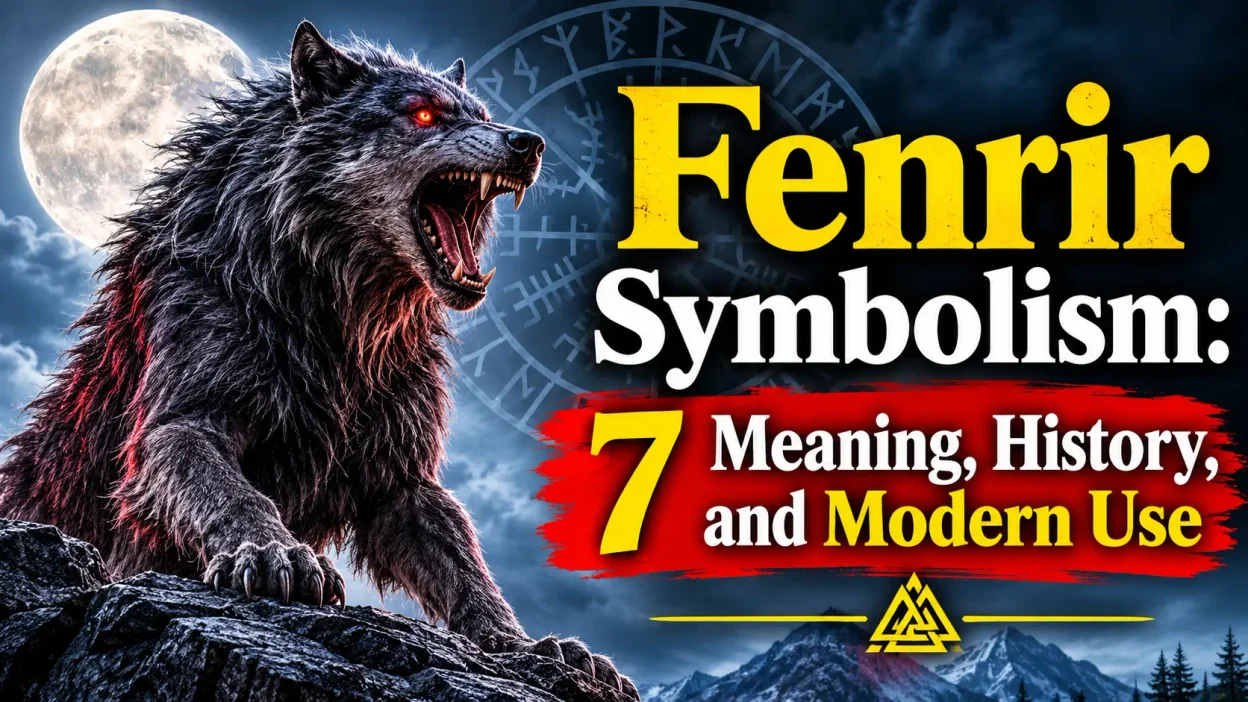
Fenrir is one of the most recognizable creatures in Norse mythology: a monstrous wolf whose strength, growing power, and eventual escape are tied to the destruction of the gods. In Fenrir symbolism, the wolf represents uncontrolled power, defiance, fate, destruction, and the consequences of trying to suppress something that cannot be contained.
Unlike ordinary wolves in folklore, Fenrir is not simply a symbol of wilderness or survival. His story involves betrayal, fear, restraint, sacrifice, and the collapse of an established order. He is a creature feared by the gods themselves, yet his imprisonment raises questions about whether danger can be prevented or whether attempts to control it only make the eventual confrontation worse.
In modern American culture, Fenrir appears in tattoos, fantasy novels, video games, heavy metal imagery, mythology-inspired jewelry, and artwork. People are drawn to him because he represents more than aggression. He can symbolize resistance to authority, independence, personal strength, anger toward injustice, and the struggle to break free from restrictions.
Understanding Fenrir requires looking beyond his monstrous appearance and examining the mythology that shaped his meaning.
Quick Answer
Fenrir commonly symbolizes unrestrained power, rebellion, destruction, freedom, and resistance to control in modern American culture. In Norse mythology, he is the wolf destined to break his bonds during Ragnarok, kill Odin, and contribute to the destruction of the old world, making him a symbol of feared destiny, suppressed strength, and the consequences of betrayal.
TL;DR
- Fenrir represents uncontrolled strength, rebellion, destruction, and resistance to authority.
- His binding by the gods symbolizes fear, betrayal, and attempts to control dangerous power.
- Ragnarok connects Fenrir with fate, the collapse of established order, and transformation.
- Modern Americans use Fenrir imagery to express independence, anger, resilience, and individuality.
- Fenrir tattoos often represent breaking restraints, confronting fear, or embracing personal strength.
- His symbolism includes both destructive potential and the desire for freedom.
1. Who Is Fenrir in Norse Mythology?
Fenrir, also known as Fenrisúlfr or Fenris Wolf, is a gigantic wolf in Norse mythology. He is the son of Loki, the trickster god, and the giantess Angrboða. His siblings include Hel, associated with the realm of the dead, and Jörmungandr, the enormous serpent that encircles the world.
The gods learn that Loki’s children are connected to future disasters. Fenrir grows rapidly and becomes so strong that the gods fear him. Although he is initially raised among them, they eventually decide that he must be restrained.
Fenrir’s story is important because he is not depicted as an ordinary enemy who simply attacks the gods. His fate is woven into the mythology’s prediction of Ragnarok, the final conflict in which the world and many of its gods face destruction.
The wolf’s identity therefore carries several layers of meaning: physical strength, supernatural danger, inevitability, and the tension between freedom and control.
2. The Meaning of Fenrir’s Name and Wolf Identity
Fenrir’s name is connected to Fenrisúlfr, commonly translated as the Fenris Wolf. The precise linguistic interpretation of the name is debated, but his identity as a monstrous wolf is unmistakable in the surviving Norse tradition.
Wolves occupied an important place in northern European imagination. They were predators that could threaten livestock, travelers, and settlements. At the same time, they were admired for their endurance, hunting ability, social organization, and capacity to survive harsh environments.
Fenrir takes these characteristics to an extreme. He is not simply a wolf representing nature; he is nature imagined as an overwhelming force capable of challenging divine authority.
His wolf form contributes to symbolic meanings such as:
- Instinct and primal power
- Independence and survival
- Danger and unpredictability
- Loyalty to one’s own nature
- Resistance to domestication
In modern symbolic interpretation, Fenrir often represents a person or force that refuses to become manageable, obedient, or harmless.
3. Ancient Origins of Fenrir’s Symbolism
Fenrir’s story survives primarily through medieval Icelandic literature, especially the Prose Edda associated with Snorri Sturluson and poems preserved in the Poetic Edda.
These texts were written down centuries after the Viking Age began, and the mythology likely developed through earlier oral traditions. The details of Fenrir’s story should therefore be understood within the surviving literary record rather than treated as a perfectly preserved account of one ancient belief.
The wolf appears in traditions connected with the end of the world, the destruction of the gods, and the breaking of restraints. His role reflects a worldview in which even powerful beings cannot permanently escape fate.
Fenrir’s ancient symbolism developed around the frightening possibility that an enemy, threat, or force of destruction could grow beyond the ability of those in power to control it.
His mythology also reflects a broader Norse interest in courage, fate, sacrifice, conflict, and the knowledge that even gods face death.
4. Fenrir and the Symbolism of Uncontrolled Power
One of Fenrir’s strongest symbolic meanings is power that cannot be safely managed.
The gods initially keep Fenrir close, hoping to monitor his growth and prevent him from becoming dangerous. But his strength increases until they can no longer handle him directly. His story shows that power can become frightening when it develops beyond the limits imposed by others.
Fenrir may symbolize:
- Strength without restraint
- A dangerous ambition
- Anger that has accumulated over time
- A person who has outgrown their limitations
- A force that established authorities cannot contain
This symbolism is not always negative. In modern personal interpretations, Fenrir can represent someone who has discovered their strength after years of being underestimated.
The same power that frightens others may be understood by the individual as necessary for survival, self-defense, or independence.
5. The Binding of Fenrir: Betrayal and Broken Trust
The gods attempt to bind Fenrir with increasingly powerful chains. He breaks the first restraints and then the second. Eventually, they obtain a magical binding called Gleipnir, which appears thin and harmless but is extraordinarily strong.
Fenrir becomes suspicious. He agrees to the final binding only if one of the gods places a hand in his mouth as a guarantee that the gods will release him if he cannot break free.
Tyr accepts the condition and places his hand in Fenrir’s mouth. When Fenrir discovers that the gods have deceived him, he bites off Tyr’s hand.
This episode introduces an important emotional dimension to Fenrir symbolism: betrayal by those who claim to act in the name of safety.
Fenrir is restrained because the gods fear what he may become. Yet their deception confirms the distrust that makes him dangerous.
The story can symbolize:
- Broken promises
- Betrayal by authority
- Fear disguised as protection
- The loss of trust
- The consequences of manipulation
For modern readers, this part of the myth can be especially meaningful when interpreting personal experiences involving control, dishonesty, or unequal power.
6. Fenrir Symbolism in the United States
Fenrir does not have a traditional American religious role or established national symbolism. His modern meaning in the United States comes primarily through Norse mythology, fantasy entertainment, mythology-inspired art, tattoos, and contemporary identity culture.
American interpretations frequently emphasize individual freedom, resistance, and self-determination. Fenrir’s imprisonment and eventual escape fit naturally into these themes.
Some people see him as a symbol of refusing to be controlled by institutions, expectations, or people who underestimate them. Others associate him with personal transformation after difficult experiences.
In American popular culture, Fenrir can communicate:
- Rebellion against authority
- Individualism
- Strength in adversity
- Anger toward injustice
- Refusal to submit
- The willingness to confront overwhelming opposition
However, his destructive role in Ragnarok remains part of his meaning. Fenrir is not simply a heroic freedom fighter. He can also represent the danger of allowing anger, resentment, or power to become destructive.
That tension makes the symbol more complex than a simple image of independence.
7. Fenrir and Ragnarok: Destruction and the End of an Era
Ragnarok is the catastrophic conflict in Norse mythology associated with the death of gods, destruction of the world, and the emergence of a new world afterward.
Fenrir’s escape from his bonds marks a major event in this final conflict. He kills Odin, one of the central gods, before being killed by Odin’s son Vidar in the surviving mythological account.
Fenrir therefore symbolizes the destruction of an established order.
This meaning can be interpreted in several ways:
- The end of an era
- The collapse of institutions
- A crisis that cannot be avoided
- The consequences of long-standing conflict
- Destruction preceding renewal
In modern symbolic interpretation, Ragnarok is sometimes viewed as a metaphor for personal upheaval. A person may associate Fenrir with the end of an old identity, the collapse of a relationship, or the moment when suppressed problems finally surface.
The mythology does not present destruction as uncomplicated liberation. Ragnarok involves immense loss, even though the surviving traditions also describe renewal afterward.
8. Fenrir as a Symbol of Fate and Inevitability
Fenrir’s destiny is known before the final events occur. The gods are warned that he will bring disaster, and their attempts to prevent the prophecy become central to his story.
This makes Fenrir an important symbol of fate.
The mythology raises a difficult question: can people prevent an outcome that has been predicted, or do their attempts to avoid it contribute to its arrival?
Fenrir may represent:
- An unavoidable confrontation
- A future feared by others
- The limits of human or divine control
- The consequences of decisions made under fear
- A destiny that cannot be escaped through force
This symbolism can resonate with people who feel trapped by circumstances or who are confronting an outcome they have tried unsuccessfully to avoid.
Fenrir also offers a reminder that predictions and fears can shape behavior. The gods act because they fear him, and their actions become part of the conflict that defines his fate.
9. Fenrir and Freedom From Restraint
The image of Fenrir breaking free from chains is one of the most recognizable aspects of his modern symbolism.
Chains are widely understood as symbols of captivity, limitation, oppression, and the loss of freedom. Fenrir’s ability to break them transforms the image into one of resistance.
In personal symbolism, this can represent:
- Leaving a restrictive environment
- Overcoming fear
- Escaping unhealthy relationships
- Breaking harmful habits
- Reclaiming independence
- Rejecting expectations that no longer fit
The symbolism is particularly common in tattoo culture, where broken chains or a wolf breaking restraints can communicate a personal story of recovery or transformation.
Fenrir’s freedom is not necessarily peaceful, however. His release brings destruction. This distinction matters when interpreting the symbol: breaking free can be empowering, but it may also involve conflict, difficult consequences, or responsibilities that come with newfound independence.
10. Fenrir’s Emotional and Psychological Meaning
Fenrir can represent emotions that have been suppressed, misunderstood, or treated as dangerous.
His story begins with fear from the gods. Rather than allowing him to develop freely, they attempt to restrain him. This can be interpreted psychologically as a metaphor for how people respond to emotions or traits they do not understand.
Fenrir may symbolize:
- Anger that has been ignored
- Strength that has been suppressed
- Fear of losing control
- The need for personal boundaries
- Frustration with unfair treatment
- The desire to be accepted without being controlled
Some people connect Fenrir with their own experiences of being labeled difficult, aggressive, intimidating, or rebellious. The symbol can become a way of reclaiming an identity that others have judged negatively.
At the same time, Fenrir’s destructive behavior invites reflection about the difference between acknowledging anger and allowing anger to control one’s actions.
11. Fenrir Symbolism in Tattoos and Personal Style
Fenrir tattoos are popular among people interested in Norse mythology, wolves, fantasy, dark artwork, and symbols of personal strength.
A Fenrir tattoo may communicate:
- Rebellion and independence
- Strength during difficult times
- Resistance to control
- Personal transformation
- Connection to Norse mythology
- The acceptance of one’s darker emotions
Different designs emphasize different aspects of the mythology.
| Tattoo Design | Common Symbolic Meaning | Interpretation |
|---|---|---|
| Fenrir with open jaws | Strength and aggression | Fearlessness or readiness to confront challenges |
| Fenrir breaking chains | Freedom and resistance | Escaping restrictions or reclaiming control |
| Fenrir with runes | Norse heritage or mythology | Interest in ancient traditions and identity |
| Fenrir with Odin | Conflict and fate | Confronting powerful forces or inevitable change |
| Fenrir surrounded by fire | Destruction and transformation | Ending an old chapter to begin another |
Some tattoo wearers choose Fenrir because they identify with his outsider status. Others admire his strength or use the image to represent a period in their life when they overcame restrictions.
The meaning depends on the individual and the design rather than a single universal interpretation.
12. Fenrir in Modern Fantasy, Gaming, and Popular Culture
Fenrir has become a recognizable figure in modern entertainment because the combination of a giant wolf, ancient prophecy, and apocalyptic conflict works naturally in fantasy storytelling.
He appears in mythology-inspired books, comics, video games, anime, role-playing games, and other forms of entertainment. His name or visual traits are also used for fictional wolves, supernatural creatures, powerful enemies, and characters associated with destruction.
In American popular culture, Fenrir often serves as shorthand for:
- A dangerous supernatural creature
- A legendary enemy
- A symbol of overwhelming force
- An apocalyptic threat
- A character with immense power and a tragic history
These adaptations sometimes change the original mythology significantly. A modern Fenrir may become a companion, protector, antihero, or misunderstood creature rather than a wolf destined to kill Odin.
Such reinterpretations reflect changing attitudes toward monsters. Contemporary audiences are often interested in the motivations and emotional experiences of creatures once portrayed primarily as threats.
13. Fenrir in Norse-Inspired Jewelry, Art, and Decor
Fenrir imagery is used in jewelry, clothing, posters, metal artwork, decorative carvings, and fantasy-themed home design.
Common visual elements include wolf heads, large fangs, chains, runic inscriptions, dark landscapes, and imagery associated with Ragnarok.
The symbol is particularly common in styles that emphasize ruggedness, strength, dark aesthetics, and mythological themes.
For some people, Fenrir jewelry is simply an appreciation of Norse mythology or fantasy art. For others, wearing the symbol serves as a reminder of independence, resilience, or the need to face difficult circumstances.
The distinction between decorative interest and personal symbolic meaning is important. Not everyone wearing a Fenrir design is expressing a particular belief or identity.
14. Misunderstandings and Controversies Surrounding Fenrir
Fenrir is sometimes presented online as a straightforward symbol of freedom, strength, or rebellion. While those interpretations are understandable, they leave out much of the original story.
Fenrir is also connected with betrayal, fear, destruction, and the death of Odin. His mythology is not a simple story about a heroic wolf fighting oppression.
Norse mythology and Viking-inspired symbols have also been appropriated by some extremist groups. Certain individuals or organizations use selected Norse imagery to communicate exclusionary or racist ideologies. These associations do not make every Norse symbol inherently extremist, but they can affect how particular designs are perceived in contemporary settings.
Fenrir imagery itself is not automatically associated with extremism. The context matters, including the accompanying symbols, slogans, clothing, and the user’s expressed beliefs.
Historically informed interpretation avoids treating all Norse-inspired artwork as political or assuming that every person who wears a wolf symbol shares the same ideology.
15. How Fenrir’s Meaning Has Evolved
Fenrir’s symbolic meaning has changed as the mythology moved from oral tradition into medieval literature and then into modern popular culture.
In the surviving Norse stories, he is a dangerous creature whose fate is connected to the destruction of the gods. His story reflects fear of overwhelming forces, fate, betrayal, and the limits of control.
In modern fantasy, Fenrir is often presented through more personal themes. He may symbolize freedom, rebellion, misunderstood strength, anger, or resistance against oppressive authority.
The shift reflects a broader cultural tendency to reinterpret monsters from the perspective of the outsider. Instead of asking only why Fenrir is dangerous, modern readers may ask why the gods feared him, whether they treated him fairly, and what his imprisonment reveals about their own actions.
His meaning has expanded without completely losing its original connection to destruction and danger.
Frequently Asked Questions
What does Fenrir symbolize spiritually?
Fenrir can symbolize personal strength, freedom, transformation, and confronting the forces that limit one’s growth. Some people interpret him as a reminder to acknowledge anger and powerful emotions rather than suppress them indefinitely.
Is Fenrir a good or evil symbol?
Fenrir is generally portrayed as a destructive force in Norse mythology, but modern interpretations are more nuanced. He can symbolize rebellion, independence, and strength, although his association with Ragnarok also represents danger and destruction.
What does a Fenrir tattoo mean?
A Fenrir tattoo commonly represents strength, independence, rebellion, resilience, or breaking free from restrictions. Some people choose the design to express their connection to Norse mythology or to symbolize overcoming a difficult period in their lives.
Why was Fenrir chained by the gods?
The gods feared Fenrir because prophecies predicted that he would bring destruction during Ragnarok. They attempted to restrain him to prevent the catastrophe, but their deception and fear became central to his story.
What does Fenrir represent in Norse mythology?
Fenrir represents a dangerous force of fate, uncontrollable power, and the destruction of the established order. His escape during Ragnarok leads to Odin’s death and contributes to the final battle between the gods and their enemies.
Is Fenrir associated with freedom?
Yes. Modern interpretations often associate Fenrir with freedom because he breaks the chains placed upon him. However, his release is also destructive, making him a symbol of freedom that can come with conflict and consequences.
Is Fenrir the same as a regular wolf symbol?
No. A regular wolf may symbolize loyalty, instinct, wilderness, family, or survival. Fenrir carries additional mythological associations with prophecy, betrayal, captivity, Ragnarok, and the destruction of the gods.
Conclusion
Fenrir represents the complicated relationship between strength, freedom, fear, and control. His mythology portrays a creature whose immense power frightens the gods, whose imprisonment involves deception, and whose eventual escape becomes part of the destruction of the old world. His symbolism includes rebellion, uncontrolled power, fate, betrayal, and the consequences of trying to suppress something that cannot be permanently contained.
In modern American culture, Fenrir is often interpreted as a symbol of independence, resilience, personal transformation, and resistance to authority. Whether represented in tattoos, artwork, jewelry, or fantasy stories, Fenrir symbolism reflects the tension between the desire to be free and the responsibility that comes with power.
Fenrir’s story remains compelling because it asks a question that extends beyond mythology: what happens when fear and control become the very forces that create the danger they were meant to prevent?