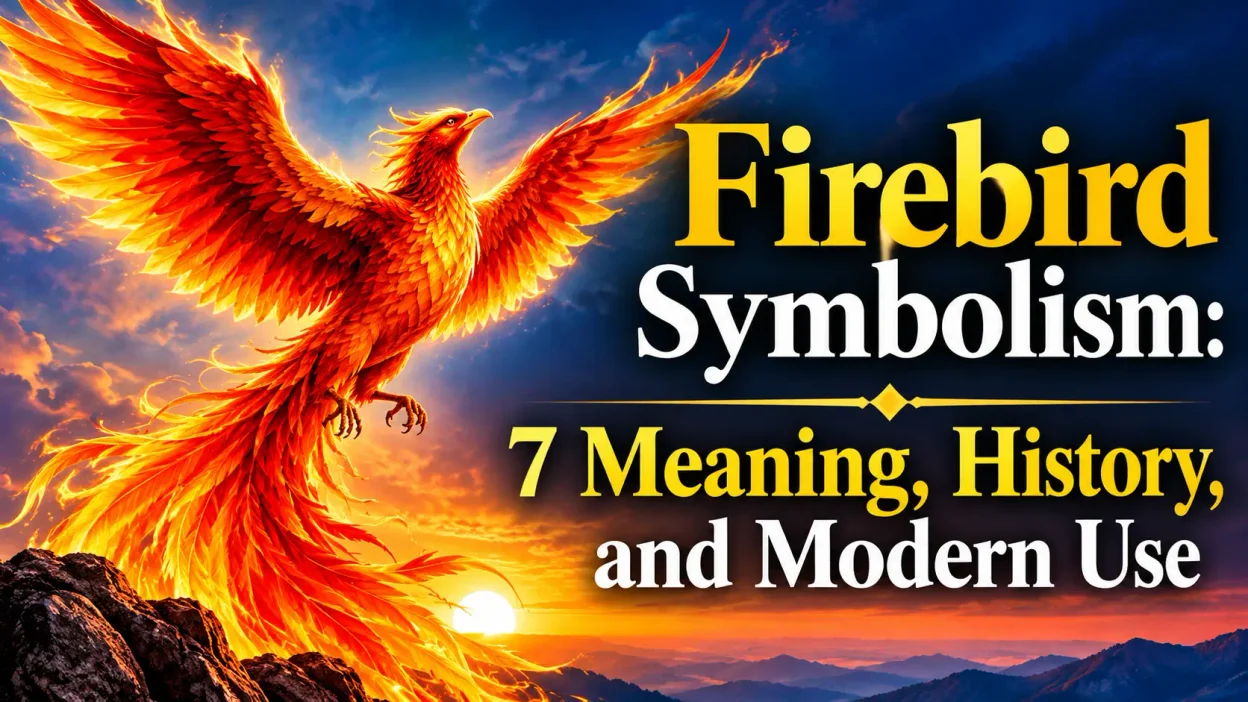
The firebird is a legendary creature that resembles a magnificent bird covered in glowing feathers of red, orange, gold, and sometimes brilliant blue. In firebird symbolism, this extraordinary creature represents beauty, inspiration, good fortune, freedom, and the pursuit of something rare or extraordinary. Its radiant appearance makes it a natural symbol of light, wonder, and the possibility of finding something valuable beyond ordinary life.
Unlike the phoenix, which is strongly associated with death and rebirth, the traditional firebird is primarily a creature of Slavic folklore. It appears in fairy tales as a dazzling bird whose feathers can illuminate darkness and whose capture sends a hero on a challenging adventure. Its beauty is often accompanied by danger, suggesting that extraordinary rewards may require courage, patience, and sacrifice.
In modern American culture, the firebird appears in art, literature, ballet, tattoos, jewelry, fantasy stories, and personal symbolism. People are drawn to its combination of beauty and independence, making it an appealing image for those who want to express ambition, creativity, personal freedom, or the pursuit of a dream.
Quick Answer
Firebird symbolism commonly represents beauty, good fortune, inspiration, freedom, and the pursuit of extraordinary opportunities in modern American culture. Rooted in Slavic folklore, the firebird also symbolizes the rewards and risks of chasing something rare, valuable, and difficult to attain.
TL;DR
- The firebird represents beauty, inspiration, fortune, and extraordinary possibilities.
- Its origins lie primarily in Slavic fairy tales and folklore.
- A glowing feather symbolizes hope, discovery, and the beginning of an adventure.
- American culture associates the firebird with creativity, freedom, and artistic expression.
- Unlike the phoenix, the firebird is not primarily a symbol of resurrection.
- Modern firebird imagery appears in tattoos, art, literature, ballet, and personal identity.
What Is a Firebird?
The Firebird – Russian Folktales Character
伊万·雅科夫列维奇比利宾 (16.08.1876 – 07.02.1942) – 画家的生平、著名的作品、展览 | Arthive
Палех Жар Птица Картинки (57 Фото)
12
The firebird is a magical bird found in Eastern European folklore, particularly Russian and other Slavic fairy-tale traditions. It is often portrayed as a large, radiant creature with feathers that shine like gold, sunlight, or flames.
Descriptions vary between stories, but its appearance usually distinguishes it from ordinary birds. Its plumage may contain brilliant shades of red, orange, yellow, gold, and occasionally blue. Some tales describe its feathers as glowing even after they have fallen from its body, making a single feather an extraordinary treasure.
The firebird is usually associated with distant, enchanted places. It may appear in a royal garden, a magical forest, or a faraway kingdom. Its arrival can bring wonder, temptation, or trouble, depending on the story.
Unlike ordinary animals, the firebird represents something beyond everyday experience. It is a creature that inspires people to imagine what might exist outside the familiar world.
The Historical Origins of Firebird Symbolism
The firebird’s best-known origins come from Slavic folklore, particularly Russian fairy tales. Its traditional name, zhar-ptitsa, translates approximately to “heat bird” or “fire bird.”
In traditional stories, the firebird often appears as an elusive creature whose beauty attracts the attention of a king or a young hero. One famous tale, commonly known as The Tale of Ivan Tsarevich, the Firebird, and the Gray Wolf, follows a prince who discovers a glowing feather while investigating the mysterious bird’s visits to his father’s garden.
The feather becomes the beginning of a much larger adventure. The prince is ordered to capture the bird, but his quest leads him through a series of difficult challenges involving magical helpers, enchanted horses, and other extraordinary discoveries.
The story demonstrates an important aspect of firebird symbolism: a seemingly small discovery can lead to an entirely different life.
The firebird became increasingly recognizable through nineteenth-century Russian literature, illustrations, and artistic interpretations of traditional fairy tales. Its popularity expanded internationally during the early twentieth century, particularly through the ballet The Firebird, composed by Igor Stravinsky and first performed in Paris in 1910.
This artistic adaptation introduced the creature to audiences far beyond its original folkloric setting.
What the Firebird Symbolizes Today
Magical World of Russian Fairytales
From Forest to Feast: The Firebird’s Journey in Slavic Fairy Tales – Mythology WorldWide
7
The firebird carries several related meanings, although individual interpretations depend on the context in which it appears.
| Context | Symbolic Meaning | Common Associations |
|---|---|---|
| Folklore | Rare fortune and magical discovery | Adventure, treasure, destiny |
| Personal symbolism | Freedom and independence | Courage, individuality |
| Art and creativity | Inspiration and imagination | Beauty, artistic expression |
| Emotional symbolism | Hope during uncertainty | Possibility, optimism |
| Modern fantasy | Extraordinary transformation | Magic, power, new beginnings |
The most consistent meaning is the pursuit of something extraordinary. The firebird is beautiful enough to inspire admiration, yet difficult enough to capture that it becomes a symbol of ambition and determination.
Its presence suggests that something valuable may exist beyond the limits of ordinary experience.
Firebird Symbolism in the United States
In the United States, the firebird is most often interpreted through fantasy, artistic expression, personal identity, and the desire to pursue one’s ambitions.
American audiences may encounter the creature in fantasy books, decorative art, ballet, animation, gaming, or symbolic designs. Although its folkloric roots are Eastern European, its imagery has become accessible to people who may know little about its original stories.
The firebird can represent the freedom to pursue a personal dream without following conventional expectations. Its ability to fly, its brilliant appearance, and its association with distant magical realms make it an appealing emblem of independence.
For some Americans, it represents a creative spirit that refuses to remain ordinary. For others, it symbolizes the discovery of an opportunity that changes their direction in life.
The creature’s meaning is not tied to one American holiday, religion, or political movement. Instead, it is used broadly as an imaginative symbol of aspiration, beauty, and possibility.
The Firebird as a Symbol of Beauty and Attraction
The firebird’s brilliant appearance is one of its most important symbolic qualities.
Its feathers may look like they contain sunlight or flames, creating an image of beauty that cannot easily be ignored. In fairy tales, this beauty attracts the attention of powerful people, kings, princes, and adventurers.
Symbolically, the firebird can represent the attraction of something extraordinary. It may be a beautiful idea, a creative opportunity, an unusual talent, a romantic possibility, or a goal that feels almost impossible to achieve.
However, the stories also suggest that beauty can become a source of distraction. A hero may become so focused on capturing the bird that he overlooks the dangers surrounding the pursuit.
This makes the firebird a more complex symbol than simple admiration. It can represent the desire for beauty while reminding people that fascination does not always lead to happiness.
Firebird Symbolism and Good Fortune
In traditional fairy tales, discovering a firebird or obtaining one of its feathers can be a sign of good fortune.
The feather is particularly important because it preserves a portion of the bird’s extraordinary brilliance. It can illuminate a dark room, attract attention, or serve as evidence that the hero has encountered something magical.
The firebird’s connection with fortune is therefore associated with discovery rather than effortless wealth.
It may symbolize:
- Unexpected opportunities
- Valuable discoveries
- Recognition of talent
- A lucky encounter
- The beginning of an exciting journey
- A reward for curiosity or courage
In modern symbolic interpretation, a firebird feather may represent a small opportunity that has the potential to produce significant change.
The feather becomes a reminder that meaningful possibilities sometimes arrive in unexpected forms.
The Firebird and Freedom
Birds are commonly associated with freedom because they move through the sky without the physical limitations experienced by people on the ground. The firebird strengthens this association through its extraordinary appearance and magical abilities.
It is rarely an ordinary creature that can be easily controlled. In many stories, it is difficult to catch, and its capture requires an unusual combination of intelligence, courage, and assistance.
The firebird can therefore symbolize a desire to escape restrictions, pursue independence, or live according to one’s own values.
For someone experiencing a major life transition, this imagery may represent the freedom to leave an unfulfilling situation, pursue a different career, explore a creative interest, or build a life that feels more authentic.
The firebird’s flight suggests that freedom is not simply the absence of limitations. It can also mean having the courage to explore possibilities that were previously inaccessible.
Firebird Symbolism in Art, Literature, and Ballet
One of the most influential modern interpretations of the firebird came through Igor Stravinsky’s ballet The Firebird, which premiered in 1910.
The ballet drew inspiration from Russian fairy tales and presented the creature as a magical figure who assists Prince Ivan. After Ivan releases the Firebird, she gives him a feather that can summon her when he needs help.
The Firebird ultimately helps Ivan defeat the evil sorcerer Kashchei and free the captive princesses.
This version strengthened the creature’s association with artistic beauty, supernatural assistance, and the triumph of good over evil. The ballet also introduced American audiences to an important figure in Russian folklore.
The role became especially significant in American ballet when dancer Maria Tallchief performed as the Firebird in George Balanchine’s 1949 production for the New York City Ballet.
The character’s vivid imagery has continued to inspire artists, choreographers, illustrators, musicians, and designers. In these settings, the firebird frequently represents creative imagination and the ability to transform an ordinary story into something visually extraordinary.
The Emotional and Psychological Meaning of the Firebird
The firebird can express emotions that are difficult to communicate through ordinary imagery.
Its brightness may represent optimism during difficult circumstances. Its flight may represent the desire to escape emotional limitations. Its rarity may represent the feeling of being different from others or possessing an unusual talent.
The creature can also symbolize the excitement that comes from discovering something new.
Psychologically, people may connect with the firebird when they are:
- Exploring an unfamiliar direction in life
- Recovering confidence after disappointment
- Pursuing a difficult personal goal
- Expressing creativity
- Searching for greater independence
- Embracing their individuality
The firebird is especially appealing as a personal symbol because it combines beauty with movement. It does not remain in one place, and it does not belong to an ordinary environment.
Its imagery may encourage people to view their ambitions as something worth pursuing, even when the outcome is uncertain.
Firebird Symbolism in Different Cultures
Although the firebird is most closely associated with Slavic folklore, its imagery resembles other mythical birds found in different cultural traditions.
These similarities should not be treated as proof that all firebird stories share the same origins. Instead, they demonstrate how different societies have used extraordinary birds to represent qualities such as light, beauty, protection, and renewal.
Slavic Folklore
In Slavic fairy tales, the firebird represents beauty, fortune, wonder, and the difficult pursuit of extraordinary rewards. Its feathers are often valuable treasures, and finding the bird can initiate a heroic adventure.
Greek and Egyptian Traditions
The phoenix is an ancient mythical bird associated with the sun, death, and rebirth. Although the phoenix and firebird share fiery imagery, the phoenix is particularly connected with cyclical renewal and the return of life after destruction.
Persian Tradition
The Simurgh is a magnificent mythical bird associated with wisdom, healing, protection, and spiritual knowledge in Persian literature and mythology. It is a distinct creature rather than another name for the Slavic firebird.
Modern Western Fantasy
In modern fantasy literature, fiery birds often combine characteristics from several mythological traditions. They may represent magical protection, exceptional intelligence, healing, transformation, or the restoration of hope.
These interpretations reflect the blending of folklore in modern entertainment rather than a single historical tradition.
The Firebird and the Phoenix: Understanding the Difference
The firebird and the phoenix are often confused because both are associated with flames, glowing feathers, and extraordinary beauty. However, their traditional symbolism is different.
The firebird is primarily a creature of fairy tales whose appearance represents fortune, beauty, inspiration, and the pursuit of something rare. Its stories often revolve around a hero trying to find, capture, or obtain something from it.
The phoenix, on the other hand, is traditionally associated with the cycle of death and rebirth. Its mythology centers on its death through fire and the emergence of a new bird from the ashes.
| Symbol | Firebird | Phoenix |
|---|---|---|
| Primary meaning | Beauty, fortune, inspiration | Rebirth, renewal, resurrection |
| Traditional origin | Slavic folklore | Ancient Egyptian and Greek traditions |
| Main story | A magical bird sought by a hero | A bird that renews itself through fire |
| Common imagery | Glowing feathers, golden plumage | Flames, ashes, rising bird |
| Modern interpretation | Dreams, freedom, creativity | Recovery, survival, transformation |
The two creatures can share symbolic meanings in modern art, but their original stories are not interchangeable.
A firebird may symbolize the discovery of something extraordinary. A phoenix more directly represents the ability to begin again after destruction.
Firebird Symbolism in Tattoos
Firebird tattoos appeal to people who want a design that combines beauty, freedom, ambition, and individuality.
The creature’s vivid feathers make it suitable for elaborate tattoo designs, particularly those using red, orange, yellow, gold, and blue. Some designs emphasize its graceful wings, while others portray it surrounded by flames or flying toward the sun.
Common interpretations of a firebird tattoo include:
- Freedom: A desire to live independently and pursue personal goals.
- Creativity: A connection with artistic expression and imagination.
- Good fortune: Hope for positive opportunities and unexpected discoveries.
- Individuality: The desire to stand apart from ordinary expectations.
- Ambition: Pursuing something rare or difficult to achieve.
- Personal transformation: A change in identity, priorities, or direction.
Although transformation is a common tattoo interpretation, it is more traditionally associated with the phoenix. A firebird tattoo can express transformation, but its original folklore emphasizes the pursuit of beauty, fortune, and magical discovery.
People may also choose a firebird tattoo simply because they admire its appearance or have a personal connection to its folklore.
The Meaning of Firebird Feathers
A firebird feather is one of the most recognizable images associated with the creature.
In traditional fairy tales, the feather can remain luminous after being separated from the bird. This makes it a symbol of something valuable that can be discovered even when the source of its beauty is no longer present.
The feather may represent:
A glimpse of possibility: Finding a feather suggests that a person has encountered something extraordinary, even if they have not yet fully understood it.
A reminder of a dream: The feather can symbolize a goal that continues to inspire someone after an initial encounter.
An unexpected opportunity: A small discovery may open the door to a much larger experience.
Personal inspiration: The feather represents a spark of creativity or motivation that encourages someone to take action.
In decorative art, jewelry, or personal keepsakes, a firebird feather may serve as a reminder to remain curious and recognize opportunities when they appear.
Firebird Symbolism in Jewelry and Decor
The firebird’s striking appearance makes it a popular motif in jewelry and decorative objects.
Firebird-inspired pendants, earrings, brooches, sculptures, paintings, and stained-glass designs often feature brilliant feathers or sweeping wings. Gold and red finishes emphasize the creature’s connection with light and fire, while blue and green variations may highlight its magical or fantastical qualities.
In home decor, the firebird can function as a statement piece representing creativity, imagination, and a sense of adventure. Its imagery works particularly well in spaces dedicated to artistic pursuits or personal interests.
As jewelry, it may express independence, confidence, or an appreciation for mythology and folklore.
The firebird’s design is also adaptable. It can appear as a traditional folkloric illustration, an elaborate fantasy creature, or a simplified modern emblem.
Its symbolic meaning often depends on the owner’s personal interpretation rather than a fixed cultural rule.
Firebird Symbolism in Dreams
Dream interpretations of the firebird are generally influenced by its folkloric associations with beauty, discovery, and extraordinary opportunities.
Seeing a firebird in a dream may represent an ambition that feels exciting but difficult to achieve. Its glowing feathers might suggest inspiration, recognition, or the discovery of a new direction.
A firebird flying away could reflect a concern about losing an opportunity or struggling to hold onto something desirable. A firebird appearing close to the dreamer might symbolize a growing awareness of personal potential or an unexpected possibility.
Dreams do not have universal meanings, and their interpretation depends heavily on the dreamer’s experiences and emotions.
For someone who loves mythology, the firebird may simply reflect an interest in fantasy. For someone pursuing a new career or creative project, it might represent the excitement of an unfamiliar opportunity.
The most useful interpretation is often the one that connects the dream’s emotional atmosphere with the dreamer’s current circumstances.
Firebird Symbolism in Colors
The firebird’s colors contribute significantly to its meaning.
Red
Red feathers emphasize passion, courage, vitality, and intensity. A red firebird may represent a person who approaches life with determination and emotional energy.
Orange
Orange is associated with creativity, enthusiasm, warmth, and adventure. An orange firebird may suggest a willingness to explore unfamiliar opportunities.
Gold
Gold emphasizes fortune, beauty, achievement, and something precious. Golden feathers often reinforce the firebird’s traditional association with rare treasures and magical discoveries.
Blue
Blue can give the firebird a more mysterious or peaceful appearance. It may suggest imagination, wisdom, calmness, or the unusual nature of the creature.
White
A white firebird may symbolize purity, hope, light, or a sense of spiritual inspiration. This is primarily a modern artistic interpretation rather than a defining feature of traditional Slavic folklore.
Color choices can change the emotional character of the image without changing the firebird’s fundamental association with beauty and extraordinary possibilities.
Common Misunderstandings About Firebird Symbolism
The firebird is sometimes given meanings that come from other mythical creatures or from modern fantasy rather than its original folklore.
The firebird is not always a phoenix
The firebird is not traditionally defined by resurrection from ashes. That association belongs primarily to the phoenix, although modern artists sometimes combine the two creatures.
It does not always represent rebirth
The firebird can symbolize a new opportunity or a change in direction, but its traditional meaning centers more on beauty, fortune, discovery, and the pursuit of something extraordinary.
It is not universally a religious symbol
The firebird is rooted in folklore rather than belonging to one universally recognized religious tradition. Some modern interpretations give it spiritual meaning, but these should not be presented as universal beliefs.
Its appearance does not guarantee good fortune
In fairy tales, obtaining the firebird is often difficult and may lead to unexpected problems. Its symbolism includes the risks of pursuing something desirable, not merely the promise of reward.
Understanding these distinctions helps preserve the creature’s folkloric identity while allowing people to develop their own modern interpretations.
The Firebird’s Meaning in Modern Fantasy and Popular Culture
The firebird remains a recognizable image in modern fantasy because it offers a combination of visual beauty and narrative possibility.
Its glowing feathers, magical abilities, and connection with distant kingdoms make it an ideal creature for fantasy novels, animated films, video games, and illustrated stories. Writers may use it as a guardian, magical companion, rare creature, source of power, or symbol of a character’s ambition.
Modern adaptations sometimes give the firebird abilities that differ from traditional folklore, including healing, shapeshifting, protection, or the power to restore life. These creative additions have expanded its symbolism beyond its original fairy-tale role.
In American popular culture, the firebird may also represent an extraordinary character who refuses to be defined by ordinary circumstances. It can be portrayed as a creature of independence, beauty, or untamed imagination.
Its continuing appeal comes from its ability to function as both a visual spectacle and a symbol of something people want to discover or become.
Why the Firebird Continues to Inspire People
The firebird remains compelling because it represents something people naturally find attractive: the possibility that life contains more than what is immediately visible.
Its stories begin with an unexpected discovery. A glowing feather appears, a mysterious bird visits a garden, or a hero encounters a creature that belongs to another world. The discovery creates a question, and that question leads to an adventure.
This structure mirrors experiences in ordinary life. A new interest, an unexpected opportunity, a creative idea, or an encounter with someone inspiring can change the direction of a person’s life.
The firebird reminds people that curiosity can lead somewhere meaningful. It also suggests that pursuing an extraordinary goal may require patience, courage, and a willingness to face uncertainty.
Its appeal is not limited to people who believe in mythology or supernatural symbolism. The image can be appreciated simply as a reminder to remain open to beauty, imagination, and possibilities that have not yet been explored.
Frequently Asked Questions
What does a firebird symbolize spiritually?
A firebird may symbolize inspiration, freedom, hope, good fortune, and the discovery of personal potential. Spiritual interpretations vary, but its glowing feathers are often viewed as an image of light appearing during uncertainty.
Is a firebird a symbol of rebirth?
Not traditionally in the same way as a phoenix. The firebird can represent new opportunities and personal change, but its original folklore focuses more on beauty, fortune, and the pursuit of extraordinary discoveries.
What does a firebird tattoo mean?
A firebird tattoo commonly represents freedom, individuality, ambition, creativity, and the desire to pursue something extraordinary. Some people also use it to express personal transformation or a new chapter in their lives.
What does a firebird feather symbolize?
A firebird feather can symbolize inspiration, good fortune, discovery, and a valuable opportunity. In traditional fairy tales, a single feather may possess the bird’s magical brilliance and become the starting point of an adventure.
Is the firebird good or evil?
The firebird is not inherently evil. In traditional Slavic fairy tales, it is usually a magical and extraordinary creature whose beauty and rarity attract the attention of heroes, although the pursuit of it can create difficulties.
What is the difference between a firebird and a phoenix?
The firebird comes primarily from Slavic folklore and symbolizes beauty, fortune, inspiration, and extraordinary discovery. The phoenix is associated with death, rebirth, and renewal through fire, making the two creatures symbolically related but distinct.
What does a golden firebird symbolize?
A golden firebird emphasizes beauty, fortune, achievement, and the discovery of something precious. Gold-colored feathers also reinforce the creature’s association with sunlight, brilliance, and rare treasures.
Conclusion
Firebird symbolism represents beauty, fortune, inspiration, freedom, and the pursuit of extraordinary possibilities. Rooted in Slavic fairy tales, the creature is more than a beautiful magical bird; it is a symbol of the adventure that begins when someone discovers something rare and decides to pursue it.
In modern American culture, the firebird continues to inspire artists, writers, tattoo enthusiasts, and people drawn to its imagery of individuality and imagination. While it is sometimes confused with the phoenix, the firebird’s traditional meaning is more closely connected to discovery, aspiration, and the rewards of curiosity.
The firebird ultimately reminds us that the most extraordinary opportunities often begin with something small: a glimpse of beauty, a spark of inspiration, or the courage to follow an unfamiliar path.