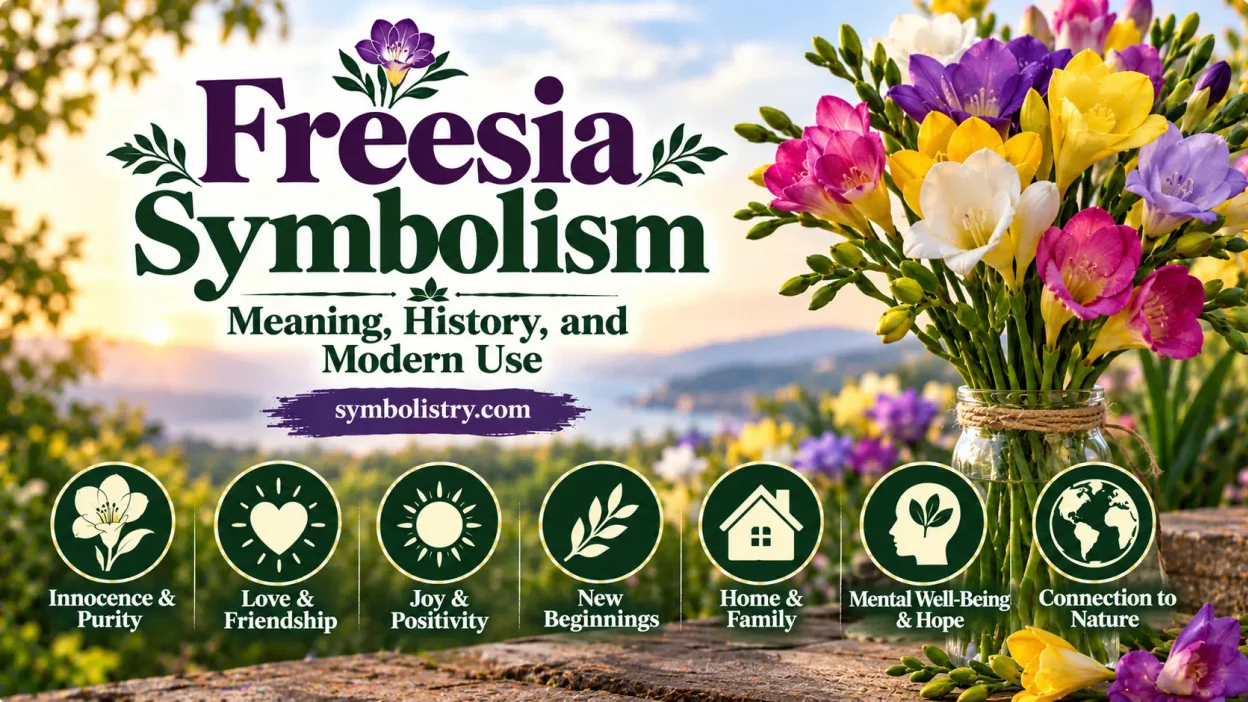
Freesia symbolism centers on friendship, trust, thoughtfulness, and innocence. Known for its elegant, trumpet-shaped blooms and sweet fragrance, freesia is a popular choice for bouquets, weddings, spring arrangements, and gifts that express appreciation without overwhelming the recipient. Its delicate appearance makes it feel personal and sincere, while its range of colors allows people to communicate different emotions.
Native to southern Africa, freesia became familiar to flower lovers in Europe and North America through horticulture and the cut-flower trade. Today, Americans often encounter it in florists’ shops, wedding bouquets, celebratory arrangements, and fragrant home displays. Although the flower has no single, universally accepted symbolic meaning, it is commonly associated with the qualities people value in close relationships.
Understanding freesia means looking beyond its appearance. Its fragrance, color, botanical origins, and role in gift-giving all help explain why this flower has become a thoughtful way to express affection, gratitude, and respect.
Quick Answer
Freesia symbolism commonly represents friendship, trust, innocence, and thoughtfulness in modern American culture, especially in bouquets, weddings, and gifts for people we appreciate. Its historical associations developed alongside European flower-giving traditions, while its fragrance and graceful blooms have helped it become a modern expression of sincerity and caring relationships.
TL;DR
- Freesia commonly symbolizes friendship, trust, innocence, and appreciation.
- The flower originates in southern Africa, not Victorian Europe.
- Fragrant blooms make freesia popular for American weddings and celebrations.
- Different flower colors can suggest romance, happiness, purity, or admiration.
- Freesia gifts often communicate sincere affection without excessive formality.
- Its symbolism comes from cultural associations rather than a universal, fixed code.
1. What Freesia Flowers Look Like
8
Freesia is a flowering plant recognized for its slender, arching stems and rows of funnel-shaped blossoms. The flowers open progressively along one side of the stem, creating a curved arrangement that looks graceful without being overly formal. Depending on the variety, blooms may be white, cream, yellow, pink, red, orange, lavender, or purple.
Many freesias have a fresh, sweet fragrance that can suggest citrus, honey, or a clean spring garden. Not every variety smells equally strong, but fragrance is an important part of the flower’s appeal.
These physical characteristics help explain its associations with gentleness and thoughtfulness. Freesia does not usually dominate an arrangement in the way a large sunflower or dramatic lily might. Instead, its repeated blooms and delicate structure create an impression of attention to detail.
In the United States, people most often encounter freesia as a cut flower in mixed bouquets, wedding arrangements, corsages, and seasonal displays. Its appearance is recognizable enough to contribute character to a bouquet, yet versatile enough to complement many other flowers.
2. The Core Symbolism of Freesia
Freesia is commonly associated with four ideas: friendship, trust, innocence, and thoughtfulness. These meanings are especially prominent in contemporary florist descriptions and flower-gifting traditions, although their historical documentation is not equally strong.
Friendship is perhaps its most approachable association. Freesia makes a suitable gift for someone whose companionship matters, whether that person is a longtime friend, a supportive colleague, or a family member.
Trust suggests reliability and emotional security. A bouquet of freesia can represent a relationship in which people feel comfortable being honest with one another. This interpretation works for romantic partnerships as well as platonic relationships.
Innocence refers to sincerity, openness, and good intentions rather than a literal lack of experience. White flowers particularly encourage this interpretation because white is frequently associated with purity and simplicity in American floral design.
Thoughtfulness concerns the intention behind the gift. Choosing a fragrant flower with an elegant shape can communicate that the sender considered the recipient’s tastes instead of selecting an arrangement without much personal meaning.
These associations overlap, but they are not identical. Friendship describes a relationship, trust describes its foundation, innocence describes an attitude, and thoughtfulness describes an action. Together, they give freesia a distinct place among flowers used to communicate appreciation.
3. Southern African Origins and the Flower’s Name

5
Freesia’s natural history begins in southern Africa, particularly the Cape region of present-day South Africa. Related species occur in other parts of Africa. The plants belong to the iris family, Iridaceae, and many of the familiar cultivated forms descend from southern African species.

plantsandflowersfoundationholland.org
+1
The genus was named in honor of Friedrich Heinrich Theodor Freese, a German physician, by botanist Christian Friedrich Ecklon. The name therefore has a genuine connection to a relationship between two people, even though that naming story should not be treated as proof that the flower had a universal traditional meaning of friendship.
plantsandflowersfoundationholland.org
+1
During the nineteenth century, freesia entered European horticulture. Its decorative qualities and pleasant scent helped it attract attention among gardeners and flower growers. Later breeding produced cultivated varieties with a wider selection of colors, flower forms, and fragrance characteristics.
Dutch growers played an important role in developing and commercializing modern freesias. As cultivation expanded, the flower became more readily available to florists and consumers in international markets.
plantsandflowersfoundationholland.org
+1
This botanical history offers a useful distinction: the flower originated in Africa, while much of its familiar modern floral symbolism developed through international horticulture, commercial floristry, and contemporary flower-gifting practices.
4. Freesia and the Victorian Language of Flowers
The Victorian language of flowers, also called floriography, allowed people to attach messages to particular blooms and arrangements. During the nineteenth century, flower dictionaries circulated in Britain, France, and North America, giving readers ways to express affection, admiration, courtship, and sometimes disapproval through floral gifts.
RHS
+1
This tradition provides an important background for understanding modern flower meanings. However, it is easy to assume that every flower’s present-day interpretation comes directly from a documented Victorian code.
Freesia requires a more cautious approach. Although contemporary florist guides frequently describe it as a flower of trust and friendship, its appearance in widely circulated Victorian flower dictionaries is not consistently established. The plant’s introduction into European horticulture also occurred relatively late in the nineteenth-century period when floriography was popular.
It is therefore more accurate to describe trust and friendship as established modern floral associations, rather than to claim that every aspect of freesia’s meaning has been traced to a definitive Victorian source.
The broader Victorian tradition still matters. It helped establish the idea that flowers could communicate feelings that were difficult to express directly. Modern Americans continue to use flowers in much the same emotional role, even when they are unfamiliar with the historical dictionaries.
Freesia fits naturally into that tradition because its fragrance, delicate form, and use in personal bouquets lend themselves to messages of appreciation and sincere affection.
5. What Freesia Symbolizes in the United States
In contemporary American culture, freesia is most useful as a flower of personal connection rather than a symbol tied to one national holiday, religion, or historical event.
Its meaning is usually communicated through the occasion and the relationship between the people involved. A bouquet sent to a friend may express gratitude and companionship. The same flowers given to a romantic partner may suggest tenderness and mutual trust.
American florists often use freesia in mixed arrangements because it combines easily with roses, tulips, lilies, and greenery. Its smaller blossoms add movement and fragrance, while its color can complement the more prominent flowers.
Freesia is also appropriate for occasions that call for a thoughtful gesture without a grand declaration. It can accompany a thank-you note, celebrate a personal achievement, welcome a new neighbor, or brighten the day of someone recovering from an illness.
Unlike flowers that carry highly recognizable associations in American public life, freesia has no single dominant national meaning. It is not an official emblem of the United States, nor is it universally connected with one specific American custom.
That flexibility is part of its appeal. People can give freesia to express affection without necessarily implying a proposal, a formal apology, or a romantic commitment.
6. Freesia Color Meanings

White freesia — sincerity and innocence
White varieties can suggest honesty, new beginnings, and clear intentions. They work well in wedding arrangements, simple gifts, and bouquets intended to feel calm and understated.

Yellow freesia — happiness and friendship
Yellow blooms are often associated with optimism, warmth, and cheerful companionship. They suit birthdays, congratulations, and casual gestures of appreciation.

Pink freesia — affection and tenderness
Pink flowers commonly convey gentle affection, kindness, and gratitude. They can suit friends, relatives, and romantic partners when a softer expression feels appropriate.

Purple freesia — admiration and elegance
Lavender and purple shades can suggest refinement, individuality, and appreciation. They are a good option when you want a bouquet that feels distinctive without being overly dramatic.

Red and orange freesia — passion and enthusiasm
Warmer shades can bring energy, attraction, and excitement to an arrangement. Their effect depends on the surrounding flowers and whether the occasion is romantic or celebratory.
Color meanings are flexible conventions, not rules. A yellow freesia does not automatically mean friendship, nor does a white one guarantee a message of innocence. Personal preferences, local customs, and the wording of a gift card may matter more than a color guide.
For a meaningful bouquet, choose colors that reflect the recipient’s tastes as well as the feeling you hope to communicate.
7. Freesia Symbolism in Love and Romantic Relationships
Freesia offers a different expression of love from flowers traditionally associated with intense passion. Red roses often communicate romantic desire, while freesia is more closely associated in modern floristry with trust, affection, and the everyday care that helps relationships last.
In a romantic relationship, a freesia bouquet can represent the comfort of being understood. It may suit a couple who values honesty, companionship, and shared experiences just as much as grand romantic gestures.
The flower can also be used during the early stages of dating. Because freesia does not have the same widely recognized romantic message as a red rose, it can communicate interest without necessarily suggesting an overwhelming declaration of love.
For established couples, the symbolism may be more personal. A partner might choose freesia because its scent recalls a particular occasion, because the recipient enjoys its appearance, or because the flower represents a shared memory.
There is no universal rule that freesia must be given to friends rather than romantic partners. Its meaning depends on the relationship, the setting, and the intentions of the person giving it.
8. Freesia at Weddings and Anniversaries

7
Freesia is well suited to weddings because its shape, fragrance, and variety of colors work with both traditional and contemporary floral designs. It can be incorporated into bridal bouquets, bridesmaid arrangements, boutonnieres, and reception centerpieces. Its practical use in wedding floristry is documented by horticultural extension resources.
Mississippi State University Extension Service
+1
Symbolically, white freesia can complement a wedding’s themes of sincerity and new beginnings. Pink varieties may contribute a sense of tenderness, while yellow flowers can introduce warmth and optimism.
Freesia also works as a supporting flower. Arranged alongside roses, ranunculus, or tulips, it adds fragrance and a more relaxed, natural shape without taking attention away from the main blooms.
Some contemporary flower guides identify freesia as the flower for a seventh wedding anniversary. This association appears in commercial floral references, but it is not a universal cultural standard, so couples should feel free to choose flowers that better reflect their own relationship.
Teleflora
+1
For anniversary gifts, freesia can represent the trust and companionship that develop over time. The meaning becomes more personal when the flowers connect with a shared memory or a preference the couple has maintained throughout the relationship.
9. Emotional and Psychological Associations
Flowers communicate through more than established meanings. Their colors, shapes, fragrances, and associations with personal experiences can influence how people respond to them.
Freesia is particularly interesting because fragrance plays a major role in its appeal. A familiar scent can bring back memories of a person, a room, a celebration, or a particular period of life. These associations vary between individuals, so the same fragrance may feel comforting to one person and unfamiliar to another.
Its curved stems and relatively small blossoms may also contribute to perceptions of delicacy and grace. In a bouquet, the repeated flowers create visual rhythm, while the open spaces between the blooms can make the arrangement feel lighter than a dense cluster of large flowers.
Color contributes another layer. Soft pinks and whites can create a gentle impression, while yellow, orange, and red varieties make a display feel more energetic.
These responses are not fixed psychological laws. People interpret flowers through memories, cultural expectations, personal preferences, and the context in which they receive them.
A freesia bouquet given after a difficult week, for example, may become associated with relief and support. The emotional meaning develops through the experience of receiving the flowers, not simply from a dictionary definition.
10. Freesia in Memorials, Sympathy, and Difficult Times
Freesia is not among the most universally recognized flowers of mourning in American culture. White lilies, roses, and chrysanthemums may have more established associations with funerals and memorial arrangements, depending on the community and tradition.
Nevertheless, freesia can be appropriate for expressing sympathy because it offers a gentle appearance and a fragrance that may bring comfort to some recipients.
White or pale pink varieties can complement a sympathy bouquet when the intention is to communicate care, tenderness, or remembrance. Freesia may also be suitable for a personal arrangement sent to someone grieving, particularly when the recipient appreciates fragrant flowers.
There is no inherent negative meaning attached to freesia in mourning. Its associations with innocence, affection, and thoughtfulness can be interpreted in a comforting way, but the flower does not carry a universally accepted message about death or the afterlife.
When selecting flowers for a funeral or memorial, the family’s preferences and cultural or religious practices should take priority over a general symbolism guide.
For private expressions of remembrance, a familiar flower may mean more than one with a traditional funeral association. If freesia reminds someone of a loved one, that personal connection can make it a meaningful choice.
11. How Freesia Is Used in Modern Life

9
Modern freesia symbolism extends beyond formal bouquets. Its appearance and fragrance make it useful in several everyday settings.
- Home decor: Freesia in a glass vase can add color and fragrance to an entryway, kitchen, or dining table. The arrangement can suggest hospitality and attention to detail.
- Gifts for friends: A small bunch is an approachable way to acknowledge a birthday, thank someone for their help, or celebrate a friendship.
- Wedding design: Freesia can soften structured arrangements and contribute fragrance to bridal flowers and reception decor.
- Personal celebrations: Its different colors work well for graduations, promotions, new homes, and other occasions when a thoughtful gift is appropriate.
- Fragrance and beauty: Freesia-inspired scents appear in some perfumes and personal-care products, where the flower’s fresh, floral character may suggest cleanliness or springtime.
- Art and illustration: Its curved stems and recognizable blossoms make it suitable for botanical prints, stationery, and floral designs.
Freesia is less firmly established as a tattoo symbol than flowers such as roses, lotuses, or cherry blossoms. Someone who chooses a freesia tattoo may do so to represent a friendship, a loved one, a personal memory, or an appreciation for the flower itself.
In each case, the meaning is created through a combination of shared floral associations and personal intention. A flower does not need to have a famous historical legend to become an important symbol in someone’s life.
12. Cross-Cultural Interpretations of Freesia
Freesia has traveled through international horticulture and floristry, but its symbolic meanings are not identical everywhere.
In European and North American flower-gifting traditions, modern florist guides commonly associate freesia with trust, friendship, and innocence. These associations reflect contemporary floral conventions rather than a single, universally documented ancient tradition.
In Japan and other places where seasonal flowers play a prominent role in gifting and floral arrangement, the setting, season, color, and presentation can influence how a bouquet is received. However, it would be misleading to claim that freesia has one fixed religious or traditional meaning across East Asian cultures.
Freesia does not have a widely established, universal role in major religious narratives comparable to the lotus in several Asian religious traditions or the lily in some Christian artistic traditions. Its cultural significance is more closely connected to ornamental horticulture, floral design, fragrance, and gift-giving.
Southern Africa is important to the flower’s botanical origins, but the plant’s natural origin alone does not establish a shared traditional meaning among all African communities.
This distinction matters because flowers can acquire new associations as they move between countries. The most responsible interpretation separates a plant’s geographic history from the meanings people assign to it in particular cultural settings.
13. Common Misunderstandings About Freesia Symbolism
Several popular claims about freesia deserve a closer look.
Myth: Freesia has one ancient meaning recognized around the world.
There is no good basis for treating its modern meanings as universal. Friendship, trust, and innocence are common contemporary associations, but different people may interpret the flower differently.
Myth: Its meaning comes entirely from the Victorian language of flowers.
Victorian floriography helped popularize the idea of communicating through flowers, but the precise historical origin of freesia’s modern symbolism is less certain than many simplified flower guides suggest.
Myth: Every freesia color has a fixed emotional message.
Color conventions can help people choose a bouquet, but they are not standardized codes. A recipient’s favorite color may matter more than a conventional interpretation.
Myth: Freesia is only appropriate for friendship.
Although friendship is a common association, freesia can be used in romantic bouquets, wedding arrangements, family gifts, and personal celebrations.
Myth: A freesia bouquet automatically communicates a particular commitment.
Flowers can suggest feelings, but they cannot establish another person’s intentions with certainty. If a gift is meant to express a serious sentiment, a personal note is a clearer way to communicate it.
Understanding these distinctions does not make freesia less meaningful. It allows people to appreciate its symbolism without mistaking a modern convention for an unquestionable historical fact.
14. Freesia Symbolism at a Glance
The following table summarizes common contemporary interpretations, especially those useful when selecting flowers in the United States.
| Context | Common meaning | Typical associations | Important note |
|---|---|---|---|
| Friendship gifts | Trust and appreciation | Loyalty, companionship | A natural choice for close friends |
| Romantic relationships | Affection and sincerity | Honesty, tenderness | Does not necessarily imply intense passion |
| Weddings | Innocence and new beginnings | Commitment, elegance | Meaning depends on the couple’s preferences |
| White flowers | Purity and sincerity | Simplicity, openness | A common color association, not a universal rule |
| Yellow flowers | Joy and friendship | Warmth, optimism | Useful for cheerful occasions |
| Memorial arrangements | Care and remembrance | Comfort, affection | Not a universal funeral flower |
The central idea is consistent: freesia works best when its visual beauty and personal meaning complement the occasion. Its associations offer a starting point, not a set of rules that every recipient is expected to understand.
Frequently Asked Questions
What does a freesia flower symbolize?
Freesia commonly symbolizes friendship, trust, innocence, and thoughtfulness in modern floral traditions. Its fragrant blooms and graceful appearance also make it a popular choice for expressing appreciation and affection.
What does freesia symbolize in a romantic relationship?
In a romantic relationship, freesia can represent trust, sincerity, and gentle affection. It is especially suitable for couples who want to celebrate companionship and emotional closeness rather than communicate passion alone.
What does a freesia tattoo mean?
A freesia tattoo may represent friendship, loyalty, innocence, or a meaningful relationship. Some people choose it to commemorate a loved one or a personal memory, giving the design significance beyond conventional flower meanings.
What does white freesia symbolize?
White freesia is commonly associated with purity, sincerity, innocence, and new beginnings. These associations make it suitable for weddings, personal celebrations, and thoughtful gifts, although the recipient’s own interpretation may differ.
Is freesia a positive or negative symbol?
Freesia is generally associated with positive qualities, including friendship, trust, affection, and thoughtfulness. It has no widely established negative meaning in mainstream American floral traditions, although individual memories and cultural contexts can affect its interpretation.
Is freesia associated with a wedding anniversary?
Some contemporary florists identify freesia as a flower for the seventh wedding anniversary. This is a modern gifting convention rather than a universal historical rule, so couples can choose it for its symbolism or simply because they enjoy the flower.
Why is freesia associated with friendship?
Friendship is a common modern association in floral guides, and the flower’s name honors Friedrich Freese, a friend of botanist Christian Ecklon. That naming history offers a fitting connection, although it does not prove that friendship was the flower’s original or universal symbolic meaning.
Conclusion
Freesia symbolism brings together friendship, trust, innocence, and thoughtful affection. Its southern African origins, graceful blooms, and distinctive fragrance help explain its appeal, while contemporary floral traditions have made it a popular choice for weddings, personal gifts, and everyday expressions of appreciation.
In the United States, freesia does not depend on one rigid cultural code. Its meaning can change with its color, the occasion, and the relationship between the giver and the recipient. A white bouquet may suggest sincerity, yellow flowers may communicate cheerfulness, and a mixed arrangement may simply show that someone took the time to choose something beautiful.
Ultimately, freesia is most meaningful when the flower matches the sentiment behind it. Whether given to celebrate a lasting friendship, honor a loving partnership, or brighten an ordinary day, it offers a thoughtful reminder that care is often communicated through small, deliberate gestures.