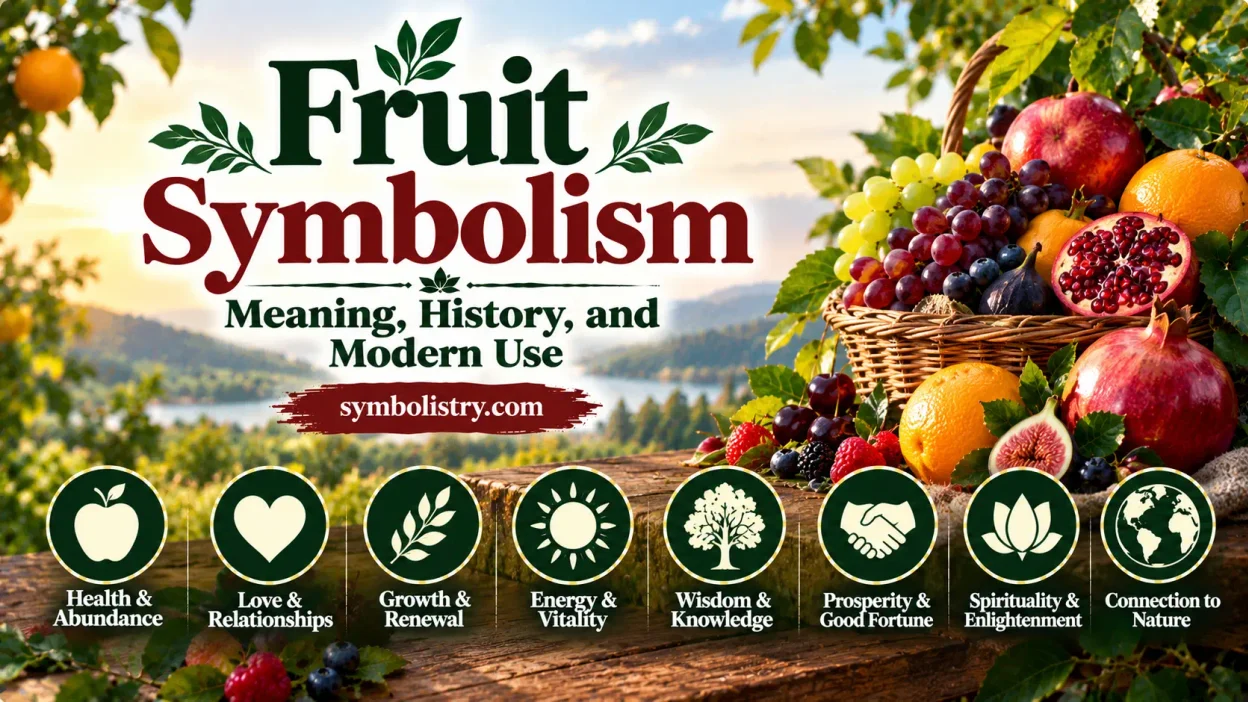
Fruit symbolism connects ordinary foods with ideas about life, love, prosperity, fertility, temptation, generosity, and renewal. From apples in familiar stories to grapes in religious art and pomegranates in ancient mythology, fruit often carries meanings that extend beyond its taste, appearance, or nutritional value. These associations develop through cultural traditions, religious teachings, folklore, literature, and the practical importance of food.
In the United States, fruit appears in settings that range from Thanksgiving tables and wedding decorations to children’s stories, advertising, paintings, tattoos, and seasonal displays. A bowl of fresh fruit may suggest health and hospitality, while a bitten apple might evoke curiosity, forbidden knowledge, or temptation. The meaning depends on the particular fruit and the context in which it appears.
Understanding these associations helps explain why artists, writers, designers, and ordinary people continue to use fruit as a form of visual language. Although some meanings have ancient roots, others reflect modern American values, commercial imagery, and personal experiences.
Quick Answer
Fruit symbolism commonly represents abundance, fertility, health, love, prosperity, and the rewards of life in modern American culture. Historically, fruit has also symbolized divine blessing, temptation, knowledge, mortality, and spiritual renewal in religious traditions, mythology, and folklore.
TL;DR
- Fruit commonly represents abundance, nourishment, prosperity, and life’s rewards.
- Ancient cultures associated harvests and fruit-bearing trees with fertility and renewal.
- Apples, grapes, pomegranates, and figs carry distinct cultural and religious meanings.
- American holidays use fruit to express gratitude, hospitality, and seasonal change.
- In art and fashion, fruit can communicate romance, temptation, vitality, or identity.
- A fruit’s meaning changes according to its color, condition, setting, and cultural context.
1. Why Fruit Became a Symbol of Life and Abundance
Fruit has practical importance long before it becomes a symbol. It provides nourishment, appears seasonally, contains seeds, and often grows in abundance under favorable conditions. These qualities make it a natural image for survival, fertility, growth, and the continuation of life.
A fruit-bearing tree can provide food year after year, while a successful harvest can sustain an entire household or community. In societies dependent on agriculture, healthy orchards and productive vines were closely connected to security and prosperity. Fruit therefore became an understandable representation of a life that was flourishing rather than struggling.
Fruit also carries an element of reward. A ripe peach, a cluster of grapes, or a basket of apples represents the result of time, favorable conditions, and cultivation. In paintings and stories, these objects can suggest the benefits of patience, care, and labor.
The symbolism remains recognizable today. A fruit basket given to a new neighbor may express generosity, while fruit arranged on a dining table can communicate welcome and abundance. The underlying idea is simple: something nourishing is available to share.
2. Ancient Roots of Fruit Symbolism
Fruit symbolism developed independently in many societies, shaped by local crops, religious beliefs, and agricultural practices. There is no single origin for the idea that fruit represents prosperity or fertility.
In ancient Mesopotamia and the Mediterranean world, cultivated gardens and productive trees could represent royal power, divine favor, and an ordered landscape. Fruit trees were valuable resources, so images of abundant gardens often conveyed more than beauty. They could suggest stability, wealth, and a community’s ability to support itself.
In ancient Greek mythology, fruit appears in stories about desire, marriage, seasonal change, and the relationship between humans and the gods. The pomegranate is particularly associated with the story of Persephone, whose consumption of its seeds connects her to the underworld and the seasonal cycle.
In ancient Egypt, dates, figs, grapes, and other cultivated foods belonged to everyday life as well as religious and funerary settings. Offerings of food expressed care for the deceased and the hope of continued sustenance beyond death.
These examples show that fruit symbolism grew from lived experience. Because fruit could feed people, mark seasonal transitions, and produce seeds for future growth, it offered a compelling way to express hopes about life, death, and renewal.
3. Fertility, Growth, and the Continuation of Life
Fruit often symbolizes fertility because it develops from a flowering plant and commonly contains seeds. The visible result of growth becomes a metaphor for reproduction, creativity, and the ability to produce something new.
In traditional artwork, a fruit-filled branch may suggest a thriving family or a prosperous household. A tree bearing many fruits can also represent descendants, inheritance, or the continuation of a family line. Such interpretations vary across cultures and should not be treated as universal rules.
Fruit also represents creative fertility. A writer might describe an idea as bearing fruit, or a gardener might use an orchard as an image of patient effort finally producing results. Here, the meaning extends beyond biological reproduction to include projects, relationships, and personal development.
In contemporary American life, this symbolism appears in wedding decorations, garden imagery, and illustrations celebrating parenthood. Pomegranates, figs, and other seed-filled fruits may be used to suggest fertility, although their meaning depends on the community and design.
Importantly, fertility symbolism does not mean every fruit image refers to pregnancy or family life. The same image may communicate abundance, sensuality, health, or creativity without any reproductive implication.
4. What Fruit Represents in American Culture
In the United States, fruit has a broad range of everyday associations. It can represent healthy living, family hospitality, natural freshness, abundance, and the pleasures of seasonal food.
Fruit is prominent at Thanksgiving and other gatherings because meals often communicate gratitude and generosity. Apples, cranberries, grapes, and seasonal produce appear in dishes and decorations that connect food with harvest traditions. These customs do not all have one ancient symbolic origin; many reflect practical agriculture, regional cuisine, and later American holiday practices.
Fruit also plays a role in the image of the American home. A bowl of apples on a kitchen counter can suggest domestic comfort, while a colorful arrangement of citrus fruit may communicate freshness and a cheerful atmosphere. In advertising, fruit is frequently used to imply natural ingredients, flavor, or wellness.
The association between fruit and health is especially familiar in American public messaging. The apple in a lunchbox or the orange served at breakfast often represents a sensible, nourishing choice. Yet the image can also be commercial: a product displaying bright fruit may encourage consumers to associate it with nature, even when the product itself is highly processed.
Fruit consequently operates in two ways in American culture. It represents real nourishment and hospitality, but it also functions as a visual shorthand for qualities that brands, families, and institutions want to communicate.
5. The Symbolism of Apples: Knowledge, Temptation, and Renewal

The apple is one of the most recognizable fruits in Western symbolism. Depending on the story or setting, it can represent knowledge, temptation, health, beauty, love, or the rewards of effort.
Its association with knowledge and temptation is strongly influenced by popular interpretations of the biblical Garden of Eden story. Genesis describes the forbidden fruit but does not identify it as an apple. The apple became familiar in later Western artistic and cultural traditions, helping establish the modern image of an apple as the fruit of forbidden knowledge.
In American schools, the apple has another meaning: education and appreciation for teachers. The familiar image of giving an apple to a teacher reflects a longstanding cultural association, although the exact origins of the custom are not certain.
Apples also feature in fairy tales and popular culture. In the story of Snow White, a poisoned apple connects beauty with danger and deception. In other settings, an apple may simply communicate freshness, health, or an autumn harvest.
These different meanings demonstrate why context matters. A red apple in a classroom illustration suggests something very different from a dark, partially eaten apple in a suspenseful painting.
6. Grapes and the Meaning of Celebration and Spiritual Life

Grapes are associated with abundance, celebration, pleasure, and community. Their growth in clusters makes them a useful visual representation of plenty, while their role in winemaking connects them to feasting, hospitality, and ritual.
In ancient Greek and Roman traditions, grapes and wine were associated with Dionysus and Bacchus, deities linked to wine, festivity, and altered states of experience. Artistic depictions of grapevines could therefore evoke celebration, sensual pleasure, and the release of ordinary restraints.
In Christianity, grapes and wine carry major religious associations. The grapevine appears in biblical imagery, and wine plays a central role in the Eucharist or Communion, where it is associated with Christ’s blood. The precise interpretation depends on the Christian tradition.
In American life, grapes may appear in wedding arrangements, vineyard photography, restaurant décor, and harvest festivals. They can suggest abundance and sophistication, especially in settings associated with winemaking.
Grapes can also symbolize connection. Because they grow together in clusters, they lend themselves to visual metaphors for family, friendship, and community. In religious art, however, the same fruit may have a more specific theological meaning.
7. Pomegranates, Figs, and the Meanings of Fertility and Wisdom

Pomegranates and figs have long histories in Mediterranean and West Asian cultures, where they were valued as foods and incorporated into religious, artistic, and literary traditions.
The pomegranate’s many seeds make it a natural symbol of fertility, abundance, and potential. In Greek mythology, its connection to Persephone adds themes of seasonal return, attachment, and the relationship between life and the underworld. In some Jewish traditions, the pomegranate is associated with religious observance and the commandments, although interpretations and customs differ.
The fig has its own complex history. In biblical narratives, fig leaves are associated with Adam and Eve’s response to their awareness of nakedness. Elsewhere in ancient Mediterranean culture, figs could represent nourishment, fertility, and cultivated prosperity.
In Buddhist traditions, the fig tree has a particularly important association through the bodhi tree, under which Siddhartha Gautama is traditionally said to have attained enlightenment. The sacred tree is commonly identified as a type of fig, the sacred fig (Ficus religiosa). The symbolism belongs to the tree and the religious story rather than to all figs in every context.
In contemporary design, pomegranates and figs can evoke heritage, Mediterranean cooking, natural luxury, or an appreciation for traditional foodways. Their meanings become more specific when they appear within a recognizable religious or cultural setting.
8. Bananas, Oranges, Cherries, and Other Everyday Fruits
Not every fruit has a single, established symbolic meaning. Some associations develop mainly through color, shape, flavor, advertising, and popular culture.
| Fruit | Common symbolic associations | Typical modern context |
|---|---|---|
| Orange | Vitality, warmth, freshness | Food packaging, seasonal décor, hospitality |
| Cherry | Romance, sweetness, youth, sensuality | Fashion, desserts, pop culture |
| Banana | Humor, playfulness, energy | Comedy, cartoons, everyday food imagery |
| Lemon | Sharpness, freshness, sourness, disappointment | Cooking, design, expressions such as “when life gives you lemons” |
| Peach | Sensuality, softness, summer, affection | Art, fashion, emojis, seasonal imagery |
| Watermelon | Summer, refreshment, community gatherings | Picnics, cookouts, seasonal advertising |
Cherries often appear in American fashion and pop culture as images of sweetness, flirtation, or retro style. Their associations may be playful, but cherries can also carry sexual implications depending on the design and audience.
Peaches can suggest warmth and sensuality because of their color, softness, and familiar use in romantic imagery. In digital communication, the peach emoji has acquired additional meanings, including a reference to the buttocks. That modern interpretation is distinct from the fruit’s ordinary culinary meaning.
Lemons illustrate how a fruit’s physical qualities can shape language. Their sourness contributes to expressions associated with disappointment, while their freshness makes them popular in cleaning products, drinks, and summer-themed designs.
These associations are flexible rather than universal. A banana in a grocery advertisement usually communicates food and energy, while a banana peel in a cartoon may serve as a visual joke.
9. Fruit in the Bible and Religious Traditions
Fruit appears in several religious traditions as a sign of blessing, moral choice, spiritual nourishment, and the relationship between human beings and the divine. Its meaning depends on the passage, the fruit involved, and the beliefs of the community interpreting it.
In the Bible, the Garden of Eden story uses forbidden fruit to frame questions about obedience, desire, and the consequences of human choices. Although popular Western art often depicts an apple, the biblical text does not name the fruit. Treating the apple as the definite biblical fruit confuses a later artistic convention with the original account.
The New Testament uses fruit as a metaphor for the results of a person’s character and actions. The expression “fruit of the Spirit” in Galatians 5:22–23 refers to qualities such as love, joy, peace, patience, and kindness. In this context, fruit represents the visible outcome of spiritual development rather than literal food.
In Islam, fruit appears among the blessings associated with God’s provision and descriptions of Paradise. The Quran mentions pomegranates in its descriptions of gardens, connecting the fruit with divine generosity and the abundance of creation.
In Buddhist traditions, the symbolism of fruit can relate to the results of spiritual practice, much as a tree produces the results of its growth. Specific fruits also appear in individual religious stories and artistic traditions.
These interpretations should remain distinct. An apple in a Christian painting, a pomegranate in a Jewish holiday setting, and fruit in a Buddhist teaching may communicate different ideas even when all three suggest nourishment or growth.
10. The Emotional and Psychological Meaning of Fruit
Fruit imagery often works because it connects abstract ideas with familiar sensory experiences. Color, texture, smell, ripeness, and the act of eating can influence how an image feels before a viewer consciously interprets it.
Ripe fruit may evoke pleasure, satisfaction, comfort, and the enjoyment of something that has reached its proper time. A fresh strawberry or peach can suggest summer, affection, and sensual enjoyment. A basket of assorted fruit may communicate generosity or the feeling of having enough.
Unripe or rotten fruit can create a different response. It may suggest neglect, decay, disappointment, or an opportunity that has passed. In a still-life painting, a bruised apple or spoiled pear might encourage viewers to think about mortality and the temporary nature of physical beauty.
Fruit can also evoke childhood memories. An orange at Christmas, a watermelon at a family cookout, or apples picked at an orchard may connect an image with a particular season or relationship. These associations are personal, not universal, but they help explain why familiar food can carry emotional weight.
The psychological effect also depends on presentation. Bright, symmetrical fruit arrangements tend to look orderly and inviting, while isolated, damaged, or unusually colored fruit may create unease. Artists use these contrasts to communicate mood without needing to explain it in words.
11. Fruit in Art, Literature, and Popular Culture

Artists have used fruit to explore beauty, morality, wealth, desire, and the passage of time. A fruit’s recognizable appearance allows a painter or writer to communicate several ideas through a single object.
In European still-life painting, fruit can demonstrate an artist’s ability to represent color, light, and texture. Yet the arrangement may also carry symbolic meaning. Abundant fruit can suggest prosperity, while damaged produce may remind viewers that material pleasures do not last forever.
Literature uses fruit in similarly flexible ways. A forbidden fruit may represent an attractive choice with consequences. A harvest may mark the completion of a difficult journey, and a fruit-bearing tree may stand for family history or a community’s survival.
In contemporary American entertainment, fruit often serves a more immediate visual purpose. Bright cherries can communicate a playful, retro aesthetic, while a red apple can suggest innocence, temptation, or danger. These images appear in album artwork, movie posters, clothing, packaging, and music videos.
Fruit also works as a storytelling device because its physical condition can mirror a character’s circumstances. A fresh peach might appear during a period of romance or happiness, while a rotting fruit bowl could signal neglect or a household in decline. The meaning becomes clearer when the image is considered alongside the larger story.
12. Why Fruit Appears in Tattoos, Jewelry, and Home Décor
Fruit tattoos and decorative objects often combine traditional associations with individual experiences. People may choose a fruit because of its appearance, a family memory, a favorite food, or a meaning drawn from a particular cultural tradition.
An apple tattoo might represent education, knowledge, temptation, or an important personal connection. A cherry design may communicate flirtation, youthful style, or enjoyment of life’s pleasures. A pomegranate can suggest fertility, heritage, abundance, or renewal, particularly when the design references a specific tradition.
Jewelry featuring fruit often emphasizes natural beauty and playfulness. Small strawberry earrings, cherry pendants, and citrus-shaped accessories can express a colorful personal style without carrying a fixed symbolic message.
In home décor, fruit imagery can create an impression of warmth and hospitality. Botanical prints, ceramic bowls, embroidered fruit, and kitchen illustrations connect the home with food, gardens, and seasonal life. A pomegranate motif may add a historical or regional influence, while lemons can create a bright, summery atmosphere.
Before interpreting a fruit tattoo or ornament, it is worth considering the owner’s intentions. A design that carries religious meaning for one person may simply be an aesthetic choice for another. Symbolism can inform interpretation, but it cannot establish someone’s beliefs or identity on its own.
13. Fruit Symbolism on Social Media and in Advertising
Digital culture has made fruit imagery more flexible, allowing familiar foods to communicate humor, affection, personality, and sometimes meanings unrelated to the actual fruit.
The peach emoji is a clear example. Although it depicts a fruit, its resemblance to the human body has given it a widely recognized additional meaning in digital communication. Cherries can also acquire suggestive associations in certain online contexts, while strawberries may convey sweetness, romance, or a playful aesthetic.
These meanings are not fixed across every platform or audience. An emoji can communicate one thing in a private conversation and something different in a food advertisement or recipe post. The surrounding words, images, and relationship between participants help establish the intended meaning.
Advertising relies on a similar process. Fruit imagery can make products appear fresh, wholesome, colorful, or natural. However, the presence of fruit in a package design does not automatically establish that a product is healthy or contains substantial amounts of real fruit.
In brand design, fruit can also identify a flavor quickly. A lemon suggests citrus, a cherry suggests sweetness, and a coconut may evoke tropical settings. These associations are commercially useful because consumers recognize them immediately.
Modern fruit symbolism therefore operates through both cultural tradition and visual convention. Some meanings come from centuries of religious and artistic use; others emerge from digital communication and marketing practices.
14. Common Misunderstandings About Fruit Symbolism
Fruit symbolism can become misleading when an interpretation is treated as universal or when a modern association is presented as an ancient fact.
One common misunderstanding is the belief that every fruit has a single, established meaning. In reality, the same fruit may represent prosperity in one setting, temptation in another, and nothing beyond food in a third. Symbolic meaning develops through context rather than through a fixed dictionary of objects.
Another mistake is assuming that every fruit image in religious art has a biblical origin. Artists have drawn from classical mythology, local traditions, religious texts, and contemporary customs. A pomegranate, for example, can appear in both mythological and Christian imagery without having precisely the same meaning in each.
Modern internet interpretations can also be mistaken for historical traditions. The peach emoji’s contemporary associations, for instance, should not be projected onto historical paintings or older decorative objects.
Color requires similar care. Red fruit may suggest love or vitality, but red can also indicate danger, sacrifice, or blood depending on the subject. A darkened fruit might suggest decay, yet it could simply reflect an artist’s choice of lighting.
Finally, symbolism should not be confused with evidence about a person’s character. Choosing a fruit tattoo, wearing fruit-shaped jewelry, or displaying a fruit painting does not prove that someone subscribes to a particular spiritual belief.
The most reliable interpretation considers the fruit’s physical qualities, historical background, cultural setting, and intended audience together.
15. How Fruit Symbolism Continues to Evolve
Fruit symbolism persists because it can adapt to new settings without losing its connection to familiar experiences. The apple can remain associated with education while also serving as an image of temptation. Grapes can suggest ancient religious traditions, modern celebrations, or the commercial world of vineyards.
Migration and cultural exchange have expanded the range of fruit imagery found in American life. Foods associated with Mediterranean, East Asian, South Asian, Latin American, and Middle Eastern traditions appear in American homes, restaurants, markets, festivals, and artistic practices. Their symbolism may travel with them, change in a new setting, or acquire additional meanings.
Personal identity also influences interpretation. Someone who grew up around citrus orchards may associate oranges with family history, while another person may connect the same fruit with winter holidays or a memorable trip. Neither interpretation cancels the others.
Contemporary artists and designers continue to combine traditional meanings with new visual styles. Fruit can represent environmental awareness, sustainable agriculture, body image, consumer culture, or the relationship between nature and technology. These uses are often less about inherited symbolism than about the questions an artist wants to raise.
The meaning of fruit is therefore not frozen in the past. Its symbolic language remains useful precisely because it can communicate established cultural ideas while accommodating changing experiences and values.
Frequently Asked Questions
1. What is the most common symbolic meaning of fruit?
Fruit most commonly represents abundance, nourishment, growth, and the rewards of life. Depending on the fruit and context, it may also symbolize fertility, love, prosperity, temptation, or spiritual fulfillment.
2. What does fruit symbolize in a dream?
Fruit in a dream may reflect personal associations with satisfaction, opportunity, desire, health, or growth. Ripe fruit might suggest fulfillment, while rotten fruit could bring to mind disappointment or something neglected, but dream imagery has no universally established interpretation.
3. What does a fruit tattoo mean?
A fruit tattoo can express love, vitality, family memories, fertility, cultural heritage, or personal style. Its meaning depends on the specific fruit, the design, and the reason the wearer chose it.
4. What fruit symbolizes love and romance?
Apples, cherries, peaches, and pomegranates can all appear in romantic imagery. Apples may suggest beauty or temptation, cherries can evoke flirtation, peaches often communicate sensuality, and pomegranates have historical associations with fertility and marriage.
5. What does fruit represent in the Bible?
Biblical fruit can represent God’s provision, moral choices, spiritual development, and the results of a person’s actions. The forbidden fruit in Genesis is not identified by species, while the New Testament’s fruit metaphors include the qualities described as the fruit of the Spirit.
6. Which fruit symbolizes good luck and prosperity?
Pomegranates are associated with prosperity and abundance in several cultural traditions, particularly because of their numerous seeds. Oranges and other fruits also appear in celebratory customs in some communities, but no single fruit universally guarantees or represents good luck.
7. What is the difference between ripe and rotten fruit symbolism?
Ripe fruit often suggests fulfillment, maturity, pleasure, and the successful completion of growth. Rotten fruit may suggest decay, neglect, disappointment, or the passage of time, especially in artwork concerned with mortality.
Conclusion
Fruit symbolism connects familiar foods with some of the most recognizable human concerns: nourishment, love, family, fertility, prosperity, knowledge, and the passage of time. Its meanings developed through agricultural life, mythology, religion, literature, and artistic traditions, then continued to change as societies adopted new foods and forms of expression.
In modern American culture, fruit can represent health and hospitality, serve as a romantic or playful image, communicate religious beliefs, or help tell a story. An apple, grape, peach, or pomegranate may carry several meanings at once, depending on its setting and the person interpreting it.
Ultimately, understanding fruit symbolism means looking beyond the object itself to its cultural history, physical qualities, and intended use. A simple piece of fruit can suggest an abundant harvest, a cherished memory, a spiritual teaching, or the promise of something still to come.