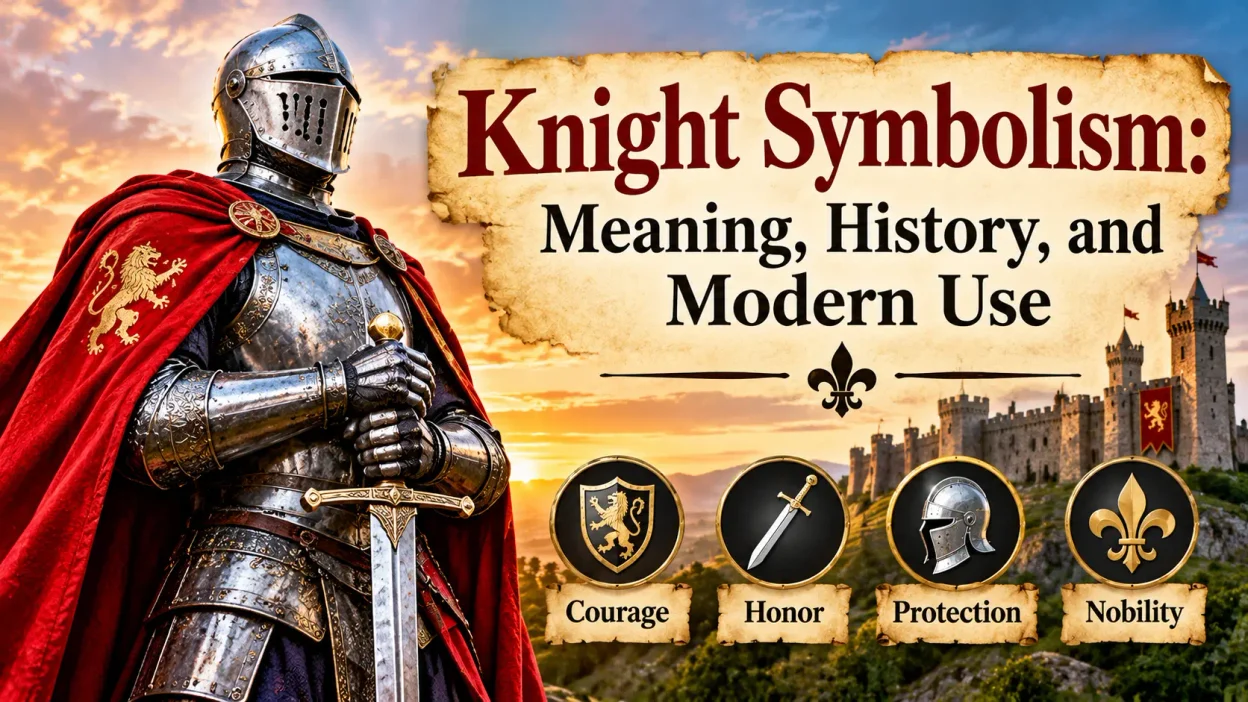
A knight is one of the most recognizable figures from medieval history. Usually depicted wearing metal armor, carrying a sword or shield, and riding a powerful horse, the knight represents more than a warrior prepared for battle. In stories, artwork, religious traditions, and modern popular culture, knight symbolism is closely associated with courage, honor, loyalty, protection, and the responsibility to stand up for others.
The image has remained familiar for centuries because it combines physical strength with an expectation of moral character. A knight is often imagined as someone who faces danger, defends vulnerable people, keeps promises, and accepts responsibility even when doing so involves personal sacrifice.
In the United States, knights appear in everything from fantasy films and historical reenactments to sports mascots, tattoos, jewelry, and decorative designs. Although the original medieval institution has largely disappeared, the knight remains a recognizable image of personal integrity, determination, and the desire to protect what matters.
Quick Answer: What Does Knight Symbolism Mean?
Knight symbolism commonly represents courage, honor, loyalty, protection, and moral responsibility in modern American culture. Historically, knights were mounted warriors associated with military service, aristocratic identity, Christian traditions, and the developing ideals of chivalry.
TL;DR
- Knights represent courage, discipline, honor, and responsibility.
- Medieval knighthood developed from mounted military service.
- Chivalry connected martial skills with social and religious expectations.
- American culture often portrays knights as protectors and heroes.
- Knight tattoos can express loyalty, resilience, and personal values.
- Modern interpretations distinguish honorable conduct from historical warfare.
1. What a Knight Represents as a Symbol
The traditional knight is a mounted warrior dressed in protective armor, often carrying a sword, shield, lance, or banner. These visual details help explain why knights acquired such recognizable symbolic associations.
Armor suggests protection and preparedness. The sword represents action, authority, and the ability to defend or confront wrongdoing. A shield communicates defense, while a horse suggests mobility, strength, and status.
Together, these elements create an image of someone prepared to face difficult circumstances.
The knight’s meaning also depends on how the figure is presented. A knight standing with a sword lowered may suggest restraint and peace after conflict. A knight charging into battle communicates determination and bravery. A kneeling knight can represent humility, devotion, or service to a higher authority.
Unlike a simple image of physical strength, the knight traditionally combines strength with expectations about how that strength should be used.
That distinction explains why knights continue to appear in stories about heroes, leaders, guardians, and people who accept difficult responsibilities.
2. Ancient and Medieval Origins of Knightly Symbolism
The knight as a recognizable historical figure developed in medieval Europe, particularly as mounted warfare became increasingly important.
The English word knight comes from the Old English cniht, which originally referred to a boy, servant, or attendant. Over time, the term became associated with a mounted warrior who served a ruler or powerful lord.
By the ninth century, many knights and nobles held land in exchange for military and other services. Their horses, weapons, training, and equipment made them important members of medieval military society.
Knights eventually became associated with an emerging aristocratic identity. Their position was not simply based on fighting ability. Family background, land ownership, political relationships, and service to powerful patrons also influenced their standing.
During the eleventh and twelfth centuries, the idea of chivalry developed alongside this military culture. The French word chevalerie, connected to cheval (horse), originally referred to knighthood and its associated practices.
Over time, writers and religious authorities increasingly connected knightly identity with moral expectations.
This historical development established the foundation for the knight’s later associations with honor, loyalty, courage, and duty.
3. Courage and the Willingness to Face Danger
Courage is among the most familiar meanings associated with knights.
Medieval knights were expected to participate in dangerous military campaigns, defend territories, and demonstrate their abilities in combat. Their profession required physical bravery, endurance, and the willingness to face serious risks.
However, modern interpretations of knightly courage extend beyond warfare.
In American culture, a knight can represent someone willing to confront difficult situations rather than avoid them. This might mean defending another person, speaking against unfair treatment, accepting responsibility, or continuing through a difficult personal experience.
A knight standing with a raised sword often communicates readiness to act. The image suggests that courage involves more than feeling fearless. It involves making a decision despite uncertainty or danger.
The distinction between courage and aggression is important.
A person who uses strength carelessly is not necessarily displaying the qualities traditionally associated with an honorable knight. The modern ideal emphasizes bravery guided by judgment and responsibility.
For this reason, knight imagery frequently appeals to people who value perseverance and standing firm when circumstances become challenging.
4. Honor, Integrity, and Personal Responsibility
Honor is another central meaning of the knight.
In medieval society, a knight’s reputation could influence political relationships, military opportunities, social standing, and family prestige. Keeping agreements, demonstrating loyalty, and fulfilling obligations could strengthen that reputation.
Literature gradually developed a more idealized picture of knightly honor.
Arthurian stories, medieval romances, and later historical fiction presented knights as individuals expected to act according to principles rather than personal convenience.
The legendary knights associated with King Arthur’s court, for example, are frequently judged by their loyalty, honesty, and ability to maintain their commitments.
In modern American life, this meaning appears whenever knight imagery is used to represent integrity.
A knight can symbolize:
- Keeping promises even when circumstances change.
- Accepting responsibility for personal decisions.
- Treating others with fairness and respect.
- Refusing to abandon important principles.
- Choosing honesty over personal advantage.
The symbolism is especially relevant in discussions of leadership and character.
A knight is not simply someone who possesses authority. The idealized figure is someone who understands that authority comes with obligations.
5. Protection, Loyalty, and Service to Others
Knights are frequently portrayed as guardians who defend people, communities, and important causes.
This association developed partly through medieval expectations surrounding military service. Knights protected their lords, defended territories, and participated in campaigns intended to secure political and religious interests.
Religious and literary traditions later strengthened the image of the knight as a defender of vulnerable people.
In stories, knights often protect villages, rescue captives, defend travelers, or confront powerful enemies threatening innocent communities.
These fictional examples have become especially influential in modern interpretations.
In the United States, knight imagery can represent:
- Commitment to family.
- Loyalty to friends and partners.
- Responsibility toward a community.
- Support for people experiencing injustice.
- Protection of personal values and beliefs.
A knight holding a shield is particularly suitable for communicating this meaning. The shield does not primarily suggest attacking an enemy; it represents the willingness to stand between danger and something worth protecting.
However, protection should not automatically be interpreted as controlling another person. The healthier modern meaning emphasizes support, respect, and responsible action.
6. Chivalry and the Traditional Knightly Code
Chivalry is closely connected to the symbolism of knights, although its historical meaning was more complicated than popular stories suggest.
During the Middle Ages, chivalry referred to a developing aristocratic and military culture. It included expectations concerning combat, status, loyalty, reputation, and appropriate conduct.
Medieval writers gradually promoted virtues such as generosity, courage, courtesy, religious devotion, and restraint.
These expectations were not always consistent. Different writers and communities emphasized different qualities, and there was never one universally followed medieval rulebook governing every knight.
Historical knights could be violent, politically ambitious, and involved in conflicts that contradicted later romantic descriptions of chivalry.
Nevertheless, the ideal became influential.
Today, Americans generally understand chivalry through everyday behavior rather than medieval military traditions.
It may refer to holding a door open, treating people respectfully, offering assistance, keeping one’s word, or showing consideration.
The modern meaning has also expanded beyond traditional gender expectations. Respect and courtesy are not qualities that belong exclusively to men or require women to occupy passive roles.
The knight therefore represents an ideal of considerate behavior, even when the historical reality was considerably less romantic.
7. Religious Symbolism and the Christian Knight
Knights have an important connection to medieval Christianity.
During the Middle Ages, the Catholic Church influenced European ideas about warfare, political authority, morality, and social responsibility. Some religious leaders attempted to regulate violence among Christian warriors and encouraged the protection of certain groups.
Religious ceremonies also became part of knightly traditions.
A knight’s ceremonial preparation could include prayer, confession, bathing, and the blessing of weapons. These practices gave knighthood a religious dimension and connected military service with spiritual responsibility.
The cross became a recognizable symbol in certain Christian military contexts.
Military-religious orders, including the Knights Templar and Knights Hospitaller, further connected knighthood with Christian institutions.
However, their histories were not identical. These organizations combined religious commitments with military, charitable, and administrative responsibilities in different ways.
In religious symbolism, the knight can therefore represent:
- Devotion to religious principles.
- Service to a higher purpose.
- Spiritual discipline.
- The struggle between temptation and responsibility.
- The defense of a religious community.
It is important to distinguish these historical associations from the belief that every knight followed the same religious commitments.
Today, a knight carrying a cross may communicate Christian faith, medieval history, or a personal connection to religious ideals, depending on the individual and design.
8. Knight Symbolism in American Culture
The knight is not native to American medieval history, but the image has become deeply established in American popular culture.
Americans often encounter knights through historical fiction, fantasy entertainment, children’s stories, museums, video games, and educational materials.
Unlike medieval Europeans, Americans generally approach the knight as a historical or fictional figure rather than as a familiar social rank.
The image frequently communicates a recognizable combination of bravery, leadership, discipline, and protection.
Sports culture provides another important example.
Numerous American schools, colleges, and athletic organizations use knight imagery for their mascots. The armored figure creates an impression of determination, competitiveness, team loyalty, and strength.
The knight is also familiar in American fantasy entertainment. Stories featuring medieval kingdoms, legendary swords, castles, and heroic journeys often use knights to represent the struggle between good and evil.
In some narratives, the knight is a defender of justice. In others, the character is flawed, ambitious, or morally conflicted.
This flexibility helps the image remain relevant.
For American audiences, a knight can represent traditional heroism without necessarily communicating support for monarchy, aristocracy, or medieval political systems.
9. The Meaning of Knight Armor, Swords, Shields, and Horses
Individual elements of knight imagery carry their own symbolic associations. Understanding them can help explain why particular knight designs communicate different messages.
Armor: Armor commonly represents protection, emotional resilience, preparation, and the ability to withstand difficult circumstances. In personal symbolism, it can also suggest guarded emotions or a desire to remain strong.
Sword: A sword can symbolize courage, authority, justice, decisive action, and the ability to confront challenges. Depending on its presentation, it may also represent conflict or aggression.
Shield: The shield is strongly associated with defense, loyalty, family protection, and standing firm against adversity. A decorated shield may also communicate heritage and personal identity.
Helmet: A helmet can represent discipline, preparedness, self-control, and mental protection. Its concealed face may also suggest anonymity or a private identity.
Horse: The horse traditionally communicates strength, movement, status, and freedom. In knightly imagery, it also represents the relationship between the warrior and the animal essential to mounted combat.
Crown: When included in knight imagery, a crown can represent authority, leadership, achievement, or allegiance to a ruler.
These elements are often combined in tattoos, coats of arms, decorative artwork, and fantasy illustrations to create a more specific personal message.
10. Cross-Cultural Interpretations of Knightly Ideals
The medieval European knight is a specific historical figure, but many societies have developed their own traditions of honorable warriors and protectors.
These traditions should not be treated as identical forms of knighthood. Their social structures, religious beliefs, military practices, and ethical expectations developed in different circumstances.
Japan and the samurai: Samurai culture is sometimes compared with European knighthood because both involved military elites, service relationships, martial training, and expectations surrounding reputation. Bushido, the later system of ideals associated with samurai, is frequently connected with loyalty, discipline, courage, and self-control. However, samurai traditions developed independently and should not be reduced to a Japanese version of European chivalry.
Islamic societies: Medieval Muslim societies had their own traditions of military service, leadership, courage, and honorable conduct. Concepts such as futuwwa developed around ideals of generosity, self-discipline, and noble behavior, although their meanings varied across historical settings.
European Arthurian tradition: The legends of King Arthur helped establish the knight as a literary figure associated with quests, loyalty, sacrifice, and moral testing. The Round Table became a lasting image of fellowship and shared responsibility.
Christian military orders: Groups such as the Templars and Hospitallers combined religious identity with military and institutional responsibilities, giving knightly symbolism a specific Christian historical dimension.
These comparisons demonstrate that courage, loyalty, and service are not exclusive to European knights. Different societies have developed distinct ways of expressing similar human ideals.
11. Emotional and Psychological Meaning of the Knight
The knight often appeals to people because the image expresses a desire to feel capable, protected, and prepared.
Armor can represent the emotional defenses people develop after difficult experiences. A person who has experienced disappointment, betrayal, or hardship may identify with the image of someone who continues forward despite personal struggles.
The knight can also represent an ideal self: someone more disciplined, confident, dependable, and willing to accept responsibility.
Several emotional associations commonly emerge:
- Security: The armored figure suggests safety and protection.
- Confidence: A knight standing upright communicates self-belief and readiness.
- Resilience: Armor represents the ability to withstand pressure.
- Loyalty: The knight suggests commitment to people and principles.
- Purpose: A knight on a quest represents having a goal worth pursuing.
- Sacrifice: The willingness to face danger suggests putting important responsibilities ahead of convenience.
There is also a more complicated psychological interpretation.
A knight who never removes his armor can represent emotional isolation. Constantly appearing strong may prevent someone from expressing vulnerability or asking for help.
This makes the symbol more interesting than a simple image of toughness.
A balanced interpretation recognizes that genuine strength can include compassion, honesty, and the willingness to acknowledge personal limitations.
12. Knight Tattoos, Jewelry, and Personal Style
Knight imagery is popular in tattoo culture because it combines recognizable visual elements with several possible personal meanings.
A person may choose a knight tattoo to commemorate a difficult period, express loyalty to family, represent personal discipline, or celebrate an interest in medieval history.
Different designs can communicate different ideas.
| Design | Common Symbolic Meaning | Personal Association |
|---|---|---|
| Knight in full armor | Strength and resilience | Overcoming hardship |
| Knight with sword | Courage and determination | Standing up for beliefs |
| Knight with shield | Protection and loyalty | Family and responsibility |
| Kneeling knight | Humility and devotion | Faith and respect |
| Knight on horseback | Leadership and ambition | Personal progress |
| Knight helmet | Discipline and identity | Mental strength |
Knight imagery also appears in jewelry, pendants, rings, decorative shields, and clothing.
A small knight helmet pendant might represent courage or personal identity. A ring featuring a medieval shield may communicate family heritage or an interest in heraldic design.
In home decoration, knight figures and armor-inspired objects often create a historical, traditional, or fantasy atmosphere.
Some people use them to express an interest in medieval history, while others simply appreciate the craftsmanship and visual appearance.
The important point is that modern personal use does not require someone to follow every historical meaning attached to the figure.
13. Knights in Literature, Movies, and Video Games
Popular entertainment has played a major role in keeping knight imagery recognizable.
Arthurian literature is one of the most influential sources of the modern knightly image.
Stories about King Arthur and the Knights of the Round Table present knighthood as a combination of bravery, loyalty, fellowship, and moral responsibility. Characters such as Sir Lancelot and Sir Gawain also demonstrate that knights can struggle with conflicting duties and personal weaknesses.
Later literature developed the romantic knight further.
In modern fantasy films and games, knights frequently appear as warriors defending kingdoms, protecting companions, or fighting supernatural enemies.
Video games often give knight characters specialized armor, weapons, abilities, and allegiances. These design choices allow players to associate the character with different values, including strength, defense, discipline, and sacrifice.
The image also appears in chess.
The knight is one of the six chess pieces and has a distinctive L-shaped movement. Its unusual movement allows it to jump over other pieces, making it useful for creating unexpected attacks and defensive opportunities.
Although chess uses the historical knight as inspiration, its strategic function should not be confused with a universal symbolic meaning. In this setting, the piece primarily represents a specific type of movement and tactical possibility.
14. Negative Interpretations and Misuse of Knight Symbolism
Although knights are usually presented positively, their symbolism is not entirely free from controversy.
Historical knights were professional warriors. They participated in territorial conflicts, political struggles, invasions, and religious wars. Their actions sometimes involved violence against civilians and the pursuit of personal wealth or status.
The romantic image of a perfectly honorable warrior does not accurately represent every historical knight.
Another issue concerns the idea of chivalry.
Popular culture sometimes presents medieval chivalry as a universal system of kindness and respect. In reality, historical expectations were shaped by social hierarchy, aristocratic privilege, religious institutions, and gender assumptions.
The image of a knight rescuing a helpless woman, for example, can reinforce outdated ideas about gender when presented as the only acceptable form of protection.
There are also modern political and cultural contexts in which medieval knight imagery is used to promote exclusionary ideas about heritage, religion, or social superiority.
A historical symbol should be understood in its actual context rather than automatically treated as an endorsement of every cause that adopts it.
The distinction matters because the same knight image can represent personal courage in one setting and a much more complicated political message in another.
15. How the Meaning of Knights Has Changed Over Time
The knight’s symbolic identity has developed through several historical stages.
| Historical Period | Main Association | Changing Interpretation |
|---|---|---|
| Early medieval period | Mounted military service | Military strength and loyalty |
| High Middle Ages | Aristocratic knighthood | Chivalry and social responsibility |
| Later Middle Ages | Heraldry and knightly orders | Family identity and status |
| Renaissance and later | Literary and historical romance | Heroism and noble character |
| Modern period | Popular culture and personal identity | Courage, protection, and resilience |
During the early medieval period, the knight was primarily understood through military service and mounted combat.
As medieval society developed, knighthood became more closely associated with aristocratic identity, ceremonial traditions, and ideals of conduct.
Later literary traditions transformed the knight into a more romantic figure. Stories about quests, noble sacrifices, legendary swords, and heroic battles strengthened the connection between knighthood and moral character.
During the nineteenth century, renewed interest in medieval history and romantic literature further popularized the image of the honorable knight.
In contemporary culture, the knight has become a flexible symbol.
Someone might use it to represent family loyalty, another person might associate it with religious devotion, and someone else might simply appreciate its connection to fantasy storytelling.
The historical warrior has gradually become a broader image of character, personal responsibility, and the desire to defend meaningful principles.
Frequently Asked Questions
1. What does a knight symbolize spiritually?
A knight can spiritually represent devotion, discipline, service, and the struggle to remain faithful to personal or religious principles. In Christian contexts, the image may also communicate a commitment to defending faith and serving a higher purpose.
2. Is a knight a symbol of strength?
Yes. Knights commonly symbolize physical strength, courage, emotional resilience, and the ability to face difficult circumstances. Armor and weapons reinforce this interpretation, while the knight’s traditional responsibilities connect strength with discipline.
3. What does a knight tattoo mean?
A knight tattoo often represents loyalty, protection, bravery, perseverance, or personal honor. The specific meaning depends on the design, such as a knight holding a shield, carrying a sword, or kneeling in prayer.
4. What does a knight symbolize in Christianity?
In Christian symbolism, a knight may represent faith, spiritual discipline, devotion, and service to God. Historical Christian military orders also connected knighthood with religious commitments, although their military and political activities were more complicated than idealized portrayals suggest.
5. Are knights considered symbols of loyalty?
Yes. Knights are frequently associated with loyalty because medieval warriors often served particular rulers, families, or military institutions. In modern interpretations, loyalty usually refers to commitment to family, friendship, personal principles, and important responsibilities.
6. What is the difference between a knight and a samurai symbolically?
Both figures can represent courage, discipline, loyalty, and martial responsibility, but they developed within different historical and cultural systems. Knights belonged to European medieval society, while samurai were members of Japan’s warrior class.
7. Does a knight symbolize good or evil?
Knights are generally associated with positive qualities such as bravery, protection, and honor. However, their historical role as warriors means the image can also represent conflict, authority, aggression, or the misuse of power.
Conclusion
The knight has evolved from a medieval mounted warrior into a widely recognized symbol of courage, honor, loyalty, protection, and personal responsibility. Its historical associations come from military service, aristocratic traditions, religious institutions, and the development of chivalric ideals.
In modern American culture, knight symbolism is especially connected with standing up for others, remaining committed to personal values, and facing challenges with determination. Whether it appears in a tattoo, a sports mascot, a historical illustration, or a fantasy story, the knight continues to represent the relationship between strength and responsibility.
Ultimately, the most meaningful interpretation of a knight is not simply the ability to fight or withstand hardship. It is the decision to use personal strength with integrity, restraint, and consideration for others.