
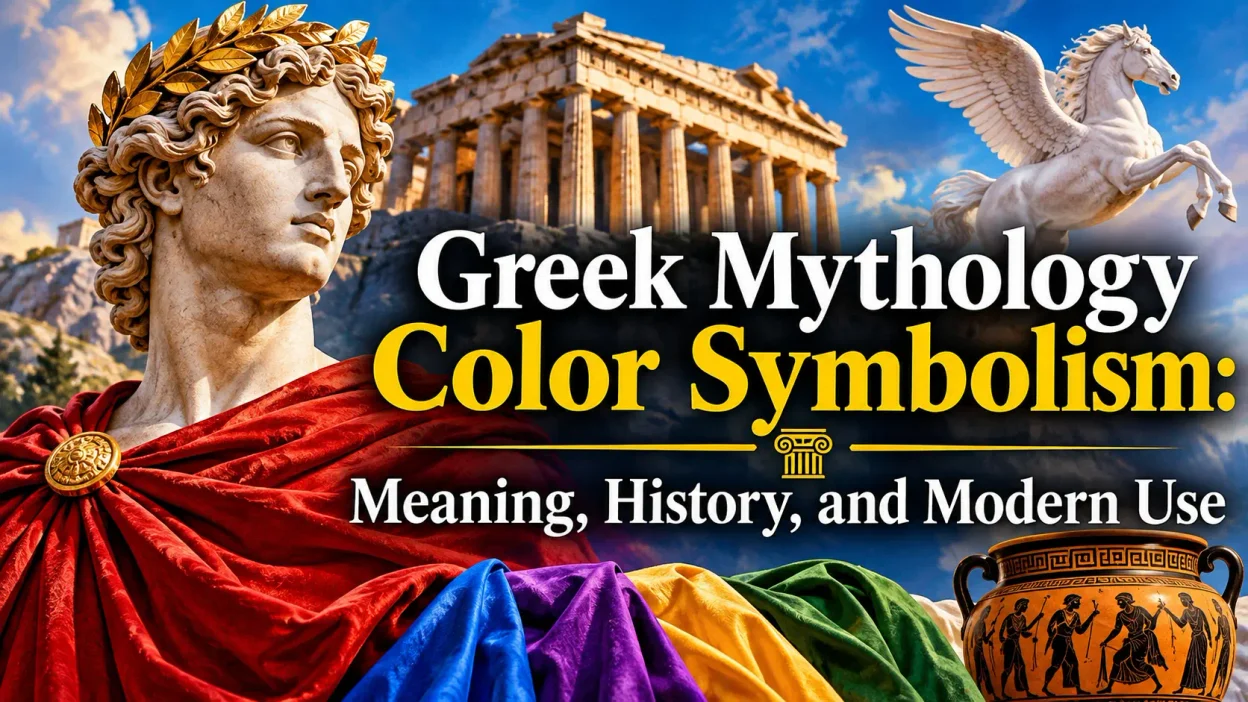
Greek mythology color symbolism connects colors with gods, emotions, power, nature, death, and the supernatural. In ancient Greek stories and artwork, colors helped communicate a character’s status, divine identity, emotional condition, or connection to the world of mortals. Although ancient Greeks did not follow one universal color chart, certain shades developed recognizable associations through mythology, religious ceremonies, poetry, clothing, and visual art.
Colors were particularly important because Greek mythology was filled with visual contrasts. Light and darkness, blood and purity, gold and ordinary materials, and the brightness of the heavens against the shadows of the underworld all helped shape how mythical stories were understood. A color could suggest divine favor, danger, mourning, celebration, or authority depending on the setting.
Today, Americans often associate Greek mythology colors with familiar images of gods and goddesses, fantasy artwork, classical architecture, jewelry, tattoos, fashion, and modern storytelling. Understanding their ancient background makes these associations more meaningful and helps separate historical symbolism from modern interpretations.
Quick Answer
Greek mythology color symbolism commonly represents divinity, power, wisdom, passion, purity, death, and transformation. Purple and gold are associated with royalty and divine authority, red with blood and life, white with purity and sacredness, while black often represents mourning, the underworld, and mystery.
TL;DR
- Purple symbolized wealth, authority, and prestige because of expensive ancient dyes.
- Gold represented divine radiance, immortality, wealth, and the gods.
- Red connected with blood, sacrifice, love, life, and danger.
- White suggested brightness, purity, celebration, and sacred offerings.
- Black was associated with death, mourning, darkness, and underworld deities.
- Modern American art uses Greek colors to communicate mythology, identity, and emotion.
1. Why Color Was Important in Greek Mythology
Color was not simply decorative in ancient Greek culture. It could communicate meaning through the appearance of clothing, weapons, temples, animals, offerings, and artistic representations of the gods.
Greek mythology developed in a society where religion, politics, family, art, and public life were closely connected. A color seen in a temple might have religious significance, while the same color used on a ruler’s clothing could suggest authority or wealth.
The ancient Greeks also experienced colors differently from the way modern people organize them into rigid symbolic categories. Their color vocabulary could describe brightness, darkness, texture, shine, and the changing appearance of objects. A word translated as a particular color in English might refer to several shades or visual qualities.
For example, descriptions of the sea, wine, hair, flowers, and metals often included qualities that modern readers would interpret as combinations of color and light. This makes Greek mythology’s color symbolism more flexible than a simple list of meanings.
The significance of a color depended on the myth, the deity, the ritual, and the object being described.
2. Gold Symbolism: Divine Power and Immortality
Gold was one of the most recognizable colors and materials associated with divine power in Greek mythology. Its brightness, durability, and rarity made it an appropriate representation of the gods, extraordinary wealth, and objects that existed beyond ordinary human life.
Gold frequently appeared in descriptions of divine clothing, palaces, weapons, ornaments, and sacred objects. Its brilliance suggested a quality that ordinary materials could not easily reproduce.
Gold and the gods
The gods of Olympus were often described with luminous or splendid qualities. Gold helped artists and storytellers communicate their extraordinary status.
The color could suggest:
- Divine radiance
- Immortality
- Wealth and abundance
- Authority and leadership
- Sacred protection
- Excellence beyond human limitations
Gold was also associated with the sun and its brightness, although solar symbolism in Greek mythology was more specifically connected with figures such as Helios and later traditions involving Apollo.
The Golden Fleece
The Golden Fleece is one of the most famous golden objects in Greek mythology. In the story of Jason and the Argonauts, the fleece becomes a symbol of a difficult quest, royal legitimacy, heroic ambition, and the pursuit of something extraordinarily valuable.
Its golden appearance communicates more than material wealth. It represents a prize whose possession could change a person’s destiny and political position.
In modern American fantasy literature, games, films, and artwork, gold continues to communicate magical importance, legendary treasure, and divine power.
3. Purple Symbolism: Royalty, Wealth, and Authority
Purple was one of the most prestigious colors in ancient Mediterranean societies. The production of certain purple dyes required considerable labor and resources, making purple garments expensive and associated with people of high social status.
The ancient Greek term for purple did not always correspond to the violet shade familiar today. It could refer to reddish-purple, crimson, dark purple, or colors with a shimmering quality.
Purple and royal status
Purple garments could communicate:
- Wealth and privilege
- Political authority
- Prestige
- Exceptional status
- Luxury
- Divine or ceremonial importance
Purple appeared in descriptions of powerful figures, luxurious clothing, and objects connected with elite life.
The association between purple and authority became particularly influential in later Greek and Roman traditions. Alexander the Great’s use of purple clothing and royal imagery helped reinforce its association with political power.
Purple in modern American culture
In the United States, purple frequently appears in fantasy artwork, mythology-inspired fashion, ceremonial design, and luxury branding.
A purple cloak worn by a mythical king or goddess may communicate authority without requiring additional explanation. In tattoos, purple can represent ambition, individuality, spiritual curiosity, or a connection to classical mythology.
However, purple’s modern meanings are not identical to ancient Greek meanings. Today it can also represent creativity, femininity, LGBTQ+ identity, mystery, or personal expression.
4. Red Symbolism: Blood, Passion, Sacrifice, and Life
Red was closely connected with the human body, blood, warfare, sacrifice, and life. Its visibility and emotional intensity made it useful in religious rituals, artistic representations, and descriptions of dramatic events.
In Greek mythology, blood was a reminder of mortality, violence, family relationships, and the consequences of divine or human conflict.
Red and sacrifice
Sacrifice played a significant role in ancient Greek religious practices. The color red could be associated with blood offered during ceremonies and the relationship between mortals and divine powers.
Red also appeared in clothing and ritual contexts connected with transitions in life. Certain ancient traditions associated red garments with weddings, adulthood, or important ceremonial occasions.
Red and mythology’s emotional themes
Red can communicate several contrasting ideas:
- Love and desire
- Courage and strength
- Bloodshed and violence
- Fertility and life
- Sacrifice and transformation
- Anger and danger
These associations make red especially useful in depictions of Ares, Aphrodite, heroic battles, tragic love stories, and mythological creatures.
In modern American mythology-inspired artwork, red is often used to depict passion, power, revenge, courage, or dangerous supernatural forces.
5. White Symbolism: Purity, Light, and Sacredness
White was associated with light, brightness, favorable circumstances, celebration, and sacredness in many ancient Greek contexts.
White clothing and white animals could appear in religious ceremonies and offerings connected with celestial deities. The brightness of white made it visually appropriate for objects or practices associated with light and favorable divine relationships.
White and the divine
White could represent:
- Purity
- Light
- Celebration
- Hope
- Favorable omens
- Sacredness
- Beauty
The color was sometimes associated with divine figures whose qualities included brightness, radiance, or a favorable relationship with the heavens.
However, white did not always mean innocence or goodness. Greek mythology frequently used color in ways that depended on the situation. White could also describe physical appearance, clothing, animals, or objects without carrying a symbolic meaning.
White in modern American culture
Americans commonly associate white with weddings, innocence, peace, new beginnings, and spirituality.
In mythology-inspired art, white clothing may suggest a goddess’s purity, a priestess’s sacred role, or a hero’s transformation. White marble statues also contribute to modern perceptions of Greek mythology, although many ancient statues and architectural elements were originally painted in multiple colors.
That historical detail is important because the familiar image of Greece as a civilization of entirely white marble is incomplete.
6. Black Symbolism: Death, Mourning, and the Underworld
Black was associated with darkness, death, mourning, the earth, and the underworld. Its symbolism was particularly important in stories involving Hades, Persephone, the dead, and the forces that existed beyond ordinary human life.
The Greek underworld was not simply a place of evil. It was the realm of the dead, governed by divine laws and containing different destinations for souls. Black could communicate its distance from the brightness and activity of the living world.
Black and Hades
Hades was the ruler of the underworld, and modern artwork frequently depicts him using black, charcoal, dark gray, and deep purple.
These colors communicate:
- Death and mortality
- Darkness and hidden knowledge
- Mourning and grief
- The underworld
- Fear of the unknown
- Authority over the dead
Black could also be used in religious contexts involving chthonic deities, or gods connected with the earth and the underworld. In some rituals, dark-colored offerings were appropriate for particular divine powers.
Black was not always negative
It is inaccurate to assume that black automatically represented evil in Greek mythology. Darkness could be sacred, necessary, protective, or connected with the natural cycle of life.
Night, the earth, and the underworld were important parts of the Greek mythological universe. Black could represent a powerful force that humans respected rather than something they considered morally bad.
In contemporary American mythology artwork, black often represents mystery, danger, independence, grief, or supernatural power. Its meaning depends heavily on whether the artwork portrays a villain, a protective deity, a grieving figure, or a mysterious hero.
7. Blue Symbolism: The Sea, Sky, and Divine Nature
Blue is strongly associated with Greek mythology in modern American visual culture, particularly through depictions of Poseidon, Zeus, the ocean, and the sky.
However, modern blue imagery should not be confused with a fixed ancient Greek color system. Ancient Greek color vocabulary did not map neatly onto the modern spectrum, and the gods were not universally assigned specific colors.
Poseidon and the sea
Poseidon is frequently depicted in blue because he rules the sea. In modern artwork, blue communicates his connection with oceans, storms, waves, maritime power, and the natural world.
His blue imagery may suggest:
- Water and ocean life
- Emotional intensity
- Storms and destructive natural forces
- Power and unpredictability
- Travel and exploration
The sea in Greek mythology was never merely peaceful. It could provide trade, travel, and nourishment while also destroying ships and threatening human lives.
Blue can therefore represent both calm and danger.
Zeus and the sky
Modern artists frequently use blue, white, and gray when depicting Zeus because of his connection with the sky, thunder, and storms.
A bright blue sky may suggest his celestial authority, while dark storm clouds communicate his anger and power.
In the United States, blue is also commonly associated with calmness, trust, stability, and wisdom. These modern associations influence how audiences interpret blue mythological imagery.
8. Green Symbolism: Nature, Renewal, and Fertility
Green is often used in modern depictions of Greek mythology to represent nature, fertility, growth, agriculture, renewal, and the changing seasons.
Its strongest mythological associations are connected with the natural world and stories involving agricultural cycles.
Demeter and the earth
Demeter was the goddess of agriculture, grain, and fertility. Her mythology explains the changing seasons through her relationship with Persephone.
When Persephone spends part of the year in the underworld, Demeter’s grief affects the earth. Her return marks a period of renewed growth and agricultural abundance.
Modern artwork often uses green to represent:
- Spring and renewal
- Fertility and growth
- Agriculture and abundance
- Nature and healing
- Life after hardship
Persephone and transformation
Persephone is especially associated with transformation because she occupies a position between the living world and the underworld.
Green may represent her springtime identity, while darker shades may communicate her role as queen of the underworld. The contrast between these colors illustrates the myth’s central themes of seasonal change, duality, and the relationship between life and death.
Green is a modern interpretive color rather than an exclusive ancient color assigned to these goddesses.
9. Yellow Symbolism: Knowledge, Light, and Caution
Yellow and golden shades are often used in modern representations of Greek mythology to communicate sunlight, intellectual brilliance, warmth, and divine illumination.
These associations are particularly strong in artwork depicting Apollo, who is connected with music, prophecy, healing, poetry, and the sun in later traditions.
Yellow and Apollo
Apollo’s imagery frequently includes bright gold, yellow, and white. These colors emphasize the clarity, beauty, and radiance associated with his divine qualities.
Yellow can suggest:
- Intelligence and knowledge
- Sunlight and warmth
- Creativity
- Hope and optimism
- Divinity and illumination
- Warning or instability in modern contexts
The final two interpretations can coexist. A bright yellow object might suggest divine brilliance in a mythological painting, while a yellow background in modern artwork might communicate anxiety, jealousy, or danger.
Ancient Greek descriptions of yellowish and greenish colors were not always separated in the same way as modern color terminology, making direct symbolic translations difficult.
10. Color Associations With Major Greek Gods and Goddesses
Modern artists, designers, and writers frequently assign colors to individual gods to make their identities immediately recognizable.
These associations often come from the gods’ attributes, their natural domains, ancient objects, or later artistic traditions. They should not be treated as an official ancient Greek color code.
| Deity | Common Modern Color | Symbolic Associations |
|---|---|---|
| Zeus | Blue, white, gold | Sky, authority, thunder, divine power |
| Hera | White, gold, purple | Marriage, royalty, dignity, protection |
| Athena | Gray, blue, gold | Wisdom, strategy, justice, craftsmanship |
| Poseidon | Blue, green | Oceans, storms, power, unpredictability |
| Aphrodite | Pink, red, white | Love, beauty, desire, attraction |
| Ares | Red, black | Warfare, aggression, courage, destruction |
| Apollo | Gold, yellow, white | Sunlight, music, prophecy, healing |
| Artemis | Silver, white, green | Moon, wilderness, independence, protection |
| Hades | Black, dark purple | Underworld, death, authority, mystery |
| Demeter | Green, gold, brown | Agriculture, fertility, harvest, abundance |
| Persephone | Green, red, black | Spring, transformation, the underworld |
| Hermes | Gold, yellow, blue | Travel, communication, intelligence, movement |
These colors are commonly used in contemporary mythology artwork, fantasy media, and popular culture. Individual artists may choose different palettes, and ancient representations were not necessarily consistent.
11. Color Symbolism in Greek Religious Rituals
Colors could influence the appearance and meaning of ancient Greek religious ceremonies.
The selection of clothing, animals, objects, and offerings sometimes depended on the deity being honored and the nature of the ritual.
White was often associated with celestial gods and favorable ceremonial occasions. Darker colors could be appropriate for rituals connected with underworld deities or the dead. Red and purple shades could carry associations with sacrifice, sacredness, and extraordinary status.
These practices were not governed by a single universal rule.
Greek religion developed over many centuries and across different cities, regions, and local traditions. A ritual’s color choices could reflect local customs, the particular deity, the material available, and the purpose of the ceremony.
This explains why colors in Greek mythology sometimes appear to carry contradictory meanings. Their symbolism was connected with the specific religious or cultural situation rather than a standardized system.
12. The Emotional and Psychological Meaning of Greek Mythology Colors
Color influences how modern audiences emotionally experience mythology. Artists use familiar visual associations to help viewers understand a character before the story explains that character’s motivations.
A red background may make a scene feel violent or passionate. Blue can create a sense of calm or emphasize the vastness of the sea. Gold can make a figure appear important, powerful, or supernatural.
The emotional associations often include:
- Gold: admiration, prestige, ambition, and divine importance
- Purple: luxury, authority, individuality, and mystery
- Red: love, anger, courage, danger, and excitement
- White: calmness, innocence, hope, and sacredness
- Black: grief, fear, elegance, and hidden power
- Blue: tranquility, trust, freedom, and emotional depth
- Green: renewal, growth, nature, and balance
- Yellow: optimism, creativity, energy, and caution
These meanings are influenced by modern color psychology, American cultural expectations, and individual experiences. They are not universal emotional responses.
A person who associates black with elegance may interpret a black mythological costume differently from someone who associates it with grief or fear.
13. Greek Mythology Color Symbolism in American Art and Pop Culture
Greek mythology remains a major source of inspiration for American entertainment, visual art, fashion, literature, and popular culture. Color helps modern creators adapt ancient stories for audiences who may not know the original myths.
In movies, video games, novels, and television, colors frequently become visual shortcuts for a god’s personality or domain.
For example, a character associated with Poseidon might wear blue clothing and carry a weapon surrounded by ocean imagery. A character connected with Hades might wear dark clothing, while a hero associated with Apollo might appear in gold or white.
Color in fantasy storytelling
Modern fantasy often borrows Greek mythology’s visual vocabulary to create recognizable archetypes.
- Gold suggests a legendary hero, divine ruler, or magical object.
- Red suggests danger, warfare, love, or revenge.
- Purple suggests royalty, magical power, or supernatural influence.
- Blue suggests water, storms, wisdom, or divine authority.
- Black suggests the underworld, mystery, or hidden power.
These choices make mythological stories easier to understand visually, even when the characters and storylines are adapted significantly.
American pop culture
Greek mythology colors appear in superhero-inspired designs, fantasy video games, mythology-themed merchandise, children’s books, museum exhibitions, and fashion collections.
The colors are often combined with familiar symbols such as lightning bolts, tridents, laurel wreaths, helmets, columns, wings, and Greek-style clothing.
Modern interpretations may also blend Greek mythology with other traditions, creating new meanings that reflect contemporary American storytelling rather than ancient Greek religious beliefs.
14. Greek Mythology Colors in Tattoos, Jewelry, and Personal Style
Greek mythology-inspired tattoos often use color to communicate the wearer’s interpretation of a deity, hero, or mythological story.
A person choosing an Athena tattoo might use blue, gray, and gold to represent wisdom, strategy, and authority. A Poseidon tattoo might feature deep blue and green to express a connection with the ocean. An Aphrodite design might use red, pink, and white to symbolize love, beauty, or romance.
Color can also influence the emotional atmosphere of a tattoo.
| Tattoo Color | Possible Mythological Meaning |
|---|---|
| Gold | Achievement, divine protection, excellence |
| Red | Passion, bravery, sacrifice, life |
| Purple | Power, royalty, individuality |
| Blue | Wisdom, oceans, calmness, freedom |
| Black | Mystery, mortality, strength |
| Green | Renewal, nature, fertility |
Greek mythology jewelry often uses gold-colored metals, gemstones, and symbolic imagery. Laurel wreaths, Medusa heads, Greek keys, and mythological figures may appear in necklaces, rings, bracelets, and earrings.
For many Americans, these designs express personal values rather than religious devotion. Someone might choose a Greek mythology tattoo to represent independence, resilience, intellectual curiosity, personal transformation, or a favorite literary story.
15. Common Misunderstandings About Greek Mythology Color Symbolism
Modern discussions of Greek mythology colors sometimes treat interpretations as historically established facts when they are actually contemporary artistic conventions.
Several misunderstandings are worth avoiding.
Every Greek god had an official color
There was no universally recognized ancient color chart assigning one specific shade to each Olympian. Modern artists often use colors based on a deity’s characteristics, but these choices can vary.
Ancient Greek statues were always white
Many ancient statues and architectural elements were originally painted. Their colors have faded, worn away, or disappeared over time, leaving the marble appearance that shaped modern perceptions of classical Greek art.
Purple always meant royalty
Purple could suggest wealth and status because certain dyes were expensive, but its use and meaning depended on the context. It was not exclusively a royal color in every ancient Greek setting.
Black represented evil
Black was associated with death, mourning, and the underworld, but these associations did not automatically make it morally negative. Underworld deities were important parts of Greek religious life.
Blue had the same meaning in ancient Greece as it does today
Modern blue symbolism is heavily influenced by contemporary color terminology and psychology. Ancient Greek descriptions of color were more complicated and sometimes emphasized darkness, brightness, or other qualities rather than modern hue categories.
Understanding these distinctions makes mythology more historically accurate and prevents modern interpretations from being mistaken for ancient traditions.
16. How Greek Mythology Color Symbolism Has Evolved
Greek mythology colors have changed meaning as the stories moved through different societies, artistic periods, religions, and forms of media.
In ancient Greece, color was connected with religious rituals, clothing, materials, visual art, social status, and the natural world. Purple dyes and gold objects could communicate wealth, while white, black, and red had important ceremonial associations.
During later Roman and European periods, classical mythology continued to influence artistic representations of gods, heroes, and legendary stories. The symbolism of certain colors became intertwined with additional cultural and religious traditions.
In modern America, mythology-inspired colors are frequently used for storytelling, fashion, tattoos, entertainment, personal identity, and decorative art.
The meanings have expanded beyond their ancient contexts. Purple can now represent individuality, blue can communicate tranquility, and black can symbolize sophistication as well as the underworld.
The evolution of color symbolism demonstrates that myths remain culturally relevant because people reinterpret them through the values and visual language of their own time.
Frequently Asked Questions
What is the most important color in Greek mythology?
There is no single most important color across all Greek mythology. Gold and purple are especially associated with divine authority, wealth, and prestige, while white, black, and red played significant roles in religious and ceremonial traditions.
What does purple symbolize in Greek mythology?
Purple commonly represents wealth, prestige, royal authority, and high social status. Its association with luxury developed partly because some ancient purple dyes were difficult and expensive to produce.
What color represents Zeus?
Modern artwork most commonly depicts Zeus using blue, white, and gold. These colors emphasize his association with the sky, thunder, divine authority, and celestial power, although ancient Greek mythology did not establish one exclusive color for him.
What does red symbolize in Greek mythology?
Red can represent blood, sacrifice, life, love, courage, warfare, and danger. Its meaning depends on the story, the object, and the religious or artistic context.
What does black symbolize in Greek mythology?
Black is often associated with death, mourning, darkness, and the underworld. It is particularly common in modern depictions of Hades, but ancient Greek religious symbolism did not always treat darkness as evil.
What does gold symbolize in Greek mythology?
Gold symbolizes divine radiance, wealth, immortality, authority, and extraordinary value. Mythological golden objects, such as the Golden Fleece, often represent a difficult quest or a prize capable of changing a hero’s destiny.
Did ancient Greeks assign colors to each god?
No universal color system assigned a specific shade to every Greek deity. Modern associations such as blue for Poseidon or gold for Apollo are largely artistic conventions based on their domains and attributes, rather than strict ancient rules.
Conclusion
Greek mythology color symbolism reveals how colors helped communicate divine power, emotional experience, social status, religious beliefs, and the relationship between life and death. Gold and purple often suggest wealth and authority, red connects with blood and passion, white with light and sacredness, and black with mourning and the underworld.
These meanings developed through ancient religious practices, artistic traditions, mythology, and the physical properties of materials such as dyes and metals. They were never completely fixed, and the same color could communicate different ideas depending on its context.
In modern American culture, Greek mythology colors continue to appear in tattoos, fantasy artwork, movies, jewelry, fashion, and personal expression. Their enduring appeal comes from the ability to communicate recognizable mythological themes while allowing artists and individuals to give those themes new meanings.



[…] The firebird’s colors contribute significantly to its meaning. […]