
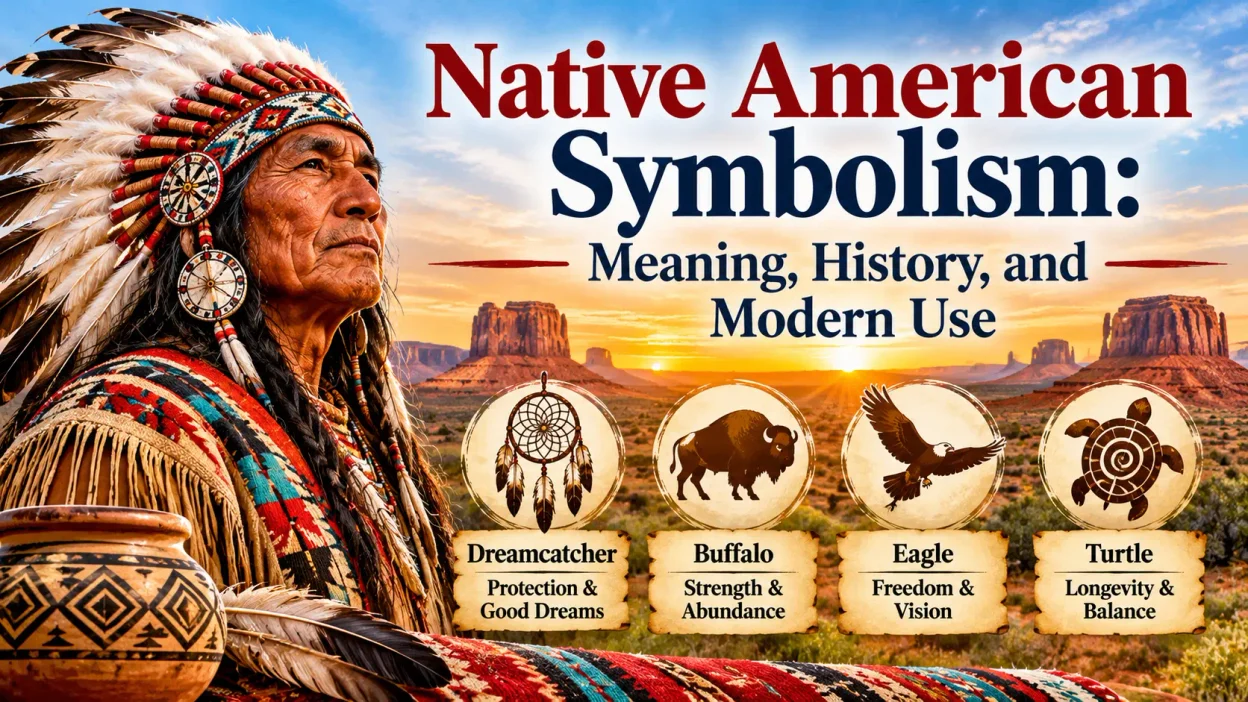
Native American symbolism encompasses the images, patterns, animals, colors, natural materials, and ceremonial objects used by Indigenous peoples throughout North America. These visual traditions communicate ideas about family, community, spirituality, the natural world, ancestry, and the relationship between humans and other forms of life. Native American symbolism is not one unified system. Instead, hundreds of distinct Indigenous nations have developed their own ways of expressing meaning through art, storytelling, and cultural practices.
For many Americans, these symbols appear in familiar places: museum collections, traditional beadwork, pottery, jewelry, clothing, architecture, and contemporary Indigenous artwork. Some have also become widely recognized through popular culture, although their original meanings are not always represented accurately.
Understanding these symbols requires more than assigning a simple definition to an animal or geometric shape. Their meanings come from particular communities, histories, languages, and relationships with the land. Learning about them offers a better understanding of Indigenous creativity and the continuing presence of Native American cultures in the United States.
Quick Answer
Native American symbolism commonly represents connection to nature, spiritual beliefs, community, ancestry, protection, and the interconnectedness of life in modern American cultural understanding. Historically, individual Indigenous nations developed distinct symbols through their ceremonies, creation stories, relationships with animals, and artistic traditions.
TL;DR
- Native American symbols express relationships with nature, family, and community.
- Each Indigenous nation has its own visual traditions.
- Animals often communicate cultural teachings and ancestral relationships.
- Circles and directional patterns can represent interconnectedness and life’s cycles.
- Beadwork, pottery, and textiles preserve cultural knowledge.
- Modern Indigenous artists continue adapting traditional visual languages.
1. What Native American Symbols Look Like
Native American symbols appear in many artistic forms, from simple geometric patterns to detailed representations of animals, plants, celestial bodies, and human figures. Their appearance depends on the nation, region, materials, and purpose behind the artwork.
Common visual elements include:
- Circles, spirals, and intersecting lines
- Animal tracks and animal figures
- Feathers and bird imagery
- Sun, moon, stars, and water patterns
- Repeating geometric designs
- Plant forms and natural landscapes
- Beaded shapes and embroidered patterns
These elements can appear on pottery, woven baskets, clothing, ceremonial objects, painted surfaces, jewelry, and architectural features.
For example, Pueblo pottery traditions often incorporate carefully arranged geometric patterns, while Northwest Coast Indigenous art is recognized for distinctive forms and visual conventions representing animals, ancestral beings, and relationships.
The appearance of a symbol alone does not always reveal its meaning. A similar shape might serve a decorative, historical, spiritual, or identifying purpose depending on who created it.
2. Why There Is No Single Native American Symbol System
One of the most important facts about Indigenous symbolism is that Native American cultures are not interchangeable.
The United States is home to hundreds of federally recognized tribal nations, alongside other Indigenous communities. These nations have different languages, territories, histories, governments, artistic practices, and spiritual traditions.
The visual traditions of the Navajo (Diné), Cherokee, Lakota, Ojibwe, Hopi, Haudenosaunee, and Tlingit peoples cannot be reduced to one common dictionary of symbols.
Even when two communities use similar imagery, their interpretations may differ.
A circle, for instance, can represent relationships, continuity, or a particular ceremonial concept in one tradition. In another community, the same shape might have a different meaning or simply function as part of an artistic composition.
This distinction matters because many popular websites present Native American symbols as though every Indigenous nation shares identical beliefs.
A more accurate approach is to identify the specific tribe, artist, historical period, and cultural setting associated with an image.
3. Historical Origins of Indigenous Symbolism
Indigenous visual traditions developed over thousands of years, long before the formation of the United States.
Early communities used markings, carvings, paintings, textiles, pottery, and other objects to communicate information and preserve cultural knowledge. Rock art and pictographs, for example, could record important events, spiritual experiences, relationships with places, and aspects of community life.
As societies developed, artistic practices became closely connected to local environments and available materials.
Different regions produced distinctive traditions:
- Southwest: Pottery, woven textiles, basketry, and sandpainting traditions.
- Great Plains: Painted hides, quillwork, beadwork, and designs associated with ceremonial life.
- Northeast: Wampum belts, decorative arts, and patterns connected to diplomacy and community identity.
- Northwest Coast: Carved wooden objects, masks, monumental poles, and elaborate animal imagery.
- Arctic regions: Carvings, clothing designs, and artistic representations reflecting relationships with animals and the environment.
These traditions were never static. Artists adapted materials, techniques, and designs as communities encountered new circumstances.
European colonization introduced major disruptions, including forced displacement, restrictions on cultural practices, and the removal of Indigenous objects from their communities. Nevertheless, Native artists continued creating, teaching, and preserving their visual traditions.
4. The Circle and the Meaning of Interconnectedness
The circle is an important visual form in several Indigenous traditions. Depending on the community and context, it can express continuity, relationships, cycles, and the connection between different parts of existence.
Circular imagery appears in ceremonial settings, beadwork, artwork, and structures.
One well-known example is the sacred hoop associated with certain Plains traditions. In Lakota teachings, the circle can express the relationship between individuals, communities, the natural world, and the larger order of life.
The circle also appears in medicine wheel traditions, although the specific teachings associated with these forms vary among Indigenous nations.
It is important not to assume that every Indigenous circle represents exactly the same philosophy. Its meaning depends on the tradition in which it appears.
For modern audiences, circular designs often suggest unity and balance. Those interpretations can be useful starting points, but they should not replace the specific teachings of the communities that created them.
5. Animal Symbolism and Relationships With Nature
Animals occupy important places in many Indigenous stories, artistic traditions, and systems of kinship. They may appear as ancestors, relatives, teachers, helpers, or significant beings within particular cultural narratives.
Their meanings are not universal, and an animal should not automatically be assigned one fixed spiritual interpretation.
Some examples of animals appearing in Indigenous traditions include:
Eagle: Eagles and their feathers hold particular ceremonial, spiritual, and cultural importance in many Indigenous communities. Their significance can be connected with honor, prayer, leadership, and relationships with the sacred.
Bear: Bears appear in the stories, clan systems, and artistic traditions of different nations. Depending on the community, they may be associated with particular ancestral relationships, protection, knowledge, or strength.
Buffalo: For many Plains nations, the American bison has been central to food systems, clothing, shelter, trade, ceremony, and cultural identity. Its importance cannot be separated from the history of Plains communities.
Turtle: Turtles appear in important creation narratives among several Indigenous peoples. In some traditions, the turtle is connected with the creation of land and the origins of the world.
Wolf: Wolves appear in different Indigenous stories and artistic traditions. Their significance may involve relationships, community, hunting, or particular clan histories.
These examples demonstrate why animals should be understood through their specific cultural settings rather than through generalized internet definitions.
6. The Medicine Wheel and the Four Directions
The medicine wheel, sometimes called the sacred hoop, is among the most recognizable visual forms associated with certain Indigenous traditions.
It commonly appears as a circle divided by intersecting lines, sometimes with different colors representing the four directions.
Depending on the nation and teaching, the directions may connect with seasons, stages of life, natural elements, responsibilities, or other aspects of existence.
The arrangement of colors is not universal. Different communities use different interpretations, and the same color may carry different meanings in separate traditions.
The medicine wheel is not simply a decorative diagram or a universal self-improvement chart. It can have ceremonial and spiritual importance, and some teachings are intended to remain within their respective communities.
For visitors encountering one in a museum, the most respectful interpretation begins with understanding which Indigenous tradition it represents.
7. The Symbolism of Feathers and Eagles
Feathers, particularly eagle feathers, hold important cultural and spiritual significance for many Native American nations.
Their importance is connected with the bird itself, community traditions, ceremonial practices, and the circumstances under which a feather is received or used.
In some communities, an eagle feather may be presented to recognize an achievement, honor an individual, or acknowledge a meaningful contribution.
However, eagle feathers are not ordinary decorative accessories. Their use and distribution can be governed by specific cultural protocols and, in the United States, legal protections.
The feathered warbonnet is another image frequently associated with Native American identity. Traditionally, certain feathered headdresses carried particular meanings related to leadership, earned honor, and community responsibilities among specific Plains nations.
They were not everyday accessories worn by all Native Americans.
Modern entertainment often presents feathered headdresses as generic representations of Indigenous people. This overlooks their cultural importance and the considerable diversity of Native clothing and ceremonial traditions.
8. Colors and Their Cultural Associations
Color is an important part of many Indigenous artistic and ceremonial traditions. Natural pigments, mineral colors, plant dyes, and later commercial materials have all contributed to the appearance of Native American artwork.
However, there is no universal Native American color chart. The significance of a particular color depends on the nation, design, and purpose of the object.
Some common colors found in Indigenous artwork include:
| Color | Possible cultural associations | Important distinction |
|---|---|---|
| Red | Earth, vitality, or particular ceremonial meanings | Interpretations vary by nation |
| Yellow | Sunlight, warmth, or directional associations | Not universal |
| Black | Night, particular directions, or other cultural concepts | Context determines meaning |
| White | Purity, particular natural elements, or ceremonial associations | Varies between traditions |
| Blue | Sky, water, or natural surroundings | Depends on the artwork |
| Turquoise | Natural beauty, regional materials, and cultural identity | Particularly important in some Southwestern traditions |
Color choices can communicate relationships with the environment and the spiritual world. They can also reflect artistic preferences, available materials, and the individual intentions of the maker.
In contemporary American culture, turquoise jewelry and silverwork are strongly associated with some Southwestern Native American artistic traditions. Navajo, Zuni, and Hopi artists, for example, have distinctive approaches to metalwork and stone settings.
These traditions deserve recognition as individual artistic practices rather than being treated as one generic style.
9. Dreamcatchers: Protection, Dreams, and Ojibwe Tradition
The dreamcatcher is probably one of the most widely recognized objects associated with Native American symbolism in the United States.
It typically consists of a circular hoop, a woven web, and sometimes beads and feathers. Its origins are particularly associated with the Ojibwe, also known as Anishinaabe, people.
Traditional dreamcatchers are connected with teachings about protecting sleeping children and filtering harmful dreams. Their construction and meaning belong to a particular cultural history, rather than to a universal Native American tradition.
During the twentieth century, dreamcatchers became more widely recognized through the broader Indigenous cultural revival and intertribal movements. Commercial production eventually introduced them to mainstream American markets.
Today, they appear in bedrooms, jewelry, clothing, gift shops, and home decorations.
Their widespread popularity has created a complicated situation. Some Indigenous artists and communities continue to make and share dreamcatchers as expressions of cultural identity, while mass-produced versions often remove the object from its original context.
A dreamcatcher is best understood through its Ojibwe origins and subsequent history rather than as a universal symbol shared by every Native nation.
10. Plants, Trees, and the Natural World
Plants are important in many Indigenous traditions because they provide food, medicine, materials, shelter, and connections to ancestral knowledge.
Their significance extends beyond decoration. Particular plants may be associated with specific ceremonies, healing practices, seasonal activities, and community responsibilities.
Three examples help illustrate this relationship.
Cedar: Cedar has important cultural and practical uses in several Indigenous communities. Depending on the nation, it may be associated with protection, purification, healing, or ceremonial practices.
Sage: Different varieties of sage have been used by Indigenous communities for particular purposes, including some ceremonial practices. The plant’s cultural importance should not be confused with generalized wellness products marketed to the public.
Sweetgrass: Sweetgrass is used in various Indigenous traditions, including some practices involving braiding and ceremonial offerings. It can represent relationships with the land, community, and spiritual responsibilities.
These plants do not have identical meanings across Indigenous nations. Even the same plant may be used differently depending on regional knowledge and cultural teachings.
Their importance also reflects a broader relationship between people and their environments. Traditional knowledge often develops through generations of observing seasonal changes, understanding local ecosystems, and using natural resources responsibly.
11. Beadwork, Pottery, and the Visual Language of Identity
Native American artwork frequently communicates identity through its materials, patterns, and construction techniques.
Beadwork is one of the most recognizable examples. Indigenous artists use beads to create floral patterns, geometric arrangements, animal imagery, and designs associated with particular communities or individuals.
Different regions developed distinctive techniques. Some artists use loom beadwork, while others employ techniques that attach beads directly to fabric or leather.
Pottery also carries cultural and historical meaning. Pueblo pottery traditions, for example, include recognizable forms and designs that connect contemporary artists with generations of knowledge.
Woven baskets, textiles, and carved objects can communicate similar relationships through patterns and materials.
These objects may express:
- Family and community identity
- Regional artistic traditions
- Historical experiences
- Personal creativity
- Spiritual or ceremonial relationships
- Connections to ancestral knowledge
It is important to recognize that Indigenous artists are not simply reproducing historical designs. Many continue to experiment with contemporary materials and techniques while maintaining relationships with their cultural traditions.
Their artwork is both an expression of living identity and an evolving creative practice.
12. Native American Symbolism in American Culture and Public Life
Native American imagery has influenced American art, architecture, fashion, museums, education, and public memory.
In the United States, these symbols appear in several different settings.
Museums and cultural institutions: Museums preserve Indigenous objects and provide opportunities to learn about the nations and artists behind them. Contemporary exhibitions increasingly emphasize Native perspectives rather than presenting Indigenous cultures only as part of the distant past.
Public art: Murals, sculptures, installations, and community monuments sometimes incorporate Indigenous imagery to recognize local histories and continuing Native presence.
Education: Indigenous artwork and storytelling are used to teach students about regional histories, cultural traditions, and the relationships between communities and their environments.
Jewelry and fashion: Native-made silverwork, beadwork, textiles, and other crafts have influenced American design. Authentic Indigenous craftsmanship remains an important part of this creative landscape.
National celebrations: Native American Heritage Month in November provides an opportunity to recognize Indigenous history, achievements, languages, artists, and contemporary communities.
However, public familiarity with Native American imagery does not always translate into accurate cultural understanding.
Sports mascots, commercial branding, and entertainment have frequently used generalized Indigenous imagery without acknowledging the nations or communities from which particular designs originated.
Modern American understanding is gradually becoming more attentive to the difference between cultural appreciation and cultural exploitation.
13. Emotional and Psychological Meaning
Native American visual traditions can communicate emotional experiences that are closely connected to relationships, memory, community, and place.
For Indigenous individuals, a particular pattern or object may carry personal significance because it connects them with family members, ancestors, childhood experiences, or a specific homeland.
A handmade item may represent the time and knowledge passed between generations. A ceremonial object may recall an important community responsibility. An animal image may connect someone with a family or clan relationship.
For people outside Indigenous communities, these visual traditions can encourage reflection on themes such as:
- Belonging and cultural identity
- Respect for the natural environment
- Family and ancestral relationships
- Continuity between generations
- Responsibility toward a community
- Memory and historical recognition
It is important to distinguish these personal responses from the original cultural meanings of a symbol.
A person may find a circular pattern comforting or interpret an eagle as a reminder of freedom. That personal association does not automatically make it an Indigenous teaching.
Respectful interpretation allows room for individual emotional responses without claiming ownership of another community’s cultural knowledge.
14. Cross-Cultural Connections and Differences
Indigenous cultures throughout the world have developed visual traditions that express relationships with nature, spirituality, family, and the environment.
Some broad similarities can be found between Native American visual traditions and other cultural systems.
For example, circles appear in numerous religious and artistic traditions around the world. They can represent cycles, continuity, unity, or sacred space.
Animals also have important roles in many cultures. They may appear in creation stories, family identities, folklore, and religious narratives.
Plants, stones, water, and celestial objects can similarly become important parts of cultural expression.
However, shared visual forms do not necessarily indicate shared origins or meanings.
A circular design in a Lakota ceremonial context should not automatically be interpreted through Buddhist, Hindu, Celtic, or Western psychological symbolism.
The same caution applies to animal imagery. A wolf in one Indigenous nation’s creation story may have a different role from a wolf in European folklore.
Understanding cultural similarities is useful, but recognizing differences is equally important.
15. Cultural Appropriation, Misunderstandings, and Misuse
Native American symbolism has often been misunderstood because outsiders have treated different Indigenous cultures as one interchangeable tradition.
One common problem is the belief that every Native American symbol has a universal definition. Online charts sometimes assign fixed meanings to arrows, feathers, animals, and colors without identifying the community or historical context.
Another issue is the commercial use of culturally significant objects.
Dreamcatchers, headdresses, medicine wheels, and sacred imagery sometimes appear in products designed without meaningful involvement from Indigenous artists or communities.
Several distinctions are worth understanding:
Cultural appreciation involves learning about a tradition, recognizing its origins, supporting Indigenous creators, and respecting community boundaries.
Cultural appropriation can occur when culturally significant designs or objects are copied, commercialized, or used without appropriate understanding or permission.
Historical misrepresentation occurs when entertainment and advertising portray Indigenous peoples through stereotypes instead of recognizing their individual cultures and contemporary identities.
The use of eagle feathers also deserves particular care. Federal law protects eagles and restricts possession and distribution of their parts, with specific exceptions and provisions for enrolled members of federally recognized tribes.
These issues do not mean that people cannot learn about Indigenous symbolism. Rather, they encourage a more responsible approach that recognizes cultural ownership, history, and living traditions.
16. Native American Symbolism in Tattoos, Jewelry, and Modern Design
Native American-inspired imagery appears in contemporary tattoos, accessories, fashion, interior decoration, and graphic design.
Its popularity reflects interest in nature, animals, geometric patterns, and Indigenous visual traditions. However, not every design marketed as Native American has a genuine connection to a particular Indigenous nation.
Tattoos: People sometimes choose feathers, animals, arrows, or circular patterns because they associate them with courage, freedom, direction, or connection to nature. These can be personal interpretations, but sacred or community-specific designs should not be treated as generic tattoo motifs.
Jewelry: Beadwork, silverwork, turquoise, and handmade pendants remain important in contemporary Indigenous craftsmanship. Purchasing directly from Native artists helps support the people who maintain these traditions.
Home decoration: Geometric patterns, woven textiles, pottery, and natural materials are popular in American interior design. Authentic Indigenous pieces should be recognized by their makers and cultural origins.
Fashion: Contemporary Native designers combine traditional techniques with modern silhouettes, materials, and visual approaches. Their work demonstrates that Indigenous fashion is an active and developing creative field.
Social media: Indigenous artists, educators, and cultural organizations use digital platforms to explain traditions, challenge stereotypes, share artwork, and discuss questions of cultural ownership.
Modern use does not necessarily weaken a traditional symbol. Indigenous artists have always adapted their creative practices to changing circumstances. The important distinction is whether the community and its cultural knowledge are respected.
17. How Native American Symbolism Continues to Evolve
Native American symbolism is not limited to historical artifacts or museum displays. It remains part of contemporary Indigenous life.
Artists continue creating beadwork, paintings, sculptures, clothing, digital artwork, and public installations. Some preserve older techniques, while others experiment with new materials and subjects.
Contemporary artwork may address environmental protection, Indigenous sovereignty, language revitalization, historical memory, family relationships, and community resilience.
These developments show that cultural traditions can remain recognizable while adapting to modern life.
For younger generations, traditional designs may provide connections to ancestors and community histories. For established artists, they can offer opportunities to reinterpret familiar visual forms through personal creativity.
Native American symbolism therefore represents both cultural continuity and artistic change. Understanding it requires recognizing Indigenous peoples not simply as subjects of American history but as active participants in the country’s present and future.
Frequently Asked Questions
1. What is the most common meaning of Native American symbolism?
Native American symbolism commonly communicates relationships with nature, spirituality, family, community, and ancestry. The specific meaning depends on the Indigenous nation and the context in which a particular symbol appears.
2. Do all Native American tribes use the same symbols?
No. Indigenous nations have distinct languages, histories, artistic practices, and spiritual traditions. Similar images may appear in different communities but can carry entirely different meanings.
3. What does the Native American medicine wheel symbolize?
In several Indigenous traditions, the medicine wheel or sacred hoop represents relationships among the four directions, life cycles, and aspects of existence. Its colors, teachings, and ceremonial uses vary between nations.
4. What does an eagle feather represent in Native American culture?
Eagle feathers hold particular spiritual and cultural importance in many Indigenous communities. They may be associated with honor, prayer, achievement, and ceremonial responsibilities, although their meanings and protocols differ.
5. What does a dreamcatcher symbolize?
Dreamcatchers originated in Ojibwe tradition and are associated with protecting sleeping children from harmful dreams. Their familiar circular hoop and woven web have since become widely recognized in American popular culture.
6. Is it disrespectful to wear Native American-inspired jewelry?
Not necessarily. Buying authentic work from Indigenous artists and learning about its origins can be a respectful way to appreciate Native craftsmanship, while copying sacred or restricted designs without permission can be inappropriate.
7. Why are Native American symbols important today?
They preserve cultural knowledge, communicate Indigenous identity, and maintain connections between generations. Contemporary Native artists also use traditional visual elements to express modern experiences and address current community concerns.
Conclusion
Native American symbolism represents a wide range of cultural knowledge, spiritual beliefs, artistic traditions, and relationships with the natural world. Animals, colors, geometric patterns, feathers, plants, and ceremonial objects can communicate ideas about family, identity, responsibility, and the connections between generations.
The most important thing to remember about Native American symbolism is that there is no single meaning shared by every Indigenous nation. Each community has its own history, teachings, and artistic language. Appreciating these traditions means looking beyond familiar images and understanding the people and cultural experiences behind them.
Today, Indigenous artists continue to preserve and reinterpret these traditions, ensuring that their cultural expressions remain part of contemporary American life.
[…] manticore has several connected symbolic meanings. Most come from its traditional reputation as a predator that hunts human […]
[…] modern American life, this meaning appears whenever knight imagery is used to represent […]
[…] modern American culture, Hera may therefore […]
[…] Modern American art uses Greek colors to communicate mythology, identity, and emotion. […]
[…] commonly represents nourishment, love, hospitality, abundance, family, and cultural identity in modern American culture. Historically, food has also symbolized survival, spiritual devotion, prosperity, social […]
[…] flag’s distinctive circular arrangement of stars gives it a different appearance from the modern American flag. Instead of emphasizing the country’s growth through additional states, it recalls the […]
[…] independence, personal liberty, hope, courage, and the ability to grow without restriction in modern American culture. Sunflowers, wildflowers, iris, poppies, and lotus flowers can express these ideas through […]
[…] is central to the film’s understanding of modern American […]
[…] modern American culture, visible products can signal wealth, professional success, taste, or access to exclusive […]