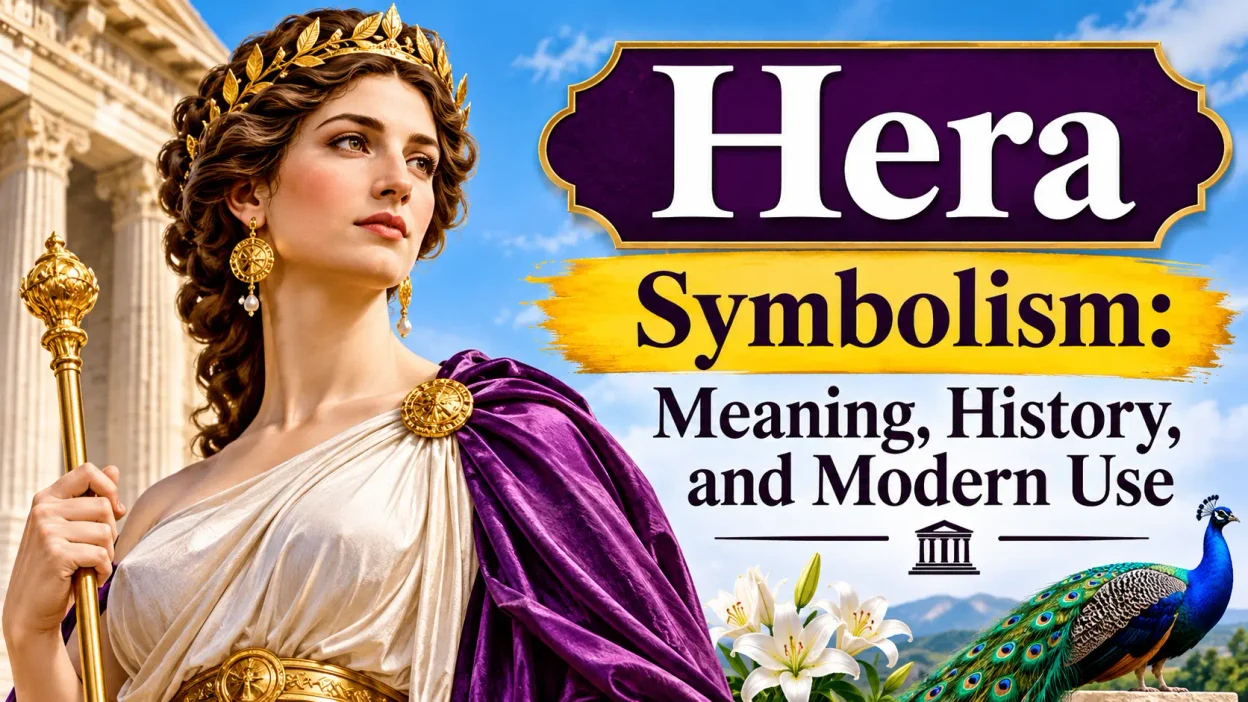
Hera is one of the most recognizable goddesses in Greek mythology, known as the queen of the Olympian gods and the wife of Zeus. Her name is associated with marriage, queenship, feminine authority, family protection, and the responsibilities that come with commitment. Hera symbolism reflects these ideas, but her stories also reveal jealousy, pride, betrayal, and the struggle to maintain dignity in difficult relationships.
In ancient Greek religion, Hera was more than the wife of the most powerful god. She had her own temples, worshippers, religious festivals, and responsibilities. Women and families sought her protection, particularly in matters involving marriage, childbirth, and important stages of life.
Today, Hera appears in classical artwork, literature, mythology-inspired tattoos, jewelry, fashion, and popular culture. American audiences often interpret her as a symbol of feminine strength, marital commitment, self-respect, and the complicated nature of power within relationships.
Understanding Hera requires looking beyond her reputation as a jealous wife. Her religious history and mythology present a goddess whose authority was respected even when her personal stories were filled with conflict.
Quick Answer
Hera symbolism commonly represents marriage, feminine authority, loyalty, queenship, and the protection of family in modern American culture. Historically, the Greek goddess also represented royal legitimacy, women’s life transitions, childbirth, fertility, and the sacred responsibilities of marriage.
TL;DR
- Hera represents marriage, commitment, and the responsibilities of partnership.
- Her crown and scepter symbolize queenship, authority, and dignity.
- The peacock represents beauty, pride, visibility, and royal status.
- Ancient Greeks worshipped Hera as a protector of women and families.
- Modern interpretations emphasize feminine strength, independence, and self-respect.
- Her mythology explores jealousy, betrayal, loyalty, and unequal relationships.
1. Who Is Hera in Greek Mythology?
Hera is the daughter of the Titans Cronus and Rhea. She is the sister and wife of Zeus, the ruler of Mount Olympus, and the queen of the Olympian gods. Her position places her among the highest-ranking figures in Greek mythology.
As queen of the gods, Hera possesses authority over the divine household and represents the social importance of marriage. She is also connected with women, family life, childbirth, and the legitimacy of royal families.
Her mythology is complicated because she frequently clashes with Zeus over his relationships with other women and the children born from those relationships. These conflicts are central to many famous Greek myths.
However, reducing Hera to an angry or jealous wife overlooks her independent religious importance. Ancient Greeks worshipped her in major sanctuaries, and her authority extended beyond her marriage to Zeus.
She represents a particular kind of power: the authority of a queen whose position carries public, religious, and social responsibilities.
2. The Core Symbolic Meaning of Hera
Hera carries several connected meanings. Some come from her position as Zeus’s wife, while others developed through her worship and the stories associated with her.
Marriage and commitment: Hera represents the seriousness of marriage and the expectations surrounding a lasting partnership. Her mythology also demonstrates how betrayal can damage those commitments.
Feminine authority: As queen of Olympus, she symbolizes a woman holding a position of influence and exercising authority in a male-dominated divine hierarchy.
Dignity and self-respect: Hera’s royal status makes her an emblem of personal dignity. Modern interpretations often connect her refusal to accept humiliation with the importance of maintaining one’s standards.
Family protection: Her ancient worship connected her with marriage, childbirth, and women’s lives, making her an important protective figure.
Pride and jealousy: Her stories reveal the destructive possibilities of wounded pride, possessiveness, and unresolved relationship conflict.
These meanings should be understood together. Hera is not simply a symbol of perfect marriage or ideal womanhood. She represents both the dignity associated with commitment and the emotional difficulties that can accompany it.
3. Ancient Greek Origins and the Worship of Hera
Hera’s importance goes back much further than many familiar versions of Greek mythology.
Her name appears in Mycenaean Greek records, suggesting that her worship existed before the classical period. Important religious centers dedicated to her developed at Argos, Samos, Olympia, and other locations.
One of her most famous sanctuaries was the Heraion near Argos, between Argos and Mycenae. The sanctuary at Samos was also especially important and became a major center of religious activity.
These places demonstrate that Hera was not merely a literary character created for entertaining stories. She was an established goddess with a substantial religious following.
Her worship included offerings, festivals, statues, and ceremonies connected with marriage and women’s lives. Some communities understood her authority through local traditions, which means her responsibilities could differ from one sanctuary to another.
This regional diversity matters because ancient Greek religion did not always assign every god one fixed role. Hera could be understood as a queen, protector, agricultural figure, or guardian of important life transitions depending on the community.
Her long religious history explains why her symbolism includes more than the stories of Zeus and his family. OUP Academic+2
4. Hera as the Goddess of Marriage and Commitment
Marriage is among Hera’s most established symbolic associations. As the wife of Zeus, she was connected with the institution of marriage and the expectations that accompanied it.
In ancient Greece, marriage was not understood only as a private romantic relationship. It also involved family alliances, inheritance, social standing, and the continuation of households.
Hera’s religious responsibilities reflected this wider importance. Women could turn to her during marriage-related transitions, while ceremonies and offerings recognized her connection with the marital bond.
Her mythology, however, creates an interesting contrast. Zeus repeatedly violates the expectations of fidelity, while Hera responds with anger and punishment.
This contrast gives her symbolism an additional dimension. She can represent the ideal of marital commitment while also illustrating what happens when one partner repeatedly disregards that commitment.
In modern American culture, Hera may therefore symbolize:
- Marriage built on mutual respect.
- Loyalty and relationship boundaries.
- The desire for emotional security.
- The importance of honoring commitments.
- The difficulty of maintaining a partnership after betrayal.
Her symbolism is particularly relevant to people who view marriage as a serious promise rather than simply a romantic celebration.
5. Hera as a Symbol of Feminine Authority and Queenship
Hera’s royal identity is essential to understanding her symbolism. She is not simply associated with Zeus because of marriage; she holds a recognized position within the Olympian hierarchy.
Her crown, throne, and scepter communicate authority. These objects distinguish her from ordinary figures in mythology and establish her as a ruler with status and influence.
The symbolism of queenship includes:
- Leadership and responsibility.
- Social recognition and legitimacy.
- Confidence and self-respect.
- Protection of a household or community.
- The ability to exercise influence.
For modern American audiences, Hera can represent feminine leadership without relying on traditionally masculine images of power.
Her authority is also different from the independence associated with goddesses such as Athena or Artemis. Hera’s identity is closely connected with marriage, family, and royal responsibility, yet she remains a powerful divine figure in her own right.
This makes her an interesting symbol for discussions of women who hold authority while navigating personal and social expectations.
Her story also raises questions about how power operates within relationships and institutions, especially when public status does not guarantee private happiness.
6. Hera’s Symbols and Their Meanings
Hera is associated with several recognizable objects and animals. These symbols developed through ancient artwork, religious traditions, and descriptions of her statues.
| Symbol | Meaning | Common Associations | Notes |
|---|---|---|---|
| Peacock | Beauty, pride, royalty | Dignity and visibility | One of her best-known attributes |
| Pomegranate | Fertility and marriage | Family and abundance | Appears in descriptions of ancient Hera statues |
| Crown | Queenship and authority | Leadership and status | Reflects her position among the gods |
| Scepter | Divine power | Control and legitimacy | An important royal attribute |
| Cow | Fertility and protection | Motherhood and nourishment | An animal associated with Hera |
| Veil | Marriage and womanhood | Commitment and transition | Connects her with bridal imagery |
The meaning of individual symbols can vary according to their historical or artistic context.
The Peacock
The peacock is probably Hera’s most recognizable animal symbol. Its elaborate feathers, impressive appearance, and distinctive eye-like markings make it a natural visual expression of royal beauty and visibility.
In modern symbolic interpretations, the peacock can represent pride, confidence, dignity, and the desire to be recognized.
Its association with Hera also makes it useful in mythology-inspired artwork and decorative designs.
The Pomegranate
The pomegranate has long been associated with fertility, abundance, and marriage in ancient Mediterranean traditions.
It appears in descriptions of a famous statue of Hera at Argos, where the goddess held a pomegranate alongside a royal scepter.
Its connection with Hera reflects her relationship with family life, fertility, and the continuity of marriage.
The Crown and Scepter
The crown represents her status as queen of the gods, while the scepter communicates authority and legitimate power.
Together, they create a visual language of leadership, dignity, and royal responsibility.
The Cow
The cow was another animal associated with Hera in ancient Greek tradition. It could represent fertility, nourishment, motherhood, and the protection of living communities.
These associations connect Hera with the productive and protective aspects of nature, not only with marriage and royalty. ΥΣΜΑ+2
7. Hera’s Role in Motherhood, Childbirth, and Fertility
Hera’s connection with motherhood is sometimes overlooked because many popular retellings concentrate on her conflicts with Zeus.
In ancient Greek religious practice, however, she was associated with women’s lives, marriage, fertility, and childbirth. These responsibilities made her relevant to families beyond the royal household of Olympus.
Her children included Ares, Hebe, and Eileithyia in important mythological traditions. Eileithyia was associated with childbirth, and ancient accounts sometimes described her as Hera’s daughter.
Hera’s connection with fertility was not limited to the birth of children. It also reflected the continuation of family lines, the stability of households, and the social importance of legitimate descendants.
In American interpretations, this aspect of Hera can represent:
- The protection of mothers and families.
- The transition into parenthood.
- Fertility and the continuation of generations.
- The responsibilities associated with raising children.
- Respect for women’s experiences during major life changes.
It is important not to confuse Hera’s historical associations with a requirement that women marry or become mothers. Her symbolism can be appreciated as part of ancient religious history without treating traditional family roles as universal expectations.
8. Hera and Her Complicated Relationship With Zeus
Hera’s relationship with Zeus is one of the most important sources of conflict in Greek mythology.
Although their marriage establishes her position as queen of the gods, Zeus repeatedly pursues relationships with mortal women and other goddesses. Many myths describe Hera responding by confronting or punishing the women involved and, in some stories, their children.
The story of Heracles is a particularly familiar example. Heracles was born from Zeus’s relationship with Alcmene, and Hera became one of his greatest obstacles. In some versions, she sent serpents to attack him while he was an infant.
Her hostility toward Leto and her children, Apollo and Artemis, provides another example of the conflicts surrounding Zeus’s relationships.
These stories can make Hera appear cruel. However, they also reflect the unequal expectations within the divine marriage. Zeus repeatedly breaks marital boundaries while Hera is expected to maintain the dignity and stability of the household.
Modern readers may interpret this relationship through several perspectives:
Betrayal: Hera’s stories demonstrate the emotional consequences of repeated dishonesty.
Possessiveness: Her reactions sometimes illustrate how jealousy can become destructive.
Unequal power: Her position as queen does not give her complete control over her marriage.
Self-respect: Her refusal to quietly accept every humiliation can be interpreted as an assertion of personal dignity.
These interpretations do not excuse every action Hera takes in mythology. Instead, they help explain why her character remains open to different readings.
9. Hera’s Meaning in Roman Culture: The Connection With Juno
When Greek mythology influenced Roman religion and literature, Hera became closely identified with the Roman goddess Juno.
The two goddesses share important associations with marriage, women, childbirth, and divine authority. However, Juno developed her own religious identity within Roman society.
Juno was an important protector of the Roman state and was worshipped under several titles. Her responsibilities included matters of marriage, women’s lives, and the security of the community.
This distinction is important. Hera and Juno are closely related through the ancient process of cultural identification, but they should not be treated as completely interchangeable in every religious context.
For modern readers, the connection adds another historical layer to Hera’s symbolism. Her influence extends beyond Greek stories into Roman ideas about marriage, public authority, and the protection of civic life.
It also explains why classical artwork and older books sometimes identify Hera by the name Juno.
10. Hera Symbolism in American Culture
Hera does not have the same everyday cultural presence as figures from Christianity, American national history, or contemporary popular culture. Most Americans encounter her through Greek mythology, classical education, literature, museums, films, and mythology-inspired entertainment.
Nevertheless, her image has several recognizable meanings in the United States.
Feminine leadership: Her position as queen makes her a recognizable figure for discussions of women’s authority and leadership.
Marriage and commitment: Her association with marriage connects her with wedding imagery, relationship discussions, and traditional ideas about partnership.
Confidence and self-respect: Her royal appearance and refusal to surrender her status make her an emblem of dignity.
Complex relationships: Her mythology provides material for conversations about infidelity, jealousy, boundaries, and unequal relationships.
Classical beauty: Her crown, veil, and peacock frequently appear in artistic interpretations of ancient Greek culture.
Unlike symbols associated with American national holidays, Hera does not have a widely established place in mainstream U.S. celebrations. Her cultural presence is primarily educational, artistic, literary, and personal.
She is particularly interesting to contemporary audiences because her stories can be examined from both historical and modern perspectives.
11. The Emotional and Psychological Meaning of Hera
Hera’s character represents emotional experiences that many people recognize, even when they have never studied Greek mythology.
Her stories involve love, disappointment, betrayal, pride, competition, and the desire to be respected.
From a psychological perspective, Hera can symbolize the tension between personal identity and relationship identity.
She is a queen in her own right, but much of her mythology revolves around her marriage. This creates an interesting question: how does someone maintain an independent sense of worth when their personal relationships repeatedly challenge it?
Her symbolism can reflect several emotional experiences.
- Feeling undervalued: Hera’s conflicts can represent the frustration of being overlooked or disrespected.
- Protecting personal boundaries: Her reactions can prompt reflection on the importance of recognizing unacceptable behavior.
- Pride and dignity: Her royal identity suggests the desire to preserve self-respect.
- Emotional insecurity: Her jealousy illustrates how fear of losing a relationship can influence behavior.
- Resilience: Her continued presence in mythology represents endurance despite repeated conflict.
Hera is not a psychological diagnosis or a universal personality type. These are modern interpretive connections rather than claims made by ancient Greek religious traditions.
Her character is useful precisely because it allows readers to examine both healthy and unhealthy responses to difficult relationships.
12. Hera in Art, Literature, and Popular Culture
Artists have represented Hera for centuries, usually emphasizing her mature beauty, royal appearance, and commanding presence.
In ancient Greek sculpture, she was commonly depicted as a dignified woman wearing a crown or elaborate headdress. Some representations show her seated on a throne, reinforcing her position as queen.
Later European artists continued to use Hera and her Roman counterpart Juno in paintings about divine marriage, royal authority, and classical mythology.
In literature, Hera appears in several important works:
- The Iliad: Homer presents Hera as an influential goddess involved in the Trojan War and the conflicts among the Olympians.
- The Odyssey: She belongs to the wider divine world surrounding the adventures of Odysseus.
- The Aeneid: The Roman goddess Juno plays a major role in opposing Aeneas.
- Classical mythology retellings: Modern writers often explore Hera’s perspective and reconsider her reputation as a jealous wife.
Contemporary entertainment has also introduced her to American audiences through mythology-inspired books, television, animation, games, and films.
These portrayals are not always historically accurate. Some emphasize her anger, others highlight her authority, and some reinterpret her as a misunderstood figure navigating an unfair marriage.
The difference between artistic interpretation and ancient religious tradition is worth remembering. A modern fictional portrayal does not necessarily represent how ancient Greeks understood or worshipped Hera.
13. Hera Tattoos, Jewelry, and Personal Style
Hera-inspired designs can appeal to people who appreciate Greek mythology, classical art, feminine authority, or the symbolism of marriage.
Unlike a generic goddess illustration, a Hera design can communicate a combination of personal values and mythological interests.
Popular design choices include:
Hera portrait tattoos: A classical portrait of the goddess can represent dignity, authority, and an appreciation for ancient mythology.
Peacock tattoos: A peacock or its feathers can represent pride, beauty, confidence, and royal identity.
Crown and scepter designs: These objects emphasize leadership, status, and self-respect.
Pomegranate imagery: This design can represent fertility, abundance, marriage, or family continuity.
Greek-inspired jewelry: Necklaces, rings, pendants, and earrings featuring peacocks or classical crowns can express an interest in mythology and traditional artistry.
The intended meaning depends on the person wearing the design. Someone might choose Hera because of her connection with marriage, while another person may identify with her position as a powerful goddess.
A tattoo does not have to represent every aspect of the original mythology. Personal symbolism can focus on one particular quality, story, or visual attribute.
14. Misunderstandings and the Evolution of Hera’s Symbolism
Hera’s reputation has changed considerably as mythology has been retold across different periods.
One common misunderstanding is that she was simply the goddess of jealousy. This interpretation comes largely from stories about her reactions to Zeus’s relationships.
Although jealousy is a recurring feature of her mythology, it is not an adequate description of her religious identity. Her ancient worship included marriage, fertility, women’s life transitions, royal authority, and community protection.
Another misunderstanding is that Hera represents an ideal marriage. Her relationship with Zeus is frequently troubled, and the myths do not present their partnership as a model of mutual faithfulness.
Her symbolism has also been simplified in some modern interpretations that describe her only as an angry wife or a symbol of feminine revenge.
A more balanced interpretation recognizes several historical and contemporary dimensions:
| Period or Context | Main Interpretation | Important Distinction |
|---|---|---|
| Mycenaean Greece | Established divine figure | Her worship predates classical mythology |
| Ancient Greek religion | Marriage and royal protection | Her responsibilities varied by location |
| Roman religion | Connection with Juno | Juno had distinct civic responsibilities |
| European classical art | Queenship and idealized beauty | Artistic representations vary |
| Modern American culture | Feminine authority and self-respect | Often interpreted through contemporary values |
Her meaning has not developed in one straight line. Ancient worshippers, classical writers, Roman religious communities, European artists, and modern American audiences have each emphasized different aspects of her identity.
That evolution is why Hera remains a complicated figure rather than a symbol with one universally accepted definition. OUP Academic+3
Frequently Asked Questions
1. What does Hera symbolize spiritually?
Hera is commonly associated with marriage, loyalty, feminine authority, family protection, and personal dignity. In spiritual interpretations inspired by Greek mythology, she can represent commitment, relationship boundaries, and the responsibilities that accompany love.
2. What does a Hera tattoo mean?
A Hera tattoo can symbolize feminine strength, queenship, self-respect, marriage, or devotion to personal values. Designs featuring peacocks, crowns, and pomegranates emphasize different aspects of her mythology.
3. Why is the peacock associated with Hera?
The peacock is one of Hera’s traditional sacred animals and a recognizable attribute in classical representations. Its elaborate feathers have made it an enduring visual association with beauty, pride, and royal status.
4. Is Hera a positive or negative symbol?
Hera can represent positive qualities such as commitment, leadership, dignity, and protection. However, her mythology also explores jealousy, possessiveness, anger, and revenge, making her a complex rather than exclusively positive symbol.
5. What does Hera represent in marriage?
Hera represents the sacred and social responsibilities associated with marriage, including loyalty, commitment, and family stability. Her troubled relationship with Zeus also illustrates the consequences of infidelity and broken promises.
6. What is the difference between Hera and Juno?
Hera is the Greek queen of the gods, while Juno is her Roman counterpart. They share associations with marriage, women, and divine authority, but Juno also held important responsibilities connected with the Roman state and civic protection.
7. What are Hera’s most important symbols?
Her best-known symbols include the peacock, pomegranate, crown, scepter, cow, and bridal veil. Together, these objects communicate beauty, fertility, marriage, queenship, and feminine authority.
Conclusion
Hera represents marriage, queenship, feminine authority, family protection, and personal dignity. Her mythology also explores jealousy, betrayal, pride, and the emotional difficulties that can arise when relationships fail to meet expectations.
Understanding Hera symbolism means looking beyond her reputation as Zeus’s jealous wife. Her ancient worship reveals a respected goddess with important responsibilities in Greek religious life, while her modern interpretations offer ways to explore leadership, commitment, independence, and self-respect.
Whether encountered in classical sculpture, mythology-inspired jewelry, literature, or tattoos, Hera remains a compelling figure because her stories acknowledge an important reality: authority and dignity do not make someone immune to emotional conflict.