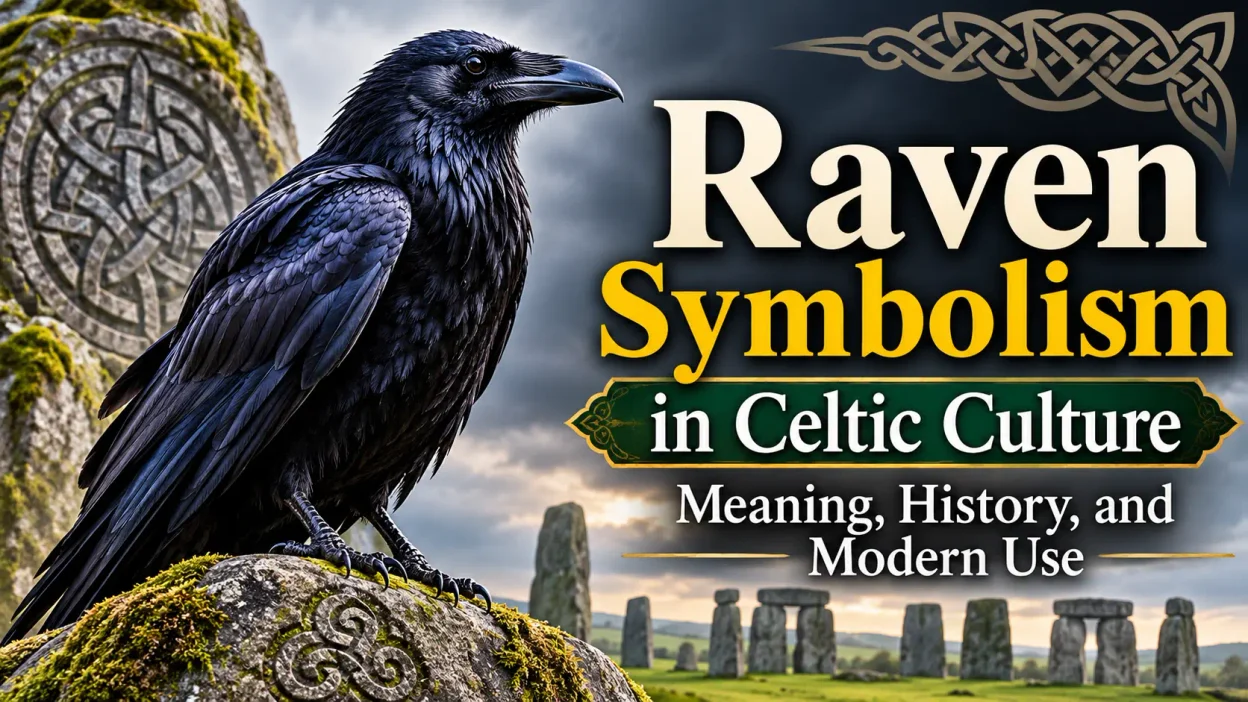
Ravens hold an important place in Celtic mythology, particularly in the stories of ancient Ireland and Wales. Their dark feathers, powerful calls, intelligence, and habit of gathering around battlefields made them memorable birds in the natural world. Over time, these characteristics became connected with prophecy, warfare, death, protection, and communication with the supernatural.
In Celtic storytelling, the raven was rarely just an ordinary bird. It could appear as a messenger, an omen of approaching danger, or the animal form of a supernatural figure. Irish traditions especially connect ravens and crows with the Morrígan, a formidable goddess associated with war, fate, and sovereignty. Welsh mythology offers another important connection through Brân the Blessed, whose name is associated with the raven.
Today, raven symbolism in Celtic culture continues to interest people exploring mythology, folklore, spiritual traditions, tattoos, and ancestral heritage. Understanding its original context reveals a more complicated picture than simply treating the raven as a symbol of death or bad luck.
Quick Answer
Raven symbolism in Celtic culture commonly represents prophecy, protection, intelligence, transformation, and the connection between life and death. Historically, Irish mythology associated ravens with the Morrígan and the violence of battle, while Welsh tradition connected the bird with Brân the Blessed, a legendary guardian associated with protection and prophetic wisdom.
TL;DR
- Ravens represented prophecy, fate, and messages from the supernatural.
- Irish mythology connected them with the war goddess Morrígan.
- Welsh mythology associated them with Brân the Blessed.
- Their battlefield presence linked them with death and transformation.
- Modern Americans use Celtic ravens to express heritage, independence, and mystery.
- Raven tattoos often represent wisdom, resilience, protection, and personal change.
1. What Makes the Raven Important in Celtic Tradition?
The raven is a large black bird belonging to the crow family. It has a heavy bill, shaggy throat feathers, strong wings, and a distinctive call. Ravens are also highly intelligent, capable of solving problems, remembering individuals, and adapting to different environments.
These characteristics help explain why ravens attracted attention in ancient Celtic communities. They were familiar birds in the landscapes of Ireland, Scotland, Wales, and parts of continental Europe. Their ability to survive in varied environments made them noticeable, while their habit of feeding on animal remains brought them into contact with battlefields and places associated with death.
The raven’s symbolic importance developed through a combination of natural observation, religious imagination, and storytelling.
It is also important to understand that Celtic culture was not a single, uniform belief system. Irish, Welsh, Scottish, and continental Celtic traditions developed different stories and interpretations. Their raven symbolism overlaps, but the details are not always interchangeable.
2. The Morrígan: Ireland’s Raven-Associated War Goddess
One of the strongest connections between ravens and Celtic mythology comes from the Irish goddess known as the Morrígan.
The Morrígan is associated with warfare, fate, death, and sovereignty. Medieval Irish stories portray her as a supernatural figure who can influence battles, confront warriors, and appear in different forms.
She is particularly connected with ravens and crows. In some stories, she takes the appearance of a dark bird, allowing her to observe events and interact with warriors without appearing in human form.
Her connection with the hero Cú Chulainn is especially significant. In the stories surrounding his final battle and death, a bird associated with the Morrígan appears on or near his body. This image connects the bird with the arrival of death and the supernatural forces surrounding a warrior’s fate.
The Morrígan’s relationship with ravens is not simply about destruction. She also represents the unpredictable forces that determine the outcome of conflict. Her appearance can signal that a decisive moment has arrived, even when the people involved cannot fully understand what is coming.
For this reason, the raven became associated with battle, warning, fate, and supernatural authority in Irish storytelling.
3. Badb and the Symbolism of the Battle Raven
Another important figure is Badb. Her name is closely associated with crows and ravens, and she is sometimes described through the title Badb Catha, commonly translated as Battle Crow or Battle Raven.
Badb belongs to the complex group of supernatural female figures associated with the Morrígan. Medieval Irish literature does not always present these figures in a consistent way. They can appear as individual personalities, related goddesses, or overlapping aspects of a larger supernatural presence.
The battle raven represents the frightening atmosphere surrounding armed conflict. Its appearance suggests that death is close, while its cries can function as warnings of approaching disaster.
Badb’s symbolism also communicates the idea that war has consequences beyond the battlefield. Victory, defeat, death, and political power are connected in a larger pattern of fate.
For modern readers, the Battle Raven can represent courage in difficult circumstances, awareness of danger, and the willingness to confront uncomfortable truths.
4. Brân the Blessed and the Raven as a Guardian
Welsh mythology offers a different interpretation through Brân the Blessed. His Welsh name, Bendigeidfran, is commonly translated as Blessed Raven.
Brân appears in the Second Branch of the Mabinogi. He is portrayed as a giant king associated with Britain, and his story includes war, sacrifice, death, and the protection of his people.
After receiving a mortal wound during a conflict in Ireland, Brân instructs his companions to remove his head and carry it back to Britain. In the traditional account, the head continues to speak and provide companionship and guidance during the journey.
Eventually, it is buried at a location associated with London, facing toward France. The story gives Brân an unusual relationship with death: although his body has died, his head continues to protect and guide others.
This legend adds another dimension to raven symbolism. Rather than representing only battlefield destruction, the raven can also suggest guardianship, continuity, wisdom, and protection beyond physical death.
Brân is particularly important when comparing Welsh raven traditions with the Irish stories of the Morrígan. Both connect the bird with death, but Brân’s story places greater emphasis on guardianship and the continuation of responsibility.
5. Ravens, Prophecy, and Messages from the Otherworld
Prophecy is one of the most recognizable meanings associated with ravens in Celtic folklore. Their calls, movements, and unexpected appearances could be interpreted as signs of events that had not yet happened.
In ancient Irish tradition, divination was an important part of supernatural storytelling. Some accounts connect Druids with augury, the practice of interpreting the movements or behavior of birds to gain insight into future events.
Ravens were particularly suitable for this role because of their distinctive voices and association with battlefields. Their calls could sound unsettling to people unfamiliar with the bird’s behavior, making them natural figures in stories about warnings and predictions.
The raven’s prophetic role did not always mean that something terrible would happen. A warning could give a person time to recognize danger, prepare for conflict, or change a decision.
This distinction matters because modern interpretations sometimes reduce Celtic raven symbolism to bad omens. In traditional stories, however, knowing about danger could also be a form of protection.
The raven therefore represents awareness of what may be coming, especially when the future is uncertain.
6. Death, the Afterlife, and the Boundary Between Worlds
Ravens became associated with death partly because of their natural behavior. They are scavengers and may gather where animals or people have died. In societies where warfare was a recurring reality, seeing ravens around battlefields would have been familiar.
Irish mythological stories developed this observation into a supernatural association. The Morrígan and Badb could appear in bird form around moments of death, connecting ravens with the transition between life and mortality.
However, the raven’s association with death should not automatically be understood as a symbol of evil.
Death in Celtic mythology could represent several things:
- The end of a person’s earthly life.
- The consequences of warfare and political conflict.
- A transition into the Otherworld.
- The fulfillment of a prophecy or destiny.
- The transformation of an individual’s place in the world.
The Otherworld is a recurring feature of Irish and Welsh mythology. It is not simply equivalent to the Christian concept of heaven or hell. Depending on the story, it can be a supernatural realm associated with extraordinary beings, magical experiences, and encounters beyond ordinary human existence.
The raven’s presence near this boundary makes it an effective symbol of transition. It represents the possibility that the visible world is not the only reality described in traditional Celtic stories.
7. The Raven as a Symbol of Intelligence and Wisdom
Although Celtic raven stories frequently involve war and death, intelligence is another meaningful modern interpretation of the bird.
Ravens demonstrate remarkable problem-solving abilities. They can remember locations, recognize familiar individuals, and adapt their behavior when circumstances change. These natural characteristics make them suitable symbols of observation and strategic thinking.
In mythology, a bird that watches events from above can occupy a position between ordinary characters and supernatural knowledge. It sees what people on the ground may overlook.
This quality helps explain why ravens work so well as prophetic figures. Their symbolism involves more than predicting the future; it also suggests recognizing patterns, understanding consequences, and paying attention to details.
For modern Americans interested in Celtic-inspired symbolism, a raven can represent:
- Independent thinking.
- Curiosity and intellectual ability.
- Strategic decision-making.
- Awareness of hidden information.
- Learning through difficult experiences.
It is worth distinguishing this interpretation from the famous ravens of Norse mythology. Odin’s Huginn and Muninn are directly associated with thought and memory. They are Norse figures, not evidence that every Celtic raven traditionally represented the same qualities.
8. Protection, Sovereignty, and the Defense of a Homeland
Protection is particularly relevant to the Welsh tradition surrounding Brân the Blessed.
His story connects the raven with kingship, responsibility, and the defense of a community. Brân is not simply a supernatural figure associated with death. His continuing presence after his physical death suggests that his responsibility toward his people has not ended.
This idea creates a connection between raven symbolism and sovereignty.
In ancient Irish mythology, sovereignty often involved the legitimate relationship between a ruler, the land, and the well-being of the people. The Morrígan’s association with kingship and battle places her within this broader world of political and supernatural authority.
The raven can therefore represent the difficult responsibilities that come with power.
In modern interpretations, people sometimes choose Celtic raven imagery to express loyalty to family, protection of their home, or a connection with ancestral places. These meanings are contemporary interpretations inspired by traditional stories rather than universal historical beliefs.
The protective raven is especially meaningful for someone who sees strength as the ability to remain watchful and defend what matters.
9. Raven Symbolism in Irish, Welsh, and Scottish Traditions
Although these traditions share some cultural connections, their raven stories should not be treated as identical.
| Celtic tradition | Raven association | Common symbolic interpretation | Important figure |
|---|---|---|---|
| Irish | War, prophecy, fate, death | Warning and supernatural knowledge | Morrígan and Badb |
| Welsh | Kingship, protection, continuity | Guardianship and guidance | Brân the Blessed |
| Scottish Gaelic | Folklore, omens, and supernatural birds | Warning and awareness | Regional bird traditions |
| Continental Celtic | Bird imagery associated with native deities | Religious and supernatural connections | Regional divine figures |
Irish traditions: Irish mythology provides some of the clearest literary connections between ravens, crows, warfare, and prophecy. The Morrígan and Badb are central examples.
Welsh traditions: The story of Brân the Blessed offers a distinctive connection between ravens, kingship, protection, and the continuation of a guardian’s influence after death.
Scottish traditions: Gaelic folklore includes beliefs about birds as omens and supernatural signs. However, local traditions vary, and not every belief about crows or ravens can be assigned to an ancient Celtic religious system.
Continental Celtic traditions: Archaeological and historical evidence from ancient Gaul and other Celtic-speaking regions shows that birds appeared in religious imagery. Their exact meanings are not always clear, so interpretations should be made cautiously.
These differences demonstrate why the phrase Celtic raven symbolism covers several related traditions rather than one fixed religious meaning.
10. What the Raven’s Black Color Represents
The raven’s black feathers contribute significantly to its modern symbolic appeal.
In American visual culture, black is frequently associated with mystery, mourning, seriousness, authority, elegance, and the unknown. These associations influence how people interpret black birds in art, clothing, tattoos, and decorative objects.
In Celtic-inspired artwork, the raven’s dark appearance often emphasizes its connection with the supernatural world.
However, black should not automatically be interpreted as evil. Its meaning depends on the context in which the raven appears.
For example, a black raven standing beside a battlefield may communicate death and conflict. The same bird watching over a stone fortress may suggest protection and vigilance.
Its glossy feathers also have a subtle visual quality that artists can use to communicate intelligence, beauty, and strength.
The color adds atmosphere to the symbol, but the stories and cultural setting provide its more specific meaning.
11. Raven Symbolism in Modern American Culture
In the United States, Celtic raven imagery appears in mythology-inspired artwork, fantasy literature, jewelry, tattoos, historical reenactments, and alternative spiritual communities.
Many Americans encounter the raven through Irish heritage celebrations, Welsh cultural organizations, Celtic festivals, and popular representations of ancient European mythology.
The bird can communicate several different ideas depending on the person using it.
For someone interested in Irish ancestry, a raven associated with the Morrígan may represent an interest in traditional mythology, female supernatural power, and the history of Ireland.
For someone drawn to Welsh stories, Brân the Blessed may provide a symbol of guardianship, homeland, and loyalty.
Others may choose the raven because it represents independence, intelligence, or comfort with subjects that are often considered dark or difficult.
The raven also appears frequently in modern fantasy and gothic aesthetics. Its association with ancient ruins, supernatural characters, and forgotten kingdoms makes it visually effective in storytelling.
However, contemporary American interpretations should not be confused with historical Celtic religious practices. A person wearing a raven pendant today may be expressing personal identity rather than following a specific ancient tradition.
12. Why People Choose Celtic Raven Tattoos
Celtic raven tattoos combine the bird’s natural appearance with the visual language of traditional Celtic-inspired artwork.
The raven itself can represent intelligence, independence, protection, prophecy, or an acceptance of life’s difficult experiences. Celtic knotwork adds another layer of visual meaning, often suggesting continuity, interconnectedness, or an interest in Celtic artistic heritage.
Some popular designs include:
- Raven with Celtic knots: Represents a connection between the bird and Celtic-inspired heritage.
- Raven with the Morrígan: Expresses an interest in Irish mythology, fate, and supernatural female power.
- Raven with a sword: Connects the bird with warfare, courage, and the Battle Raven tradition.
- Raven with a skull: Combines mortality, remembrance, and transformation.
- Raven on a branch: Suggests observation, patience, and awareness.
- Raven with a triskelion: Combines a modern Celtic-inspired design with themes of movement and continuity.
A tattoo featuring the Morrígan should be understood as a specific mythological reference, not simply a generic raven design. Similarly, a tattoo of Brân the Blessed communicates a different story from one inspired by the Irish war goddesses.
For many Americans, these designs are ways to express personal values while showing appreciation for Celtic folklore.
13. Common Misunderstandings About Celtic Raven Symbolism
Raven symbolism is sometimes misunderstood because modern interpretations combine different mythologies, spiritual beliefs, and popular culture.
Several distinctions are worth remembering.
Ravens and crows are not always interchangeable. They are related birds, but they are different species. Medieval Irish literature and later interpretations do not always distinguish clearly between them. Consequently, some mythological figures associated with crows are also described as raven figures in modern retellings.
The Morrígan is not simply a raven goddess. She is a complex figure associated with war, fate, sovereignty, and supernatural power. Her bird form is one aspect of her mythology, not her entire identity.
Brân and the Morrígan belong to different traditions. Brân is a Welsh mythological figure, while the Morrígan belongs to Irish mythology. Both are associated with ravens or related birds, but their stories should not be combined into a single ancient legend.
A raven does not always predict death. Although battlefield stories frequently connect the bird with mortality, other interpretations involve warning, protection, observation, and knowledge.
Another common misunderstanding comes from modern claims that every Celtic symbol has one universal spiritual meaning. Ancient communities had regional traditions, different religious practices, and stories that changed through oral and written transmission.
Recognizing these differences makes the symbolism more meaningful rather than less interesting.
14. Emotional and Psychological Meaning of the Celtic Raven
The raven often appeals to people who identify with independence, observation, and resilience.
Unlike symbols that communicate innocence or gentleness, the raven has a more complicated visual personality. It can appear threatening, intelligent, watchful, or strangely beautiful. This combination makes it suitable for expressing feelings that are difficult to communicate through simpler imagery.
Its association with prophecy can appeal to someone who values intuition and careful observation. Its connection with the Morrígan may attract people interested in strength, personal authority, and confronting difficult situations.
The Welsh association with Brân can carry a different emotional message. It may represent loyalty, responsibility, and the desire to protect people or places that hold personal importance.
For someone experiencing grief, the raven can also become a personal symbol of remembrance. Its connection with mortality may help express an awareness of loss without necessarily suggesting fear or despair.
These psychological meanings are personal interpretations, not scientifically established effects of the bird. A raven does not automatically communicate the same emotions to everyone. Its meaning depends on individual experiences, cultural background, and the stories a person associates with it.
15. How Celtic Raven Symbolism Has Changed Over Time
The raven’s meaning has developed through centuries of storytelling, religious change, artistic interpretation, and modern popular culture.
In early Celtic societies, birds were part of the natural environment and could also appear in religious practices and supernatural beliefs. Their behavior offered material for interpreting signs, particularly in stories involving warfare and the future.
Medieval Irish literature preserved important traditions involving the Morrígan, Badb, and Cú Chulainn. Welsh literature preserved the story of Brân, whose severed head continued to speak after death.
As these stories were copied, translated, and retold, their interpretations changed. Later Christian traditions, medieval folklore, and regional beliefs sometimes gave dark birds additional associations with death, danger, or supernatural activity.
During the nineteenth and twentieth centuries, renewed interest in Celtic literature, folklore, and heritage helped bring these figures to wider audiences. Modern fantasy, illustration, and historical fiction introduced new generations to raven-associated characters.
In contemporary American culture, the raven has become a flexible symbol. Some people emphasize its historical connection with Irish or Welsh mythology, while others use it to express independence, intelligence, protection, or personal transformation.
The original stories remain important, but modern meanings are not limited to the interpretations found in medieval texts.
Frequently Asked Questions
1. What does a raven symbolize in Celtic mythology?
A raven commonly symbolizes prophecy, warfare, death, fate, and supernatural knowledge in Celtic mythology. Its association with the Morrígan and Badb is especially strong in medieval Irish stories.
2. Is the raven associated with the Morrígan?
Yes. The Morrígan is associated with ravens and crows and can appear in bird form in Irish mythological stories. Her connection with these birds reflects her role in warfare, fate, and the deaths of warriors.
3. What does Brân the Blessed represent?
Brân the Blessed represents guardianship, kingship, protection, and continuity in Welsh mythology. His story is particularly notable because his severed head continues to speak and guide his companions after his death.
4. Is a raven a good or bad omen in Celtic culture?
The raven can represent both warning and protection, depending on the story. Its association with battle and death gives it ominous qualities, but its prophetic role can also provide valuable knowledge about approaching danger.
5. What does a Celtic raven tattoo mean?
A Celtic raven tattoo commonly represents intelligence, independence, protection, prophecy, or transformation. Designs featuring the Morrígan or Brân can also communicate a specific interest in Irish or Welsh mythology.
6. Are ravens and crows the same in Celtic mythology?
No. Ravens and crows are different birds, although historical Celtic stories and later interpretations sometimes use their identities interchangeably. This overlap is especially noticeable in stories about the Morrígan and Badb.
7. Does the raven symbolize the Otherworld in Celtic tradition?
The raven is associated with supernatural events and figures connected with the Otherworld in some Celtic stories. Its appearances around death and prophecy make it a natural symbolic link between ordinary human experiences and the supernatural world.
Conclusion
Ravens occupy an important place in Celtic mythology because they connect the natural world with stories about prophecy, warfare, death, protection, and supernatural authority. Irish traditions associate them particularly with the Morrígan and Badb, while Welsh mythology offers a different perspective through Brân the Blessed and his role as a guardian.
Today, raven symbolism in Celtic culture has expanded beyond its original mythological settings. Americans use Celtic-inspired raven imagery to express intelligence, independence, ancestral interest, resilience, and an appreciation for traditional folklore.
The most meaningful interpretation depends on the story behind the image. A raven associated with the Morrígan communicates something different from one representing Brân the Blessed, and both offer more than a simple association with darkness or death.
[…] olive wreath carries several meanings that developed through different historical and cultural […]
[…] continuity of royal institutions. Their elaborate beadwork, faces, and bird imagery carry specific cultural meanings rather than serving merely as decoration. National Museum of African […]
[…] In the United States, eye imagery has acquired several overlapping cultural meanings. […]