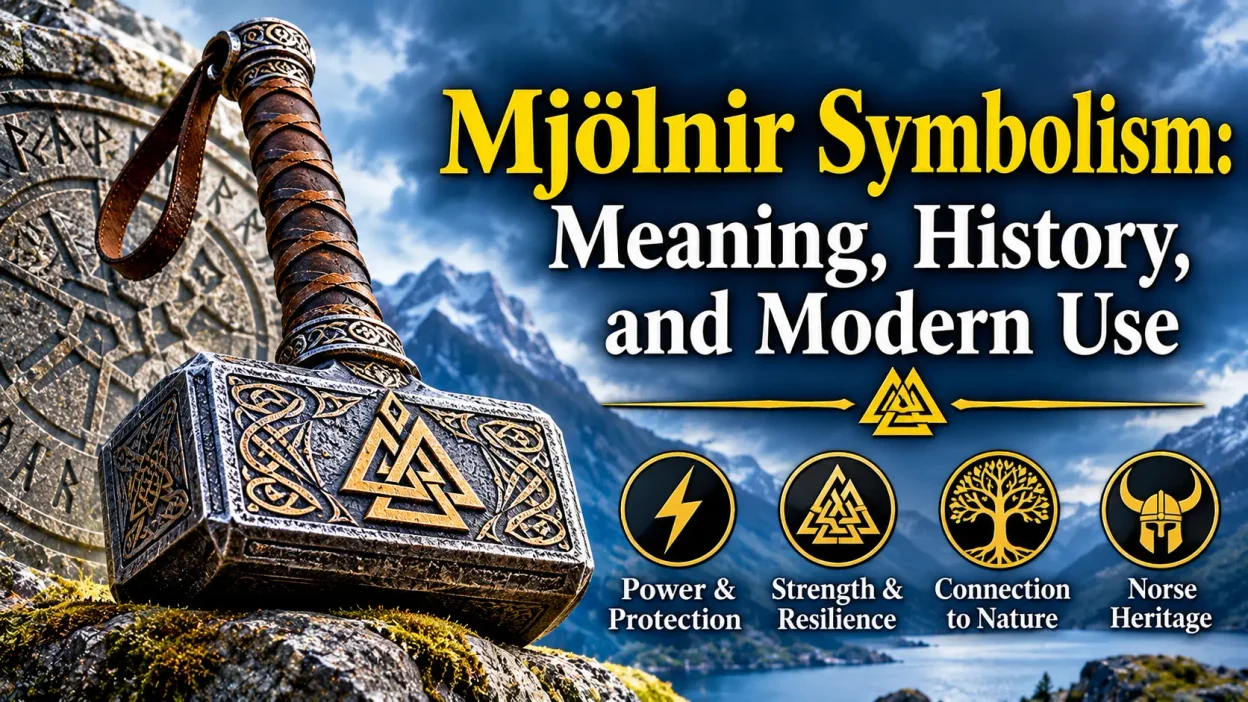
Mjölnir, the legendary hammer of Thor, is one of the most recognizable symbols from Norse mythology. Its symbolism connects to protection, strength, courage, justice, and the defense of others. Today, Mjölnir symbolism appears in American jewelry, tattoos, Norse-inspired fashion, religious practices, and popular entertainment, where it can communicate both ancient heritage and personal identity.
For the Vikings, Thor’s hammer was more than a weapon belonging to a thunder god. It represented the ability to confront destructive forces, protect communities, and maintain order in a world shaped by powerful natural elements. Archaeological discoveries of miniature hammer pendants show that people also carried this image as a personal religious object.
In modern America, the symbol has taken on additional meanings. Some people recognize it through Marvel’s Thor, while others wear it to express an interest in Scandinavian history, Norse paganism, ancestral traditions, or personal resilience. Understanding these different interpretations helps explain why an ancient hammer remains culturally relevant.
Quick Answer
Mjölnir commonly symbolizes protection, strength, courage, and the defense of others in modern American culture, especially through Norse-inspired jewelry, tattoos, and popular culture. Historically, Thor’s hammer represented divine authority, protection, fertility, and the power to overcome destructive forces in Norse religious traditions.
TL;DR
- Mjölnir is Thor’s hammer and a central symbol of Norse mythology.
- Its traditional meanings include protection, strength, fertility, and divine authority.
- Viking Age communities wore miniature hammer pendants as religious amulets.
- Modern Americans associate it with Norse heritage and personal resilience.
- Marvel’s Thor has made the hammer recognizable across popular culture.
- Some extremist groups have appropriated the symbol, but it is not inherently hateful.
1. What Mjölnir Looks Like and What It Represents
Mjölnir is traditionally depicted as a compact hammer with a short handle and a broad, distinctive head. Its shape varies across historical artifacts, modern illustrations, jewelry, and fictional interpretations.
Some archaeological examples have simple, symmetrical designs, while modern versions feature elaborate engravings, runes, knotwork, animal patterns, or Scandinavian-inspired decoration.
In Norse mythology, Mjölnir belongs to Thor, the god associated with thunder, storms, strength, and protection. It is his principal weapon against giants and other threats to the divine and human worlds.
The hammer is unusual because its purpose extends beyond physical combat. It represents the ability to defend order against destructive forces.
Its most recognizable symbolic associations include:
- Protection: Defending individuals, families, and communities.
- Strength: Physical power, determination, and endurance.
- Courage: Facing danger rather than avoiding responsibility.
- Justice: Confronting threats and restoring balance.
- Fertility: Supporting life, growth, and agricultural prosperity.
- Divine authority: Representing Thor’s responsibility as a protector.
These meanings explain why the hammer became an important religious and cultural image rather than simply an illustration of a mythological weapon.
2. Ancient Roots of Mjölnir in Norse Mythology
Mjölnir comes from the religious and mythological traditions of pre-Christian Scandinavia. Thor was one of the most important gods in the Norse pantheon, particularly among communities whose livelihoods depended on agriculture, livestock, and survival in challenging natural conditions.
Thunderstorms could be frightening and destructive, but rain was also necessary for crops and healthy landscapes. Thor’s association with thunder therefore connected him with both dangerous natural power and the conditions that supported human life.
He was frequently portrayed as a defender of gods and humans against giants, known in Old Norse tradition as jötnar.
Mjölnir became the physical expression of that protective responsibility. Its power represented the ability to confront forces that threatened the stability of the world.
The name is commonly interpreted as meaning something like “crusher,” although its precise linguistic origin remains debated.
This interpretation fits the hammer’s mythological role: it could destroy enemies, break obstacles, and deliver devastating blows.
Importantly, surviving written accounts were recorded in medieval Iceland, after Scandinavia had largely converted to Christianity. They preserve older traditions, but they should not automatically be treated as exact descriptions of every Viking Age religious belief.
3. How the Dwarves Created Thor’s Hammer
One of the most memorable stories about Mjölnir concerns its creation.
According to the account preserved in Snorri Sturluson’s Prose Edda, Loki caused trouble by cutting off the golden hair of Thor’s wife, Sif. To repair the damage, Loki arranged for skilled dwarven craftsmen to create extraordinary treasures.
A competition between craftsmen eventually produced several remarkable objects belonging to the gods.
Among them was Mjölnir, created by the dwarven brothers Brokkr and Sindri, also known in some traditions as Eitri.
Loki interfered with their work by taking the form of a fly and biting one of the craftsmen. The distraction affected the hammer’s production, leaving it with a shorter handle than originally intended.
Despite this imperfection, Mjölnir became one of the greatest treasures of the gods.
The story contributes several layers of symbolism:
- Craftsmanship: Exceptional objects require skill and persistence.
- Imperfection: Something can become extraordinary despite a flaw.
- Ingenuity: Creativity can overcome difficult circumstances.
- Responsibility: Great power carries an obligation to use it wisely.
The short handle also explains why traditional depictions of Mjölnir often look different from ordinary modern hammers.
4. Mjölnir as a Symbol of Protection
Protection is among the strongest historical associations of Thor’s hammer.
Thor was known as a defender who confronted giants and other threatening beings. His weapon represented the security of the gods and the wider world against destructive forces.
This protective association extended into everyday religious life.
Archaeologists have discovered Viking Age hammer-shaped pendants in graves, settlements, and other archaeological contexts. These objects are generally interpreted as representations of Mjölnir and evidence of devotion to Thor.
People may have worn them as amulets, seeking divine protection in daily life.
For modern Americans, the protective meaning often becomes personal. Someone might wear a Mjölnir necklace to represent responsibility toward family, loyalty to friends, or the determination to stand against injustice.
The symbol can also represent emotional protection: maintaining personal boundaries, recovering from difficult experiences, and developing the confidence to face uncertainty.
However, historical religious protection and modern personal interpretation are not necessarily identical. Their connection comes from the shared idea of defending what matters.
5. Strength, Courage, and Personal Resilience
Mjölnir also represents strength, but its meaning is broader than physical power.
Thor is often depicted as exceptionally strong, yet his mythological role involves more than defeating enemies. He repeatedly confronts dangerous situations to protect the gods and maintain stability.
This makes the hammer an image of strength directed toward a purpose.
In modern American culture, people may connect it with:
- Overcoming personal obstacles.
- Remaining determined during difficult periods.
- Defending vulnerable people.
- Developing confidence and discipline.
- Accepting responsibility for difficult decisions.
A person recovering from hardship might choose a Mjölnir tattoo to represent resilience. Someone else might wear a pendant as a reminder to remain dependable and courageous.
There is also an important distinction between strength and aggression.
The traditional protective interpretation emphasizes strength used in defense, not violence for its own sake. That distinction helps explain why the hammer appeals to people who value loyalty, perseverance, and responsibility.
6. Fertility, Marriage, and the Renewal of Life
Although Mjölnir is famous as a weapon, its symbolism was not limited to warfare or protection.
Thor also had associations with fertility, agricultural prosperity, and the conditions necessary for communities to flourish.
Rain was essential to farming societies, making the thunder god relevant to the natural cycles that sustained crops and livestock.
Thor’s hammer also appears in Norse mythological traditions connected with blessing and consecration.
In the Poetic Edda poem Þrymskviða, Thor’s hammer plays an important role in a wedding-related ritual. Thor disguises himself as a bride to recover Mjölnir after the giant Thrym steals it. During the wedding ceremony, the hammer is placed in his lap, allowing him to reclaim his weapon.
The episode connects Mjölnir with marriage, ritual blessing, and the restoration of order.
For this reason, fertility and marriage symbolism deserve a place alongside the hammer’s better-known associations with strength and protection.
These historical connections should not be confused with a universal modern wedding tradition. Contemporary couples who use Mjölnir imagery generally do so through personal interest in Norse culture or religious practice.
7. What Mjölnir Means in Modern American Culture
In the United States, Mjölnir has several overlapping cultural identities.
For some Americans, it is primarily a reference to Norse mythology. Others recognize it through comic books, movies, video games, and fantasy entertainment.
It also appears in modern Heathen and Ásatrú religious communities, where it can represent devotion to Thor and connection with pre-Christian Northern European traditions.
The meaning often depends on the person wearing or displaying it.
| Context | Meaning in the USA | Common Associations | Notes |
|---|---|---|---|
| Norse mythology | Divine strength and protection | Thor, giants, thunder | Historical religious roots |
| Modern paganism | Religious devotion | Heathenry, Ásatrú | May be used in rituals |
| Jewelry | Personal identity | Courage, heritage | Often worn as a pendant |
| Tattoos | Resilience and determination | Strength, loyalty | Meaning varies individually |
| Entertainment | Heroism and supernatural power | Marvel’s Thor | Fictional interpretations |
Unlike some historical symbols with a single dominant modern interpretation, Mjölnir can communicate religious, historical, artistic, or entertainment-related interests.
An American wearing the hammer does not necessarily follow a Norse religion or claim Scandinavian ancestry. Personal context matters.
8. Viking Age Amulets and Archaeological Evidence
Archaeological discoveries provide some of the clearest evidence that Mjölnir mattered to ordinary people, not just to storytellers describing the gods.
Small hammer-shaped pendants have been discovered across Scandinavia and in areas connected to Viking trade, travel, and settlement. Many date from the ninth through eleventh centuries.
They were made from different materials, including:
- Silver, often used for decorative pendants.
- Iron, a practical and widely available metal.
- Bronze, suitable for casting detailed designs.
- Amber, valued for its appearance and decorative qualities.
Some pendants were discovered in burial contexts, while others came from settlements and hoards.
A particularly interesting group of finds consists of iron rings carrying several small pendants, sometimes including miniature hammers. Their exact religious purpose remains uncertain, but archaeologists associate them with Norse ritual practices.
One remarkable discovery from Denmark helped confirm that certain miniature objects really represented hammers: a pendant carried a runic inscription identifying the object as a hammer.
These discoveries demonstrate that the symbol had a real place in Viking Age material culture. It was not simply a modern invention inspired by medieval stories.
9. Mjölnir and the Arrival of Christianity in Scandinavia
The spread of Christianity changed the religious landscape of Scandinavia between the Viking Age and the medieval period.
As Christian communities expanded, older Norse religious practices gradually lost their dominant position. During this transition, symbols associated with traditional gods continued to appear in objects, jewelry, and monuments.
Some historians have interpreted Mjölnir pendants as expressions of resistance to Christianity, particularly because hammer-shaped amulets and Christian crosses sometimes appeared in overlapping historical contexts.
However, the idea that every hammer pendant was an intentional rejection of Christianity is too simplistic.
People could wear Mjölnir because of religious devotion, inherited customs, personal protection, or attachment to traditional beliefs. Different communities may have used the same object for different reasons.
The visual contrast between the hammer and the cross nevertheless became historically significant.
Both objects could communicate religious identity. The cross represented Christianity, while Mjölnir represented devotion to Thor and the older Norse religious world.
This period helped establish the hammer as an enduring marker of cultural and religious identity.
10. Mjölnir in Other Cultural and Religious Traditions
Mjölnir belongs specifically to Norse mythology, but the association between thunder, divine authority, and protective weapons appears in several other mythological traditions.
These similarities do not mean the traditions are identical. They demonstrate that ancient societies often used powerful natural phenomena to express ideas about divine authority and protection.
Consider a few examples:
- Greek mythology: Zeus carries the thunderbolt, representing divine authority and the power to punish wrongdoing.
- Roman mythology: Jupiter is associated with thunder and lightning, reflecting his position as a supreme deity.
- Vedic tradition: Indra wields the vajra, a divine weapon associated with thunder, lightning, and victory over destructive forces.
- Celtic mythology: The Dagda possesses a magical club associated with destruction and restoration, although it is not the same object or tradition as Mjölnir.
The comparison with the vajra is particularly interesting because both objects connect divine power with the forces of nature.
However, Mjölnir should not be described as a universal thunder symbol. Its identity comes from its particular relationship with Thor and the religious traditions of Northern Europe.
For Americans interested in comparative mythology, these parallels offer a useful way to understand why thunder weapons appear in so many ancient stories.
11. Emotional and Psychological Meaning of the Hammer
Beyond its religious and historical background, Mjölnir can carry personal emotional significance.
Its shape communicates strength and stability. Its association with Thor adds the idea of protection, while its mythological stories introduce questions about courage, responsibility, and perseverance.
For some people, the hammer represents the desire to become someone others can depend on.
For others, it communicates independence and the ability to overcome personal struggles.
Its psychological associations can include:
Security: A reminder that personal safety, family, and community deserve protection.
Confidence: An image of believing in one’s abilities when facing uncertainty.
Resilience: A reminder that difficulties can be confronted without abandoning personal values.
Belonging: A connection to a religious community, historical interest, or cultural tradition.
Responsibility: An understanding that strength should be accompanied by judgment and restraint.
There is also an important emotional distinction between displaying strength and seeking conflict. Mjölnir’s protective interpretation allows people to express confidence without necessarily celebrating aggression.
Its meaning ultimately depends on the values attached to it by the individual.
12. Why People Choose Mjölnir Tattoos and Jewelry
Mjölnir has become a popular design in Norse-inspired jewelry and tattoo culture.
Its recognizable shape works well in small pendants, larger necklaces, engraved metalwork, and detailed body art.
People choose the design for different reasons.
Protection and family: Some wear it as a reminder to defend loved ones and remain dependable.
Personal strength: A tattoo can represent overcoming a difficult chapter in life.
Norse religious identity: Practitioners of modern Heathen traditions may use the hammer as an expression of religious devotion.
Historical interest: Some people appreciate Viking Age archaeology, Scandinavian craftsmanship, and Norse mythology.
Personal independence: Others associate the image with determination and the ability to stand firm under pressure.
The style can also change the impression.
A simple silver pendant may emphasize historical inspiration, while a heavily decorated hammer with runes and knotwork may communicate a stronger interest in Norse visual traditions.
For tattoos, people sometimes combine Mjölnir with ravens, wolves, Yggdrasil, or other mythological imagery.
These combinations can create a larger narrative about identity, protection, wisdom, or connection with the natural world.
However, anyone considering a Mjölnir tattoo should understand the meanings of additional runes and symbols rather than assuming every Viking-inspired design has the same cultural background.
13. Thor’s Hammer in Movies, Comics, and Popular Entertainment
Modern American familiarity with Mjölnir owes much to the popularity of superhero entertainment.
Marvel Comics introduced its version of Thor in 1962. The character and his hammer subsequently became major parts of the Marvel universe, including the Marvel Cinematic Universe.
In these fictional stories, Mjölnir is more than a weapon. It becomes a test of character.
The famous idea that someone must be worthy to lift the hammer gives it an additional association with moral responsibility.
In the Marvel interpretation, the hammer is connected with qualities such as:
- Self-sacrifice.
- Courage under pressure.
- Humility.
- Leadership.
- Responsibility for others.
These ideas have helped make Mjölnir recognizable to Americans who may have little knowledge of ancient Scandinavian religion.
However, Marvel’s version is a modern fictional interpretation. The worthiness enchantment, as commonly portrayed in the films and comics, should not be confused with the complete historical religious meaning of Thor’s hammer.
The entertainment industry has made the image more accessible while introducing new associations that sometimes overshadow its older origins.
14. Misuse, Controversies, and Misunderstandings
Mjölnir has a complicated modern public image because the symbol has been adopted by different groups with very different beliefs.
Most importantly, its historical origins are not inherently racist or extremist.
The hammer belongs to pre-Christian Norse religious traditions and is used by people who value Scandinavian history, mythology, and modern Heathen religions.
However, some white supremacist and neo-Nazi groups have appropriated Thor’s hammer and other Norse-inspired symbols.
In certain extremist contexts, Mjölnir may be combined with racist slogans, swastikas, or other hate imagery. Some groups use Norse mythology to promote exclusionary ideas about ancestry and racial identity.
This creates a problem for people who wear the symbol for legitimate religious, historical, or personal reasons.
It is important to distinguish between three different things:
- Historical meaning: The hammer’s association with Thor, protection, religious practice, and Norse culture.
- Contemporary religious meaning: Its use by modern Heathens and other people who practice or study Norse-inspired spirituality.
- Extremist appropriation: Its use by individuals or organizations promoting racial hatred.
A hammer pendant by itself does not establish someone’s political beliefs or affiliations.
The surrounding imagery, statements, behavior, and organizational connections provide important context. Assuming that every person wearing Mjölnir supports extremist ideology would unfairly misrepresent its many legitimate uses.
Cultural awareness means recognizing misuse without allowing extremist groups to define an ancient religious symbol for everyone else.
15. How Mjölnir’s Meaning Has Changed Over Time
The history of Mjölnir shows how a symbol can retain its central identity while gaining new interpretations.
In pre-Christian Scandinavia, the hammer represented Thor’s divine power and protective role. Archaeological evidence suggests that people also used miniature versions as personal religious objects.
During Christianization, the hammer continued to carry associations with older religious traditions. In some contexts, it became a visible expression of attachment to pre-Christian beliefs.
Centuries later, interest in Norse mythology grew through literature, historical scholarship, art, and popular entertainment.
In modern America, the symbol has become part of several different cultural environments.
| Historical period | Main interpretation | Cultural setting |
|---|---|---|
| Pre-Christian Scandinavia | Protection and divine authority | Norse religious traditions |
| Viking Age | Religious devotion and personal protection | Pendants and ritual objects |
| Christianization | Traditional religious identity | Religious transition |
| Modern revival | Norse-inspired spirituality | Heathen communities |
| Contemporary America | Heritage, resilience, and entertainment | Jewelry, tattoos, media |
Marvel’s interpretation added another layer by connecting the hammer with worthiness and heroic responsibility.
Today, someone may recognize Mjölnir as a superhero weapon, while another person sees it as a religious symbol or an expression of historical interest.
Neither interpretation explains every use. The symbol’s meaning depends on its historical background and the intentions of the person displaying it.
Frequently Asked Questions Mjölnir Symbolism
1. What does Mjölnir symbolize?
Mjölnir symbolizes protection, strength, courage, and divine authority. In Norse mythology, it represents Thor’s responsibility to defend gods and humans against destructive forces.
2. What does a Mjölnir tattoo mean?
A Mjölnir tattoo often represents personal strength, resilience, protection, or an interest in Norse mythology. For some people, it also expresses religious devotion or a connection to Scandinavian heritage.
3. Is Mjölnir a religious symbol?
Yes. Historically, Mjölnir was associated with the pre-Christian Norse religion and the worship of Thor. Today, it remains a religious symbol for some practitioners of Heathenry and Ásatrú.
4. Why did Vikings wear Thor’s hammer?
Viking Age people wore miniature hammer pendants that are generally understood as religious amulets associated with Thor. They may have represented protection, devotion, and blessings in everyday life.
5. Is Mjölnir a symbol of good luck?
Some people interpret Mjölnir as a symbol of good fortune, protection, and positive outcomes. Historically, its associations with fertility and agricultural prosperity also connected it with the well-being of communities.
6. Is Thor’s hammer associated with white supremacy?
Some white supremacist groups have appropriated Mjölnir, but the symbol itself is not inherently racist. It has legitimate historical, religious, and cultural meanings, and its appearance should be evaluated in context.
7. What is the difference between Mjölnir and Marvel’s Thor hammer?
Traditional Mjölnir comes from Norse mythology and represents Thor’s divine weapon and protective authority. Marvel adds fictional features, particularly the famous worthiness enchantment, giving the hammer additional associations with character and moral responsibility.
Conclusion
Mjölnir represents much more than the weapon of a mythological thunder god. Its traditional associations with protection, strength, fertility, courage, and divine authority explain why it became an important symbol in Norse religious life. Viking Age hammer pendants also demonstrate that people carried this image as part of their personal beliefs and everyday culture.
In modern America, Mjölnir symbolism brings together ancient mythology, religious identity, historical interest, personal resilience, and popular entertainment. Although different people interpret the hammer in different ways, its central association with protecting what matters remains recognizable.
Whether displayed as a silver pendant, a detailed tattoo, or an image inspired by Norse mythology, Thor’s hammer continues to represent the relationship between strength and responsibility.