
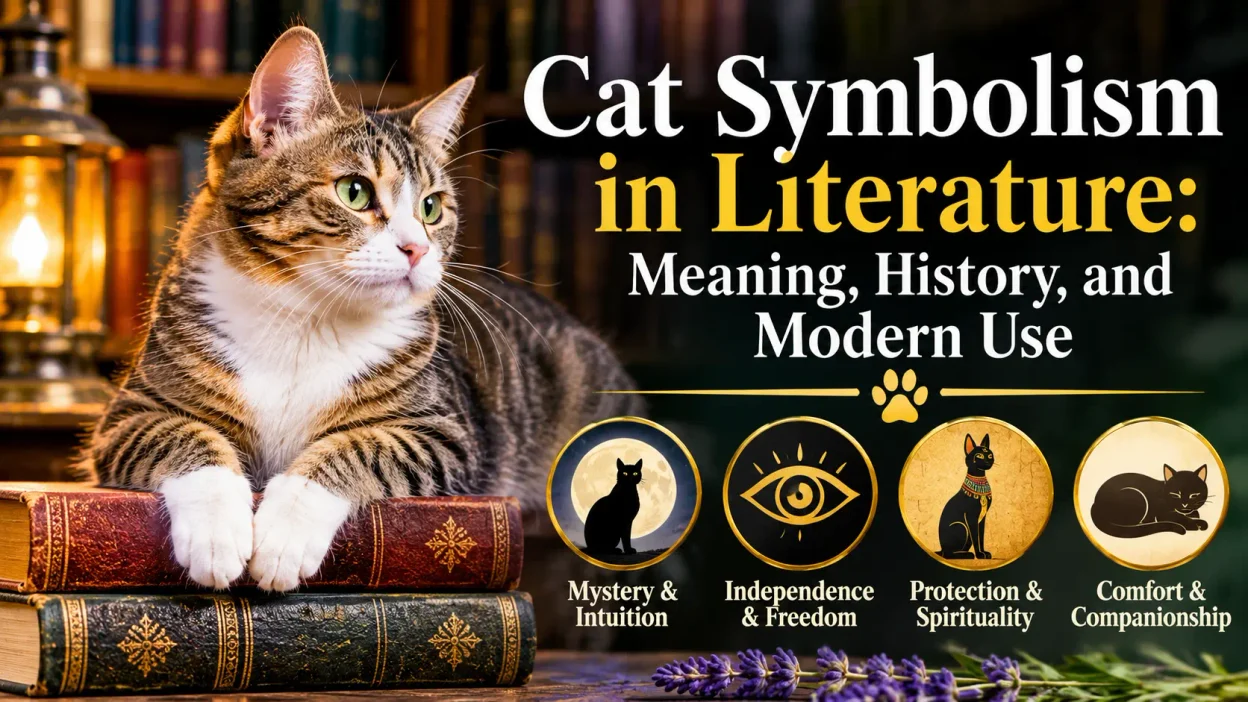
Cats have occupied a distinctive place in storytelling for centuries. In literature, they rarely function as ordinary background animals. A cat sitting silently in a doorway, watching a character from a windowsill, or appearing unexpectedly in a dream can suggest independence, secrecy, intelligence, danger, comfort, or a connection to the supernatural. Cat symbolism in literature allows writers to communicate complicated ideas through an animal that is familiar but often difficult to understand.
Unlike dogs, which frequently represent loyalty and companionship in stories, cats are often portrayed as independent observers. They may live alongside human characters without appearing entirely attached to them. This quality makes them useful literary figures for exploring loneliness, personal freedom, curiosity, and the tension between civilization and instinct.
In American literature and popular storytelling, cats appear in children’s books, Gothic fiction, fantasy, poetry, horror, and contemporary novels. Their meanings change according to the writer, historical period, and cultural setting. A black cat might suggest superstition in one story, while another presents the same animal as a symbol of protection or misunderstood identity.
Understanding these different interpretations reveals why cats remain such recognizable and adaptable figures in literature.
Quick Answer
Cat symbolism in literature commonly represents independence, mystery, curiosity, intelligence, and feminine identity in modern American storytelling. Historically, cats have also symbolized protection, supernatural knowledge, transformation, bad luck, and connections between the human and spiritual worlds.
TL;DR
- Cats frequently represent independence and resistance to control.
- Ancient Egyptian traditions associated cats with protection and divine power.
- Black cats often appear in Gothic fiction and supernatural storytelling.
- Writers use cats to explore loneliness, curiosity, and hidden identities.
- Children’s literature frequently portrays cats as clever, adventurous companions.
- Modern stories challenge traditional associations between cats and superstition.
Why Cats Make Effective Literary Symbols
Cats possess physical and behavioral characteristics that make them particularly useful in fiction. Their quiet movements, reflective eyes, sharp claws, nighttime activity, and unpredictable reactions create an unusual combination of elegance and danger.
A writer can introduce a cat without explaining its purpose immediately. The animal might appear harmless at first, but its presence can gradually become unsettling. Alternatively, a cat that initially seems aloof may become the only dependable companion in a character’s life.
Several qualities make cats especially effective literary symbols:
- Independence: Their willingness to act without human direction suggests personal freedom.
- Observation: Their watchful behavior makes them natural symbols of awareness and hidden knowledge.
- Adaptability: Their ability to move between different environments suggests survival and transformation.
- Ambiguity: Their expressions and behavior can be difficult to interpret, reflecting uncertainty.
- Instinct: Their hunting behavior represents impulses that exist beneath civilized behavior.
Cats also occupy an interesting position between domestic and wild life. They can sleep beside a person one moment and disappear into the darkness the next. Writers use this contrast to represent characters who belong to society but resist being completely understood.
Ancient Roots of Cat Symbolism
Some of the oldest influential associations between cats and human storytelling developed in ancient Egypt. Cats became associated with domestic protection, fertility, motherhood, and divine authority.
The Egyptian goddess Bastet was commonly represented with feline features. Her associations included household safety, women, children, and fertility. Cats also appeared in Egyptian artwork and religious practices, sometimes as sacred representations connected with divine power.
These associations helped establish the cat as more than an ordinary household animal. It could represent a protective presence, a respected companion, or a connection to the divine.
Egyptian artistic traditions also included humorous scenes in which cats performed human activities. Such images suggest that cats could represent intelligence, social observation, and playful reversals of ordinary expectations.
As Egyptian religious and cultural influences spread through the Mediterranean, some feline associations entered Greek and Roman storytelling. Cats became connected with different divine figures and supernatural traditions. Their literary meanings were never completely uniform, but ancient representations helped establish the animal’s association with protection, femininity, and the supernatural.
Cats in European Folklore and Medieval Literature
European folklore developed a more complicated picture of cats. They could be useful household animals, clever survivors, magical companions, or suspicious creatures associated with darkness.
During the medieval period, some Christian European writings connected cats with sexual impropriety, heresy, and demonic activity. These negative associations were not universal beliefs, but they contributed to the appearance of cats as unsettling creatures in later Gothic storytelling.
Folktales also frequently presented cats as clever animals capable of overcoming stronger opponents through strategy rather than physical strength.
One familiar example is Puss in Boots. The cat helps its impoverished master gain wealth and social standing through deception, confidence, and careful planning. Its intelligence becomes more important than its physical abilities.
This tradition established an important literary distinction: a cat might be small or physically vulnerable, but it can still control a situation through observation and cleverness.
Independence and Resistance to Control
Independence is among the most recognizable meanings associated with cats in modern literature.
Unlike animals traditionally written as obedient companions, cats often appear to have their own priorities. They may accept affection without surrendering their freedom, remain near a character without becoming dependent, or leave when they choose.
Writers use this behavior to represent characters who resist social expectations.
A cat that refuses to be controlled might reflect a protagonist who rejects family pressure, restrictive traditions, or conventional ideas about success. In this context, the animal becomes a representation of self-determination.
This interpretation is especially relevant in American storytelling, where individuality and personal freedom frequently appear as important cultural themes.
A fictional cat does not always need to perform a dramatic action to communicate independence. Simply remaining distant while human characters struggle for approval can make the animal an effective contrast to their behavior.
Mystery, Darkness, and the Supernatural
Cats are particularly common in Gothic literature because their physical characteristics create an atmosphere of uncertainty.
Their ability to move quietly, see in low light, and appear unexpectedly makes them suitable companions for stories involving haunted houses, psychological tension, secrets, and unexplained events.
Black cats have an especially strong association with this literary tradition. In European folklore, they became connected with witches, supernatural forces, and bad luck. Gothic writers inherited these associations and used them to create uneasiness.
However, a cat’s presence does not automatically indicate evil. Some writers deliberately use the animal’s frightening reputation to challenge a reader’s assumptions.
A black cat might appear threatening because other characters fear it, even though the actual danger comes from human behavior. This contrast allows authors to explore prejudice, irrational suspicion, and the difference between appearance and reality.
In supernatural fiction, cats can also function as guardians of thresholds between familiar surroundings and unknown worlds.
Edgar Allan Poe and the Dark Meaning of Cats
One of the most recognizable examples of feline symbolism in American literature appears in The Black Cat by Edgar Allan Poe.
Published in 1843, the short story follows an increasingly violent narrator whose relationship with his cat becomes entangled with guilt, cruelty, alcoholism, and psychological deterioration.
The first cat, Pluto, is initially presented as a beloved household companion. However, the narrator’s behavior changes dramatically as he becomes increasingly destructive. The animal eventually becomes associated with the narrator’s moral collapse and the consequences of his actions.
The cat’s name is significant because Pluto refers to the Roman god associated with the underworld. This connection strengthens the story’s atmosphere of death and supernatural punishment.
The second cat complicates the meaning further. It resembles the first animal and carries a distinctive marking that increasingly disturbs the narrator. Its presence becomes associated with the return of guilt and the impossibility of escaping the consequences of wrongdoing.
Several interpretations are possible:
- Guilt: The cat represents the narrator’s inability to escape his past actions.
- Moral judgment: Its presence exposes the cruelty that the narrator attempts to conceal.
- Psychological instability: The animal becomes a focus for his growing paranoia.
- Supernatural punishment: Its appearance suggests that wrongdoing may have consequences beyond ordinary human control.
Poe does not provide a simple explanation of whether the cat is supernatural or whether the narrator’s disturbed mind shapes his experience. That uncertainty is central to the story’s literary effect.
The Cheshire Cat and the Symbolism of Uncertainty
Another influential literary cat appears in Alice’s Adventures in Wonderland by Lewis Carroll.
The Cheshire Cat is unusual because it appears and disappears, speaks in riddles, and challenges Alice’s understanding of the world around her.
Unlike Poe’s frightening cat, the Cheshire Cat is playful and intellectually challenging. It represents several ideas that are important to the novel:
Uncertainty: Its changing appearance reflects the instability of Wonderland.
Perspective: Its conversations encourage Alice to question what she believes she understands.
Individuality: It follows its own logic rather than accepting ordinary social rules.
The absurd: Its unusual behavior contributes to the story’s challenge to conventional reasoning.
The Cheshire Cat is particularly interesting because it does not simply provide answers. Instead, it creates more questions.
Its famous disappearing act, in which its grin remains visible after the rest of its body vanishes, also makes it an effective image of identity without a stable physical form.
In literary interpretation, the character demonstrates how a cat can represent intellectual freedom and uncertainty rather than danger or superstition.
Cats as Symbols of Femininity and Identity
Cats have frequently been associated with femininity in literature, art, and folklore. Their graceful movements, independence, and domestic associations have contributed to this connection.
In some historical traditions, feline imagery was connected with goddesses, fertility, motherhood, and feminine protection. Later writers sometimes used cats to represent women who were intelligent, self-directed, mysterious, or unwilling to follow traditional expectations.
However, these associations can carry different meanings depending on the author.
A female character compared to a cat might be portrayed as confident and independent. In another story, the same comparison might suggest manipulation, secrecy, or perceived untrustworthiness.
This distinction matters because literary symbolism often reflects the attitudes of the society in which a story was written.
Modern American writers can also use feline imagery to challenge restrictive ideas about femininity. A woman who resembles a cat might represent someone comfortable with solitude, personal boundaries, ambition, and independence.
Rather than suggesting that all women share these characteristics, the symbol offers a way to explore how individuals negotiate expectations about gender and identity.
Loneliness, Companionship, and Emotional Comfort
Cats can also represent emotional connection, especially in stories about isolated or misunderstood characters.
A fictional character may struggle to communicate with other people but find comfort in the predictable presence of a pet. The cat becomes a companion without demanding constant conversation or social performance.
This relationship can symbolize:
- Emotional safety during difficult circumstances.
- Companionship without excessive dependence.
- Comfort in solitude.
- Acceptance without judgment.
- The importance of small everyday relationships.
In American literature, this interpretation fits naturally into stories about urban loneliness, aging, grief, family separation, and personal recovery.
A cat sitting beside a character during a difficult moment may communicate affection more effectively than a long conversation.
The animal can also represent the difference between being alone and feeling lonely. A character who enjoys a quiet life with a cat may be independent rather than emotionally disconnected.
This makes feline companionship a flexible symbol for writers exploring the private emotional lives of their characters.
Intelligence, Curiosity, and Hidden Knowledge
Cats are naturally curious animals, and literature frequently turns this characteristic into a symbol of intelligence and investigation.
A cat watching a closed door, examining an unfamiliar object, or following a character into a restricted space can suggest that something remains undiscovered.
Writers may use this behavior to introduce information without directly explaining it. The animal’s attention can encourage readers to notice details that human characters overlook.
Cats can also represent knowledge that operates outside conventional reasoning.
In fantasy and children’s fiction, a talking cat may understand magical rules, recognize hidden dangers, or guide a protagonist through unfamiliar surroundings.
These characters are often neither completely trustworthy nor entirely deceptive. Their knowledge may be genuine, but their motivations remain uncertain.
The result is an interesting literary figure: an intelligent companion who helps the protagonist while preserving a sense of independence.
Cat Symbolism in American Literature and Popular Culture
In the United States, cats have become familiar figures in children’s literature, comic strips, fantasy, animation, and contemporary fiction.
American storytelling often emphasizes individuality, humor, companionship, and the unusual personalities of domestic animals. Cats fit naturally into these themes because they can be affectionate without appearing obedient and intelligent without behaving predictably.
Several fictional cats have become recognizable cultural figures:
Garfield
Garfield represents humor, laziness, appetite, and resistance to everyday responsibilities. His personality makes the cat a recognizable symbol of comic independence.
The Cat in the Hat
This character represents mischief, imagination, disruption, and playful rebellion against ordinary household rules.
The Cat in Coraline
This independent cat serves as a guide through an unsettling alternative world. It represents awareness, survival, and knowledge beyond appearances.
Puss in Boots
Puss represents confidence, resourcefulness, bravery, and the ability to overcome obstacles through intelligence.
These examples demonstrate how American popular culture has expanded the cat’s literary role. It can be a troublemaker, a loyal companion, a mysterious guide, or an unlikely hero.
Cross-Cultural Interpretations of Cats in Storytelling
Cats do not carry identical meanings across cultures. Their representation depends on religious traditions, folklore, historical experiences, and local attitudes toward animals.
Some important cultural interpretations include:
- Ancient Egypt: Cats were associated with Bastet, household protection, fertility, and divine authority.
- European folklore: Cats could represent cleverness and domestic usefulness, but some traditions connected them with witches and supernatural danger.
- Japanese folklore: The maneki-neko, or beckoning cat, represents good fortune and prosperity. Other Japanese stories feature supernatural feline beings, including the bakeneko and nekomata.
- Norse traditions: Cats are associated with the goddess Freyja in later interpretations of Norse mythology, although the historical evidence surrounding these associations requires care.
- Persian and Arabic folklore: Cats have appeared in traditions with contrasting associations, including domestic blessing, cleverness, suspicion, and supernatural beliefs.
These differences are important when interpreting literature from different backgrounds. A cat representing good fortune in one cultural setting may be portrayed as a threatening supernatural presence in another.
Writers often borrow these associations, but the meaning should be understood within the story’s particular cultural context rather than treated as universal.
What Different Cat Colors Represent in Literature
The color of a fictional cat can influence how readers interpret its role. Writers sometimes use color to establish atmosphere, suggest character traits, or reinforce familiar cultural associations.
| Cat appearance | Common literary meaning | Typical associations |
|---|---|---|
| Black cat | Mystery and the supernatural | Night, superstition, secrecy |
| White cat | Innocence or ambiguity | Purity, elegance, hidden intentions |
| Orange cat | Playfulness and confidence | Humor, warmth, mischief |
| Gray cat | Observation and uncertainty | Restraint, intelligence, independence |
| Calico cat | Individuality and variety | Uniqueness, domestic life, personality |
These meanings are literary conventions rather than fixed rules. A white cat can represent danger, and a black cat can represent comfort or protection.
Color becomes meaningful through its relationship with the plot, the characters, and the atmosphere surrounding the animal.
Psychological Meaning: Why Readers Connect With Literary Cats
Cats often appeal to readers because their behavior allows several interpretations at once.
A cat may appear affectionate but remain independent. It may observe a situation without participating, or respond to something that human characters have not noticed. These qualities make cats useful representations of complicated emotional experiences.
For example, a character who identifies with a solitary cat might see the animal as a reflection of personal independence. Someone experiencing grief might interpret a cat’s quiet companionship as a source of emotional stability.
Cats can also represent the desire to maintain personal boundaries. Their refusal to respond to every demand creates a contrast with characters who feel pressured to satisfy everyone around them.
From a psychological perspective, readers may project their own experiences onto fictional animals. This helps explain why the same literary cat can appear comforting to one reader and unsettling to another.
The symbol does not have one universal psychological meaning. Its emotional effect depends on the reader’s experiences and the story’s presentation.
Cats in Modern Fiction, Tattoos, Art, and Digital Culture
Cats continue to appear across modern creative forms. Their literary associations have expanded into visual storytelling, personal expression, entertainment, and online culture.
Modern fiction: Contemporary writers use cats in fantasy, mystery, horror, and domestic fiction. They can serve as companions, witnesses, magical guides, or representations of a character’s emotional state.
Tattoos and personal identity: Cat tattoos often represent independence, affection for animals, curiosity, personal freedom, or remembrance of a beloved pet. Black cat designs may also communicate an appreciation for Gothic aesthetics and supernatural fiction.
Jewelry and fashion: Cat-shaped pendants, rings, clothing designs, and accessories can express playfulness, elegance, individuality, or an interest in folklore.
Home decor: Cat illustrations and decorative figures frequently communicate warmth, comfort, humor, and affection for domestic animals.
Social media: Internet culture has made cats recognizable symbols of humor, personality, emotional expression, and everyday entertainment. Their unpredictable behavior provides material for memes, short videos, and fictional characters.
The modern cat is not limited to traditional associations with witchcraft or mystery. It can represent a personal identity, a favorite fictional character, or an ordinary relationship that brings comfort.
Misunderstandings and Negative Stereotypes About Literary Cats
One common misunderstanding is that cats always symbolize bad luck or evil, particularly when they appear with black fur.
This association developed through particular European superstitions and historical beliefs. It does not represent every cultural tradition, nor does it explain every appearance of black cats in literature.
Another misconception is that cats always represent femininity, secrecy, or emotional distance. These interpretations have appeared in certain literary traditions, but they should not be treated as universal descriptions of women or cats.
There is also a difference between a cat representing supernatural danger and a cat simply appearing in a frightening setting. Writers sometimes use familiar superstitions to create atmosphere without endorsing those beliefs.
Modern readers should also recognize when older literature uses animal imagery to reinforce stereotypes about gender, sexuality, or social behavior.
Understanding the historical context makes it easier to appreciate a literary work without assuming that every traditional association remains culturally appropriate today.
How Cat Symbolism Has Changed Over Time
The literary meaning of cats has changed as human relationships with these animals have developed.
In ancient Egypt, cats could represent protection, fertility, and divine authority. In some medieval European traditions, they became associated with suspicion, witchcraft, and supernatural danger.
Gothic writers later used these older beliefs to create stories about fear, guilt, and psychological uncertainty. Edgar Allan Poe’s The Black Cat demonstrates how an ordinary domestic animal could become central to a disturbing exploration of human behavior.
Children’s literature introduced a different perspective. Characters such as the Cheshire Cat and Puss in Boots presented cats as intelligent, imaginative, and capable of challenging conventional expectations.
Modern American storytelling has expanded these interpretations even further. Cats can represent companionship, humor, independence, emotional recovery, and personal identity.
The animal has not lost its historical associations with mystery. Instead, writers now have a much wider range of meanings from which to draw.
Frequently Asked Questions
What does a cat symbolize in literature?
A cat commonly symbolizes independence, mystery, intelligence, curiosity, and emotional companionship. Depending on the story, it may also represent supernatural knowledge, danger, transformation, or resistance to social expectations.
What does a black cat symbolize in literature?
A black cat often represents mystery, superstition, secrecy, and supernatural forces, particularly in Gothic fiction. However, modern writers also use black cats to represent protection, individuality, and misunderstood identity.
Why do writers use cats as symbols of independence?
Cats are commonly portrayed as animals that maintain their own boundaries and make independent choices. Writers use these characteristics to represent characters who value freedom, individuality, and resistance to control.
What does a cat symbolize in Edgar Allan Poe’s literature?
In Poe’s The Black Cat, the animal becomes associated with guilt, cruelty, psychological deterioration, and possible supernatural punishment. Its presence helps expose the narrator’s attempts to conceal his wrongdoing.
What does the Cheshire Cat symbolize in Alice in Wonderland?
The Cheshire Cat represents uncertainty, intellectual curiosity, unconventional reasoning, and the instability of Wonderland. Its riddles encourage Alice to question familiar ideas about identity and reality.
Are cats positive or negative symbols in literature?
Cats can represent either positive or negative qualities. They may symbolize companionship, intelligence, protection, and freedom, or represent deception, danger, superstition, and psychological fear.
What does a cat tattoo mean in modern American culture?
A cat tattoo commonly represents independence, affection, curiosity, individuality, or a meaningful relationship with a pet. Black cat tattoos may also reflect an interest in Gothic literature, folklore, and supernatural imagery.
Conclusion
Cats remain versatile literary symbols because their behavior combines independence, intelligence, affection, and unpredictability. From ancient Egyptian religious traditions to Gothic short stories and modern American fiction, they have represented everything from domestic protection and companionship to supernatural danger and personal freedom.
Cat symbolism in literature ultimately depends on how an author uses the animal within a particular story. A cat might reveal a character’s loneliness, challenge conventional expectations, expose hidden fears, or guide someone through an unfamiliar world.
The most interesting literary cats are often those that resist a single interpretation. They remind readers that appearances can be misleading and that independence, mystery, and companionship can exist together.
[…] European literature developed additional meanings. Green could suggest spring, youth, romantic love, and fertility, but it could also communicate […]