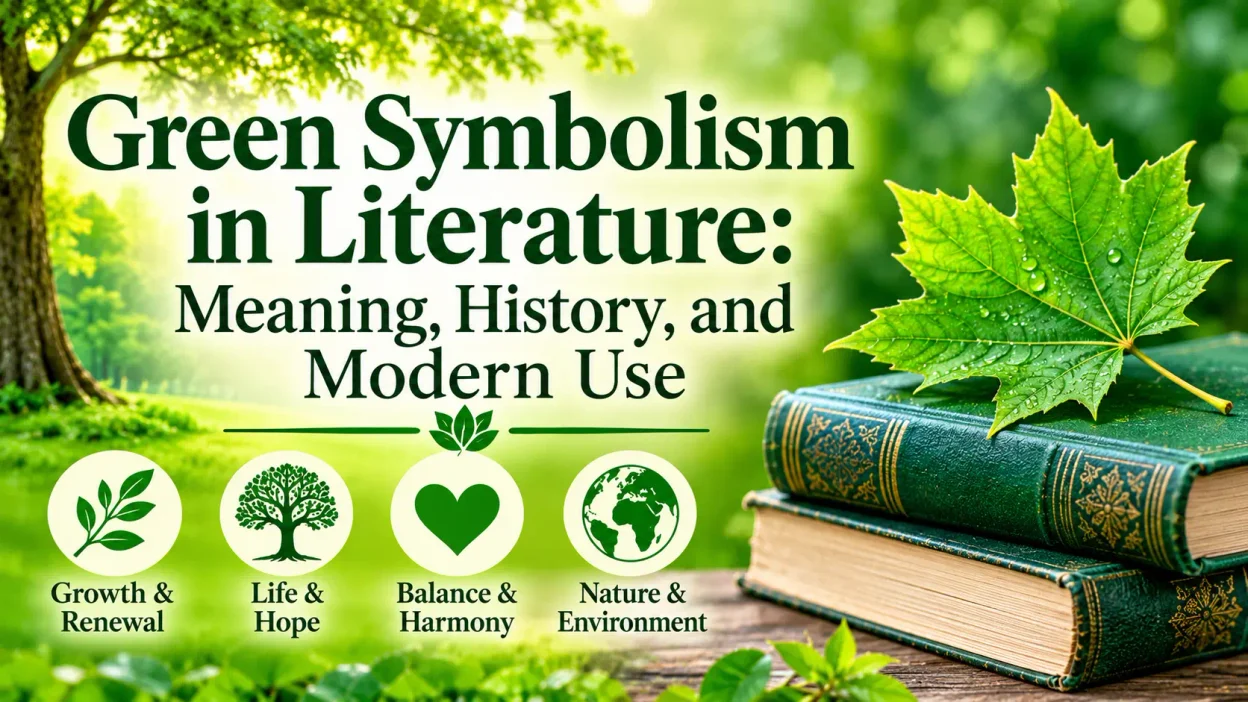
Green symbolism in literature connects the natural world with human emotions, social values, and personal transformation. Writers use green to suggest growth, fertility, hope, renewal, and the possibility of a fresh beginning. Yet the same color can represent envy, inexperience, temptation, corruption, or the unsettling force of nature. Its meaning depends on the story, the characters, and the circumstances in which it appears.
From green landscapes in pastoral poetry to the unforgettable green light in F. Scott Fitzgerald’s The Great Gatsby, the color has become an important literary device. Authors rarely choose it simply to describe a setting. A green garden, a character’s green clothing, or an object glowing in the distance can communicate ideas that dialogue never directly expresses.
In American literature, green frequently reflects the relationship between ambition and nature, innocence and experience, wealth and desire. Understanding these associations helps readers recognize how color contributes to characterization, atmosphere, conflict, and a story’s larger themes.
Quick Answer
Green symbolism in literature commonly represents nature, growth, renewal, hope, and new beginnings, while also suggesting jealousy, inexperience, temptation, and moral uncertainty. Historically, its associations with fertility, seasonal change, and the natural world developed alongside more complicated meanings connected to envy, money, and human desire.
TL;DR
- Green often represents nature, fertility, growth, and renewal.
- Springtime imagery connects green with rebirth and fresh opportunities.
- Jealousy and envy give green a darker literary meaning.
- F. Scott Fitzgerald uses green to represent Gatsby’s distant dream.
- Green clothing and landscapes can communicate identity and social status.
- Modern writers use green to explore ecology, technology, and environmental anxiety.
What Green Looks Like as a Literary Symbol
Green is the color between blue and yellow in the visible spectrum. In literature, however, it is more than a physical description. It can appear as the color of grass, forests, leaves, moss, clothing, eyes, jewels, artificial lights, or objects that attract a character’s attention.
Its natural associations make it particularly useful to writers. A green field can suggest peace and abundance, while an overgrown forest might create an atmosphere of danger or uncertainty. Green clothing can distinguish a character from the surrounding society, suggesting youth, unusual behavior, supernatural qualities, or a connection to the natural world.
The shade also matters. Fresh spring green often suggests optimism and new life. Dark forest green can communicate secrecy, age, and isolation. Pale green may suggest sickness, fragility, or immaturity, while artificial neon green can feel modern, unnatural, or unsettling.
Readers should therefore pay attention not only to the presence of green but also to its surroundings and the way characters respond to it.
Nature, Fertility, and the Cycle of Life
One of green’s oldest literary associations is the natural world. Because leaves, grasses, and many plants display green during periods of active growth, writers have used the color to represent fertility, abundance, and the continuation of life.
In poetry, green landscapes frequently establish a connection between human experience and the rhythms of nature. A field covered in fresh grass may represent prosperity, while a forest full of green leaves can suggest that life continues even when individual characters face hardship.
This symbolism also appears in pastoral literature, where writers present rural environments as alternatives to crowded cities, political conflict, or complicated social expectations. Green meadows, gardens, and wooded valleys can represent an idealized world of simplicity and balance.
However, green nature is not always comforting. Dense vegetation can conceal threats, and forests can become places where characters lose their direction. The same natural abundance that suggests life can also overwhelm human control.
This contrast allows authors to explore an important idea: nature sustains life, but it does not necessarily exist for human convenience.
Renewal, Spring, and New Beginnings
Green is strongly associated with spring because plants produce fresh leaves and landscapes recover after winter. Literature frequently uses this seasonal transformation to communicate emotional recovery, new relationships, and the possibility of change.
A character entering a green garden after a difficult period may be experiencing a symbolic return to hope. Similarly, a previously barren landscape becoming green can reflect the restoration of a family, community, or individual life.
Spring imagery also appears in romantic poetry. New growth can suggest young love, physical attraction, fertility, and emotional awakening. Writers may describe green fields or flowering trees when a character begins to recognize feelings that were previously hidden.
In American literature, these associations often connect with ideas of opportunity and reinvention. A fresh green landscape can suggest the possibility of building a different life, especially in stories involving migration, personal ambition, or recovery from loss.
Nevertheless, renewal does not always mean that the past disappears. New growth may emerge from damaged ground, reminding readers that change often develops through difficult experiences.
Youth, Innocence, and Inexperience
Green can represent youth because it is associated with early stages of growth. A young plant has not yet reached maturity, and literary characters described through green imagery may similarly be inexperienced or still developing their identities.
The phrase green meaning inexperienced remains common in modern English. A new employee might be described as green, for example, because they have not yet gained practical knowledge.
Literature uses this association to communicate more than a lack of experience. It can suggest innocence, uncertainty, idealism, and vulnerability.
A young character surrounded by green landscapes might appear emotionally connected to childhood or protected from adult responsibilities. Alternatively, green clothing could emphasize that a character has not yet learned how to navigate a complicated social environment.
The meaning can change as the story progresses. A character who begins as green and inexperienced may gradually become more confident, independent, or morally complicated.
In this way, green can function as a visual reminder that identity is still developing.
Hope, Ambition, and the Desire for a Better Future
Green frequently represents hope because growing plants suggest that the future can bring something that does not yet exist. A seed contains the possibility of a tree, just as an ambition contains the possibility of a different life.
Writers use green imagery to represent characters who imagine a better future, pursue distant goals, or refuse to accept their present circumstances.
One of the most recognizable examples appears in F. Scott Fitzgerald’s The Great Gatsby. The green light at the end of Daisy Buchanan’s dock becomes associated with Jay Gatsby’s longing for Daisy and the future he imagines with her.
The light also supports broader interpretations involving ambition, wealth, social advancement, and the American Dream. Gatsby believes that reaching his desired future will resolve the dissatisfaction he feels with his present life.
Yet Fitzgerald complicates the symbol. Gatsby’s dream is partly built on an idealized version of the past, and achieving physical closeness to Daisy does not produce the happiness he expects.
The green light therefore represents both hope and the danger of pursuing an imagined future without recognizing its limitations. PubMed Central (PMC)+1
Jealousy, Envy, and Emotional Possession
Green has a well-established association with jealousy in English-language literature. Unlike its associations with nature and renewal, this interpretation focuses on uncomfortable emotions, insecurity, rivalry, and the fear of losing something valuable.
William Shakespeare helped establish this association through the famous description of jealousy as a green-eyed monster in Othello.
In the play, jealousy becomes a destructive force that influences how Othello interprets the behavior of Desdemona and other characters. The image of a monster suggests that jealousy can take control of a person’s judgment and turn suspicion into apparent certainty.
Green works effectively in this context because it contrasts with the color’s more pleasant associations. Instead of representing healthy growth, it suggests an emotion that develops uncontrollably and damages relationships.
The expression also entered everyday English. People still use the phrase green with envy when describing someone who strongly resents another person’s success, possessions, or romantic relationship.
For literary readers, green eyes or green imagery around a jealous character may therefore suggest emotional insecurity, although the surrounding narrative must determine whether that interpretation is justified. Shakespeare Oxford Fellowship+1
Ancient and Medieval Origins of Green Symbolism
Green’s literary history is older and more complicated than its modern association with environmental awareness.
In ancient societies, green was connected with vegetation, agricultural fertility, seasonal change, and the renewal of life. These associations made it useful in religious imagery, mythology, and stories about the natural world.
In ancient Egyptian religious tradition, green was associated with regeneration and life. The god Osiris, connected with death and resurrection, was sometimes represented with green skin. This imagery reflected the relationship between vegetation, fertility, and the possibility of life after death.
Medieval European literature developed additional meanings. Green could suggest spring, youth, romantic love, and fertility, but it could also communicate instability, supernatural danger, and moral uncertainty.
A particularly interesting example is the late fourteenth-century poem Sir Gawain and the Green Knight. Its central figure, the Green Knight, appears as an extraordinary character whose green clothing and physical appearance distinguish him from Arthur’s court.
His color connects him with vegetation and the natural world, but his unusual appearance also makes him unsettling. He challenges ordinary expectations about civilization, courage, and mortality.
The Green Knight is not simply a symbol of goodness or evil. His ambiguity is central to the poem’s meaning. JSTOR+2
Religious and Spiritual Interpretations
Green appears in several religious traditions, although its meaning differs according to historical setting and belief.
In Christianity, green is commonly associated with hope, life, and spiritual growth. In many Western Christian churches, green vestments are used during Ordinary Time, the periods outside major seasons such as Advent and Lent. The color can suggest the continuing growth of faith.
Biblical garden imagery also contributes to green’s literary associations. The Garden of Eden, with its trees and vegetation, provides an important cultural image of abundance, creation, and humanity’s relationship with nature.
In Islamic traditions, green has particular religious and cultural importance. It is associated with paradise and appears in various forms of Islamic art, architecture, flags, and decorative traditions. Writers drawing on Islamic cultural settings may use green to evoke spiritual identity, sacred associations, or paradise, depending on the context.
These meanings should not be treated as universal rules. A green garment in a Christian allegory may communicate something different from a green garden in an Islamic literary setting.
Religious interpretation depends on the text’s tradition, historical period, and specific imagery.
Green Symbolism in American Literature and Culture
In the United States, green has acquired several overlapping literary meanings.
The association with the natural environment is particularly prominent in American writing. The country’s forests, agricultural landscapes, national parks, and wilderness traditions have encouraged authors to use green settings when exploring the relationship between people and nature.
American writers have also connected green with wealth and financial ambition. The color of American currency contributes to familiar expressions involving money, prosperity, and economic opportunity.
This association makes green especially relevant to stories about social mobility and the American Dream. Fitzgerald’s The Great Gatsby demonstrates how a single green object can connect romantic desire with material ambition.
Green also appears in American writing about environmental responsibility. Modern novels, essays, and poetry may use green landscapes to represent ecological health, while damaged or disappearing greenery can suggest pollution, urban expansion, and environmental loss.
The color consequently carries an interesting contradiction in American culture: it can represent the promise of economic prosperity while also reminding readers of the natural resources that economic development may threaten.
Love, Romance, and Fertility
Green can communicate romantic feelings, particularly when writers connect love with spring, flowers, gardens, and new growth.
In traditional poetry, a green landscape may provide the setting for courtship or the beginning of a relationship. Fresh vegetation suggests emotional awakening, while flowering plants can represent fertility and attraction.
Green can also suggest youthful desire. A romance involving inexperienced characters may use spring imagery to emphasize the excitement and uncertainty of first love.
However, green does not always represent successful relationships. In some literary settings, it can communicate jealousy, possessiveness, or the instability of romantic attachment.
This makes green particularly useful when an author wants to explore the difference between love as an ideal and love as an actual human relationship.
A green garden might represent romantic possibility, while green imagery connected with suspicion or rivalry could reveal the emotional problems beneath an apparently happy relationship.
Green Clothing, Identity, and Social Status
Authors sometimes use clothing color to communicate information about characters before those characters explain themselves.
Green clothing can suggest youth, wealth, fashionable taste, unusual identity, or a connection to the natural or supernatural world. Its meaning depends on the period and the character’s social environment.
In medieval romance, green garments may distinguish a character from ordinary society. The Green Knight’s appearance in Sir Gawain and the Green Knight is a particularly memorable example because his clothing contributes to his otherworldly presence.
In modern fiction, green clothing may instead indicate confidence, individuality, environmental awareness, or material success.
A wealthy character wearing expensive green clothing might be associated with luxury and status. A character choosing green as a personal style could use it to express a connection with nature or an interest in sustainability.
Green can also communicate exclusion. If a character wears something that looks noticeably different from the clothing of everyone around them, the color may emphasize their outsider status.
The important question is not simply why the character wears green, but how other people in the story respond to that choice.
Dark Green, Pale Green, and Other Shades in Literature
Different shades of green can create different emotional effects. Writers may use these distinctions to establish atmosphere or signal changes in a character’s circumstances.
| Shade or form | Common literary meaning | Typical associations |
|---|---|---|
| Bright green | Renewal and optimism | Spring, growth, opportunity |
| Dark green | Mystery and secrecy | Forests, isolation, hidden motives |
| Pale green | Weakness or immaturity | Sickness, vulnerability, inexperience |
| Emerald green | Wealth and desire | Luxury, ambition, precious objects |
| Yellow-green | Unease or jealousy | Envy, decay, suspicion |
| Artificial neon green | Unnatural change | Technology, danger, artificial environments |
These associations are interpretive possibilities rather than fixed definitions.
For example, emerald green might represent prosperity in one novel but greed in another. Dark green could make a forest feel peaceful or threatening depending on its description and the events taking place.
A useful reading technique is to compare the color’s appearance with the emotional condition of the character or setting. When the two seem connected, the color may be doing symbolic work.
Green in Fantasy, Folklore, and Mythological Writing
Fantasy literature frequently uses green to connect characters with forests, magical creatures, ancient forces, and supernatural environments.
The Green Man is an important figure in European folklore and visual tradition. Often depicted with a human face surrounded by or formed from leaves, he is commonly interpreted through themes of vegetation, seasonal renewal, and the natural world. Modern fantasy writers sometimes draw on this imagery when creating forest guardians, nature spirits, or characters whose identities are connected to plant life.
Fairies and other supernatural beings have also been associated with green clothing in parts of European folklore. In some traditional stories, wearing green could suggest an association with the fairy world, although beliefs varied considerably by region and period.
Sir Gawain and the Green Knight provides an especially important literary example. The Green Knight’s unusual appearance places him between familiar human society and a world governed by unfamiliar natural and supernatural forces.
Contemporary fantasy continues to use these associations. A green-skinned creature might represent a connection with vegetation, while an enchanted green forest could suggest a place where ordinary rules no longer apply.
Green is therefore useful in fantasy because it can make nature appear both life-giving and unfamiliar.
Emotional and Psychological Meaning of Green
Green can influence the emotional atmosphere of a literary scene because readers bring familiar cultural associations to the color.
A description of fresh green leaves may create feelings of comfort, optimism, and possibility. A character walking through a peaceful green landscape might appear to be recovering from grief or searching for emotional balance.
By contrast, an oppressive green environment can produce discomfort. An author might describe stagnant vegetation, unhealthy green skin, or an unnatural green glow to suggest illness, fear, or corruption.
Green can also communicate conflicting emotions within the same character. Someone who sees green as a sign of opportunity may simultaneously experience envy toward another person’s success.
This psychological flexibility makes green an effective color for complex characterization. It can represent the desire to grow while also exposing the insecurity that prevents someone from changing.
Readers should remember that color psychology is not a universal system. Personal experiences, cultural background, and the literary setting all influence how a particular shade is understood.
Modern Uses of Green Symbolism in Books and Popular Culture
Green remains a familiar literary symbol, but modern writers use it in ways that reflect contemporary concerns.
Environmental fiction frequently places green landscapes at the center of discussions about climate change, conservation, pollution, and human responsibility. Healthy vegetation can represent ecological balance, while the destruction of forests or disappearance of plant life can suggest environmental instability.
Science fiction often uses artificial green lighting, glowing substances, or green digital displays to create an atmosphere associated with technology, experimentation, or unfamiliar forms of life.
Young adult novels may use green clothing, eyes, or natural settings to distinguish characters and communicate their developing identities.
The color also appears in contemporary romance, mystery, and fantasy novels. A green gemstone might suggest wealth or a hidden inheritance, while an overgrown garden might conceal family secrets.
Outside books, green continues to appear in film adaptations, video games, television, graphic novels, and digital storytelling. Its associations with nature, money, and jealousy make it easy for audiences to recognize, even when a story does not explicitly explain the symbolism.
Common Misunderstandings About Green Symbolism
One common mistake is assuming that green always represents positive ideas. Although the color is frequently connected with nature, health, and renewal, literature also uses it to communicate envy, sickness, deception, and danger.
Another misunderstanding is treating every green object as a deliberate symbol. A writer may mention green grass simply to describe the setting. Symbolic interpretation becomes more convincing when the color receives unusual attention, appears repeatedly, or connects with an important character or theme.
Readers should also avoid assuming that green has always represented environmental protection. Its modern association with ecological movements developed through changing cultural and political circumstances. Earlier literary traditions used the color for a much broader range of meanings.
Finally, different cultural traditions should not be combined into one universal interpretation. Green can carry religious, historical, and political associations that are specific to particular communities.
The most reliable approach is to interpret green through the story itself rather than applying a fixed definition to every appearance.
How the Meaning of Green Has Evolved Over Time
Green’s literary meaning has changed as societies have developed new relationships with nature, religion, science, money, and personal identity.
In early agricultural and mythological traditions, green was closely connected with plant life, fertility, and seasonal renewal. These associations made it useful in stories about creation, death, and regeneration.
During the medieval period, European literature developed a more complicated relationship with the color. Green could represent spring, youth, and love, but it could also suggest supernatural danger, instability, and moral uncertainty.
The Renaissance brought further exploration of color in poetry, drama, and cultural expression. Writers used green in descriptions of beauty, desire, human behavior, and the natural world.
During the nineteenth century, Romantic literature increasingly emphasized nature as a source of beauty, freedom, and emotional experience. This helped strengthen green’s modern association with the natural environment.
In twentieth-century American literature, green became especially recognizable through stories about money, ambition, and the pursuit of happiness. The Great Gatsby remains a major example of this development.
Today, green can communicate environmental awareness, personal identity, technological change, social ambition, or emotional conflict. Its meaning continues to evolve because writers adapt familiar color associations to new cultural concerns.
Frequently Asked Questions
1. What does green symbolize in literature?
Green most commonly symbolizes nature, growth, renewal, fertility, and hope. Depending on the story, it can also represent jealousy, inexperience, greed, sickness, or supernatural forces.
2. Why does green represent jealousy in literature?
Green became associated with jealousy through established English literary expressions, especially Shakespeare’s description of jealousy as a green-eyed monster in Othello. The association survives in everyday phrases such as green with envy.
3. What does the green light symbolize in The Great Gatsby?
The green light represents Gatsby’s longing for Daisy and his imagined future with her. It also reflects the broader American Dream, including ambition, wealth, social advancement, and the difficulty of achieving idealized desires.
4. Is green a positive or negative symbol in literature?
Green can represent both positive and negative ideas. It suggests growth and hope in some settings but can communicate jealousy, corruption, illness, or danger in others.
5. What does green symbolize in poetry?
In poetry, green frequently represents spring, fertility, youth, love, and the renewal of life. Poets may also use it to describe emotional innocence, natural beauty, or the contrast between human society and the wilderness.
6. What does wearing green represent in literature?
Green clothing can suggest youth, individuality, wealth, fertility, or a connection with nature and supernatural traditions. Its meaning depends on the character’s circumstances, historical setting, and the reactions of other characters.
7. Why is green important in fantasy literature?
Green helps fantasy writers establish connections with forests, magical creatures, nature spirits, and supernatural worlds. It can make a character appear connected to natural forces or distinguish an unfamiliar world from ordinary human society.
Conclusion
Green is one of literature’s most flexible colors because it connects the natural world with complicated human experiences. It can represent growth, fertility, hope, innocence, and renewal, but it can also reveal jealousy, greed, uncertainty, and emotional conflict. Its meaning depends on the character, setting, historical period, and circumstances surrounding its appearance.
From the Green Knight’s supernatural presence to Gatsby’s distant green light, green symbolism in literature demonstrates how a simple color can communicate ideas about identity, ambition, relationships, and the human desire for change. Recognizing these associations helps readers understand not only what authors describe but also what they leave unsaid.