
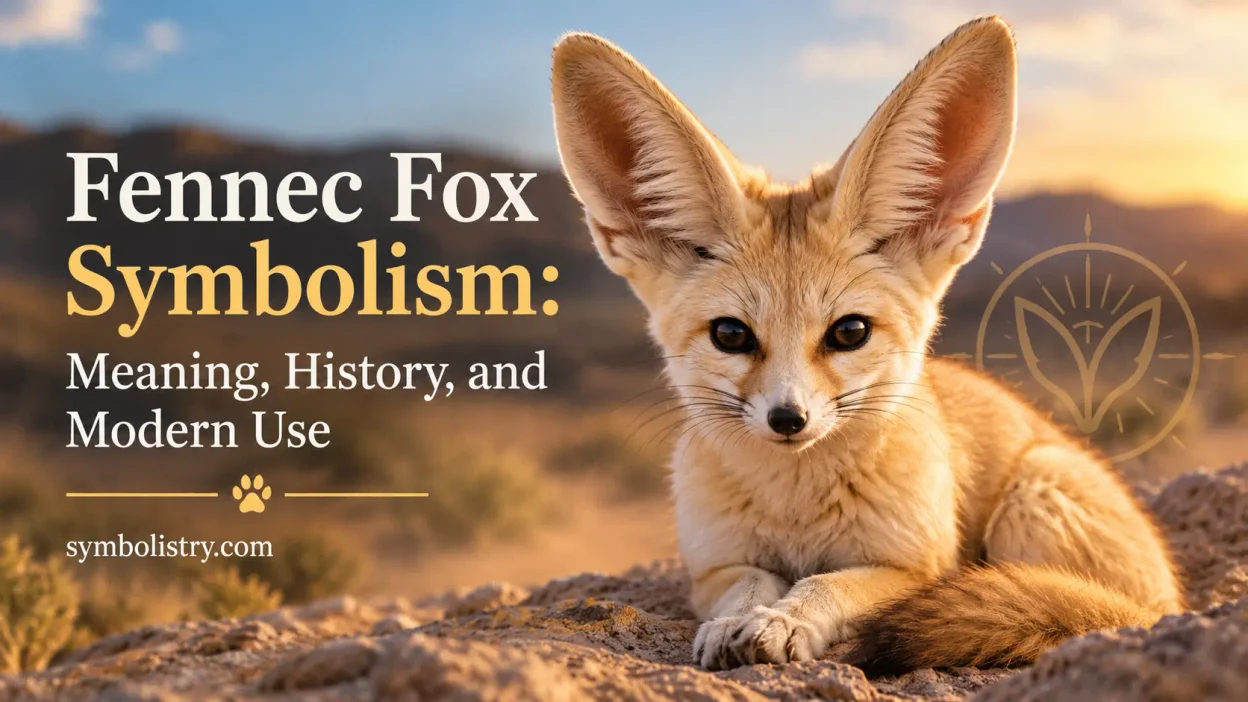
The fennec fox is one of the most recognizable animals of the Sahara: tiny, pale, quick-moving, and distinguished by ears that seem almost too large for its body. Those physical traits have made it more than an interesting desert animal. In modern symbolism, the fennec fox symbolism often centers on adaptability, alertness, curiosity, resourcefulness, and finding practical ways to survive difficult circumstances.
People are drawn to the animal partly because its appearance creates an unusual contrast. The fennec looks delicate and playful, yet it is specifically adapted to one of the world’s harshest environments. Its large ears help it detect prey and release heat, its furry feet protect it from hot sand, and its nocturnal habits allow it to avoid the worst daytime temperatures.
For Americans encountering the fennec fox through tattoos, artwork, social media, wildlife exhibits, fantasy characters, or decorative design, the animal often represents a softer form of strength. Rather than suggesting physical dominance, it can communicate cleverness, independence, attentiveness, and the ability to make a home in challenging conditions.
Quick Answer
Fennec fox symbolism commonly represents adaptability, alertness, curiosity, resourcefulness, and resilience in modern American culture, especially in personal art, tattoos, and nature-inspired design. Historically and cross-culturally, the fox has also been associated with cleverness and trickery, while the fennec’s desert adaptations add themes of survival, discretion, and environmental awareness.
TL;DR
- Fennec foxes commonly symbolize adaptability and resourcefulness.
- Their enormous ears suggest listening, awareness, and sensitivity.
- Desert survival connects them with resilience and practical intelligence.
- Fox folklore contributes associations with cleverness and trickery.
- American popular culture often emphasizes their cuteness and individuality.
- Modern tattoos and art use the fennec for personal identity.
What Makes the Fennec Fox Symbolically Distinct?
The fennec fox belongs to the canid family and is the smallest fox species. Its natural range includes sandy deserts and arid regions of North Africa, particularly the Sahara.
Its appearance does much of the symbolic work.
The oversized ears are its defining feature. They are not simply ornamental; they help the fox locate prey and dissipate heat. The pale coat blends with sandy surroundings, while thickly furred feet help protect it from hot ground.
The animal is also nocturnal. Instead of confronting the desert’s extreme daytime temperatures directly, it becomes active after dark and spends daylight hours in underground burrows.
These traits create a coherent symbolic picture: pay attention, conserve your resources, choose your timing, and adapt to the environment rather than fighting it unnecessarily.
That distinction is important. Fennec symbolism is less about overpowering an obstacle and more about responding intelligently to one.
The Core Meaning of Fennec Fox Symbolism
Several meanings naturally emerge from the animal’s biology and from broader fox traditions.
Adaptability
Adaptability is perhaps the clearest modern interpretation. The fennec does not simply tolerate the desert; its body and behavior are specifically suited to it.
As a symbol, this can represent someone who learns how to function within changing circumstances rather than waiting for circumstances to become easier.
A person might choose a fennec image during a period of moving to a new city, beginning a different career, recovering from a difficult transition, or developing a new identity.
Alertness
The fennec’s extraordinary hearing makes awareness another obvious association.
Symbolically, its ears can represent paying attention to details that other people overlook. This can be especially meaningful for someone who values observation, intuition, careful listening, or noticing subtle changes in a situation.
Resourcefulness
The fennec survives with limited water and food resources in an environment where mistakes can be costly. Its survival depends on behavior that is efficient rather than extravagant.
That makes the animal a useful symbol of making good use of what is available.
Independence
The fennec’s nocturnal lifestyle and ability to forage independently can also suggest self-reliance. However, the animal is not simply solitary. Fennecs can live in family groups and raise young within shared burrow systems.
This creates a more balanced symbolism: independence does not necessarily mean isolation.
Why the Desert Matters to Its Meaning
A fennec fox without its desert environment loses much of the context behind its symbolism.
The Sahara represents heat, limited water, open terrain, and dramatic temperature changes. The fennec’s survival strategies evolved in response to those conditions.
Its underground burrow provides protection from heat. Its activity at night reduces exposure to extreme daytime temperatures. Its ears help with both hearing and heat regulation. Its diet is flexible, and moisture can come partly from the foods it eats.
For symbolic interpretation, this matters because resilience here does not mean simply enduring suffering.
Instead, the fennec suggests finding an appropriate response to difficult conditions.
That is a more practical interpretation of resilience: change your habits, protect your energy, use your surroundings intelligently, and know when retreat is sensible.
Ancient Roots and the Broader Fox Tradition
There is an important distinction between fennec-specific symbolism and fox symbolism in general.
The fox has a much longer and better-documented history in folklore than the fennec specifically. Across various traditions, foxes have frequently been portrayed as clever, evasive, deceptive, observant, or difficult to catch.
In classical Arabic and Persian literary traditions, for example, the fox commonly appears as a crafty or cunning figure. Such stories contributed to a broader cultural association between foxes and intelligence mixed with deception.
That does not mean every North African tradition assigned the same meaning to the fennec, nor should general fox folklore automatically be presented as fennec folklore.
The fennec has its own ecological identity. Much of its modern symbolism comes from observing its distinctive appearance and desert behavior rather than from one universally recognized ancient myth.
This distinction prevents a common mistake: inventing an elaborate ancient spiritual tradition around an animal simply because its modern symbolism feels compelling.
Fennec Fox Symbolism in North African Contexts
The fennec is native to North Africa, making the Sahara essential to understanding its cultural setting.
People living in desert regions have practical knowledge of animals that outsiders may encounter primarily through photographs or wildlife exhibits. The fennec’s tracks, burrows, nighttime activity, calls, and behavior form part of the natural landscape in which it lives.
At the same time, the animal should not be reduced to a single “African symbol.” North Africa contains numerous cultures, languages, histories, and storytelling traditions.
The broader fox archetype can involve cleverness, trickery, survival, or opportunism, but interpretations vary according to place and tradition.
A respectful approach therefore treats fennec symbolism as layered rather than assigning one supposedly universal meaning to every community.
What the Fennec Fox Means in the United States
In the United States, the fennec fox is generally encountered as an exotic wildlife species rather than as a traditional American religious or folkloric symbol.
Its symbolic meaning is therefore largely shaped by contemporary visual culture.
Americans may associate the fennec with:
- individuality
- curiosity
- cleverness
- desert landscapes
- environmental adaptation
- smallness without helplessness
- playful personality
- independence
- unusual beauty
Its oversized ears and small body also make it particularly appealing in illustration, children’s media, character design, plush toys, and internet culture.
This creates a distinctly modern interpretation. Someone who chooses a fennec image may not be thinking about ancient folklore at all. They may simply identify with being observant, unconventional, adaptable, or underestimated.
A Quick Comparison of Fennec Fox Meanings
| Context | Meaning in the USA | Common Associations | Notes |
|---|---|---|---|
| Nature symbolism | Adaptability | Desert survival, resilience | Based strongly on biological traits |
| Personal identity | Individuality | Unusual, independent, curious | Common in personal art and tattoos |
| Fox folklore | Cleverness | Strategy, wit, trickery | Usually broader fox symbolism |
| Emotional symbolism | Sensitivity | Awareness, listening, observation | Inspired partly by the fennec’s hearing |
| Decorative art | Playfulness | Cuteness, charm, personality | Especially common in contemporary illustration |
The Emotional Meaning of the Fennec Fox
The emotional symbolism of the fennec is unusually gentle.
A wolf might communicate strength through size, cooperation, or endurance. A bear can suggest physical power. A large bird of prey may suggest freedom or dominance.
The fennec communicates something different.
Its symbolism can reassure people that being small, sensitive, or unconventional does not automatically mean being weak.
This is particularly relevant to modern identity symbolism. Someone who has often felt different from the people around them may connect with an animal that looks unusual but is perfectly adapted to its environment.
The fennec can therefore represent the idea that fit matters more than appearance.
A trait that looks exaggerated in one environment may be exactly what makes an organism successful in another.
Why the Fennec Fox Represents Listening
The ears deserve special attention because they are so central to the animal’s appearance and behavior.
Fennec foxes can detect sounds associated with prey beneath sand. Their ears also help release heat.
Symbolically, this creates two related ideas.
First is listening before acting. The fennec does not rely solely on what can be seen. Important information may be hidden beneath the surface.
Second is sensitivity as an advantage. In everyday human language, sensitivity can sometimes be treated as a weakness. Fennec symbolism turns that assumption around. Awareness can become useful when it helps someone understand their surroundings accurately.
For this reason, fennec imagery can suit people who value observation, empathy, careful communication, or quiet attention.
Fennec Fox Symbolism in Tattoos
Fennec fox tattoos can carry different meanings depending on the person’s reason for choosing the animal.
A minimalist fennec may represent individuality or curiosity. A desert scene can emphasize resilience and adaptation. A fennec surrounded by stars can emphasize its nocturnal character and connection with the night.
Some people may choose the animal simply because they find its appearance distinctive.
Common personal interpretations include:
- adapting to a major life change
- being underestimated
- learning to listen to intuition
- valuing independence
- embracing an unusual personality
- surviving a difficult environment
- protecting one’s private space
The surrounding design often changes the emphasis. Sand dunes make the desert connection stronger, while flowers or celestial imagery can make the tattoo more personal and decorative.
There is no universal tattoo dictionary in which a fennec has only one approved meaning. The significance ultimately depends on the person and the imagery surrounding it.
Fennec Fox Symbolism in Jewelry, Fashion, and Decor
In contemporary American design, fennec fox imagery tends to emphasize charm and personality more than ancient symbolism.
Jewelry may use the fox’s pointed face and oversized ears as a recognizable silhouette. Home decor can use fennec illustrations in children’s rooms, nature-themed spaces, or desert-inspired interiors.
Fashion and accessories often emphasize the animal’s cute and distinctive appearance.
The symbolism becomes more personal when the image is deliberately selected rather than simply used as decoration.
A fennec on a desk might represent curiosity. A framed desert illustration might symbolize an appreciation for adaptation and wildlife. A necklace might serve as a reminder to remain observant during a period of change.
The object itself does not determine the meaning; context does.
Fennec Foxes, Social Media, and Digital Culture
Digital culture has changed the way Americans encounter unusual animals.
Before social media, most people would have encountered a fennec through wildlife books, zoos, documentaries, or photographs. Today, its unusual proportions make it naturally suited to short-form visual content.
Large ears, small bodies, expressive faces, and playful behavior photograph well.
As a result, online representations often emphasize:
- cuteness
- humor
- curiosity
- quirky personality
- exotic beauty
- individuality
This can produce a significant shift in symbolism. The fennec may be treated less as a desert survivor and more as an instantly recognizable personality.
Both interpretations can coexist, but they should not be confused. A cute cartoon fennec is not necessarily making a statement about desert ecology.
Fennec Foxes and the Idea of Resilience
Resilience is one of the strongest symbolic readings because the animal is so closely adapted to environmental extremes.
Yet resilience should not be interpreted as an instruction to tolerate every hardship indefinitely.
The fennec’s actual survival strategy includes avoiding unnecessary exposure. It uses burrows, operates during cooler hours, and relies on physical adaptations that reduce the costs of desert living.
That gives its symbolism a useful nuance:
Resilience can mean knowing how to protect yourself, not simply knowing how to endure more.
For someone using the fennec as a personal symbol, this may represent boundaries, rest, strategic retreat, conservation of energy, and intelligent adaptation.
The Meaning of the Fennec’s Small Size
The fennec is physically small, but its smallness does not make it symbolically insignificant.
This contrast is one reason the animal works so well in modern identity symbolism.
It can represent:
- underestimated ability
- quiet confidence
- efficiency
- nontraditional forms of strength
- precision instead of force
- independence without dominance
The symbolism is especially relevant in cultures where strength is often represented through size and visibility.
The fennec offers another model: you do not have to be the largest presence in a landscape to be well equipped for it.
Positive and Negative Fennec Fox Symbolism
Most modern interpretations of the fennec are positive, but fox symbolism has a more complicated side.
| Positive Interpretation | More Cautionary Interpretation |
|---|---|
| Adaptability | Evasiveness |
| Cleverness | Manipulation |
| Awareness | Suspicion |
| Independence | Isolation |
| Resourcefulness | Opportunism |
| Curiosity | Restlessness |
These contrasts come primarily from the wider cultural history of foxes.
A clever fox can be an admirable problem-solver in one story and an untrustworthy trickster in another. The same image can therefore communicate intelligence or deception depending on context.
When someone uses a fennec fox symbol, it is usually inappropriate to assume negative intent simply because fox folklore includes trickster figures.
Common Misunderstandings About Fennec Fox Symbolism
One common mistake is claiming that the fennec has one ancient, universal symbolic meaning.
It does not.
The animal’s modern symbolism comes from a mixture of its biology, broader fox folklore, contemporary animal culture, and personal interpretation.
Another misconception is treating every fox tradition as specifically fennec folklore. A story about a red fox from Europe or a fox from Persian literature should not automatically be presented as a historical story about the Sahara’s fennec.
A third misunderstanding comes from confusing cuteness with domestication. Fennec foxes are wild animals, and their popularity as exotic-looking pets has sometimes obscured the specialized care they require. Their appeal as a symbol should not be taken as evidence that they are naturally suited to ordinary household life.
How Fennec Fox Meaning Has Changed Over Time
The meaning of the fennec has developed alongside changing ways of seeing animals.
In its natural environment, the animal is primarily a desert-adapted predator and member of a living ecosystem. Its survival depends on practical behaviors rather than symbolic meaning.
Older fox traditions added associations with cleverness, cunning, and deception.
Modern global media added something new: visual appeal.
The fennec became recognizable to audiences far beyond North Africa because of its extraordinary ears and small body. Wildlife photography, zoos, documentaries, illustration, animation, games, and social media have all helped transform it into a contemporary cultural image.
Today, its symbolism often combines cleverness from the fox archetype with adaptability drawn directly from the fennec’s biology.
That combination explains why the animal works so effectively as a modern symbol.
Is Fennec Fox Symbolism Spiritual or Religious?
There is no single mainstream American religious tradition that assigns the fennec fox one standardized spiritual meaning.
People can certainly use the animal in personal spiritual reflection, but those interpretations should be distinguished from documented religious traditions.
In contemporary spirituality, an individual may interpret the fennec as representing intuition, awareness, adaptability, or protection. Those are personal or modern symbolic readings rather than universally established religious doctrines.
The same distinction applies to terms such as “spirit animal” or “totem.” Different Indigenous traditions have their own specific cultural frameworks, and it is inappropriate to treat those traditions as a generic symbolic system available for anyone to borrow without context.
What a Fennec Fox Can Symbolize in Everyday Life
The symbolism becomes most useful when translated into ordinary human experiences.
A fennec can represent listening before responding when communication is difficult.
It can represent adapting when a familiar environment changes.
It can represent protecting private space without completely withdrawing from relationships.
It can represent finding practical solutions when resources are limited.
And it can represent accepting an unusual trait rather than trying to hide it.
The animal’s lesson, if there is one, is not that hardship automatically makes someone stronger. Its actual biology suggests something more concrete: survival often depends on understanding your environment and responding appropriately to it.
Frequently Asked Questions
What does a fennec fox symbolize?
A fennec fox commonly symbolizes adaptability, alertness, curiosity, resourcefulness, and resilience. Its large ears and desert adaptations also make it a natural symbol of listening carefully and responding intelligently to difficult conditions.
What does a fennec fox tattoo mean?
A fennec fox tattoo can represent individuality, adaptability, cleverness, or surviving circumstances that once seemed difficult. The surrounding imagery can change the interpretation, so a desert landscape, stars, flowers, or geometric designs may add different personal meanings.
Is the fennec fox a symbol of good luck?
There is no universal traditional belief that makes the fennec fox a standard symbol of good luck. Some modern symbolic interpretations associate it with favorable qualities such as resourcefulness and good judgment, but those are contemporary interpretations rather than a universal superstition.
What does the fennec fox symbolize spiritually?
In modern personal spirituality, people may use the fennec to represent intuition, awareness, adaptability, independence, or sensitivity. These meanings are personal interpretations and should not be confused with a single established religious doctrine.
Does a fennec fox symbolize intelligence?
It can. The broader fox archetype is frequently associated with cleverness and strategy, while the fennec’s specialized survival behaviors provide a more concrete basis for associating it with practical intelligence and problem-solving.
Is fennec fox symbolism positive or negative?
Modern fennec symbolism is generally positive, emphasizing adaptability, curiosity, cleverness, and resilience. Negative associations such as deception or manipulation usually come from the broader fox tradition rather than from a specific universal meaning assigned to the fennec.
Why are fennec foxes associated with adaptability?
Their bodies and behavior are highly specialized for desert conditions. Their large ears help with hearing and cooling, their furry feet protect them from hot sand, and their nocturnal lifestyle reduces exposure to extreme daytime heat, making adaptation central to their natural history.
Conclusion
Fennec fox symbolism combines the broader cultural image of the clever fox with the very real survival adaptations of a small desert animal. In modern American culture, it most often suggests adaptability, curiosity, awareness, resourcefulness, and an unconventional kind of strength.
Its meaning becomes especially interesting when its biology is taken seriously. The fennec does not survive the desert through size or force. It survives by listening, choosing the right time to move, protecting itself from the environment, conserving resources, and using its surroundings intelligently.
That makes the fennec a fitting modern symbol for people who see strength not as domination, but as knowing how to adapt without losing their identity.

[…] Animal symbols are often used as shorthand for identity. Someone who displays a black fox may be communicating personality without directly explaining it. […]