
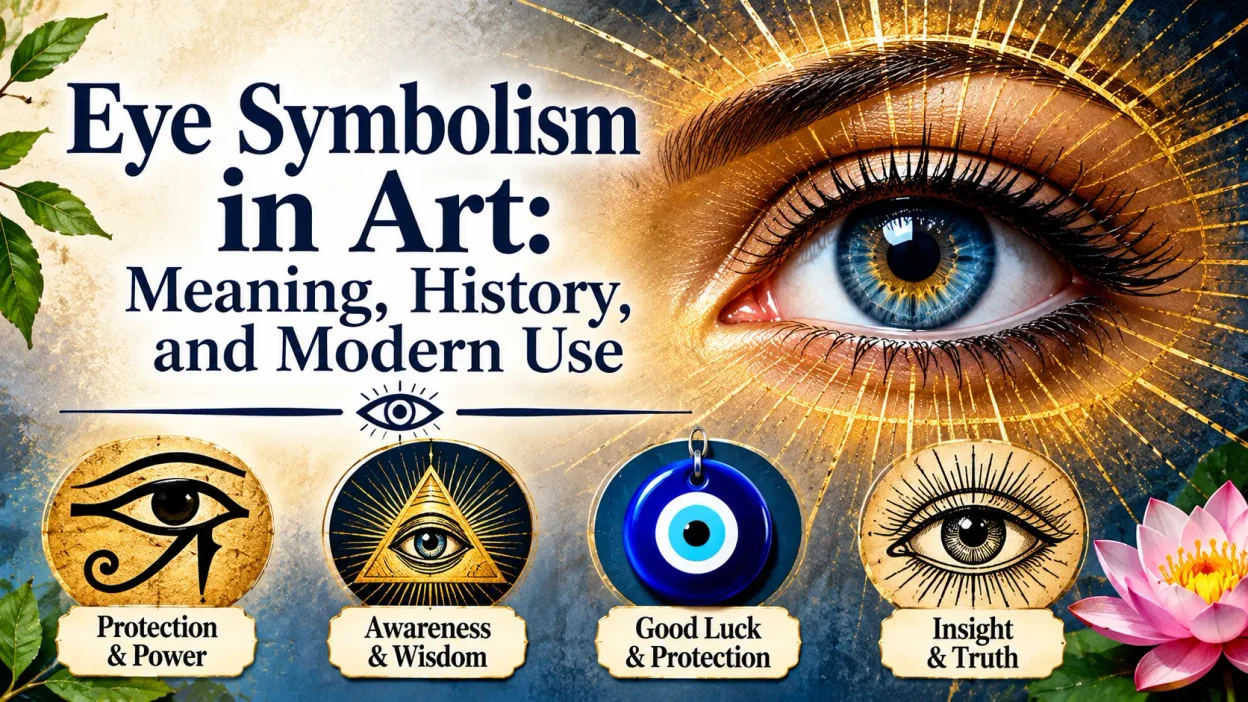
The human eye has been one of the most recognizable and expressive images in visual art for thousands of years. Artists use it to represent knowledge, awareness, truth, spirituality, vulnerability, and the complicated relationship between looking and being seen. Eye symbolism in art appears in ancient religious objects, Renaissance paintings, surrealist compositions, contemporary photography, and modern graphic design.
Unlike many artistic symbols, the eye has an immediate connection to human experience. People use their eyes to recognize faces, communicate emotions, interpret their surroundings, and understand other people. An artist can communicate trust, fear, suspicion, compassion, or authority simply by changing the direction of a painted gaze.
In the United States, eye imagery appears in museums, religious artwork, popular culture, tattoos, fashion, advertising, and national symbolism. Some representations suggest divine protection, while others question surveillance, identity, perception, and the difference between appearance and reality.
Understanding the eye in art means looking beyond its physical appearance. Its meaning depends on the historical period, artistic style, surrounding imagery, and the intentions behind the work.
Quick Answer: What Does Eye Symbolism in Art Mean?
Eye symbolism in art commonly represents awareness, perception, knowledge, truth, and the ability to see beyond appearances. Historically, eyes have also represented divine protection, spiritual insight, wisdom, authority, and the connection between the living world and the supernatural.
TL;DR
- Eyes frequently represent awareness, observation, intelligence, and understanding.
- Ancient Egyptian art connected the eye with protection and restoration.
- Renaissance artists used eyes to communicate divine knowledge and spiritual presence.
- Surrealist artists explored dreams, perception, identity, and the unconscious mind.
- American culture associates eye imagery with observation, individuality, and surveillance.
- Modern artists use eyes to explore identity, emotion, technology, and privacy.
1. Why the Human Eye Became an Important Artistic Symbol
The eye is both a physical organ and a major form of nonverbal communication. A person’s gaze can suggest affection, fear, confidence, sadness, curiosity, or hostility without requiring words.
Artists recognized this expressive potential long before modern portraiture developed. By emphasizing the eyes, they could give a figure personality, establish a relationship with the viewer, or suggest that a painted subject possessed awareness beyond the boundaries of the artwork.
An eye can also create a direct psychological connection between an artwork and its audience. When a painted figure looks directly outward, viewers may feel that the subject is acknowledging them. When the eyes are hidden, closed, or directed elsewhere, the figure can appear distant, vulnerable, contemplative, or emotionally unavailable.
This makes the eye particularly useful in paintings that explore human relationships and internal experiences.
The symbol also works independently of a human face. An isolated eye, an eye inside a geometric shape, or an oversized eye floating in an unusual landscape can communicate ideas that ordinary portraiture cannot.
2. Ancient Origins of Eye Imagery in Art
Eye imagery has roots in some of the earliest known artistic traditions. Ancient civilizations used eyes in sculpture, pottery, religious objects, and funerary artwork to communicate the presence of divine beings, the importance of vision, and protection from harm.
In ancient Mesopotamia, some votive statues featured unusually large, attentive eyes. These figures were dedicated to deities and placed in temples. Their enlarged eyes communicated constant attention and devotion, suggesting that the worshippers represented by the statues remained spiritually present before their gods.
Ancient Egyptian art developed several distinctive approaches to eye imagery. Artists included carefully detailed eyes in sculptures, painted objects, tomb decorations, and protective amulets.
Eyes were not simply decorative facial features. In certain religious and funerary settings, they helped communicate the ability of images to participate in the world of the living and the dead.
The importance of sight was connected to ideas about presence, religious practice, and the continuation of existence after death.
These early traditions established an important artistic principle: an eye could represent more than the ability to see. It could communicate attention, spiritual life, protection, and the relationship between different realms of existence.
3. The Eye of Horus and Ancient Egyptian Protection
One of the best-known eye symbols in ancient art is the Eye of Horus, also called the Wedjat eye.
According to Egyptian mythology, Horus lost an eye during his conflict with Seth. The damaged eye was restored, with the healing and restoration becoming associated with completeness, protection, and renewal.
Artists represented this symbol with distinctive markings inspired by the human eye and the facial features of a falcon.
The Eye of Horus appeared on amulets, jewelry, funerary objects, and other protective items. People associated it with safeguarding the body and supporting well-being.
Its artistic meaning included several related ideas:
- Protection: The eye served as a protective emblem.
- Healing: Its restoration represented recovery from injury or disruption.
- Completeness: The restored eye suggested the return of wholeness.
- Renewal: Its association with restoration connected it with continued life.
The symbol remains recognizable in contemporary jewelry, tattoos, decorative art, and popular culture.
However, it is important to distinguish the ancient Egyptian Eye of Horus from the later Eye of Providence. Although both feature an isolated eye, they developed in different historical and religious contexts.
4. The Eye of Providence in Christian and European Art
The Eye of Providence is usually represented as an eye surrounded by rays of light and placed inside a triangle.
Its familiar European form developed during the Renaissance and early modern period. Christian artists used the image to represent God’s omniscience, providence, and watchfulness over humanity.
The triangle commonly connected the design with the Christian doctrine of the Trinity: the Father, Son, and Holy Spirit. Rays of light reinforced the association with divine presence and illumination.
The eye communicated the idea that God could see all things, including human actions and thoughts.
The motif became especially recognizable through religious paintings, architectural decoration, and emblem books. Its appearance in European visual culture helped establish the isolated eye as a symbol of divine observation.
Over time, the design acquired additional associations with Freemasonry, political imagery, and American national symbolism.
Its meaning is not identical in every setting. In a Christian painting, it may represent divine care, while in a modern artwork it might suggest authority, observation, or the uncomfortable feeling of being watched.
5. How Renaissance Artists Used Eyes to Represent Knowledge
Renaissance artists became increasingly interested in human anatomy, perspective, naturalistic representation, and the relationship between the physical and spiritual worlds.
The eye played an important role in these developments.
Artists studied how light entered the eye, how vision worked, and how reflections could make painted surfaces appear more realistic. In portraits, the careful rendering of the eyes helped create the impression of an individual personality.
The eyes also carried philosophical and religious associations.
During this period, sight was frequently connected with knowledge and understanding. Religious artworks used visual details to communicate the relationship between earthly experience and divine truth.
The expression of the eyes could also help distinguish spiritual awareness from ordinary physical perception.
For example, a figure looking upward might suggest prayer, revelation, or contemplation. A figure with a lowered gaze could communicate humility, grief, or submission.
Renaissance artists therefore used the eye as both an anatomical feature and a storytelling device.
6. The Eye as a Window to the Soul
The expression “the eyes are the windows to the soul” has influenced the interpretation of portraits and figurative art for generations.
Although it is not a scientific description of the human eye, it expresses an enduring belief that someone’s gaze can reveal aspects of their inner character.
Artists have used this idea to make portraits feel psychologically convincing.
A direct, steady gaze may communicate confidence, honesty, authority, or self-possession. Downcast eyes can suggest sadness, reflection, embarrassment, or restraint. Wide-open eyes may indicate surprise, excitement, fear, or heightened awareness.
The meaning depends on the entire composition rather than the eye alone.
For example, a portrait of a grieving person with lowered eyes communicates something different from a religious figure looking downward in prayer.
In American portraiture, photography, and contemporary visual culture, the idea of the eye as a window into personality remains familiar. Advertising and editorial photography often use eye contact to make an image feel personal and engaging.
The concept also explains why artists pay such close attention to small details such as pupils, eyelids, reflections, and the direction of a subject’s gaze.
7. Eye Symbolism in Religious and Spiritual Artwork
Eyes appear in many religious traditions, although their meanings differ according to the beliefs and visual languages of each culture.
In Christianity, the Eye of Providence can represent God’s knowledge and watchfulness. Eyes in paintings of saints and biblical figures may also communicate spiritual awakening, devotion, or divine revelation.
In Hindu traditions, the third eye is associated with Shiva and is commonly understood in connection with spiritual insight, awareness, and the destruction of ignorance. Artistic representations often show it on the forehead.
In Buddhist visual traditions, the Buddha’s eyes can communicate awareness, compassion, and insight. The painted eyes of stupas, particularly in Nepal, are distinctive examples of sacred eye imagery.
Ancient Egyptian religious art also connected eyes with protection, restoration, and divine presence.
These traditions should not be treated as interchangeable. A third eye, a protective amulet, and an all-seeing divine eye may share visual similarities, but their religious meanings come from different histories.
Artists working with spiritual imagery often use the eye to express something that ordinary human vision cannot fully communicate.
8. The Meaning of Eyes in Surrealist Art
Surrealism transformed the artistic use of the eye during the twentieth century.
Surrealist artists explored dreams, unconscious thought, irrational experiences, and the unstable relationship between what people see and what they believe they understand.
An eye removed from its ordinary setting could become unsettling or thought-provoking. It might appear in an unexpected location, become unusually large, or exist without a recognizable human face.
One famous example is René Magritte’s The False Mirror (1929).
The painting depicts an enormous eye that occupies almost the entire composition. Instead of showing a conventional reflection, the iris contains a blue sky with clouds.
The work encourages viewers to reconsider the relationship between the observer and the outside world. Does the eye simply receive visual information, or does the mind also shape what it sees?
Surrealist imagery frequently uses eyes to question certainty, perception, and the boundaries between internal experience and external reality.
The symbol can feel beautiful, disturbing, or ambiguous because it disrupts the familiar relationship between the human face and the act of looking.
9. Eye Symbolism in American Art and Culture
In the United States, eye imagery has acquired several overlapping cultural meanings.
One of its most recognizable appearances is the Eye of Providence on the Great Seal of the United States, visible on the reverse of the one-dollar bill.
The Great Seal was adopted in 1782. Its unfinished pyramid and radiant eye represent providence and the idea of a nation guided by a higher power.
Because the image appears on American currency, millions of people encounter it regularly. It has consequently become associated with American history, government, national identity, and political discussion.
The eye also appears in American paintings, photography, advertising, films, and public design.
Its meanings often depend on the setting:
- In religious artwork, it may suggest divine guidance.
- In political imagery, it can communicate authority or public oversight.
- In portrait photography, it emphasizes personality and individuality.
- In contemporary installations, it may question surveillance and privacy.
- In commercial design, it can suggest attention, observation, or visual awareness.
American interpretations are not uniform. Some viewers see the eye on the dollar bill as a traditional religious emblem, while others associate it with conspiracy theories or secret organizations.
Understanding its historical context helps separate documented symbolism from later speculation.
10. How Color Changes the Meaning of an Artistic Eye
Color can influence the emotional interpretation of an eye in a painting, illustration, or graphic design.
Artists often use the iris, surrounding skin, background, and lighting to establish a particular mood.
| Eye Color or Treatment | Common Artistic Association | Possible Emotional Effect |
|---|---|---|
| Blue eyes | Clarity, distance, openness | Calmness or contemplation |
| Green eyes | Nature, growth, unusual perception | Curiosity or mystery |
| Brown eyes | Warmth, familiarity, humanity | Comfort and connection |
| Red eyes | Anger, danger, intensity | Fear or aggression |
| Golden eyes | Illumination, divinity, supernatural awareness | Wonder or authority |
| Closed or shadowed eyes | Reflection, grief, inward attention | Privacy or vulnerability |
These associations are not universal rules. A red eye might represent illness in one painting and supernatural power in another.
Cultural context also matters. Color symbolism varies across religious traditions, artistic movements, and individual works.
Artists sometimes deliberately contradict familiar associations to make viewers question their assumptions.
11. Eyes as Symbols of Power, Authority, and Surveillance
An eye can communicate authority because seeing and being seen are connected with control.
In traditional religious imagery, an all-seeing eye suggests that no action escapes divine knowledge. In political and institutional imagery, the same visual idea can become associated with government, observation, or social control.
Modern artists frequently explore this uncomfortable relationship.
An oversized eye looking down on a crowd might suggest surveillance. Multiple eyes arranged across a surface could communicate constant observation. A human figure surrounded by cameras or artificial eyes might represent the loss of privacy.
These interpretations have become particularly relevant in an age of smartphones, facial recognition, security cameras, and digital monitoring.
In contemporary American culture, the eye can therefore communicate two very different ideas: the reassurance of being watched over and the anxiety of being watched without permission.
The distinction often depends on whether the observer is presented as protective or controlling.
12. Emotional and Psychological Meaning of Eyes in Artwork
Eyes have an unusual ability to communicate emotional information quickly.
People naturally pay attention to faces, especially the direction of someone’s gaze. Artists use this tendency to influence how viewers interpret a scene.
A figure looking directly at the audience can create intimacy or confrontation. A figure looking away may seem distracted, ashamed, thoughtful, or emotionally distant.
An eye that appears frightened can make an otherwise ordinary composition feel threatening. A relaxed gaze can make a portrait seem welcoming.
Artists also use missing, covered, closed, or distorted eyes to represent experiences that are difficult to communicate through conventional facial expression.
For example:
- Closed eyes can suggest rest, meditation, grief, or withdrawal.
- Covered eyes can suggest vulnerability, denial, or restricted knowledge.
- Multiple eyes can represent heightened awareness or overwhelming observation.
- A single eye can emphasize focused attention or isolation.
- An empty eye socket can communicate loss, mortality, or physical destruction.
Psychological interpretations should always consider the complete artwork. A closed eye does not automatically represent sadness, just as a direct gaze does not necessarily indicate confidence.
13. Eye Symbolism in Modern Art, Tattoos, and Design
Eye imagery remains popular because it is visually simple and emotionally recognizable.
Contemporary artists use it across several different creative fields.
Tattoos
Eye tattoos can represent awareness, personal protection, intuition, memory, or the importance of seeing situations clearly. Some people choose the Eye of Horus because of its historical association with protection and restoration. Others prefer realistic eyes as representations of loved ones or personal identity.
Jewelry
Eye-shaped pendants, bracelets, and rings often draw on protective traditions. The evil eye, for example, is widely used in Mediterranean and Middle Eastern folk traditions as a protective motif against harmful envy or ill will.
Home decor
Paintings, sculptures, and decorative objects featuring eyes can create an atmosphere of mystery, spirituality, or artistic curiosity. Their effect depends heavily on size, placement, and surrounding design.
Fashion
Eye patterns appear in printed clothing, accessories, embroidery, and experimental fashion collections. Designers may use them to explore individuality, visibility, and the relationship between appearance and identity.
Digital culture
Eyes appear in emojis, illustrations, memes, online branding, and digital artwork. A pair of eyes can suggest curiosity, attention, surprise, or the feeling that someone is watching a conversation.
These modern applications demonstrate how an ancient visual motif can acquire new meanings without losing its historical associations.
14. Common Misunderstandings About Eye Symbolism
Because eyes appear in so many artistic and religious traditions, people sometimes assume that every eye-shaped image has the same meaning.
That assumption can lead to inaccurate interpretations.
One common misunderstanding is that the Eye of Horus and the Eye of Providence are identical symbols. They have different origins, visual histories, and religious associations, even though both involve an isolated eye.
Another misconception is that every eye inside a triangle represents Freemasonry. The Eye of Providence developed as a Christian emblem of divine providence before becoming associated with other organizations and cultural interpretations.
People also frequently interpret unusual eye imagery as automatically sinister or supernatural. In modern art, distorted eyes may instead explore perception, mental experience, identity, or visual experimentation.
The evil eye is another distinct tradition. It generally concerns the harmful effects of envy or hostile attention and the use of protective symbols against them. It should not be confused with every artistic representation of an observing eye.
The most reliable way to interpret eye imagery is to examine its historical period, cultural background, visual details, and original artistic context.
15. How the Meaning of the Eye Has Evolved Over Time
The eye’s artistic meaning has changed as civilizations developed new religious beliefs, philosophical ideas, artistic techniques, and technologies.
In ancient Mesopotamia, enlarged eyes communicated devotion and attentive presence. In ancient Egypt, eye imagery became closely connected with protection, healing, and the continuation of life.
During the Renaissance, artists increasingly explored the eye as a symbol of divine knowledge, human understanding, and individual expression.
Later European artistic traditions expanded these meanings through religious painting, portraiture, and symbolic compositions.
Twentieth-century Surrealism introduced more experimental interpretations, using isolated and distorted eyes to question perception and the unconscious mind.
Today, artists can use the same motif to discuss artificial intelligence, digital surveillance, identity, privacy, and the relationship between people and technology.
| Historical Period | Main Artistic Association | Common Interpretation |
|---|---|---|
| Ancient Mesopotamia | Enlarged eyes in votive figures | Devotion and attention |
| Ancient Egypt | Wedjat eye and funerary imagery | Protection and restoration |
| Renaissance Europe | Divine and human vision | Knowledge and spiritual awareness |
| Modern Surrealism | Distorted or isolated eyes | Dreams and perception |
| Contemporary art | Digital and conceptual eye imagery | Identity and surveillance |
The eye has remained relevant because seeing is a fundamental part of human experience. Its visual form is familiar, but its interpretation continues to change with the concerns of each generation.
Frequently Asked Questions
1. What does an eye symbolize in a painting?
An eye commonly represents awareness, knowledge, perception, truth, or emotional expression. Depending on the composition, it may also suggest divine observation, protection, vulnerability, or authority.
2. Why do artists paint large or oversized eyes?
Oversized eyes attract attention and emphasize the importance of seeing, awareness, or emotional expression. In some traditions, they communicate spiritual presence, while modern artists may use them to create psychological tension or challenge ordinary perception.
3. What does the Eye of Horus represent in art?
The Eye of Horus represents protection, healing, restoration, and completeness in ancient Egyptian tradition. It developed from the mythology of Horus and became a recognizable protective symbol in amulets and religious objects.
4. What does the all-seeing eye symbolize in American culture?
The all-seeing eye commonly represents divine providence and watchfulness, particularly through its appearance on the Great Seal of the United States. Modern interpretations also associate it with government authority, surveillance, and conspiracy theories, although these meanings are not interchangeable.
5. Are eye symbols in art considered positive or negative?
Eye imagery can have positive or negative associations depending on its context. It may represent wisdom, protection, awareness, and spiritual guidance, but it can also communicate suspicion, judgment, intrusion, or surveillance.
6. What does a closed eye symbolize in artwork?
A closed eye can represent meditation, rest, grief, reflection, or an inward focus on personal experience. Artists may also use it to suggest blindness to reality or a temporary separation from the outside world.
7. Why is the eye popular in modern tattoos and artwork?
The eye is recognizable, adaptable, and closely connected with human identity. People use it to express personal awareness, protection, remembrance, intuition, or their interest in historical and spiritual traditions.
Conclusion
The eye has served as an artistic symbol of awareness, knowledge, protection, spirituality, and human emotion across many different civilizations. From ancient Egyptian protective imagery to Renaissance religious paintings and modern Surrealist compositions, its meaning has developed alongside changing ideas about vision, identity, and human experience.
In contemporary American culture, eye symbolism in art connects historical traditions with modern questions about individuality, technology, privacy, and observation. Its meaning can be comforting, unsettling, spiritual, or psychological depending on the context.
Ultimately, the eye is more than a representation of physical sight. It gives artists a way to explore what people notice, what they understand, and how they experience the world around them.