
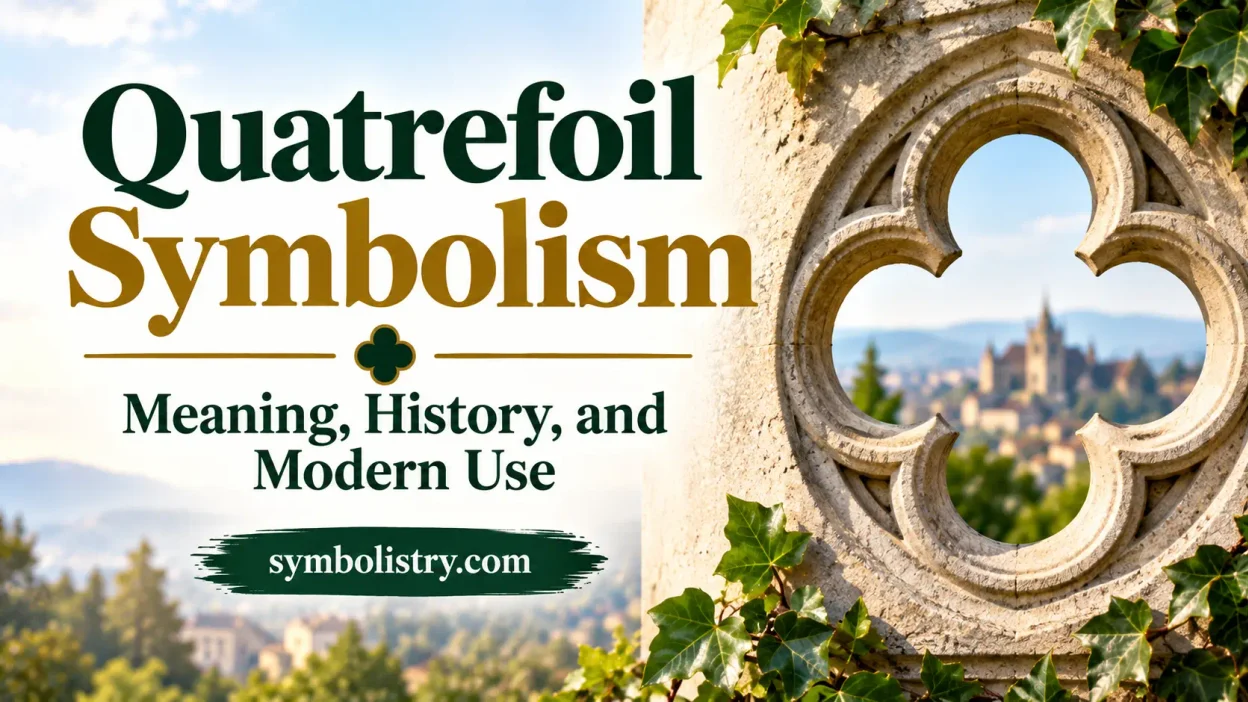
A quatrefoil is a four-lobed decorative form that resembles a four-petaled flower or four overlapping circles. Quatrefoil symbolism interests people because the shape appears in Gothic architecture, religious art, heraldry, textiles, jewelry, interior design, and modern decorative patterns, often carrying ideas of balance, order, faith, good fortune, or natural harmony.
Unlike a symbol with one universally fixed definition, the quatrefoil has acquired different meanings according to its setting. A quatrefoil carved into a medieval church does not necessarily communicate the same thing as a quatrefoil used on a modern piece of jewelry or wallpaper.
Its appeal partly comes from its structure. Four rounded sections meet around a central point, creating a form that feels organized without looking rigid. That combination has allowed the motif to move between sacred architecture, decorative art, family heraldry, and contemporary personal style.
Quick Answer
Quatrefoil symbolism commonly represents balance, harmony, completeness, and good fortune in modern American design, while its religious and historical uses can connect it with Christian ideas of fourfold order, the four Evangelists, and the cross. Historically, the motif also appeared in architectural and decorative traditions across different cultures, so its meaning depends strongly on context.
TL;DR
- Four lobes commonly suggest balance, order, and completeness.
- Gothic architecture made the quatrefoil especially recognizable in Western culture.
- Christian art sometimes connected fourfold forms with sacred groups of four.
- Heraldry gave the motif associations with nature, fortune, and family identity.
- American designers use quatrefoils in architecture, textiles, jewelry, and interiors.
- Modern personal use often emphasizes beauty rather than one fixed religious meaning.
What a Quatrefoil Actually Looks Like
A traditional quatrefoil consists of four rounded lobes arranged around a central point. One way to visualize it is to imagine four identical circles overlapping symmetrically and then tracing their outer boundary.
The resulting outline resembles a four-leaf clover, although the two are not the same thing. A four-leaf clover is a living botanical form, while a quatrefoil is primarily a geometric and decorative motif.
The word itself comes from an expression meaning “four leaves.” English dictionaries define the term both as a four-leafed or four-petaled form and as an architectural ornament made from four lobes.
There are also variations. Some quatrefoils have soft, almost floral curves, while others have sharper cusps or appear inside squares, circles, arches, or elaborate geometric frames.
This flexibility is one reason the motif has survived across radically different artistic styles.
The Core Symbolism of Four
The number four is important to understanding why the quatrefoil can feel symbolically complete.
Across many cultural systems, four is associated with structures that organize the world: four directions, four seasons, four quarters, and other four-part divisions. That does not mean every quatrefoil automatically represents these concepts. Rather, its fourfold construction makes such interpretations available when the surrounding tradition supports them.
The shape also creates visual equilibrium. Each lobe has a corresponding counterpart, so the eye naturally reads the design as balanced.
This produces several common symbolic associations:
- balance
- harmony
- order
- completeness
- stability
- unity
- fourfold organization
- natural growth
In modern American design, these meanings are usually aesthetic rather than doctrinal. A quatrefoil pattern on a wall or piece of furniture may simply communicate symmetry and refinement without carrying an explicit religious message.
Ancient and Early Appearances of Four-Lobed Forms
It would be misleading to claim that one civilization invented every version of the quatrefoil.
Four-lobed forms and related geometric motifs appeared in multiple artistic traditions. Archaeological evidence also shows four-lobed imagery in ancient Mesoamerica, including examples associated with Olmec and Maya contexts.
These examples are important because they demonstrate that a four-lobed shape cannot automatically be treated as a uniquely European or Christian invention.
The same basic geometry can emerge independently because it is relatively simple to construct. Four circles, petals, leaves, or curved sections naturally produce a recognizable fourfold design.
Its later history in Europe is therefore best understood as one stage in a much broader history of geometric and floral ornament.
How Gothic Architecture Changed Its Meaning
The quatrefoil became particularly prominent in Gothic architecture, where it was used in tracery, windows, arches, panels, and other architectural details. The National Gallery describes the quatrefoil specifically as a four-leaved ornament or aperture common in Gothic architecture.
This architectural setting strongly influenced the symbol’s later associations.
In a Gothic church, a quatrefoil was not merely a decorative flower. It belonged to a visual language built around geometric order, repeated patterns, pointed arches, stained glass, and carefully structured spaces.
Four-lobed forms could appear around sacred imagery or within larger architectural compositions. Their placement sometimes encouraged Christian interpretations involving fourfold concepts, including the four Evangelists.
At the same time, not every quatrefoil in medieval architecture had a secret theological meaning. Medieval builders and artists also valued proportion, repetition, craftsmanship, and visual beauty.
That distinction matters. A design can have religious associations without every individual example functioning as a coded religious statement.
Quatrefoil Symbolism in Christian Art
Christian interpretations are among the most recognizable historical meanings attached to the quatrefoil.
Because the design has four parts, Christian artists and viewers could associate it with groups of four found in Christian theology and scripture. Some traditions connect it with the four Evangelists—Matthew, Mark, Luke, and John—or with other fourfold religious concepts.
The shape has also been interpreted as a softened or rounded cross-like form in certain Christian contexts. Its four arms can meet around a central point, creating a visual sense of unity rather than separation.
But Christian symbolism should not be treated as the universal definition of the quatrefoil.
A quatrefoil on a church may carry Christian significance because of its setting, while the same shape on a secular textile may be primarily ornamental.
Context determines meaning.
The Quatrefoil in Medieval and Renaissance Design
During the medieval period and into the Renaissance, the motif moved beyond architectural stonework into manuscripts, textiles, decorative objects, heraldry, and other visual arts.
The Renaissance did not eliminate the quatrefoil. Instead, artists and designers incorporated it into increasingly varied decorative compositions.
One particularly interesting example comes from Ottoman textile traditions. The Metropolitan Museum of Art holds a sixteenth- to seventeenth-century Ushak carpet fragment featuring large quatrefoil medallions. Its design combines the quatrefoil form with floral and arabesque elements.
This illustrates an important point: the quatrefoil belongs to a history of cultural exchange. Its appearance in different artistic traditions does not mean that every culture assigned it an identical symbolic message.
Instead, artists repeatedly adapted the basic four-lobed geometry to local visual languages.
What the Quatrefoil Means in the United States
In the United States, the quatrefoil is most often encountered as a design motif rather than as a symbol with one fixed public meaning.
Americans may encounter it in:
- historic churches
- university architecture
- stained glass
- furniture
- wallpaper
- rugs
- jewelry
- tattoos
- architectural restoration
- heraldic-inspired graphics
- decorative metalwork
Its modern American interpretation often emphasizes balance, elegance, tradition, and symmetry.
Religious associations remain important when the quatrefoil appears in Christian architecture or devotional objects. Outside those settings, however, many people simply recognize it as an ornate four-lobed pattern.
This difference between historical meaning and everyday recognition is especially important today. A person may choose a quatrefoil necklace because they appreciate its shape without knowing anything about medieval architecture.
Quatrefoil Meaning in Heraldry and Family Identity
Heraldry gives the quatrefoil another layer of meaning.
A quatrefoil can function as a floral or leaf-like charge in heraldic design. Its compact, symmetrical shape makes it practical for shields, badges, borders, and other formal visual arrangements.
In heraldic settings, interpretation depends on the particular coat of arms and the traditions associated with it. It is therefore risky to say that every quatrefoil automatically means “family,” “wealth,” or “good fortune.”
Nevertheless, its resemblance to a leaf or clover can encourage associations with nature, growth, prosperity, and good luck.
This connection is particularly understandable in American culture, where the four-leaf clover is widely recognized as a sign of good fortune. The geometric quatrefoil can borrow some of that visual association even when it is not literally a clover.
Quatrefoil and the Idea of Good Luck
Good fortune is one of the meanings commonly attached to the quatrefoil, especially when people interpret it through its resemblance to a four-leaf clover.
The distinction between the two is important.
A four-leaf clover has a specific place in Western folklore as an uncommon natural variation associated with luck. A quatrefoil is a designed geometric form.
Because the two look similar, contemporary jewelry, graphics, and decorative objects can blur the distinction.
As a result, someone wearing a quatrefoil may intend it to represent luck, opportunity, or a fortunate new beginning. That is a reasonable modern interpretation, but it should not be projected backward onto every historical quatrefoil.
Emotional and Psychological Associations
The emotional effect of the quatrefoil comes largely from its visual structure.
Rounded forms tend to appear softer than sharp geometric shapes. Symmetry creates predictability, while the four-lobed arrangement provides enough variation to keep the design visually interesting.
That combination can make the quatrefoil feel:
- calm
- orderly
- welcoming
- graceful
- balanced
- traditional
- decorative
These are visual and cultural associations rather than fixed psychological laws.
For example, a person might choose a quatrefoil design for a home because it feels organized without appearing severe. Someone else might select it for jewelry because the shape looks classic and distinctive.
The meaning is partly created by the viewer’s own associations.
Quatrefoil Symbolism in Weddings and Celebrations
The quatrefoil works naturally in wedding design because its visual qualities fit themes of partnership and unity.
Four balanced sections meeting at one center can be interpreted metaphorically as separate elements belonging to a coherent whole. That makes the design suitable for invitations, table settings, programs, stained-glass-inspired decorations, and wedding jewelry.
Still, the symbol is not a traditional universal wedding emblem in the way that rings, flowers, or certain religious symbols are.
Its wedding meaning is usually created by the couple, designer, or cultural setting.
For one couple, it might suggest harmony. For another, family heritage. For another, it may simply be an attractive motif that complements an architectural or floral theme.
Quatrefoil Tattoos and Personal Style
A quatrefoil tattoo can carry several meanings depending on the person’s intention.
Some people may use it to represent balance or stability. Others may associate it with luck because of the resemblance to a four-leaf clover. A person with a Christian background may choose the design for its connection with fourfold Christian imagery.
The design can also work as a purely aesthetic tattoo.
Its symmetrical construction makes it adaptable to different tattoo styles, including fine-line work, geometric designs, ornamental tattoos, and combinations with flowers, initials, crosses, or other motifs.
Because the shape is relatively understated, it can communicate personal meaning without being immediately recognizable as a religious emblem.
Quatrefoil in Jewelry, Fashion, and Home Decor
Modern designers frequently use quatrefoil forms because they combine recognizable geometry with floral softness.
In jewelry, the motif can appear as a pendant, ring, earring shape, or repeated border. In interiors, it can appear on rugs, screens, wallpaper, cabinet doors, upholstery, mirrors, and tile.
The motif is especially useful when a designer wants a pattern that feels traditional without being tied to one historical period.
| Context | Meaning in the USA | Common Associations | Notes |
|---|---|---|---|
| Church architecture | Faith and sacred order | Christianity, fourfold imagery | Meaning depends on architectural context |
| Jewelry | Balance, luck, beauty | Clover, symmetry, tradition | Often personal rather than religious |
| Tattoos | Personal identity | Luck, harmony, faith | Intention determines meaning |
| Home decor | Elegance and order | Classic design, symmetry | Usually decorative |
| Heraldry | Family or historical identity | Nature, tradition, fortune | Specific arms determine meaning |
The motif’s versatility helps explain why it remains recognizable even when separated from its medieval origins.
Islamic and Cross-Cultural Connections
Quatrefoil-like forms also appear in Islamic decorative traditions, including architectural ornament and textiles. Ottoman carpets, for example, used large quatrefoil-shaped medallions within elaborate floral compositions.
It is important not to reduce Islamic use to one symbolic definition. In Islamic art, geometric and floral patterns can serve aesthetic, architectural, and cultural purposes without functioning as simple one-to-one symbols.
Likewise, the presence of a quatrefoil in Islamic art does not establish that the motif originated there. Four-lobed forms have appeared in different cultures and periods, and historians distinguish between similar visual forms and direct historical transmission.
The safest interpretation is therefore contextual: the same four-lobed geometry can participate in different visual traditions without having one universal meaning.
How the Meaning Has Changed Over Time
The quatrefoil’s history shows a gradual shift from specialized architectural and artistic usage toward broad decorative use.
In medieval Europe, its strongest associations could come from churches, manuscripts, heraldry, and formal ornament. In later periods, designers increasingly treated the motif as part of the decorative vocabulary of architecture and interiors.
Modern Americans are more likely to encounter it detached from its original setting.
That creates a layered meaning:
Historical layer: architecture, craftsmanship, religious art, heraldry, and formal ornament.
Cultural layer: tradition, balance, good fortune, nature, and family identity.
Modern layer: jewelry, tattoos, interiors, fashion, branding, and personal aesthetics.
None of these layers completely replaces the others.
Common Misunderstandings About the Quatrefoil
One common mistake is assuming that every quatrefoil is a religious symbol.
The shape certainly has important Christian associations, but it also appears in secular architecture, decorative art, textiles, and modern design.
Another misconception is that every quatrefoil means good luck. That association is understandable because of the four-leaf-clover resemblance, but it is not a universal historical definition.
It is also misleading to describe the quatrefoil as belonging exclusively to one culture. Four-lobed forms have appeared across different artistic traditions, sometimes independently and sometimes through cultural exchange.
Finally, the quatrefoil should not automatically be treated as identical to a four-leaf clover. Their visual relationship is obvious, but one is fundamentally a geometric motif and the other is a botanical form.
Why the Quatrefoil Still Works in Modern American Culture
The quatrefoil has an unusual advantage as a modern symbol: it can be meaningful without being overly specific.
A cross immediately signals a strong religious association. A heart strongly suggests love. A skull commonly signals mortality or rebellion.
The quatrefoil is more open-ended.
Its fourfold symmetry can suggest balance. Its floral appearance can suggest nature. Its history can suggest tradition. Its clover-like outline can suggest luck. Its presence in churches can suggest faith.
That allows people to use the same shape for very different reasons.
In American design, this flexibility is often more important than maintaining one historical interpretation.
FAQ
Is a quatrefoil a religious symbol?
It can be, particularly in Christian art and architecture, where fourfold forms have been connected with the four Evangelists and other Christian concepts. However, the quatrefoil is also widely used as a secular decorative motif.
What does a quatrefoil tattoo mean?
A quatrefoil tattoo can represent balance, harmony, luck, faith, tradition, or personal identity. Because the motif does not have one universal modern definition, the wearer’s intention is usually the most important factor.
Is a quatrefoil the same as a four-leaf clover?
No. A four-leaf clover is a botanical form, while a quatrefoil is a geometric or decorative design with four lobes. Their similar appearance explains why both can become associated with good fortune.
What does the quatrefoil mean in Christianity?
In Christian contexts, the four-part structure can relate to fourfold religious ideas, including the four Evangelists. Some Christian traditions also interpret the form in relation to the cross.
Does a quatrefoil always symbolize good luck?
No. Good luck is one modern association, partly because the design resembles a four-leaf clover. Historically, its meaning has also involved architecture, Christian imagery, heraldry, ornament, and geometric balance.
Why is the quatrefoil common in Gothic architecture?
Its four-lobed shape works particularly well within Gothic tracery and other architectural frameworks. The motif became an important part of Gothic decorative vocabulary, appearing in windows, arches, panels, and other elements.
Can a quatrefoil have a secular meaning?
Yes. In contemporary American culture, a quatrefoil may simply represent symmetry, elegance, tradition, or decorative beauty. Its meaning depends heavily on where it appears and why someone chose it.
Conclusion
The quatrefoil combines a simple geometric idea with a remarkably varied cultural history. Its four rounded lobes have been used in architecture, religious art, heraldry, textiles, and decorative design, allowing meanings such as balance, order, faith, tradition, and good fortune to develop around the form.
In modern America, quatrefoil symbolism is rarely limited to one interpretation. A church may use it within a Christian visual tradition, a designer may choose it for its symmetry, and an individual may wear it as a reminder of luck or personal balance.
That flexibility is part of what keeps the quatrefoil relevant: its shape is specific, but its meaning can remain personal and contextual.

[…] See also Quatrefoil Symbolism: Meaning, History, and Modern Use […]