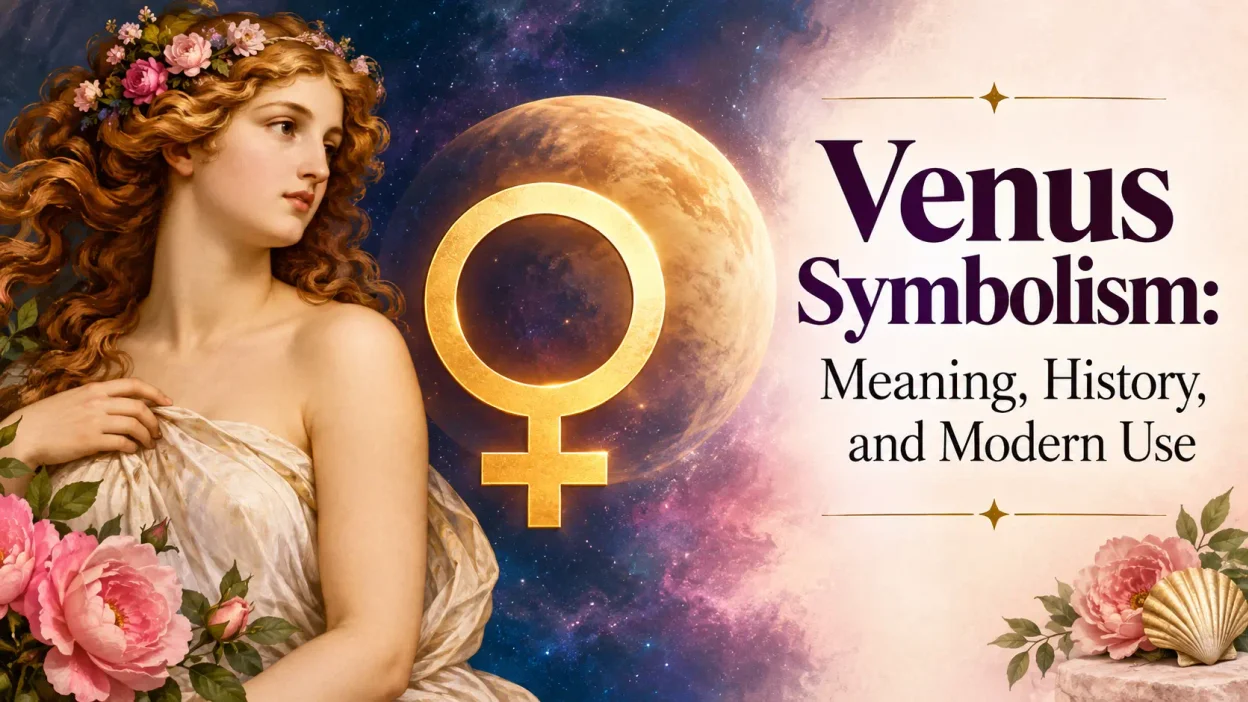
Venus symbolism is closely associated with love, beauty, attraction, desire, fertility, and feminine identity. In modern American culture, Venus can refer to the Roman goddess, the planet named after her, or the familiar Venus symbol ♀, which appears in astrology, biology, art, jewelry, and popular culture.
People are drawn to Venus because its meanings connect ordinary experiences—romantic attraction, beauty, relationships, creativity, pleasure, and self-expression—with a much older cultural tradition. The symbol can therefore carry very different meanings depending on whether it appears in mythology, a birth chart, a tattoo, a fashion design, or a scientific context.
Understanding Venus requires separating these uses rather than treating them as one fixed definition. The goddess Venus was shaped by Roman religion and earlier Mediterranean traditions, while the planet and its symbol developed additional meanings through astronomy, astrology, science, and modern culture.
Quick Answer
Venus symbolism commonly represents love, beauty, attraction, desire, and feminine identity in modern American culture. Historically, Venus was the Roman goddess associated with love and beauty, while the planet Venus and its ♀ symbol later gained additional meanings in astrology, astronomy, biology, and popular culture.
TL;DR
- Venus commonly represents love, beauty, attraction, and pleasure.
- Roman Venus combined romantic desire with fertility and prosperity.
- The planet Venus strengthened associations with brightness and feminine symbolism.
- The ♀ symbol appears in astrology, biology, gender symbolism, and design.
- Modern Americans often use Venus imagery for identity and personal expression.
- Venus symbolism can be positive, romantic, artistic, or commercially stylized.
What Venus Represents in Modern American Culture
In the United States, Venus is most recognizable as a symbol of love and beauty. Her image often suggests romance, elegance, sensuality, femininity, or artistic taste.
The meaning changes according to context. A classical painting of Venus may emphasize beauty and mythology, while a necklace featuring the ♀ symbol may communicate femininity or an interest in astrology. A tattoo of Venus could represent romantic love, self-confidence, sexuality, independence, or an appreciation for classical art.
Venus is also connected with pleasure rather than romance alone. In contemporary usage, the symbolism can include enjoying beauty, cultivating personal style, appreciating art, and valuing relationships.
This flexibility explains why Venus continues to appear in advertising, fashion, beauty branding, tattoos, astrology, and visual art.
Ancient Roots and the Roman Goddess Venus
Venus was an important Roman goddess whose identity developed over time. She became strongly associated with love, beauty, fertility, and desire, but her religious significance was broader than modern ideas of romantic attraction.
In early Roman tradition, Venus had connections with vegetation, fertility, and agricultural abundance. As Roman culture interacted with Greek culture, Venus became increasingly identified with the Greek goddess Aphrodite.
The Roman goddess eventually acquired a major place in mythology and public life. She was associated with desire and beauty, but also with motherhood, prosperity, victory, and the legendary origins of Rome.
Roman writers and artists presented Venus in different ways. She could appear as an idealized beautiful woman, a motherly figure, a divine ancestor, or a goddess connected with political legitimacy.
This broader history matters because reducing Venus to romance alone leaves out some of the reasons she became such an important figure in Roman culture.
Why Venus Became a Symbol of Love and Beauty
Venus’s association with love developed through her connection to desire, attraction, sexuality, and relationships. Her beauty was not merely decorative; it represented a force capable of influencing gods, heroes, rulers, and ordinary human behavior.
Beauty and desire were closely linked in classical mythology. A beautiful figure could inspire affection, rivalry, ambition, jealousy, or conflict. Venus therefore represented both the appeal of beauty and the consequences of attraction.
Her mythological role also helped establish an enduring artistic tradition. Artists repeatedly portrayed Venus as an ideal of physical beauty, particularly through sculptures and paintings showing her birth, beauty, bathing, or encounters with other mythological figures.
Over time, these artistic traditions made Venus one of the most recognizable classical representations of feminine beauty in Western art.
Venus, Aphrodite, and the Greek Influence
Venus and Aphrodite are often treated as the same goddess, but their histories are not identical.
Aphrodite was a Greek goddess associated strongly with love, sexual attraction, beauty, and desire. When Roman culture absorbed and adapted Greek mythology, Venus became closely identified with Aphrodite.
The relationship between the two traditions influenced later European literature and art. Renaissance artists, for example, frequently returned to classical mythology and represented Venus using visual ideas associated with Aphrodite.
For modern American audiences, this distinction is mostly relevant when interpreting historical artwork or mythology. A contemporary reference to Venus may draw from Roman tradition, Greek mythology, astrology, or modern ideas of femininity without strictly following any single ancient system.
Venus and the Origins of Rome
Venus had an important political role in Roman identity.
According to Roman tradition, Venus was the mother of Aeneas, a legendary Trojan hero whose descendants were connected to the founding of Rome. Through Aeneas, Venus became an ancestral figure for the Roman people and, particularly, for the Julian family.
Julius Caesar famously promoted the idea that his family descended from Venus through Aeneas. This gave the goddess significance beyond romance or beauty. She could symbolize ancestry, legitimacy, protection, and the prestige of Rome.
The title Venus Genetrix, meaning Venus the Mother or Ancestress, reflected this maternal and ancestral role.
This history shows how symbolism can change when religious imagery enters public life. Venus could represent personal desire in one setting and political ancestry or national identity in another.
The Planet Venus and Its Symbolic Meaning
The planet Venus added another layer to the goddess’s symbolism.
Venus is exceptionally bright in Earth’s sky and is often visible shortly before sunrise or after sunset. This prominence helped ancient cultures associate the planet with an important celestial presence.
The planet’s changing appearance as a morning or evening object contributed to its cultural importance across different civilizations. Ancient observers developed names and interpretations for the bright object long before modern astronomy established that the morning and evening appearances were the same planet.
Because the planet was associated with the goddess Venus in Roman tradition, celestial Venus inherited many of the goddess’s cultural associations.
Today, the planet can symbolize brightness, beauty, attraction, and celestial mystery in literature and popular culture, although these are cultural interpretations rather than scientific properties of the planet itself.
The ♀ Venus Symbol and What It Means
The familiar Venus symbol, ♀, is one of the most recognizable symbols associated with femininity.
Its historical connection to Venus helped it become associated with women and female identity. In modern science, it is also used in biology and medicine to identify the female sex.
The symbol appears in several other settings:
- Astrology and birth charts
- Gender-related diagrams
- Feminist artwork
- Jewelry and tattoos
- Fashion graphics
- Social media designs
- Educational materials
- Classical mythology references
Its meaning depends heavily on context. In an astrology chart, ♀ refers specifically to Venus and its astrological associations. In a biological diagram, it may indicate female sex. In fashion or jewelry, it may communicate femininity or simply reference classical symbolism.
Venus in Astrology
Venus remains one of the most familiar figures in Western astrology.
In an astrological birth chart, Venus is traditionally associated with love, attraction, relationships, pleasure, beauty, values, and personal taste. Astrological interpretations often examine Venus to discuss how a person approaches affection, romance, aesthetics, and social connection.
This modern use differs from astronomy. Astrology assigns symbolic meanings to celestial bodies, while astronomy studies them as physical objects.
For many Americans who engage with contemporary astrology, however, Venus is a familiar shorthand for romantic preferences, beauty, pleasure, and relationship patterns. This has helped preserve Venus symbolism outside strictly historical or religious contexts.
Venus and Feminine Identity
Venus has become one of Western culture’s strongest symbols of femininity, but feminine identity is not the same thing as beauty.
Historically, Venus was often portrayed according to ideals of physical attractiveness established by particular societies. Modern audiences may admire these images while also questioning the narrow beauty standards they represent.
Contemporary uses of Venus can therefore carry two different messages. One may celebrate femininity, sensuality, elegance, and beauty. Another may reclaim these qualities as forms of individual identity and self-expression rather than standards imposed from outside.
This is especially visible in fashion, body art, feminist visual culture, and social media. A person using Venus imagery may be expressing confidence and ownership of femininity rather than simply saying, “beauty.”
Emotional and Psychological Associations
Venus symbolism often evokes emotions connected with affection, attraction, pleasure, admiration, and connection.
Because love is rarely emotionally simple, Venus can also represent vulnerability. Attraction can bring excitement and confidence, but it can also create jealousy, longing, insecurity, or emotional risk.
The symbol can therefore work as a visual shorthand for the positive and complicated sides of relationships.
Venus also represents aesthetic pleasure. Someone may connect with Venus because they value art, clothing, music, architecture, cosmetics, or personal surroundings. In this sense, Venus symbolism can communicate an appreciation for beauty without having a specifically romantic meaning.
For modern audiences, that broader interpretation is increasingly important. Beauty can be understood as an aspect of personal taste rather than a fixed social standard.
Venus in Art, Fashion, and Design
Few classical mythological figures have had as long an artistic afterlife as Venus.
Renaissance and later European artists repeatedly portrayed her because classical mythology provided a culturally accepted way to depict the nude female body while exploring beauty, desire, and idealized form.
In contemporary design, Venus imagery is often simplified. Designers may use a classical profile, shell imagery, flowing hair, a mirror, or the ♀ symbol without reproducing the goddess literally.
Fashion brands and beauty-related designs may use Venus because the name immediately suggests attractiveness, femininity, luxury, or romance. Jewelry can use the symbol in a more personal way, turning an ancient emblem into a statement about identity.
The symbolism becomes especially flexible when stripped of its mythological setting.
Venus in Tattoos and Personal Expression
A Venus tattoo can mean very different things from one person to another.
Some people choose Venus to represent love or romantic relationships. Others connect with feminine strength, beauty, sexuality, independence, or artistic identity. Someone interested in classical mythology may choose the goddess for historical reasons, while an astrology enthusiast may prefer the ♀ symbol.
Common Venus-inspired tattoo elements include:
- The Venus symbol ♀
- Classical goddess portraits
- Shells associated with Venus’s birth imagery
- Roses and other flowers
- Stars or celestial imagery
- Mirrors
- Planetary symbols
- Classical sculptures
The design can shift the message significantly. A realistic classical portrait suggests mythology and art history, while a minimalist ♀ symbol may feel modern and personal.
Venus in American Popular Culture
Venus appears in American culture in ways that range from serious artistic references to playful commercial imagery.
The name is familiar in beauty, fashion, music, advertising, astronomy, astrology, and entertainment. Images inspired by the goddess are sometimes used to sell products associated with attractiveness or self-care.
The planet also has a strong place in science fiction and popular astronomy because of its unusual environment and bright appearance in the night or morning sky.
Meanwhile, astrology has brought Venus into everyday conversations about relationships and compatibility. This means Americans may encounter Venus without consciously connecting it to ancient Roman religion.
The symbol has survived partly because it can be understood at several levels: mythological, astronomical, astrological, scientific, aesthetic, and personal.
Venus Across Cultures and Traditions
Venus is specifically Roman, but the broader idea of a goddess associated with love and beauty appears in many cultures.
The Greek Aphrodite is the closest classical counterpart. Other traditions have their own deities or mythological figures connected with love, fertility, sexuality, beauty, or relationships, but they should not automatically be treated as versions of Venus.
This distinction matters because different cultures attach different values to beauty, marriage, sexuality, fertility, and feminine identity.
The planet Venus also received different names and meanings in ancient civilizations. Its brightness made it an important celestial object in cultures that carefully observed the sky.
Rather than assuming that all cultures interpret Venus identically, it is more accurate to recognize a recurring human interest in love, beauty, fertility, and celestial observation while respecting each tradition’s particular history.
Venus Symbolism by Context
| Context | Meaning in the USA | Common Associations | Notes |
|---|---|---|---|
| Roman mythology | Love, beauty, fertility, ancestry | Venus, Aphrodite, Aeneas | Historical and mythological context |
| Astrology | Love, attraction, pleasure, values | Relationships, beauty, compatibility | Symbolic rather than scientific |
| Biology | Female sex | ♀, reproduction, gender | Scientific notation |
| Tattoos | Personal love or femininity | Beauty, sexuality, identity | Meaning depends on design |
| Fashion and design | Beauty and femininity | Elegance, luxury, romance | Often separated from mythology |
| Astronomy | Bright celestial body | Evening star, morning star | Scientific meaning differs from symbolism |
Common Misunderstandings About Venus
One common misunderstanding is that Venus has always represented romance and nothing else. Roman Venus had wider associations involving fertility, prosperity, ancestry, and the identity of Rome.
Another mistake is treating the Roman goddess and Greek Aphrodite as completely interchangeable. They became closely connected, but their religious histories developed in different cultural settings.
It is also easy to confuse astrological symbolism with scientific claims. Astrology gives Venus interpretive meanings concerning relationships and personal values, while astronomy describes the planet’s physical characteristics.
The ♀ symbol can create another misunderstanding. It is strongly associated with women today, but its use can vary between mythology, astrology, biology, and modern identity-related contexts.
Recognizing these differences makes Venus symbolism easier to interpret accurately.
How Venus Symbolism Has Changed Over Time
Venus began as a Roman goddess whose significance included fertility, agriculture, love, and ancestry. Her identification with Aphrodite expanded her connection with beauty and erotic desire.
Later European artists transformed Venus into an enduring model of classical feminine beauty. During the Renaissance and subsequent centuries, her image became increasingly important in painting, sculpture, literature, and decorative art.
Modern culture has simplified many of these meanings. Venus can now stand for romance, femininity, beauty, astrology, or personal style without requiring knowledge of Roman religion.
At the same time, contemporary audiences often question traditional beauty standards. This allows Venus to be interpreted not only as an ideal of attractiveness but also as a symbol of self-definition, confidence, and control over one’s image.
The symbol has survived because its meaning has adapted to the needs of different eras.
FAQ About Venus Symbolism
What does Venus symbolize spiritually?
Venus is commonly associated with love, beauty, attraction, fertility, pleasure, and relationships. Spiritual interpretations vary widely, so Venus should not be assigned one universal religious meaning.
What does the Venus symbol ♀ mean?
The ♀ symbol is traditionally associated with Venus and is widely used to represent femininity or the female sex. It appears in astrology, biology, gender-related contexts, jewelry, tattoos, and visual design.
What does a Venus tattoo symbolize?
A Venus tattoo can represent love, beauty, femininity, sexuality, confidence, artistic appreciation, or an interest in classical mythology. The specific imagery often determines the intended meaning.
Is Venus the same as Aphrodite?
Venus became closely identified with the Greek goddess Aphrodite, but they originated in different cultural traditions. Roman Venus developed her own religious and political significance within Roman society.
What does Venus mean in astrology?
In Western astrology, Venus is traditionally associated with love, attraction, pleasure, beauty, relationships, personal values, and aesthetics. These are astrological interpretations rather than scientific descriptions of the planet.
Is Venus a symbol of femininity?
Yes, Venus is one of the major Western symbols associated with femininity. However, its historical meaning was broader and included love, fertility, prosperity, ancestry, and political identity.
Is Venus symbolism always positive?
Not necessarily. Venus can represent jealousy, seduction, vanity, rivalry, or the complications of desire as well as love and beauty. The surrounding story or visual context determines whether the symbolism feels positive, negative, or ambiguous.
Conclusion
Venus represents far more than romantic love. In American culture, the symbol can point to beauty, attraction, femininity, pleasure, creativity, relationships, astrology, or personal identity, while its historical roots connect it to Roman religion, fertility, ancestry, and the cultural identity of Rome.
The lasting appeal of Venus symbolism comes from its ability to move between mythology and everyday life. The goddess appears in classical art, the planet remains visible in the sky, and the ♀ symbol continues to appear in science, fashion, tattoos, astrology, and personal design.
Its meaning is therefore best understood through context. Venus can represent an ancient goddess, a celestial body, a feminine emblem, or a modern statement about beauty and identity—and each interpretation tells a different part of its long cultural history.