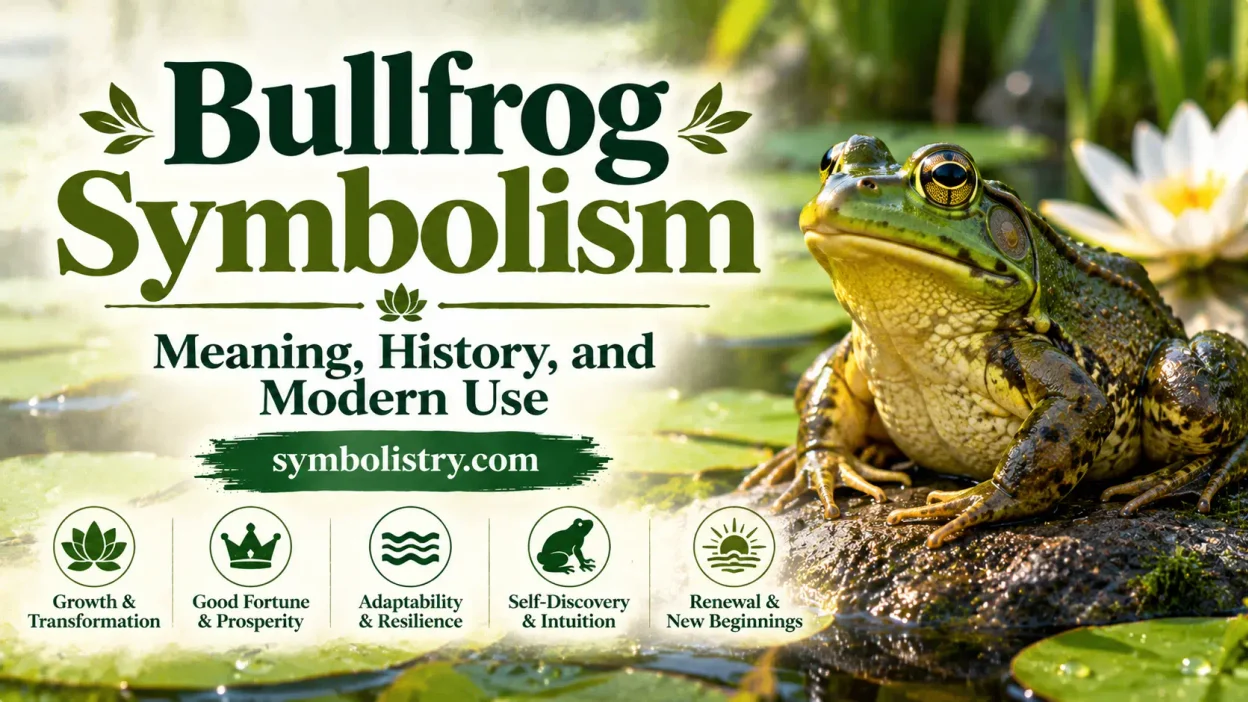
A bullfrog is hard to ignore. Its large body, powerful hind legs, wide mouth, and unmistakable call give it a presence that feels bigger than its actual size. In the United States, the American bullfrog is especially familiar around ponds, lakes, marshes, farm reservoirs, and slow-moving waterways.
Bullfrog symbolism often centers on transformation, adaptability, abundance, water, persistence, and a willingness to make oneself heard. Those associations come partly from the animal itself: bullfrogs spend much of their lives around water, undergo a dramatic change from tadpole to adult, and produce a remarkably deep call for their size.
But the meaning is not limited to modern nature imagery. Frogs have appeared in Indigenous traditions, folklore, art, and stories in many parts of the world, sometimes representing rain and fertility and sometimes carrying more complicated associations. The bullfrog’s meaning in contemporary America is therefore best understood as a combination of its natural characteristics, older frog traditions, regional folklore, and modern popular culture.
Quick Answer
Bullfrog symbolism commonly represents adaptability, transformation, abundance, and connection with water in modern American culture. Historically, frog traditions have also connected the animal with rain, fertility, renewal, and the life-giving qualities of water, although meanings vary considerably between cultures.
TL;DR
- Bullfrogs commonly represent adaptability, transformation, and persistence.
- Water connects frogs with rain, renewal, and natural abundance.
- Indigenous frog traditions differ significantly between nations and communities.
- American folklore sometimes turns the bullfrog into a local cultural emblem.
- Tattoos and artwork often emphasize change, resilience, or individuality.
- Modern interpretations increasingly connect bullfrogs with wetlands and environmental awareness.
What Makes the Bullfrog Symbolically Distinct?
Not every frog carries exactly the same cultural impression. The American bullfrog has characteristics that give it a particularly recognizable symbolic identity.
It is large compared with many other frogs, and its low, resonant call can travel considerable distances across water. The call is associated with territorial behavior and mating, but to people it can become part of the atmosphere of a summer evening beside a pond.
Its physical strength also distinguishes it from the delicate image sometimes associated with small tree frogs. A bullfrog looks sturdy, alert, and capable of sudden movement.
That combination encourages associations with strength, confidence, persistence, and self-assertion.
At the same time, the bullfrog remains strongly tied to water. Its life cycle and habitat naturally connect it with ideas of change, renewal, seasonal cycles, and environmental conditions.
The Core Meanings Associated With Bullfrogs
Several symbolic ideas appear repeatedly when people interpret the bullfrog.
Transformation comes from its metamorphosis from aquatic tadpole into an adult frog. The change is visible and dramatic, making the frog a straightforward image of personal development.
Adaptability comes from its ability to live between aquatic and terrestrial environments. Symbolically, that can suggest learning how to function during changing circumstances rather than remaining fixed in one condition.
Abundance is connected to water, reproduction, and the large numbers in which frogs can sometimes appear when environmental conditions are favorable.
Persistence reflects the bullfrog’s survival and its ability to establish itself in different environments. The meaning can apply metaphorically to people who continue despite obstacles.
Voice and self-expression are particularly relevant to the bullfrog because of its loud, distinctive call. A bullfrog can symbolize speaking up, claiming one’s space, or refusing to remain unnoticed.
These meanings should be treated as interpretive associations rather than a universal symbolic dictionary. A bullfrog appearing in a painting, tattoo, story, or dream can mean something quite different depending on the surrounding imagery.
Water, Rain, and Renewal
Water is one of the strongest foundations of frog symbolism.
People have long noticed that frogs are closely associated with wet environments and that their activity can change with weather and seasonal moisture. This makes the frog a natural cultural marker for rain and the return of water.
The connection is particularly understandable in places where rainfall determines crops, freshwater availability, and seasonal survival. A frog appearing after rain can seem like part of the landscape announcing that conditions have changed.
That association developed independently in multiple cultural traditions. Frog imagery in parts of Mesoamerica, Africa, Asia, and Indigenous North America has been connected with rain, fertility, water, or renewal, although the specific beliefs are not interchangeable.
For modern Americans, this symbolism often appears in a less religious form. A frog may simply represent fresh starts, spring, wetlands, rainfall, and the restoration of life after a dry period.
Ancient and Indigenous Frog Traditions
Frog traditions are much older than modern environmental symbolism.
In several Indigenous North American traditions, frogs appear in stories concerning water, rain, fertility, healing, creation, or transformation. However, there is no single “Native American frog meaning.” Hundreds of Indigenous nations have distinct languages, histories, ceremonial systems, and relationships with animals.
Some traditions give frogs an important relationship to moisture and rainfall. Navajo traditions, for example, include Frog in stories involving water and rain, while frog clans and frog imagery occur among several Indigenous peoples of the Southwest and Northwest Coast.
Some Wabanaki traditions also preserve stories involving a giant frog or bullfrog-like water creature. In these stories, the animal’s relationship with water becomes central to the narrative rather than simply serving as decoration.
This distinction matters. It is more accurate to say that particular Indigenous traditions associate frogs with particular meanings than to claim that all Native peoples shared one interpretation.
The broader pattern is understandable: an amphibian that depends on water naturally becomes important in cultures where rainfall and freshwater have major ecological consequences.
Bullfrog Symbolism in American Folklore
The bullfrog also has a place in American regional folklore.
One striking example comes from Windham, Connecticut, where an 18th-century episode known as the “Battle of the Frogs” eventually became part of the town’s identity. The story grew into local folklore, and the frog was eventually adopted as an emblem of the community.
This example shows how animal symbolism can develop through local storytelling rather than ancient religious tradition.
A creature does not need to have a universally recognized sacred meaning to become symbolic. Communities often turn unusual animals, local events, legends, and landscape features into markers of regional identity.
The bullfrog works particularly well in this role because its appearance and call are immediately recognizable. It can become a humorous emblem, a local mascot, or a reminder of a particular place.
What the Bullfrog Represents in the United States
In contemporary American culture, bullfrog symbolism is usually more ecological and personal than religious.
A bullfrog may represent:
| Context | Meaning in the USA | Common Associations | Notes |
|---|---|---|---|
| Nature imagery | Adaptability | Wetlands, water, wildlife | Often connected with outdoor life |
| Personal symbolism | Transformation | Growth, change, resilience | Common in tattoos and artwork |
| Local identity | Regional character | Ponds, folklore, community | Can become a town or school emblem |
| Environmental themes | Wetland life | Habitat, biodiversity, conservation | Meaning can be positive or cautionary |
| Humor and popular culture | Personality | Loudness, stubbornness, individuality | Often based on the bullfrog’s appearance and call |
American interpretations also depend on familiarity. Someone who grew up fishing around farm ponds may associate the bullfrog with summer evenings and childhood memories. Someone interested in conservation may instead see it as part of a larger conversation about wetland ecosystems and invasive species.
Transformation and Personal Growth
The frog’s life cycle gives transformation a particularly literal foundation.
A tadpole begins life as an aquatic animal with a tail and develops into a four-legged frog capable of living outside the water. Because the change is so obvious, frogs have become convenient symbols for personal development.
A bullfrog tattoo, illustration, or story may therefore represent a period in which someone has moved from one stage of life into another.
This does not necessarily mean dramatic reinvention. The symbol can also describe ordinary adaptation: leaving home, changing careers, recovering from a difficult period, becoming a parent, or learning to function in a new environment.
The bullfrog adds another dimension because it is not generally portrayed as fragile. Its symbolism can suggest changing without becoming weaker.
Strength, Confidence, and Having a Voice
The bullfrog’s call gives it a symbolic association that smaller frogs do not always carry as strongly.
A male American bullfrog’s call is deep and conspicuous. In a quiet environment, it can seem surprisingly large for the animal producing it.
That makes the bullfrog a useful metaphor for being heard.
In personal symbolism, it can represent someone who has stopped minimizing themselves or who has learned to speak with greater confidence. In a humorous context, it can suggest a person who is loud, opinionated, stubborn, or impossible to overlook.
This interpretation is especially useful because it does not require treating the animal as inherently noble. Symbolism can capture personality traits that are admirable in one context and irritating in another.
Fertility, Abundance, and the Reproductive Cycle
Frog symbolism has frequently been associated with fertility because frogs reproduce in water and can appear in large numbers under favorable conditions.
Historically, some cultures connected frogs with agricultural fertility because rain and water were essential to crops. In those settings, frog imagery could represent the conditions necessary for human and ecological abundance.
Modern American symbolism usually treats this meaning more indirectly.
A bullfrog may represent creative productivity, growth, family expansion, or the ability to generate new possibilities rather than literal fertility. The meaning is particularly common when frog imagery appears alongside plants, water, eggs, tadpoles, or other natural motifs.
It is important not to assume that every frog image carries a fertility message. Context determines whether this association is relevant.
Emotional and Psychological Associations
The bullfrog can communicate several different emotional qualities.
Its connection with water can suggest calm, reflection, and returning to a natural rhythm. Its sudden movements can represent alertness and responsiveness. Its metamorphosis can symbolize acceptance of change.
Its loud call introduces a different emotional register: confidence, assertiveness, and sometimes comic stubbornness.
For some Americans, however, the most important meaning may be personal rather than cultural. A bullfrog encountered repeatedly during childhood can become associated with a particular pond, family property, summer vacation, or outdoor experience.
In that case, the animal functions as a memory symbol. Its meaning comes from lived experience rather than a traditional symbolic system.
Bullfrogs in Tattoos and Personal Style
Bullfrog tattoos are relatively unusual compared with butterflies, snakes, lions, or birds, which makes the choice itself potentially meaningful.
Someone may choose a bullfrog to represent transformation without using a conventional “rebirth” image. The animal can also express an appreciation for wetlands, wildlife, rural landscapes, childhood memories, or an unconventional personality.
A realistic bullfrog can emphasize natural history and ecological identity. A cartoon-style frog can create humor. A bullfrog surrounded by water, reeds, or lily pads can emphasize its environmental associations.
The symbolism becomes more specific when combined with other imagery. For example, a tadpole and adult frog together can emphasize development, while rain can strengthen the themes of renewal and new beginnings.
Bullfrogs in Art, Decor, and Popular Culture
Frog imagery has a long history in illustration, children’s literature, advertising, mascots, and decorative art.
Bullfrogs work particularly well visually because their broad faces and large eyes are easy to exaggerate. Artists can make them humorous, stubborn-looking, friendly, intimidating, or cartoonish without changing the basic animal.
In home decor, frog imagery may suggest gardens, ponds, rustic landscapes, or playful natural themes. In children’s media, frogs frequently represent curiosity, transformation, humor, or adventure.
Digital culture has also broadened frog imagery. Online communities often use stylized frog characters as humorous expressions or identity markers. These uses can have little relationship to traditional frog symbolism.
That distinction is useful: a frog image online may be a cultural reference, a joke, an aesthetic choice, or a personal symbol rather than an expression of historical beliefs.
Positive and Negative Interpretations
Bullfrog symbolism is not exclusively positive.
The same traits that produce favorable meanings can produce negative ones. A bullfrog’s loud call can symbolize obnoxiousness or excessive self-assertion. Its association with stagnant water can evoke unpleasant environments. In some folklore traditions, frogs and toads have also been associated with disease, witchcraft, contamination, or misfortune.
There is another modern complication in the United States. American bullfrogs have been introduced beyond their native eastern range and can affect native amphibians through predation, competition, and disease transmission.
Consequently, an environmental interpretation of the bullfrog can be very different from a traditional symbolism article. In one context, it represents resilience and abundance; in another, it represents the ecological consequences of moving species beyond their native habitats.
Neither interpretation has to cancel out the other.
Common Misunderstandings About Bullfrog Symbolism
One common mistake is assuming that all frog symbolism automatically applies specifically to bullfrogs.
Many traditions concern frogs generally, not the American bullfrog as a distinct species. Historical meanings should therefore not be transferred to the bullfrog without considering geography, species, and cultural context.
Another mistake is presenting Indigenous symbolism as one unified belief system. Native nations have different traditions, and the meaning of Frog can vary substantially from one community to another.
A third misunderstanding is treating modern “spirit animal” interpretations as ancient universal facts. Contemporary spiritual websites often combine traditional motifs with modern self-help language. Those interpretations may be meaningful to individuals, but they should not automatically be presented as historical traditions.
How Bullfrog Meaning Has Changed Over Time
The symbolic history of the bullfrog illustrates how animal meanings evolve.
Earlier traditions often focused on practical relationships between frogs, water, rainfall, fertility, and seasonal change. Local folklore later gave frogs new roles as characters in community stories and legends.
In modern America, the emphasis has shifted toward personal identity, humor, environmental awareness, childhood nostalgia, and artistic expression.
The bullfrog can therefore mean different things to different generations. To one person it is the sound of a summer pond. To another it is an emblem of transformation. To a community it may represent local folklore. To an environmentalist, it may prompt questions about wetland health or invasive species.
The symbol remains recognizable because the animal itself provides the foundation, while culture continues to add new interpretations.
Frequently Asked Questions
What does a bullfrog symbolize spiritually?
Bullfrogs are often interpreted spiritually as symbols of transformation, renewal, water, adaptability, and abundance. However, spiritual interpretations vary, and there is no single universal bullfrog tradition shared across cultures.
What does a bullfrog tattoo mean?
A bullfrog tattoo can represent personal transformation, resilience, individuality, connection with nature, or a meaningful memory associated with water. The surrounding imagery often reveals which interpretation matters most to the wearer.
Are frogs considered symbols of good luck?
In some cultures and traditions, frogs are associated with prosperity, fertility, rain, or favorable change. In others, frogs can have negative associations, so “good luck” is not a universal interpretation.
What does a bullfrog symbolize in Native American traditions?
There is no single Native American meaning for the bullfrog. Particular Indigenous traditions associate frogs with subjects such as water, rain, fertility, healing, clans, or important mythological stories, but interpretations differ among nations.
Does a bullfrog symbolize transformation?
Yes, transformation is one of the most understandable symbolic associations because frogs undergo metamorphosis from aquatic tadpoles to adults. In personal symbolism, this can represent growth, adaptation, or moving into a new stage of life.
What does hearing a bullfrog symbolize?
In a symbolic or personal context, hearing a bullfrog may suggest water, seasonal change, summer, persistence, or finding one’s voice. There is no established universal omen attached to hearing one.
Is bullfrog symbolism always positive?
No. Bullfrogs can symbolize confidence and resilience, but their loudness can also represent stubbornness or excess, while their ecological impact can create negative associations in areas where they have been introduced.
Conclusion
Bullfrogs carry symbolic meanings that grow naturally from their biology and their place in human landscapes. Their transformation from tadpole to adult supports ideas of change, while their relationship with water connects them with renewal, rain, fertility, and ecological cycles. Their powerful call adds themes of confidence, individuality, and being heard.
In the United States, bullfrog symbolism is especially flexible. It can point to personal growth, childhood memories, regional folklore, nature, environmental concerns, or simply the distinctive personality of an animal that is difficult to overlook.
The most useful interpretation is usually the one that considers both the cultural setting and the actual animal. A bullfrog does not carry one permanent message; its symbolism changes as people encounter it in stories, landscapes, art, memory, and modern life.