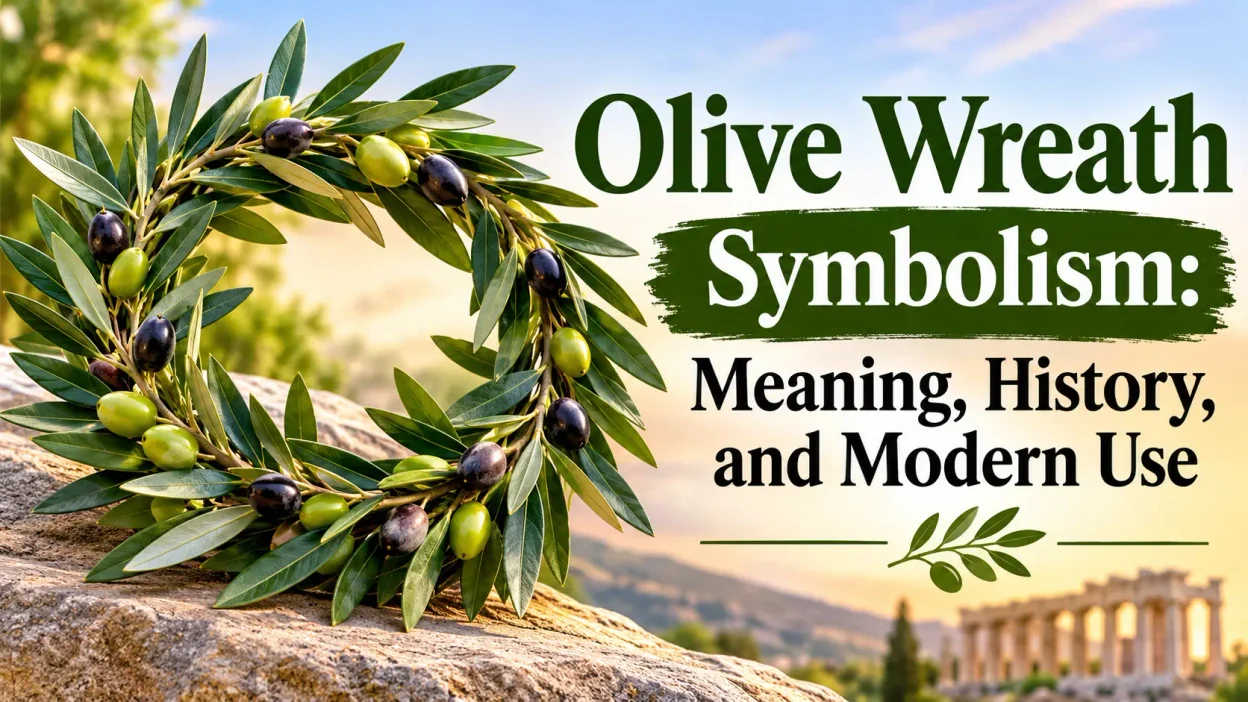
Olive wreath symbolism connects the ancient traditions of victory, honor, peace, and wisdom with the ways people express achievement and respect today. Made from branches of the olive tree, an olive wreath is a circular arrangement of slender leaves that has appeared in ancient ceremonies, athletic competitions, religious imagery, and decorative art.
The wreath is especially associated with ancient Greece, where victorious athletes received crowns made from wild olive branches. Unlike a modern trophy or medal, this natural crown represented public recognition, personal achievement, and honor connected with the gods.
In the United States, the olive wreath carries several overlapping meanings. People may recognize it as a classical symbol of achievement, a sign of peace, or an ornamental design associated with education, leadership, and historical tradition. Its meaning depends on where it appears and whether it is presented as a crown of victory, a decorative emblem, or a sign of reconciliation.
Understanding its history helps explain why such a simple arrangement of leaves continues to communicate ideas about success, dignity, and peaceful intentions.
Quick Answer
Olive wreath symbolism commonly represents victory, honor, achievement, and peace in modern American culture, especially in awards, classical designs, and commemorative imagery. Historically, it was associated with ancient Greek athletic victories, the goddess Athena, and the recognition of excellence and public honor.
TL;DR
- Victory: Ancient Greek athletes received olive wreaths as awards.
- Honor: The wreath recognized excellence, distinction, and public achievement.
- Peace: Olive imagery developed a lasting association with reconciliation.
- Wisdom: Its connection with Athena links it to intelligence and thoughtful leadership.
- American culture: It appears in classical decoration, commemorative art, and achievement-related designs.
- Modern use: Jewelry, tattoos, logos, and artwork give the wreath personal meaning.
1. What an Olive Wreath Looks Like
An olive wreath is traditionally made by weaving thin olive branches into a circular or slightly oval crown. Its leaves are usually narrow, elongated, and gray-green or silvery green, with small olives sometimes included as decorative details.
Traditional wreaths were made from freshly cut branches, although modern versions may use dried leaves, metal, fabric, or artificial materials. Some are simple arrangements of leaves, while others feature gold or silver finishes.
Several details distinguish an olive wreath from other traditional crowns:
- Leaves: Narrow olive leaves represent the characteristic foliage of the olive tree.
- Circular shape: The connected branches create a form associated with continuity and completeness.
- Branches: Their natural appearance connects the wreath with growth and endurance.
- Metallic finishes: Gold and silver versions often emphasize honor, achievement, and ceremonial importance.
Olive wreaths are sometimes confused with laurel wreaths. Although both appear in classical art and represent achievement, they have different botanical origins and historical associations. Olive wreaths are particularly connected with the ancient Olympic Games, while laurel wreaths became strongly associated with Apollo, poetic accomplishment, and victory.
2. The Main Symbolic Meanings of an Olive Wreath
The olive wreath carries several meanings that developed through different historical and cultural traditions.
Victory and achievement
Its strongest historical association is victory. Ancient Greek athletes received olive crowns to recognize their success in prestigious competitions. Today, the wreath can represent reaching an important goal through effort and discipline.
Honor and recognition
An olive wreath communicates respect for someone who has demonstrated excellence. It represents recognition that comes from accomplishment rather than simply possessing wealth or authority.
Peace and reconciliation
Olive branches have become widely recognized signs of peaceful intentions. When incorporated into a wreath, they can suggest harmony, goodwill, and the desire to resolve disagreements.
Wisdom and thoughtful leadership
The olive tree’s connection with Athena gives the wreath an additional association with intelligence, practical judgment, and responsible leadership.
Endurance and perseverance
Olive trees are long-lived plants that can survive difficult growing conditions. Their branches can therefore suggest patience, resilience, and the ability to continue through hardship.
These meanings can exist together. A wreath presented to an accomplished person, for example, may recognize both the achievement itself and the perseverance required to reach it.
3. Ancient Greek Origins and the Olympic Tradition
The most important historical association of the olive wreath comes from ancient Greece.
At Olympia, athletes competing in the ancient Olympic Games received crowns made from wild olive branches. These crowns were known as kotinos. They were prepared using branches from a sacred olive tree associated with the sanctuary of Zeus.
The tradition was connected with religious ceremonies as well as athletic competition. Winning was not simply a personal accomplishment. It brought honor to the athlete’s community and demonstrated qualities that ancient Greek society admired.
The wreath itself had little material value compared with the recognition it represented. A champion did not receive an expensive gold crown as the Olympic prize. Instead, the simple natural wreath communicated that the athlete had achieved an exceptional distinction.
This difference matters when interpreting the symbol today. The original meaning was not primarily about money, luxury, or possessions. It was about excellence, public recognition, and honor.
Ancient Greek athletic festivals also used other plant crowns. Laurel, pine, and wild celery were associated with different competitions. The olive wreath became particularly identified with Olympia.
The ancient tradition eventually influenced later artistic representations of champions, heroes, and distinguished individuals.
4. Athena and the Connection With Wisdom
The olive tree has a particularly important connection with Athena in Greek mythology.
According to a well-known myth, Athena and Poseidon competed for the patronage of the city that became Athens. Poseidon offered a gift associated with water or a powerful horse, depending on the version of the story. Athena offered the olive tree, which provided food, oil, and useful wood.
The people chose Athena’s gift, and the city received her name.
The story helps explain why olive imagery became associated with wisdom and practical intelligence. The olive tree represented something useful that could support a community for generations.
Athena was also associated with strategy, craftsmanship, civic responsibility, and intelligent decision-making. These qualities influenced the way the olive tree was understood in ancient Greek culture.
An olive wreath inspired by this tradition may therefore communicate more than athletic success. It can represent:
- Intelligence and sound judgment.
- Strategic thinking.
- Responsible leadership.
- Knowledge applied to practical problems.
- The ability to benefit a wider community.
This interpretation is particularly relevant in classical artwork and educational settings.
5. The Olive Wreath in Ancient Honor and Public Recognition
Olive wreaths belonged to a broader ancient tradition of honoring people through plant crowns.
In Greek society, wreaths could be used to recognize athletic achievement, religious dedication, and distinguished accomplishments. The particular plant often indicated the nature of the honor or the deity associated with it.
A crown of leaves was also visually meaningful. Placing a wreath on someone’s head transformed an ordinary person into the central figure of a public celebration.
The crown communicated that the individual had earned recognition.
Wreaths also appeared in funerary and religious settings. They could honor the dead, commemorate accomplishments, and express beliefs about life beyond death.
This broader tradition helps explain why wreaths eventually became part of the visual language of monuments, ceremonial decoration, and classical portraiture.
An olive wreath in an ancient-inspired painting may therefore represent a respected person, a celebrated achievement, or an offering connected with religious devotion.
6. Olive Wreath Symbolism in Roman and European Traditions
Roman culture inherited many artistic and ceremonial traditions from Greece, including the use of plant wreaths to communicate honor and distinction.
However, different wreaths carried different meanings. Roman military and civic honors frequently involved crowns made from other materials or plants, including laurel and oak.
Olive imagery also remained connected with peace and prosperity, while wreaths more generally became part of the visual language of public achievement.
During later European artistic periods, classical wreaths appeared in paintings, sculptures, architecture, medals, and decorative emblems.
Renaissance artists and later neoclassical designers frequently returned to ancient Greek and Roman imagery when representing intellectual excellence, civic virtue, and public honor.
The olive wreath became part of this visual vocabulary.
Its appearance in classical-inspired artwork often communicates an ideal of achievement that combines personal distinction with public respect.
This history explains why olive wreath designs can look traditional or ceremonial even when they appear in modern settings.
7. Religious Meaning and Christian Interpretations
The olive tree also has an important place in biblical and Christian symbolism.
One of the best-known examples appears in the story of Noah’s Ark. After the flood, a dove returns carrying a freshly plucked olive leaf. The leaf signals that the waters are receding and that life is beginning again.
This account helped establish the olive branch as an enduring image of peace, hope, and reconciliation in Christian traditions.
The olive tree also appears in the biblical account of Jesus praying at Gethsemane before his arrest. The location’s olive trees contribute to the plant’s associations with prayer, sacrifice, reflection, and spiritual endurance.
An olive wreath can draw on these associations, although it is important to distinguish the wreath from the more familiar biblical olive branch.
In Christian-inspired artwork, an olive wreath may suggest:
- Peace with God and others.
- Hope after a difficult period.
- Spiritual endurance.
- Reconciliation and forgiveness.
- The promise of renewal.
The wreath may also be used in memorial art to express remembrance and the hope of eternal peace.
Christian interpretations are not identical across denominations, and an olive wreath is not a universally prescribed Christian religious emblem.
8. What an Olive Wreath Means in American Culture
In the United States, the olive wreath is generally understood through a combination of classical heritage, achievement, peace, and ceremonial design.
American public architecture and traditional institutional artwork have frequently drawn on Greek and Roman visual traditions. Wreaths, columns, eagles, shields, and other classical elements communicate ideals associated with public service, education, and civic responsibility.
The country’s founding imagery also gives olive symbolism a particularly recognizable place in American culture.
The Great Seal of the United States, adopted in 1782, depicts a bald eagle holding an olive branch in one talon and arrows in the other. According to the original explanation of the design, these represent the nation’s capacity for peace and war.
The eagle faces toward the olive branch, expressing a preference for peace while retaining the ability to defend the country.
This is an olive branch rather than an olive wreath, but the distinction does not prevent the two designs from sharing related associations.
For Americans, an olive wreath can consequently suggest:
- Classical ideals of honor and civic virtue.
- Peaceful intentions and diplomatic goodwill.
- Recognition of achievement.
- Historical and cultural continuity.
- Respect for education and intellectual accomplishment.
The symbol does not have one official American meaning. Its interpretation depends on the surrounding imagery and the purpose of its use.
9. The Difference Between an Olive Wreath and an Olive Branch
These two symbols are closely related, but they should not be treated as interchangeable.
An olive branch is usually a single stem of olive leaves, sometimes with fruit. An olive wreath is made by arranging and connecting branches into a crown.
Their historical uses explain their different associations.
| Context | Olive Branch | Olive Wreath |
|---|---|---|
| Ancient Greece | Olive tree associations and offerings | Athletic victory and honor |
| Peace imagery | Reconciliation and goodwill | Peaceful achievement and harmony |
| Religious art | Hope and renewal | Honor, remembrance, and spiritual peace |
| American symbolism | National peace imagery | Classical honor and achievement |
| Modern design | Diplomacy and environmental themes | Awards, recognition, and personal identity |
The most recognizable American example is the olive branch held by the eagle on the Great Seal.
An olive wreath, by contrast, is more commonly interpreted through its history as a crown of achievement.
Understanding this difference helps prevent confusion when identifying symbols in paintings, monuments, jewelry, or historical illustrations.
10. Emotional and Psychological Meaning
An olive wreath can communicate emotions that go beyond its historical background.
Its circular shape and natural materials give it a different appearance from a metal trophy or an elaborate royal crown. It suggests recognition without necessarily emphasizing wealth or social status.
A sense of accomplishment: Someone may associate an olive wreath with completing a demanding goal, earning a qualification, or overcoming a personal challenge.
Peace after conflict: Its olive imagery can represent the emotional relief that comes when disagreements are resolved or relationships begin to heal.
Personal dignity: A wreath can express pride in an achievement without appearing excessively extravagant.
Resilience: The long life of olive trees provides a natural connection with patience and persistence.
Belonging and recognition: In historical settings, a wreath was a public sign that someone had earned a respected place among their peers.
The symbol can also create a feeling of calm because of its association with peaceful intentions and natural greenery.
These interpretations are not universal psychological responses. Someone familiar with classical history may immediately associate the wreath with Olympic victory, while another person may see it primarily as a decorative expression of peace.
Personal experience and cultural background influence the emotional response.
11. Olive Wreaths in Tattoos, Jewelry, and Personal Style
Modern olive wreath designs are popular choices for people who appreciate classical imagery and natural symbolism.
Their simple shape makes them adaptable to different artistic styles.
Tattoos
An olive wreath tattoo can represent personal achievement, peace, perseverance, or a new beginning. Some people choose it after overcoming a difficult period, while others use it to commemorate an important milestone.
A small wrist or ankle design may communicate understated personal meaning. A larger circular tattoo can emphasize completeness and the connection between past struggles and present accomplishments.
Jewelry
Olive wreath pendants, rings, bracelets, and earrings offer a subtle way to incorporate classical symbolism into everyday clothing.
Gold designs often emphasize honor and achievement, while silver versions may create a more understated appearance.
Fashion
Olive leaf patterns appear in embroidered clothing, accessories, and decorative prints. They can give an outfit a classical or botanical character.
Personal gifts
An olive wreath pendant or decorative ornament can make a thoughtful gift for someone celebrating graduation, professional success, or an important personal achievement.
The meaning becomes more personal when the gift is connected with the recipient’s own experiences.
12. Olive Wreaths in Weddings, Memorials, and Home Decoration
The olive wreath’s combination of natural beauty and peaceful associations makes it suitable for several ceremonial settings.
Wedding symbolism
In wedding decorations, olive leaves can represent harmony, commitment, and a peaceful shared life. An olive wreath placed on a welcome sign, table arrangement, or invitation can suggest a wish for a lasting relationship.
However, it is not a universal traditional wedding emblem. Its use is generally a modern decorative choice influenced by Mediterranean and classical design.
Memorial arrangements
Olive wreaths can express remembrance, dignity, and peace for someone who has died. They may appear in memorial artwork or commemorative arrangements.
Their meaning can be especially appropriate when families want to emphasize a person’s accomplishments, peaceful character, or lasting influence.
Home decoration
Artificial and dried olive wreaths are used in interior design because their muted green color works with natural, rustic, Mediterranean, and minimalist styles.
A wreath displayed on a wall or door may simply be decorative. In other cases, its historical associations make it a deliberate expression of peace, hospitality, or appreciation for nature.
Celebrations
An olive wreath can also decorate graduation celebrations, retirement gatherings, and achievement ceremonies.
In these situations, it offers a classical alternative to conventional trophies and congratulatory decorations.
13. Modern Digital Culture and Graphic Design
Olive wreaths have a natural place in modern graphic design because they can communicate an idea without requiring much text.
Designers use them in logos, certificates, badges, invitations, packaging, and decorative illustrations.
Their appearance can make a design feel established, traditional, or connected with classical history.
Common applications include:
- Educational graphics: A wreath can frame a name, achievement, or institutional emblem.
- Professional branding: It can suggest quality, distinction, and experience.
- Social media graphics: People may use wreath illustrations in graduation announcements and personal milestone posts.
- Certificates: The design can give recognition documents a ceremonial appearance.
- Event invitations: Olive leaves can introduce themes of peace, elegance, and classical decoration.
Color also affects interpretation.
Green emphasizes nature, renewal, and the olive tree itself. Gold makes the wreath look more ceremonial and achievement-oriented. Silver often creates a restrained, formal appearance.
Digital use has made the symbol more accessible, but its historical associations remain recognizable.
14. Common Misunderstandings and Misuse
Although olive wreath symbolism is generally positive, several misunderstandings can affect its interpretation.
Confusing olive wreaths with laurel wreaths
Both are classical crowns associated with recognition and achievement. However, their botanical identities and specific historical traditions differ. The olive wreath has a particularly strong connection with ancient Olympic victory.
Assuming every wreath means victory
Wreaths made from different plants have appeared in different religious, funerary, athletic, and decorative traditions. Their meanings depend on the plant, setting, and historical period.
Treating the olive wreath as an official American emblem
The Great Seal features an olive branch, not an olive wreath. The distinction matters when discussing official national imagery.
Assuming it always represents peace
An olive wreath can represent victory and honor without necessarily communicating reconciliation. Its appearance in a sports-inspired design, for example, may have little connection with diplomacy.
Using it without understanding its cultural background
The symbol has Greek religious and historical roots, along with later European and Christian interpretations. Using it as a generic decorative crown can remove some of this context.
There is no single universal interpretation of an olive wreath. Its meaning should be understood through its visual surroundings and intended purpose.
15. How Olive Wreath Symbolism Has Changed Over Time
The olive wreath has not retained exactly the same meaning across different historical periods.
Its development can be understood through several stages.
- Ancient Greek periodThe wreath was closely connected with athletic victory, religious tradition, and public recognition. Olympic champions received wild olive crowns as a mark of distinction.
- Roman and classical European periodsOlive and other plant wreaths appeared in ceremonies, artistic representations, and commemorative traditions. Their meanings expanded through the broader visual language of honor and civic achievement.
- Christian and religious traditionsOlive imagery became associated with biblical peace, hope, reconciliation, and spiritual endurance.
- American historical developmentClassical imagery influenced American architecture, public art, and national symbolism. The olive branch became a recognized part of the country’s official peace imagery.
- Modern cultureOlive wreaths now appear in tattoos, jewelry, branding, home decoration, and personal celebrations. Their meanings often combine historical achievement with individual identity.
The biggest change is the movement from a specific ceremonial award to a flexible symbol that individuals can use to express their own values.
A modern olive wreath tattoo, for instance, may represent overcoming adversity rather than winning a public competition.
Despite these changes, the connection between the olive wreath and earned recognition remains one of its most recognizable characteristics.
Frequently Asked Questions
1. What does an olive wreath symbolize spiritually?
An olive wreath can symbolize peace, reconciliation, hope, and spiritual endurance. In Christian-inspired imagery, its associations with the biblical olive branch may also suggest renewal and peace with God.
2. What does an olive wreath tattoo mean?
An olive wreath tattoo commonly represents personal achievement, perseverance, peace, or overcoming difficulties. Some people choose it to commemorate a major life milestone or express a commitment to living peacefully.
3. Why did ancient Greek athletes wear olive wreaths?
Ancient Olympic champions received wreaths made from wild olive branches as recognition of their victories. The award represented honor and public distinction rather than material wealth.
4. Is an olive wreath a symbol of peace or victory?
It can represent both, although its historical association with ancient Olympic victory is particularly important. The olive branch is more directly recognized as a peace symbol, especially in religious and American national imagery.
5. What is the difference between an olive wreath and a laurel wreath?
An olive wreath is made from olive branches and is strongly associated with ancient Olympic victory and peace-related imagery. A laurel wreath is made from bay leaves and is traditionally connected with Apollo, poetry, distinction, and achievement.
6. What does a gold olive wreath represent?
A gold olive wreath often emphasizes honor, recognition, excellence, and lasting achievement. Its metallic appearance gives the traditional natural crown a more formal and ceremonial character.
7. Is the olive wreath an American national symbol?
The olive wreath itself is not an official American national emblem. However, the olive branch is an important element of the Great Seal of the United States, where it represents peace alongside the arrows representing the power of war.
Conclusion
The olive wreath has a history that reaches from ancient Greek athletic competitions to modern art, personal accessories, and ceremonial decoration. Its most recognizable meanings are victory, honor, achievement, peace, and perseverance. Its association with Athena also connects it with wisdom and thoughtful leadership.
In modern American culture, olive wreath symbolism brings together classical traditions and contemporary expressions of personal accomplishment. Whether it appears in a tattoo, a graduation design, a memorial arrangement, or decorative artwork, the symbol can communicate recognition without relying on extravagant imagery.
Its lasting appeal comes from a simple idea: achievement deserves recognition, peace deserves protection, and meaningful accomplishments are worth remembering.