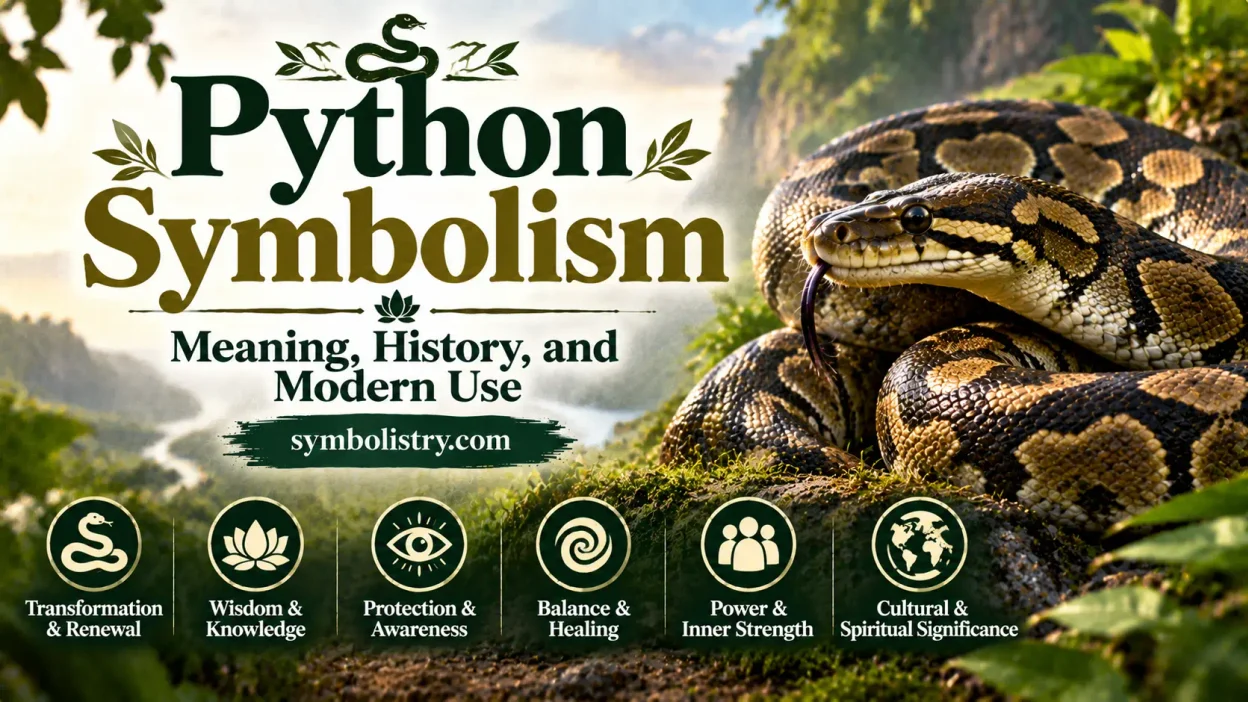
Python symbolism is unusual because the word “Python” connects two different worlds: an ancient animal associated with mythology, transformation, danger, and renewal, and a modern programming language associated with simplicity, creativity, problem-solving, and technology. The programming language itself was named after Monty Python’s Flying Circus, not directly after the snake, but the snake became central to Python’s visual identity through its familiar two-snake logo.
For Americans, the Python symbol is now strongly associated with computers, software development, artificial intelligence, data science, education, and technical creativity. A person wearing a Python logo is generally signaling an interest in programming rather than making a statement about ancient serpent mythology.
That distinction matters because Python’s modern symbolic meaning developed in layers. The name began as a playful reference to British comedy, while the visual identity eventually adopted snakes that gave the language an entirely different set of associations.
Quick Answer
Python symbolism commonly represents creativity, problem-solving, technical skill, and accessible programming in modern American culture. Its snake imagery also carries older associations with transformation, knowledge, healing, danger, and renewal, while the programming language’s name itself comes from Monty Python’s Flying Circus.
TL;DR
- Python represents coding, creativity, learning, and technical problem-solving.
- The programming language was named after Monty Python, not the reptile.
- Its two-snake logo created a strong visual connection with serpent symbolism.
- In the United States, Python is closely linked with AI and data science.
- Snake imagery adds associations with transformation, knowledge, and adaptability.
- Modern Python symbolism is mostly technological rather than religious or mystical.
What Does Python Represent Today?
In contemporary American culture, Python most commonly represents programming ability and technological creativity.
Unlike an ordinary corporate logo, Python has become recognizable across several areas of modern life. Students encounter it in computer science courses. Developers use it for software and automation. Scientists use it for numerical work and research. Data professionals use it to analyze information, while AI developers use it extensively for machine learning and related applications.
The language’s own design reinforces some of these associations. Python emphasizes readable syntax, modularity, and rapid development, which has helped it become particularly accessible to learners and useful across many technical fields.
As a result, the Python symbol can communicate more than “I know how to code.” It can suggest curiosity, practical intelligence, experimentation, and a willingness to build things with technology.
Why the Name Python Was Chosen
The first important distinction in Python symbolism is that the programming language was not originally named because of the snake.
Guido van Rossum began developing Python around the end of 1989 as a successor to the ABC programming language. While working on the project, he was reading scripts from the British comedy series Monty Python’s Flying Circus. He wanted a short, distinctive name and chose “Python” while in a playful mood.
That origin gives the word a humorous quality that remains part of the programming language’s culture.
This is why Python has historically included playful references, unusual examples, and a sense that programming does not always have to look intimidating or formal. The name helped establish a personality for the language before the snake imagery became its dominant visual association.
How the Two-Snake Logo Changed Python’s Symbolism
The familiar Python logo shows two stylized snakes facing in opposite directions. Today, the image is so closely connected with the programming language that many people assume the animal inspired the name.
It did not.
The snake imagery became part of Python’s visual identity afterward. The Python Software Foundation describes the logo as being based on Mayan representations of snakes, while also noting that its simple geometric forms can invite additional interpretations.
The two-snake design gave the language a memorable visual identity. Instead of simply displaying the word “Python,” the logo allowed programmers to recognize the language through an animal image.
That created an interesting symbolic split:
- The name came from comedy.
- The logo emphasizes snakes.
- The modern meaning centers on programming and technology.
Together, these elements give Python a distinctive identity that is both technical and playful.
Ancient Roots of Snake Symbolism
The snake itself has a much older symbolic history than the programming language.
Across different cultures, snakes have represented contradictory ideas. Their ability to shed their skin has encouraged associations with renewal and transformation. Their hidden movement and venom have made them symbols of danger and unpredictability. Their association with the earth, underground spaces, water, and seasonal change has also contributed to ideas about regeneration and mystery.
Ancient Greek traditions connected the serpent with healing through Asclepius, whose staff was traditionally depicted with a single snake. This image eventually became one of the enduring symbols associated with medicine.
Other traditions connected serpents with wisdom, fertility, protection, creation, or supernatural beings. These meanings were not universal, however. A snake that represented healing or renewal in one tradition could represent temptation, danger, or disorder in another.
That contradiction remains important when interpreting snake imagery today.
Snake Symbolism in American Culture
The United States has its own distinctive history with snake imagery.
One of the best-known examples is the rattlesnake, which became an important political symbol during the American Revolution. Benjamin Franklin used a segmented snake in the famous “Join, or Die” image, and the rattlesnake later appeared on the Gadsden flag with the warning “Don’t Tread on Me.”
In that context, the snake represented vigilance, self-defense, independence, and resistance.
American culture has also preserved more personal interpretations of snakes. In tattoos, art, folklore, fashion, and popular entertainment, snakes can communicate danger, resilience, transformation, rebellion, or independence.
Python’s logo does not automatically inherit all of these meanings. Still, Americans who already associate snakes with those ideas may unconsciously bring some of that symbolism to the Python image.
Python Symbolism and Knowledge
One of the strongest symbolic connections between the snake and Python is knowledge.
Serpents have appeared in many stories involving knowledge, wisdom, hidden information, or access to something forbidden. The meaning varies greatly by culture and religious tradition, so it would be inaccurate to claim that snakes universally symbolize wisdom.
The modern Python language creates a different kind of connection with knowledge.
Programming is fundamentally about turning instructions and ideas into functioning systems. Learning Python therefore becomes associated with acquiring a practical technical skill. For students, the Python logo can symbolize the transition from being a technology user to becoming someone capable of creating with technology.
That makes the snake image surprisingly appropriate as a modern emblem, even though the connection was not the original reason for naming the language.
Transformation and the Idea of Change
Transformation is another useful way to understand Python symbolism.
A snake sheds its old skin and emerges with a changed appearance. Historically, this physical process has contributed to symbolic associations with renewal and regeneration.
Programming has its own form of transformation: an idea becomes an algorithm, an algorithm becomes code, and code produces something that can be used.
Python is especially associated with this process because it is used for rapid experimentation and development. A programmer can write a small script, test it, change it, and build upon it.
The symbolism therefore works on two levels. The snake suggests transformation through its natural behavior, while Python as a programming language represents transformation through technology.
Python as a Symbol of Learning
Python has become particularly important in education, which gives its symbolism another dimension: learning without unnecessary barriers.
Its relatively readable syntax has made it a common introductory programming language. Students can encounter programming concepts without first having to master highly complex syntax.
That has helped Python become associated with accessibility and gradual skill-building.
For an American student, teacher, or career changer, a Python logo may therefore symbolize a beginning. It can represent the first step into software development, data analysis, automation, scientific computing, or artificial intelligence.
This is different from symbols traditionally associated with academic achievement. Python does not primarily say “I have finished learning.” It often says, “I am learning how to build.”
Python, Creativity, and Problem-Solving
Programming is sometimes described as purely mathematical, but Python’s cultural image increasingly connects it with creativity.
Developers use Python to automate repetitive work, analyze large collections of information, build applications, process images, explore scientific questions, and experiment with new technologies.
That versatility gives the Python symbol a strong association with creative problem-solving.
The symbol can therefore appeal to people who do not think of themselves simply as programmers. A data scientist, researcher, teacher, engineer, student, or artist working with computational tools may use Python as part of their creative process.
In this sense, the logo represents a tool for turning abstract ideas into practical results.
Python and Artificial Intelligence
In 2025–2026, Python symbolism is increasingly connected with artificial intelligence.
Python has become deeply embedded in AI, machine learning, data analysis, scientific computing, and automation. Its large ecosystem of libraries and frameworks makes it a common environment for experimenting with computational models and processing data.
This has changed what the Python logo can communicate in American technology culture.
A Python sticker on a laptop may once have suggested general software development. Today, it may also suggest AI engineering, machine learning, data science, robotics, or automation.
Python 3.14 was released in October 2025, and the 3.14 series continued receiving maintenance releases into 2026. The language therefore remains an actively developed part of the modern software ecosystem.
What Python Symbolizes in American Work and Education
Python’s symbolism is especially visible in American schools, universities, technology companies, research environments, and professional development.
| Context | Meaning in the USA | Common Associations | Notes |
|---|---|---|---|
| Education | Learning and technical growth | Computer science, students, teaching | Often used as an introductory language |
| Technology | Programming ability | Software, automation, development | One of Python’s most recognizable associations |
| AI and data | Analytical capability | Machine learning, statistics, data science | Especially prominent in modern technology culture |
| Personal identity | Technical creativity | Developer culture, coding communities | Often displayed on clothing, stickers, or profiles |
| Snake imagery | Transformation and caution | Resilience, danger, renewal | Comes from broader serpent symbolism, not Python’s naming origin |
The result is a symbol that can function as both a professional marker and a personal identity signal.
Python Symbolism in Tattoos and Personal Style
Python-themed tattoos are usually more personal than the standard programming logo.
A person may choose the two-snake Python logo because programming played an important role in their education or career. Another person may combine the Python logo with code, a computer, mathematical imagery, or references to artificial intelligence.
A snake tattoo, however, does not automatically mean programming.
That distinction is important. Someone choosing a realistic python snake may be drawing on traditional associations with transformation, strength, independence, danger, or survival. Someone using the official Python logo is much more likely to be referencing software.
The surrounding imagery usually determines which interpretation is most reasonable.
Python Symbolism in Digital Culture
Python has a particularly strong presence in digital culture because its users often identify themselves through online communities.
The logo can appear on developer profiles, programming tutorials, conference materials, educational projects, stickers, laptop covers, and community merchandise.
It also functions as a shorthand. A person does not always need to write “Python programmer” when the two-snake logo already communicates the idea.
The visual simplicity helps. The two contrasting snake forms are recognizable even when displayed at a small size, making the logo effective on screens, clothing, notebooks, and software-related materials.
Religious and Mythological Interpretations
Python should not automatically be interpreted as a religious symbol simply because its logo contains snakes.
In Christian traditions, the serpent has often been connected with temptation and the story of Eden, although Christian interpretation of serpent imagery is more complicated than a simple “snake equals evil” formula. Other biblical passages use serpent imagery differently, including the bronze serpent associated with healing in the wilderness.
Greek mythology also contains important serpent imagery, including the serpent associated with Asclepius and the healing tradition.
Elsewhere, serpents have appeared as protective, creative, divine, or cosmological figures.
These traditions demonstrate why snake symbolism cannot be reduced to a single universal meaning. The modern Python logo belongs primarily to computing culture, even though its visual form can remind viewers of much older traditions.
Common Misunderstandings About Python Symbolism
The biggest misunderstanding is that the programming language was named after the snake.
It was not. The name came from Monty Python’s Flying Circus, while the snake imagery became part of the language’s later visual identity.
Another misconception is that the two snakes necessarily symbolize a specific philosophical duality. The logo’s shapes may invite interpretations involving balance or opposition, but those interpretations should not be presented as the official meaning of Python.
It is also inaccurate to assume that every snake-related Python reference carries the same symbolic meaning. A programmer’s Python tattoo, a mythological serpent, and a political rattlesnake emblem belong to different cultural contexts.
Understanding the context is more reliable than assigning one meaning to every snake image.
How Python Symbolism Has Evolved
Python’s symbolism has changed substantially since the language began.
In its earliest period, the name mainly carried a playful connection to British comedy. As Python became more widely adopted, the two-snake logo became increasingly recognizable.
The language’s growth in education added another meaning: accessibility and learning. Its expansion into scientific computing added associations with research and analysis. Its role in AI and data science has now strengthened associations with advanced technology and innovation.
The underlying symbol has therefore moved from a joke-inspired name to a recognizable technological identity.
That evolution is part of what makes Python interesting as a modern symbol. Its meaning was not fixed at the beginning; users gradually gave the name and logo new cultural associations through the ways they used them.
What Python Symbolizes in 2026
In 2026, Python is best understood as a symbol of technical creativity, accessible programming, problem-solving, and participation in modern computing culture.
For many Americans, the word immediately suggests software rather than wildlife. The two-snake logo can represent programming communities, education, AI, data science, automation, and professional technology.
At the same time, the animal imagery adds a secondary layer. Depending on the viewer and context, the snakes may evoke transformation, adaptability, danger, knowledge, healing, or independence.
The modern meaning is therefore a combination of cultural history and contemporary technology rather than a single fixed definition.
Frequently Asked Questions
What does Python symbolize in programming?
Python commonly symbolizes readable programming, creativity, problem-solving, and accessible technology. Its logo has become a recognizable marker of the Python programming community.
Why does Python have a snake logo?
The programming language was named after Monty Python’s Flying Circus, but snakes became part of its visual branding later. The official Python logo uses two stylized snakes and has become strongly associated with the language.
Does Python symbolize wisdom?
The snake has been associated with wisdom and knowledge in some traditions, but this is not the official meaning of the Python programming language. In modern technology culture, Python is more directly associated with learning, coding, and technical problem-solving.
What does a Python tattoo mean?
A Python programming logo tattoo can represent coding, software development, education, or a personal connection to technology. A realistic python snake tattoo may instead represent transformation, resilience, independence, or other traditional snake associations.
Is Python a religious symbol?
The programming language itself is not a religious symbol. Its snake imagery may remind viewers of religious and mythological traditions involving serpents, but the Python logo primarily represents computing.
Why is Python associated with artificial intelligence?
Python has a large ecosystem of tools used in AI, machine learning, data analysis, and scientific computing. This widespread technical use has made the Python name and logo increasingly associated with modern AI culture.
Does Python symbolize transformation?
Transformation is a reasonable secondary interpretation because snakes have long been associated with renewal and change, partly because they shed their skin. In the programming context, Python can also symbolize transforming ideas and data into working systems.
Conclusion
Python symbolism brings together two very different histories: the ancient cultural symbolism of the snake and the modern history of computer programming. The programming language’s name came from comedy, while its recognizable two-snake logo created an unexpected connection with older ideas surrounding serpents.
Today, python symbolism in the United States is primarily about technology, learning, creativity, and problem-solving. Its associations with artificial intelligence, data science, software development, and education have made it one of the most recognizable visual identities in modern programming culture.
The most useful way to understand the symbol is to keep its layers separate: the name began with humor, the logo adopted snake imagery, and millions of users gave the symbol its modern technological meaning through everyday use.