Introduction
Elm trees have long been valued for more than their shade and graceful shape. In the United States, they are closely associated with town streets, historic landscapes, public spaces, and long-lived communities. Elm tree symbolism often centers on strength, protection, endurance, dignity, and connection.
The elm has an especially interesting place in American history because mature elms once formed dramatic canopies over streets and village centers. Their wide branches created natural gathering places, while their long lives made them useful symbols of continuity between generations.
Yet the elm also carries a more complicated story. The devastation caused by Dutch elm disease changed the American landscape and turned the tree into a reminder of loss, resilience, and restoration. That history adds emotional weight to the elm’s modern symbolism.
Today, people may encounter elm imagery in tattoos, landscape design, historical artwork, memorial settings, and nature-inspired decor. Understanding the tree’s meaning requires looking at both its physical qualities and the cultural stories built around it.
Quick Answer
Elm tree symbolism commonly represents strength, protection, endurance, community, and resilience in modern American culture. Historically, elms were also connected with gathering places, dignity, shelter, and long-standing communities, while their later decline added associations with loss and renewal.
TL;DR
- Elms commonly symbolize strength, protection, endurance, and community.
- Their broad canopies represent shelter and shared public spaces.
- American elms became symbols of historic towns and civic life.
- Dutch elm disease added themes of loss and recovery.
- Elm imagery can represent stability, memory, and renewal today.
What Is an Elm Tree?
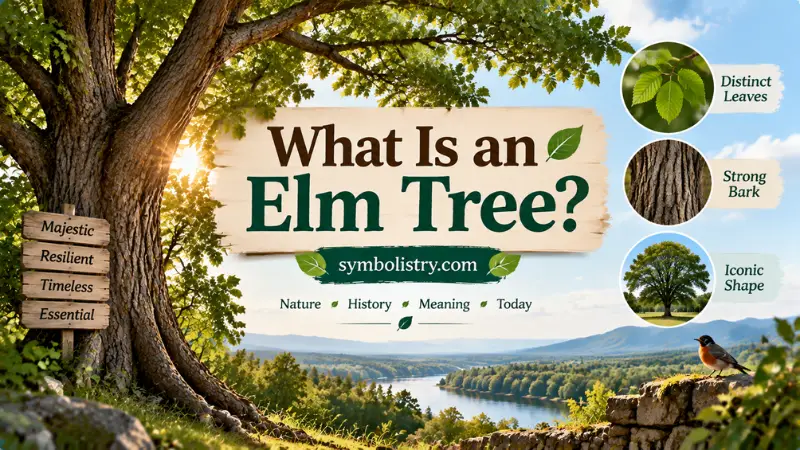
Elm is the common name for trees in the genus Ulmus. Different elm species have been planted across North America, Europe, and other regions, with American elm becoming especially important in the United States.
The American elm was once one of the defining trees of many eastern and central American towns. Its vase-shaped growth habit allowed branches to arch high above streets, creating what looked like living tunnels of foliage.
That physical structure helps explain many interpretations of elm tree symbolism.
The tree does not usually appear delicate or compact. Instead, it creates a broad, protective presence. Its branches extend outward and upward, producing shade over whatever lies beneath them.
This makes the elm naturally suited to symbolic ideas such as shelter, stability, generosity, and community.
The tree’s height and longevity add another layer. A mature elm can become a landmark rather than simply another plant in a landscape.
People may remember a particular elm because it stood beside a school, courthouse, church, cemetery, family property, or town green.
In that way, the tree can become part of collective memory.
What Does an Elm Tree Symbolize?
The most common meanings associated with the elm include:
- Strength and stability
- Protection and shelter
- Endurance and longevity
- Community and gathering
- Dignity and wisdom
- Resilience after loss
- Renewal and continuity
These meanings do not come from one universal symbolic tradition. Instead, they developed from the tree’s physical appearance, historical uses, folklore, literature, landscape traditions, and the role elms played in communities.
An elm standing beside a public road communicates something different from an elm planted at a gravesite or used in a personal tattoo.
Context matters.
Still, the tree’s broad crown and long association with settled landscapes make it particularly well suited to symbolism involving stability and connection.
Elm Tree Symbolism: Strength and Stability
Strength is one of the clearest meanings associated with the elm.
A mature elm has a substantial trunk and a large crown that can dominate the surrounding landscape. Its shape suggests structural strength rather than fragility.
For this reason, elm tree symbolism can represent a person, family, or community that remains steady through changing circumstances.
Strength here does not necessarily mean physical power.
It can mean reliability.
An elm may symbolize someone others can depend on, much as people once depended on large shade trees to define streets and public spaces.
The tree can therefore work as a metaphor for emotional steadiness, family continuity, or a strong foundation.
This interpretation is particularly appropriate when elm imagery appears in memorial art or family designs.
A tree that remains rooted while its surroundings change provides a straightforward image of stability.
Elm Tree Symbolism: Protection and Shelter
The broad canopy of an elm naturally creates a sense of shelter.
Historically, shade trees were important features of roads, village centers, parks, and residential landscapes. People could walk beneath them, rest in their shade, or gather nearby.
That physical experience supports a major aspect of elm tree symbolism: protection.
The elm can represent a safe place or a person who provides support to others.
This symbolism can apply to parents, grandparents, families, communities, and institutions.
A large tree does not protect by force. It protects by creating space where others can exist comfortably.
That makes the elm a useful symbol of quiet protection.
In artwork, an elm with an expansive canopy may suggest a family protecting its members. In landscape design, a mature elm can create a similar emotional impression simply through its presence.
Elm Tree Symbolism: Endurance and Longevity
An elm can become a long-standing part of a landscape.
That quality makes longevity another important part of elm tree symbolism.
A tree that survives for decades can witness changes that occur around it: new buildings, changing families, different generations, and shifting neighborhoods.
This gives the elm a natural relationship with memory.
For many people, an old tree is more than vegetation. It can function as a living marker of time.
Someone may remember climbing a tree as a child and later seeing the same tree in adulthood. A mature elm near a historic property may become part of the identity of that place.
The symbolic message is simple: some things endure while circumstances change.
This is why elm imagery can work especially well for family histories, heritage projects, memorial gardens, and designs focused on continuity.
Elm Tree Symbolism: Community and Gathering
The elm has a strong connection with public life in the United States.
American elm trees were widely planted along streets and in civic landscapes. Their arching branches could form continuous canopies over roads, giving towns a distinctive visual identity.
This history gives elm tree symbolism a communal quality.
The tree is not only about the individual. It can represent the spaces people share.
A row of elms along a street suggests neighborhood identity. A large elm on a village green suggests a gathering place. A mature tree beside a public building can become part of the visual memory of a community.
This makes the elm particularly different from symbols that focus primarily on private or individual experience.
The elm can represent belonging.
It can stand for the idea that a healthy community provides shade, space, and continuity for many people rather than serving only one person.
Elm Tree Symbolism: Dignity and Wisdom
The elm’s height and formal shape can also suggest dignity.
Its branches often spread in an orderly, elevated structure, giving mature specimens a stately appearance.
That visual quality has contributed to interpretations involving wisdom, maturity, and respect.
An old elm can look established without appearing ornamental in the delicate sense. Its presence comes from size, age, and structure.
This makes elm tree symbolism suitable for representing an older person whose authority comes from experience rather than status.
The association with wisdom should not be confused with a fixed ancient belief that every elm literally represented knowledge.
It is better understood as visual and cultural symbolism.
Large old trees commonly become metaphors for age and accumulated experience. The elm fits that pattern particularly well because of its historical role as a mature landscape tree.
Elm Tree Symbolism: Resilience After Loss
The history of the American elm changed dramatically during the twentieth century.
Dutch elm disease devastated large populations of American elm trees across the United States. The disease spread through populations that had once made the tree a familiar part of American streets and neighborhoods.
The loss was not simply botanical.
Many communities lost trees that had been planted decades earlier and had become part of their identity.
This history transformed modern elm tree symbolism.
The elm can now represent resilience after widespread loss.
A surviving elm may be seen as more than an old tree. It can represent the persistence of a landscape that endured a major environmental change.
This interpretation is especially relevant when people encounter historic elms or efforts to preserve disease-resistant elm varieties.
The symbolic message becomes one of recovery:
Something important was lost, but the story did not end there.
Elm Tree Symbolism: Renewal and New Beginnings
Because the elm’s American story includes both decline and restoration, renewal has become another reasonable modern interpretation.
Communities have continued planting and preserving elm trees, including varieties selected for greater resistance to Dutch elm disease.
That ongoing effort gives elm tree symbolism a forward-looking quality.
The tree can represent rebuilding rather than simply remembering.
This distinction matters.
A memorial tree may focus on what has been lost. A newly planted elm can focus on what comes next.
The two ideas can exist together.
An elm planted to replace an older tree may symbolize continuity across generations. The new tree is not identical to the old one, but it carries the same role in the landscape.
That makes the elm a useful symbol for fresh starts that still honor the past.
Elm Tree Symbolism: Ancient Roots and Early Cultural Associations
Elms have a much older cultural history in Europe than in the United States.
In European folklore and literature, elm trees appear in various local traditions, though their meanings were not identical everywhere. Their association with landscapes, boundaries, burial places, and rural life contributed to different regional interpretations.
The English elm, wych elm, field elm, and other species became part of European agricultural and settlement landscapes.
Some historical traditions associated elm wood with practical uses, while the trees themselves appeared in folklore and literary imagery.
One should be careful, however, about assigning one universal ancient meaning to the elm.
Unlike certain plants with well-documented religious symbolism, the elm did not have one standardized symbolic role across European cultures.
Instead, elm tree symbolism developed through many local relationships with the tree.
This is important because modern websites sometimes present a single ancient meaning as if it were universally accepted.
The historical record is more varied.
Elm Tree Symbolism in the United States
The American story of the elm is especially important because the tree became closely connected with the nation’s built environment.
During the eighteenth, nineteenth, and early twentieth centuries, elms were planted in many American communities. Their size and shape made them excellent shade trees for streets, campuses, parks, and town centers.
Some historic American landscapes became recognizable because of their elm-lined streets.
This gave the tree a civic identity.
Elm tree symbolism in the United States can therefore suggest more than nature. It can represent a particular vision of community life: shaded streets, public gathering places, established neighborhoods, and continuity between generations.
The elm became part of the scenery of American civic life.
Its later decline from Dutch elm disease made people more aware of how much cultural meaning had been attached to those trees.
The loss of mature elms changed the appearance of towns and created a sense of absence that still influences how some historic trees are remembered.
Elm Trees and American History
Elms appear in the historical landscape of the United States in ways that sometimes overlap with stories of the American Revolution and early national history.
Certain individual trees became associated with local historical events or traditions. The best-known example is the Washington Elm in Cambridge, Massachusetts, which local tradition connected with George Washington taking command of the Continental Army in 1775.
Whether every detail of such tree traditions can be independently verified is a separate historical question.
What matters symbolically is that communities often attach major events to old trees.
The tree becomes a witness.
That idea strengthens elm tree symbolism around memory, continuity, and public history.
An old elm can represent the relationship between a physical place and the stories people tell about it.
Elm Tree Symbolism in Mourning and Memorials
Trees are common choices for memorial planting because they provide a living alternative to a conventional monument.
An elm can be particularly appropriate when the desired message includes endurance, memory, or continuity.
In a memorial setting, elm tree symbolism may represent a life that continues to influence others after death.
The tree grows while people remember.
Its roots can suggest family connections, while its branches can suggest descendants or relationships extending outward.
An elm planted in memory of someone can therefore communicate both grief and continuation.
This is different from saying that elm trees have a universal religious meaning about death.
They do not.
The memorial meaning comes from the broader human practice of using trees as living markers of remembrance, combined with the elm’s own associations with longevity and community.
Elm Tree Symbolism: Emotional and Psychological Meaning
The emotional appeal of an elm often comes from its sense of scale.
A mature tree can make a person feel sheltered without requiring any conscious symbolic interpretation. Its canopy creates a physical environment that changes how a place feels.
That experience can support psychological associations with safety, stability, belonging, and calm.
At the same time, old trees can trigger memories.
A person may associate an elm with childhood, a hometown, a school, or a familiar street.
This is why elm tree symbolism can become highly personal.
The same tree may mean community to one person and family memory to another.
Its emotional associations often include:
- Security
- Belonging
- Stability
- Nostalgia
- Protection
- Respect
- Continuity
- Recovery
These meanings are not psychological rules. They are common interpretations that emerge from the tree’s physical presence and cultural context.
Elm Tree Symbolism in Tattoos and Personal Style
Elm trees can make meaningful tattoo designs because their shape allows the artist to communicate an entire idea without relying on text.
A large elm with spreading branches can represent family and protection.
A tree with visible roots can emphasize heritage and identity.
A damaged but growing elm can represent recovery after hardship.
A small elm sapling can represent a new beginning.
The addition of dates, initials, names, birds, or landscape elements can make the symbolism more personal.
For someone choosing an elm tattoo, the most important question is usually not “What does every elm tattoo mean?”
It is “What part of the elm’s story reflects my own?”
That might be resilience after a difficult experience, connection to a hometown, respect for family history, or the desire to build a stable future.
In personal style, elm tree symbolism works because it can communicate strength without using aggressive imagery.
Elm Trees in Art, Literature, and Decor
Elm imagery can fit naturally into art that focuses on landscape, memory, history, and home.
Artists may use a large tree to frame a scene or create a sense of permanence. Writers may use an old tree as a marker of place or time.
In home decor, tree imagery often represents family and rootedness. Elm designs can add a more specific association with American landscapes and historic streets.
A wall print featuring an old elm might evoke a quiet New England town. A stylized elm with spreading roots might emphasize family heritage.
The symbolism depends heavily on the surrounding design.
A bare elm can suggest winter, age, or loss.
A flowering or leafy elm can suggest renewal and life.
An old tree beside a house can suggest memory and belonging.
The visual context determines which aspect of elm tree symbolism becomes most noticeable.
Elm Tree Symbolism in Modern American Culture
Modern Americans are less likely to encounter elm trees as universal street features than people did before Dutch elm disease reshaped many communities.
That change has actually made the surviving elm more noticeable.
A mature elm in a historic neighborhood can feel special because people know that large old trees are not easily replaced.
This has created a modern association between elms and heritage preservation.
Historic districts, parks, college campuses, cemeteries, and older residential neighborhoods may contain mature elm specimens that serve as landscape landmarks.
In this setting, elm tree symbolism often combines the past and present.
The tree represents what a community inherited while also raising questions about what it chooses to preserve.
That makes the elm relevant to modern conversations about urban forestry, environmental stewardship, historic landscapes, and sustainable planting.
Elm Tree Symbolism by Context
| Context | Meaning in the USA | Common Associations | Notes |
|---|---|---|---|
| Family tree design | Continuity and heritage | Roots, generations, belonging | Often personalized |
| Historic landscape | Memory and endurance | Old towns, civic identity | Connected to place |
| Memorial planting | Remembrance and renewal | Life, loss, continuation | Meaning comes from context |
| Tattoo | Resilience or protection | Strength, roots, growth | Highly personal |
| Public park or street | Community and shelter | Shade, gathering, neighborhood | Reflects civic history |
The same elm can communicate different ideas depending on where it appears.
A tree in a family illustration may focus on ancestry. An elm in a historic town may focus on community memory.
This flexibility is one reason the tree remains useful as a modern symbol.
Common Misunderstandings About Elm Tree Symbolism
One common mistake is claiming that the elm has one universal symbolic meaning.
It does not.
The tree has different associations across European folklore, American history, landscape traditions, literature, and modern personal symbolism.
Another misunderstanding is treating every association with the American elm as an ancient tradition.
Many American meanings developed through relatively recent landscape history. The widespread planting of American elms and their later destruction by Dutch elm disease are especially important to modern interpretations.
It is also inaccurate to assume that an elm always symbolizes strength in a positive sense.
In a memorial or historical context, the same tree may represent loss, absence, or the passage of time.
Finally, not every old elm is a historical landmark.
A tree can be culturally meaningful to a family or neighborhood without being connected to a nationally important event.
Personal significance is still real significance.
Historical Meaning vs. Modern Meaning
| Historical Context | Earlier Association | Modern Interpretation |
|---|---|---|
| European rural landscapes | Practical and local cultural roles | Heritage and tradition |
| American town streets | Shade and civic landscape | Community and belonging |
| Historic trees | Place-based memory | Preservation and identity |
| Dutch elm disease | Landscape loss | Resilience and recovery |
| New plantings | Replacement and restoration | Renewal and continuity |
This distinction helps keep elm tree symbolism historically responsible.
Some meanings are inherited from older cultural traditions.
Others are modern interpretations based on the tree’s appearance and American environmental history.
The symbolic language surrounding the elm continues to evolve because the tree itself occupies a changing place in American landscapes.
Positive and Negative Meanings of Elm Trees
Elm symbolism is mostly positive, but it can also carry more difficult associations.
Positive meanings
- Strength
- Stability
- Protection
- Community
- Longevity
- Wisdom
- Heritage
- Resilience
- Renewal
- Belonging
More difficult meanings
- Loss
- Aging
- Absence
- Environmental decline
- Nostalgia
- Mortality
The negative meanings are generally contextual rather than traditional rules.
For example, an elm destroyed by disease may represent loss, while a newly planted elm may represent recovery.
This contrast makes the tree especially useful for stories involving change.
The elm does not need to represent an idealized version of life. It can represent the fact that communities lose things and still rebuild.
How Elm Meaning Has Evolved Over Time
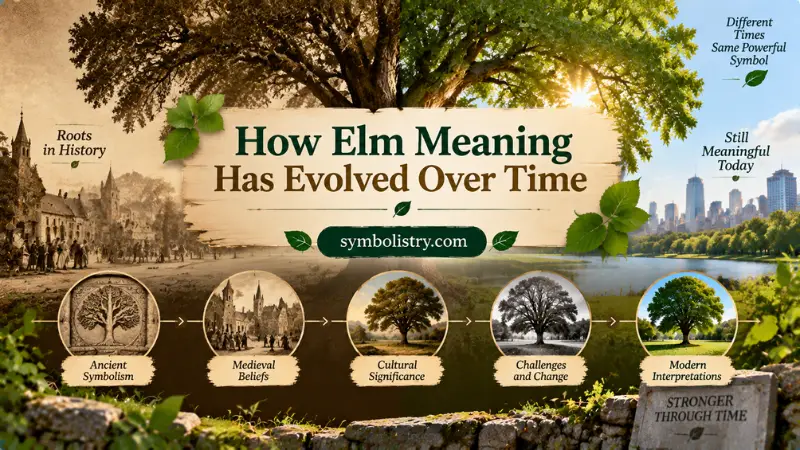
The symbolic history of the elm can be understood as a movement from landscape utility toward cultural memory.
In earlier European settings, elms were part of working landscapes and local traditions.
In the United States, the American elm became a major street and civic tree. Its distinctive canopy helped shape the visual character of many communities.
Then Dutch elm disease caused widespread losses.
That event changed the emotional relationship many Americans had with the tree. The elm became associated not only with established landscapes but also with environmental vulnerability and recovery.
Today, restoration efforts and disease-resistant cultivars have created a new chapter.
The tree can now represent the possibility of preserving familiar landscape traditions while adapting to environmental challenges.
This is an important part of modern elm tree symbolism because it connects memory with action.
The goal is not simply to remember old elms.
It can also be to create new ones.
Why Elm Trees Still Matter Symbolically Today
The elm remains relevant because it represents something increasingly recognizable in modern life: continuity within change.
Cities change.
Neighborhoods change.
Families move.
Landscapes disappear and are rebuilt.
A mature tree makes those changes visible because it grows slowly enough to outlast many human decisions.
That is why an elm can symbolize stability without suggesting that nothing ever changes.
Its stronger message is that change happens around rooted things.
For Americans interested in family history, historic preservation, environmental stewardship, or personal resilience, the elm offers a symbol that connects those ideas without requiring a supernatural interpretation.
It is a tree associated with places people remember and communities people build.
FAQ About Elm Tree Symbolism
Are elm trees symbols of strength?
Yes, strength is one of the most common modern interpretations. The elm’s large trunk, height, broad crown, and long-standing presence in American landscapes make the association with stability and endurance easy to understand.
What does an elm tree tattoo mean?
An elm tattoo can represent resilience, family roots, protection, heritage, or personal growth. The design can change the message, with roots emphasizing ancestry and spreading branches emphasizing family or community.
What does an elm tree symbolize spiritually?
An elm can be given spiritual meanings such as protection, stability, renewal, and connection between generations. However, there is no single universal religious doctrine that assigns one spiritual meaning to all elm trees.
What does elm tree symbolism mean?
Elm tree symbolism commonly represents strength, protection, endurance, community, and continuity. In modern America, the tree can also symbolize resilience because of the dramatic history of American elms and Dutch elm disease.
Why are elm trees important in American symbolism?
American elms became strongly associated with streets, towns, parks, campuses, and civic landscapes. Their widespread loss from Dutch elm disease later turned them into symbols of environmental loss, preservation, and recovery.
Do elm trees symbolize death or mourning?
An elm is not inherently a symbol of death, but it can represent mourning, remembrance, or loss in memorial settings. The tree’s longevity can also suggest continuing memory after someone’s death.
Do elm trees symbolize family?
They can. A mature elm’s roots and branching structure provide a natural metaphor for ancestry, generations, and relationships extending outward from a shared foundation.
Conclusion
Elm tree symbolism is largely built around strength, protection, endurance, community, heritage, and resilience. The tree’s broad canopy suggests shelter, its long life suggests continuity, and its place in American streets and historic landscapes connects it with shared memory.
The elm also carries a modern lesson shaped by environmental history. The loss of millions of American elms showed how quickly a familiar landscape can change, while restoration efforts demonstrate that communities can preserve important traditions in new forms.
For many Americans today, the elm is more than a tree associated with shade and beauty. It can represent the kind of continuity that allows a community to remember its past while still making room for what comes next.