
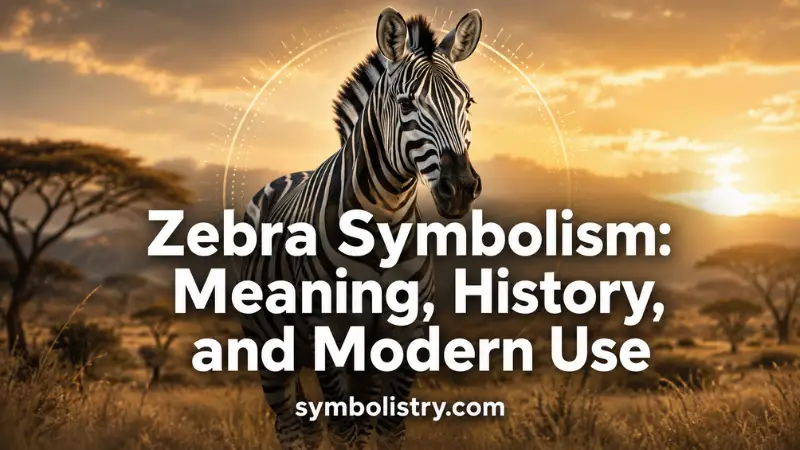
Zebras are among the most visually recognizable animals in the world. Their sharply contrasting coats, herd behavior, African habitat, and ability to survive alongside major predators have given them a distinctive place in art and popular imagination. In modern American culture, zebra symbolism commonly centers on individuality, balance, belonging, resilience, and standing out without separating oneself from a larger community.
Unlike animals with long-established religious roles, such as lions, snakes, or doves, zebras do not carry one universal symbolic meaning. Their significance changes with context. An African national emblem, a rare-disease awareness symbol, a tattoo, and a zebra-print fashion design may all use the same animal while communicating very different ideas.
Quick Answer
Zebra symbolism commonly represents individuality, balance, contrast, community, and resilience in modern American culture. Historically, zebras appear in African visual traditions and, in Botswana, became an official national symbol connected with wildlife, unity, and racial harmony.
TL;DR
- Zebras often represent individuality within a larger community.
- Black-and-white stripes can suggest contrast, balance, and coexistence.
- African representations are diverse, not one universal tradition.
- Botswana officially uses the zebra as a national symbol.
- In America, zebras also represent rare-disease awareness.
- Tattoos often emphasize uniqueness, resilience, or unconventional identity.
What Makes the Zebra Such a Distinctive Symbol
A zebra combines two qualities that do not usually appear together: extreme visual individuality and obvious group membership.
From a distance, a herd may appear unified by the same black-and-white pattern. Up close, however, each animal has its own stripe arrangement. Scientists and wildlife specialists can use differences in stripe patterns and body markings to distinguish individuals and species. There are three living zebra species: the plains zebra, mountain zebra, and Grevy’s zebra.
That combination naturally lends itself to human interpretations about identity. A zebra can belong to a recognizable group without becoming visually identical to every other member.
For that reason, the animal works especially well as a modern symbol of being yourself while remaining connected to family, community, or culture.
What Zebras Commonly Mean in the United States
There is no official American definition of what a zebra represents. Instead, several meanings have developed through visual culture, medicine, fashion, wildlife imagery, and personal symbolism.
| Context | Common Meaning in the USA | Why the Association Works |
| Personal identity | Individuality | Each animal has a distinctive stripe pattern |
| Group imagery | Community and belonging | Many zebras live and travel socially |
| Black-and-white design | Contrast and balance | Opposing colors form one unified pattern |
| Rare-disease advocacy | Being uncommon or overlooked | “Zebra” became medical shorthand for an unusual diagnosis |
| Tattoos | Resilience and self-expression | The animal combines visibility with survival |
| Fashion and decor | Boldness and unconventional style | Zebra print is immediately recognizable |
These interpretations often overlap. Someone choosing a zebra tattoo, for example, may see the animal as both an emblem of individuality and a reminder that being different does not require isolation.
Why the Stripes Suggest Contrast and Balance
Much of modern zebra meaning comes from the visual effect of the coat.
Black and white create one of the strongest contrasts available in design. Yet the stripes do not compete visually as separate halves. They repeat across the same body, creating a single pattern.
That makes the zebra an effective metaphor for differences that can coexist: independence and connection, visibility and protection, consistency and variation, or opposing experiences that belong to the same life.
This should not be turned into a rigid rule that black represents one moral quality and white represents another. Such interpretations are culturally dependent and can introduce meanings that have little to do with zebras themselves.
A more grounded interpretation focuses on contrast within unity. Two visibly different elements form one recognizable whole.
Individuality Without Isolation
One of the strongest contemporary interpretations of the zebra is uniqueness.
Zebras look similar enough to be immediately recognized as members of the same kind, but individual stripe arrangements vary. Wildlife institutions have compared these patterns to fingerprints because they can help distinguish one animal from another.
This physical trait gives the zebra unusual symbolic usefulness.
A peacock may suggest displaying individuality. A lone wolf may suggest independence from the group. A zebra communicates something different: individuality inside the group.
That distinction appeals to people who want to express a personal identity without rejecting family, friendship, culture, or community. It can also represent accepting the features that make someone recognizable rather than trying to erase them.
Community, Vigilance, and Survival
Zebras are social equids, although their social organization varies by species. Plains and mountain zebras often form relatively stable family groups, while Grevy’s zebras have a more fluid social structure. Living near other animals can provide practical advantages, including greater collective awareness of predators.
This behavior helps explain modern associations with community and mutual protection.
Symbolically, the zebra does not have to mean dependence on others. A more accurate interpretation is individual strength supported by social awareness.
Zebras live in landscapes containing formidable predators. They are prey animals, but they are not defenseless. They can run, bite, and kick, and they rely heavily on alertness and movement.
As a result, resilience is a more appropriate symbolic association than fearlessness. Zebras survive not because danger disappears, but because they respond to it.
The Real Function of Zebra Stripes
People often build symbolic meanings around the zebra’s stripes, so it helps to separate symbolism from biology.
Scientists have proposed numerous explanations for striping, including camouflage, predator confusion, social recognition, temperature control, and protection from biting insects. Research has not reduced the question to a completely uncontested single explanation, but experimental evidence strongly supports a role in reducing successful landings by biting flies.
In controlled observations, horse flies approached zebras but had more difficulty making controlled landings on striped surfaces. Experiments using striped coverings on horses produced similar effects.
This biological research does not prove that zebras “symbolize protection.” Symbolic meaning is created by people, not evolution.
Still, knowing that an animal’s most distinctive visual feature has a real survival function can strengthen modern interpretations involving adaptation, defense, and resilience without resorting to supernatural explanations.
African Roots and Early Representations
Because all living zebra species are native to Africa, any discussion of their history should begin there rather than treating the animal as a generic Western design motif.
Zebra-like animals appear in African rock-art traditions. Sites documented in areas including Namibia, Tanzania, Botswana, and Zimbabwe contain representations of zebras among other animals. Some of these traditions extend far back into the archaeological past.
However, an animal’s appearance in ancient or Indigenous art does not automatically reveal exactly what it symbolized.
Rock art may relate to hunting, spirituality, environmental knowledge, storytelling, ritual life, social memory, or several meanings at once. Scholars repeatedly caution that the significance of individual images depends on cultural and archaeological context.
Therefore, claims such as “Africans believed the zebra universally represented balance” should be treated skeptically. Africa contains thousands of communities and a vast range of historical traditions. There is no single pan-African zebra doctrine.
Botswana and the Zebra as a National Symbol
One of the clearest documented cultural uses of the zebra comes from Botswana.
Botswana’s coat of arms, adopted around the country’s independence in 1966, includes two zebras supporting the central shield. The animals represent the country’s natural fauna, while official explanations also connect zebra imagery and the black-and-white national colors with racial harmony and Botswana’s pluralistic society. The country also recognizes the zebra as its national animal.
This gives the zebra a meaning that is more specific than generic ideas about “balance.”
Within this national context, the animal can communicate wildlife heritage, shared identity, harmony, and belonging to the Botswanan landscape.
It is a useful reminder that symbolic meaning is strongest when tied to an identifiable cultural setting rather than assigned broadly to an entire continent.
From African Wildlife to American Popular Culture
For many Americans, the first encounter with zebra imagery comes through zoos, children’s books, nature documentaries, toys, classrooms, fashion, or animal-themed decor rather than through traditional symbolism.
This changes how meaning develops.
The bold stripes make the zebra useful when designers want something energetic and immediately recognizable. In children’s imagery, zebras may communicate wildlife, safari settings, curiosity, or difference. In adult fashion and interiors, the pattern often carries a more assertive message.
Because zebra print cannot easily disappear into the background, it commonly suggests confidence, visibility, unconventional taste, or playful extravagance.
These meanings come from the visual impact of the pattern rather than from an ancient symbolic code.
A Major American Meaning: Rare-Disease Awareness
One of the most important modern uses of the zebra in the United States has little to do with fashion or African wildlife.
In medicine, students have traditionally been taught a saying that compares common diagnoses to horses and unusual diagnoses to zebras: when hearing hoofbeats, consider the common explanation before the rare one.
Rare-disease advocates later reclaimed the zebra.
Today, the zebra serves as an official mascot within the U.S. rare-disease community, where displaying stripes can show support for people living with uncommon medical conditions. The imagery is especially visible around Rare Disease Day.
The symbol also has a particular connection with Ehlers-Danlos syndromes and hypermobility spectrum disorders. Community organizations use zebra imagery to emphasize that uncommon conditions should not be dismissed simply because they are uncommon and that individual experiences can vary significantly.
In this context, a zebra may communicate recognition, advocacy, persistence, medical visibility, and solidarity.
This is one of the clearest examples of a relatively recent American meaning becoming more socially specific than older generalized symbolism.
Zebra Tattoos and Personal Identity
Zebra tattoos can carry several meanings depending on composition and personal motivation.
A realistic zebra may emphasize endurance, wildlife appreciation, African landscapes, or respect for the animal itself. A close-up stripe pattern can focus more directly on identity and difference.
Two zebras together may represent companionship or family. A zebra incorporated into rare-disease imagery may instead mark a diagnosis, support a loved one, or commemorate a difficult medical journey.
Some wearers choose the animal because it challenges the idea that fitting into a group requires looking or behaving exactly like everyone else.
That makes individuality one of the most natural tattoo interpretations, but it should never be assumed. Tattoos are highly personal, and the wearer’s intended meaning matters more than any online symbolism list.
Zebra Print in Fashion, Jewelry, and Decor
Zebra imagery functions differently when the whole animal disappears and only the stripes remain.
In clothing, handbags, shoes, jewelry, wallpaper, rugs, and furniture, zebra print often works as a visual statement. The high contrast creates movement and immediately draws attention.
As a result, the design may communicate boldness, independence, confidence, or a willingness to break from restrained style.
In a minimalist room, one zebra-patterned object can function as deliberate contrast. In fashion, the same pattern can shift from playful to dramatic depending on how it is used.
Digital culture has expanded this meaning further. Zebra patterns appear in profile art, graphics, awareness campaigns, stickers, and social posts where stripes can represent anything from personal style to medical advocacy.
Context therefore matters more than the pattern alone.
Emotional and Psychological Associations
People often respond to zebras through three immediate visual ideas: contrast, repetition, and variation.
Contrast makes the animal noticeable. Repetition gives its appearance order. Variation prevents that order from becoming uniform.
Together, those qualities can make the zebra an appealing metaphor for a person whose identity contains apparent opposites—someone who is independent but socially connected, highly visible but protective of privacy, or unconventional while still valuing belonging.
The animal can also represent comfort with complexity. Human experiences are rarely divided cleanly into one side or another, despite the zebra’s black-and-white appearance.
This produces an interesting symbolic reversal: an animal famous for two sharply contrasting colors can actually suggest that differences can exist simultaneously within one coherent identity.
Is the Zebra a Spiritual or Religious Symbol?
The zebra does not have a single widely documented spiritual meaning shared across major world religions.
It is not a major recurring biblical symbol, nor does it occupy the kind of standardized religious role associated with animals such as lambs, serpents, doves, lions, or elephants in particular traditions.
Modern spiritual interpretations sometimes assign zebras ideas such as harmony, freedom, protection, community, or embracing individuality. These can be meaningful as personal interpretations, but they should not be presented as ancient teachings unless they can be tied to a specific documented tradition.
The distinction matters.
Personal symbolism asks, “What does this animal mean to me?” Historical symbolism asks, “What did a particular community actually associate with this animal?”
Those are both legitimate questions, but they require different kinds of answers.
Common Misunderstandings About Zebra Meaning
The most common mistake is treating visual associations as historical facts.
For example, because zebras are black and white, it is easy to claim that they have represented cosmic duality for thousands of years. There is little basis for making such a universal statement.
Another problem is attaching broad beliefs to “African culture.” Zebra imagery occurs in multiple African settings, but those settings belong to different peoples, periods, languages, and traditions. Similar-looking animal images do not necessarily carry the same meaning.
It is also misleading to say that zebra stripes definitely evolved as camouflage. The evolutionary question remains scientifically active, and substantial evidence supports biting-fly deterrence.
Finally, symbolic interpretations should not replace zoological reality. Zebras are wild equids with their own ecology and behavior, not characters designed to illustrate human personality traits.
Good symbolism begins with the actual animal and builds interpretation carefully from there.
How the Zebra’s Meaning Has Evolved
The zebra’s symbolic history is not a straight line from one ancient definition to one modern definition.
In African rock art, the animal belonged to landscapes where people encountered wild fauna directly. The exact significance of many surviving images cannot be recovered with certainty.
In Botswana’s modern national identity, zebra imagery gained an official civic role connected to wildlife and national unity.
In American popular culture, the stripes became associated with visual individuality and bold design.
Medicine then produced another transformation. The “zebra” moved from being shorthand for an unlikely diagnosis to becoming a positive identity and advocacy symbol for people whose rare conditions can otherwise be overlooked.
These uses demonstrate how symbolism actually develops: not through a fixed dictionary of meanings, but through history, institutions, stories, communities, and repeated cultural use.
FAQs
What does a zebra symbolize spiritually?
In contemporary personal spirituality, a zebra may represent individuality, balance, community, adaptability, or accepting different sides of oneself. These interpretations are largely modern and should not be treated as one universal ancient spiritual tradition.
Is a zebra a symbol of good luck?
There is no widely established American tradition in which zebras universally represent good luck. Someone can personally use a zebra as a fortunate or encouraging symbol, but that meaning depends on the individual or cultural context.
What does a zebra tattoo mean?
A zebra tattoo often represents individuality, resilience, belonging, or comfort with being visibly different. It can also represent rare-disease awareness, particularly when combined with advocacy language or stripe motifs associated with medical communities.
What does a zebra represent in rare-disease awareness?
The zebra represents uncommon diagnoses that may initially be overlooked because clinicians are trained to consider common conditions first. U.S. rare-disease organizations now use zebra imagery and stripes as symbols of visibility, advocacy, and solidarity.
Does a zebra have a biblical meaning?
Zebras do not have a major established symbolic role in the Bible comparable with animals such as lambs, lions, serpents, or doves. Christian interpretations involving balance, uniqueness, or creation are therefore modern personal applications rather than standard biblical symbolism.
Why do zebras symbolize individuality?
Their appearance provides an unusually clear visual metaphor: zebras share the same general striped design, yet individual stripe patterns vary. This makes the animal well suited to expressing the idea of belonging to a group while retaining a recognizable identity.
Do zebra stripes symbolize black and white thinking?
Not necessarily. Although the colors may suggest opposites at first glance, modern interpretation often emphasizes coexistence rather than rigid division—the contrasting stripes combine to form one animal and one continuous pattern.
Conclusion
The zebra has no single definition that applies across every culture and period. Its modern meanings grow from several different sources: distinctive stripes, social behavior, African cultural history, Botswana’s national imagery, American design culture, and the animal’s important role in rare-disease advocacy.
At its most grounded, zebra symbolism expresses individuality without isolation, contrast without fragmentation, and resilience without pretending that survival is effortless. The animal’s appeal comes not from an invented universal mythology, but from something visible in the zebra itself: every individual fits an unmistakable pattern while remaining distinctly its own.