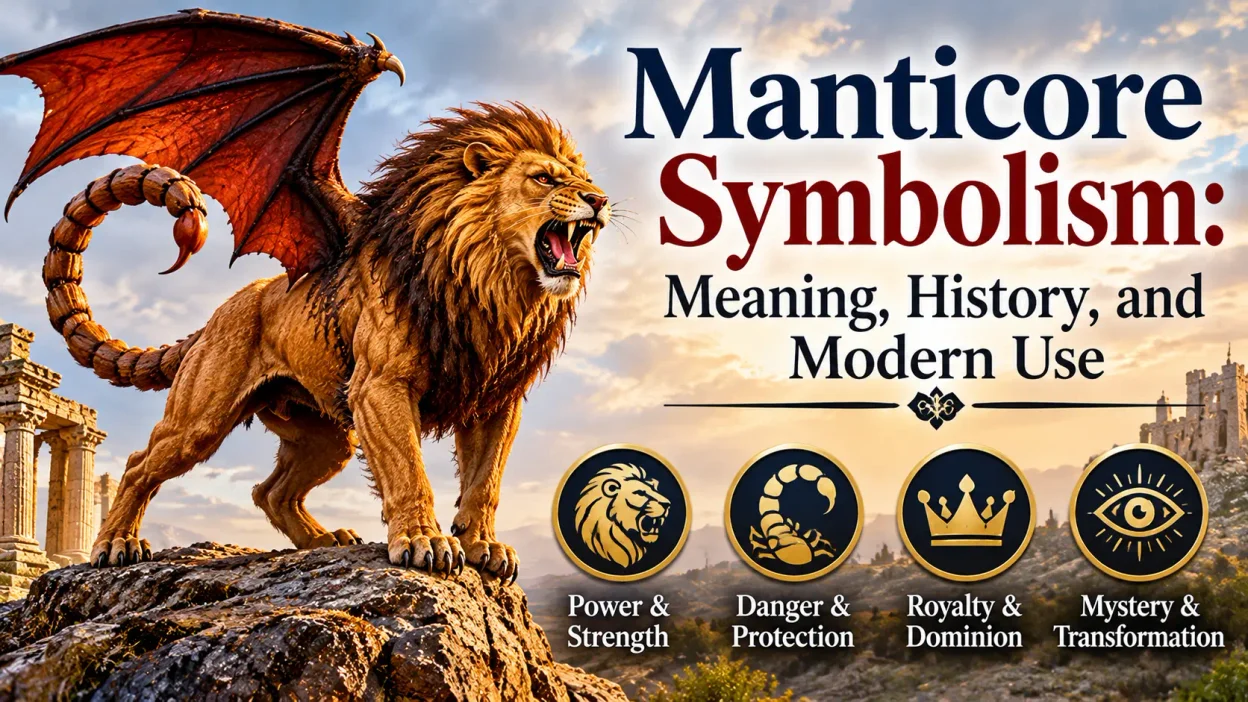
Manticore symbolism explores the meaning of one of mythology’s most unsettling hybrid creatures. Traditionally depicted with the face of a human, the body of a lion, and the tail of a scorpion, the manticore represents danger, cruelty, deception, and the frightening combination of human intelligence with animal aggression. Its unusual appearance makes it a memorable figure in ancient legends, medieval art, and modern fantasy.
Unlike familiar mythical creatures such as unicorns and griffins, the manticore is rarely associated with protection or good fortune. Its traditional reputation is much darker. Stories describe it as a human-eating predator capable of attacking from a distance with poisonous tail spines.
Today, Americans most often encounter the manticore through fantasy literature, tabletop role-playing games, video games, mythology collections, and fantasy artwork. Its appearance also raises interesting questions about human nature, hidden danger, and the boundary between civilization and savagery.
Understanding its history helps explain why this creature continues to represent threats that are difficult to recognize until it is too late.
Quick Answer: What Does the Manticore Symbolize?
Manticore symbolism commonly represents danger, deception, cruelty, predatory behavior, and the darker side of human nature. Historically associated with man-eating monsters in ancient accounts and evil or destructive forces in medieval European traditions, the manticore now frequently symbolizes hidden threats, dangerous intelligence, and the frightening mixture of human and animal characteristics.
TL;DR
- Danger: Represents a threat that combines intelligence with physical strength.
- Deception: Its human face suggests danger hidden behind a familiar appearance.
- Cruelty: Its appetite for human flesh represents merciless aggression.
- Ancient origins: Its earliest literary descriptions connect it with Persia and India.
- Medieval meaning: European traditions associated it with evil and destructive behavior.
- Modern interpretation: Fantasy culture uses it as a symbol of monstrous power.
1. What Is a Manticore? Appearance and Physical Characteristics
A manticore is a legendary creature traditionally described as having three distinct animal and human characteristics:
- A human head and face.
- The powerful body of a lion.
- A scorpion-like tail equipped with poisonous spines.
Some descriptions give it reddish fur, blue or gray eyes, and three rows of sharp teeth. Other versions emphasize its ability to launch venomous spikes at enemies, making it dangerous even from a distance.
Its appearance is important to its symbolism. The human face suggests intelligence, recognition, and familiarity, while the lion’s body communicates physical dominance. The scorpion tail introduces another kind of danger: an unexpected attack from behind.
Together, these features create an unsettling creature that seems to combine the most threatening qualities of several beings.
In modern fantasy illustrations, the manticore sometimes has wings, exaggerated claws, horns, or additional monstrous features. These variations depend on the artist or fictional universe rather than one universally established ancient description.
2. The Core Symbolism of the Manticore
The manticore has several connected symbolic meanings. Most come from its traditional reputation as a predator that hunts human beings.
Danger and destruction: Its legendary appetite for people makes it a natural representation of serious threats and destructive behavior.
Deception and concealed intentions: Its human face creates uncertainty about whether something that looks familiar can actually be trusted.
Cruelty: Its violent hunting habits connect it with mercilessness and a lack of compassion.
Predatory intelligence: Unlike an ordinary wild animal, the manticore combines human-like features with the strength and instincts of a powerful predator.
Fear of the unknown: Its association with distant lands and unfamiliar creatures reflects the anxieties that surrounded poorly understood places in ancient accounts.
These meanings are not equally prominent in every period. Ancient descriptions concentrate on its monstrous appetite, while later European interpretations increasingly use it as a representation of moral evil.
3. Ancient Origins: Persian Connections and Greek Accounts
The manticore is traditionally associated with ancient Persian mythology, although the surviving historical evidence requires some care.
Its earliest well-known written description comes from Ctesias, a Greek physician who served at the Persian royal court during the fifth century BCE. He wrote about unusual animals and customs associated with India in a work called Indica.
Ctesias did not personally travel throughout India. His descriptions included information gathered from other people, and his original work survives only in fragments preserved by later writers.
The name manticore is generally connected with an Old Iranian expression commonly translated as “man-eater.” This meaning reflects the creature’s defining characteristic: its supposed preference for human flesh. PBS+2
The geographical association is also significant. Ancient Greek accounts frequently placed the creature in India, even though later interpretations often describe it more broadly as a Persian mythical beast.
One possibility discussed by modern scholars is that stories about the manticore developed from exaggerated descriptions of unfamiliar large predators, particularly tigers.
However, the exact origin of the legend remains uncertain.
The important distinction is that the manticore’s Persian connection is part of its traditional history, while its earliest surviving literary descriptions come through Greek writers.
4. What the Manticore Symbolized in Ancient Cultures
Ancient accounts primarily presented the manticore as a dangerous creature rather than a positive spiritual symbol.
Its association with human flesh made it an image of uncontrolled appetite and predatory violence. It represented the possibility that nature contained dangers beyond ordinary human understanding.
For Greek readers, descriptions of the creature also contributed to ideas about unfamiliar territories. India was geographically distant from the Greek world, and accounts of extraordinary animals helped shape perceptions of its natural environment.
The manticore therefore carried two connected associations:
- The physical threat of an animal capable of killing people.
- The cultural anxiety surrounding unfamiliar lands and creatures.
Ancient descriptions sometimes treated the manticore as a real animal rather than an entirely imaginary being. This reflects how early natural history mixed observation, travelers’ stories, speculation, and folklore.
The creature’s reputation grew as later writers repeated and expanded its description.
5. The Manticore in Medieval European Symbolism
During the Middle Ages, the manticore entered European bestiaries, illustrated books that described real and imaginary animals.
These books did more than catalogue creatures. They often used animals to communicate moral and religious lessons.
The manticore became associated with destructive behavior, evil, and the dangers of uncontrolled appetite. Some medieval interpretations connected it with the Devil or other representations of wickedness.
Its hybrid appearance made it particularly suitable for moral interpretation. A creature with a human face but the behavior of a man-eating predator could represent the conflict between outward appearance and inward character.
The medieval tradition also emphasized its three rows of teeth, frightening voice, and poisonous tail.
The Rochester Bestiary, dating to around 1230, includes a description of the manticore as an exceptionally bloodthirsty creature that desires human flesh. Medieval artwork helped preserve this image for later generations. Kent History & Archaeology+2
Its meaning gradually shifted from a supposed dangerous animal of distant lands into a more recognizable symbol of moral corruption.
6. What the Human Face Represents
The human face is arguably the most psychologically interesting part of the manticore.
Many mythical monsters look entirely unlike human beings. Dragons, giant serpents, and enormous sea creatures communicate danger through their unfamiliar physical forms.
The manticore is different.
Its human face creates an uncomfortable resemblance between the monster and the people it threatens. This makes it suitable for interpretations involving hypocrisy, manipulation, and the darker possibilities of human behavior.
The face can suggest:
- Intelligence without compassion.
- Familiarity hiding harmful intentions.
- Human reasoning used for destructive purposes.
- The tension between appearance and character.
This does not mean that every depiction of a manticore represents a dishonest person. Rather, the human face provides an artistic way to explore the idea that cruelty does not always appear in an obviously monstrous form.
A frightening creature that looks partly human can make the audience question what truly separates humanity from savagery.
7. The Lion’s Body: Strength, Pride, and Aggression
The lion’s body gives the manticore much of its physical authority.
In many cultural traditions, lions symbolize royalty, courage, leadership, protection, and strength. They have appeared in royal emblems, coats of arms, sculptures, and religious artwork.
However, the lion also represents the dangerous side of power.
Its strength can become aggression, its dominance can become tyranny, and its ability to hunt can represent predatory authority.
When these qualities become part of the manticore, the lion’s body takes on a darker interpretation.
Rather than simply representing courage or nobility, it communicates overwhelming physical power directed toward destruction.
This distinction matters when interpreting manticore artwork. A lion standing proudly in a royal emblem may represent legitimate authority, while a manticore attacking a person represents power without restraint.
8. The Scorpion Tail: Hidden Danger and Retaliation
The manticore’s scorpion tail is one of its most recognizable characteristics.
In traditional descriptions, the tail carries poisonous spikes or a dangerous sting. Some accounts describe the creature launching these spines toward enemies like arrows.
Symbolically, the tail represents danger that is difficult to anticipate.
A person might recognize the threat posed by the manticore’s claws and teeth, but its tail introduces an additional weapon that can strike unexpectedly.
This makes it a useful metaphor for:
Hidden hostility: Harmful intentions that remain concealed until an attack occurs.
Retaliation: The ability to respond with unexpected and disproportionate force.
Poisonous influence: Words, actions, or relationships that cause lasting damage.
Unseen consequences: Threats that emerge from places people do not normally watch.
The tail also distinguishes the manticore from ordinary lion imagery. Its danger does not depend entirely on direct physical confrontation.
9. Manticore Symbolism in the United States
In the United States, the manticore is primarily understood through mythology, fantasy entertainment, literature, gaming, and visual storytelling.
It does not have a widely established role in American national traditions, religious holidays, or mainstream public ceremonies. Unlike the bald eagle, the buffalo, or the American flag, it is not a familiar national symbol.
Instead, its meaning depends heavily on the fictional or artistic setting in which it appears.
In American fantasy culture, the manticore often communicates:
- A dangerous enemy with unusual abilities.
- A creature that combines intelligence and physical force.
- A challenge that requires preparation and courage.
- The consequences of entering unfamiliar territory.
Its historical associations with evil also make it suitable for darker fantasy stories.
American audiences may encounter it in mythology books, fantasy-themed merchandise, illustrations, collectible figures, and role-playing games.
The creature’s recognizable appearance makes it particularly effective in fictional worlds where monsters need to communicate their danger immediately.
10. Psychological and Emotional Meaning of the Manticore
The manticore can be interpreted as a representation of fears that involve both external threats and human behavior.
Its appearance brings together several qualities that people often find disturbing: aggression, unpredictability, intelligence, and concealed hostility.
Psychologically, it can represent the fear of being harmed by something that initially appears familiar.
The human face creates recognition, while the lion’s body and scorpion tail undermine any sense of safety.
This contrast can also be interpreted as an internal struggle.
A person might use the manticore as an artistic metaphor for destructive impulses, uncontrolled anger, selfishness, or the temptation to use strength against others.
However, these are modern interpretive possibilities rather than established psychological meanings.
Emotionally, the creature can communicate:
- Fear of betrayal.
- Anxiety about unfamiliar situations.
- Concern about abusive or controlling behavior.
- Recognition of destructive impulses.
- The need for caution and self-protection.
Its symbolism is especially useful in stories about characters who must confront something dangerous that is not immediately recognizable.
11. Manticore Symbolism in Tattoos, Jewelry, and Personal Style
The manticore is a distinctive choice for people interested in mythology, unusual creatures, and darker fantasy imagery.
Although it is not as common in tattoo culture as dragons, wolves, or phoenixes, its unusual design offers several opportunities for personal expression.
Manticore tattoos
A manticore tattoo can represent strength, independence, danger, resistance, or an interest in mythology. Some people may choose it because they identify with its intimidating appearance or its combination of different creatures.
Others may use it to represent overcoming personal fears or confronting destructive behavior.
Jewelry
Manticore-inspired pendants, rings, and decorative pieces can communicate an interest in fantasy, medieval imagery, or mythical creatures.
The human head, lion body, and scorpion tail also make the creature suitable for detailed metalwork.
Clothing and accessories
The manticore sometimes appears in fantasy-themed clothing, graphic designs, embroidered artwork, and collectible accessories.
In personal style, it can communicate an appreciation for unusual mythology and darker visual aesthetics.
There is no universally accepted meaning for a manticore tattoo or piece of jewelry. Personal interpretation, design, and cultural background all influence its message.
12. The Manticore in Modern Fantasy, Literature, and Games
Modern fantasy has helped keep the manticore recognizable to audiences who may know little about its ancient history.
One important example is tabletop role-playing culture, particularly Dungeons & Dragons.
In fantasy games, the manticore is commonly presented as a dangerous monster with a lion-like body, wings in many versions, and a tail capable of firing deadly spikes.
Its role is often practical as well as symbolic. It gives players an enemy that can attack both at close range and from a distance.
This makes the creature a natural fit for adventures involving dangerous wilderness areas, forgotten ruins, and encounters with powerful monsters.
The manticore has also appeared in modern fantasy literature and popular entertainment. Its presence in works such as J. K. Rowling’s Harry Potter and other fantasy narratives demonstrates how older mythological creatures continue to influence contemporary storytelling. PBS+1
Modern adaptations do not always preserve the original symbolism.
Some versions emphasize its intelligence, others its physical power, and some portray it as a magical guardian or a creature that can be defeated and controlled.
This flexibility allows writers and game designers to reinterpret the manticore without losing its recognizable appearance.
13. Positive and Negative Interpretations
The manticore is traditionally a negative symbol, but modern interpretations can give it more complicated meanings.
Its historical reputation is strongly associated with human predation, cruelty, and destructive behavior. Nevertheless, fantasy artwork and personal symbolism sometimes emphasize its strength and survival abilities.
| Context | Symbolic Meaning | Common Associations |
|---|---|---|
| Ancient mythology | Predatory danger | Human-eating monster |
| Medieval bestiaries | Evil and corruption | Destruction and cruelty |
| Modern fantasy | Strength and threat | Magical power and combat |
| Tattoo culture | Individuality and resilience | Personal identity |
| Psychological interpretation | Hidden hostility | Fear and self-awareness |
Negative interpretations
- Cruelty and mercilessness.
- Manipulation and deception.
- Aggression without restraint.
- Destruction and predatory behavior.
- Fear of the unfamiliar.
Positive modern interpretations
- Strength in difficult circumstances.
- Courage when confronting danger.
- Individuality and unconventional identity.
- Survival and adaptability.
- Recognition of one’s destructive impulses.
These positive interpretations are modern personal readings, not traditional religious or historical meanings.
14. Misunderstandings and the Evolution of Manticore Symbolism
Several misunderstandings surround the manticore, particularly because its history crosses different cultures and literary traditions.
It is not exclusively a Persian written tradition.
The creature is traditionally linked with Persian mythology, but its earliest surviving literary description comes from the Greek writer Ctesias. The distinction between traditional cultural origin and surviving written evidence is important.
It is not a religious figure with one universally accepted meaning.
Medieval Christian writers sometimes used the manticore to represent evil, but this does not make it a central figure in Christianity or a creature with one fixed religious interpretation.
Its appearance is not completely consistent.
The original descriptions and later illustrations differ. Some versions have wings, unusual colors, or additional animal features.
It does not always represent a particular person or group.
Modern fantasy artists may use it simply because it is an interesting monster. Its appearance alone does not establish a political, religious, or personal message.
The creature’s meaning has changed considerably over time.
| Historical period | Main interpretation |
|---|---|
| Fifth century BCE | Man-eating creature described in Greek accounts |
| Roman period | Dangerous animal repeated in natural history |
| Medieval Europe | Evil, destructive appetite, and moral warnings |
| Early modern period | Mythological and natural-history curiosity |
| Modern era | Fantasy monster, artistic subject, and personal symbol |
The manticore has therefore moved from ancient descriptions of supposedly unfamiliar wildlife into medieval moral storytelling and eventually into modern imaginative culture. Encyclopedia.com+2
Its continued appearance in fantasy demonstrates how an old monster can acquire new meanings without losing its historical associations.
Frequently Asked Questions
1. What does a manticore symbolize spiritually?
The manticore does not have one universally recognized spiritual meaning. In medieval Christian interpretations, it could represent evil, destructive appetite, and the Devil, while modern spiritual interpretations sometimes use it as a metaphor for confronting harmful impulses.
2. Is the manticore a good or evil symbol?
Traditionally, the manticore is a negative symbol associated with cruelty, danger, and human predation. Modern fantasy can give it more neutral or positive characteristics, such as strength, survival, and independence.
3. What does a manticore tattoo mean?
A manticore tattoo can represent personal strength, individuality, danger, or an interest in ancient mythology. Some people choose the creature because it reflects their appreciation for unusual fantasy imagery rather than a specific symbolic belief.
4. Is the manticore Persian or Greek?
The manticore is traditionally connected with Persian mythology, and its name is associated with an Iranian expression meaning man-eater. However, its earliest surviving written description is attributed to the Greek writer Ctesias in the fifth century BCE.
5. What is the difference between a manticore and a sphinx?
A traditional manticore has a human head, lion’s body, and scorpion-like tail. A sphinx generally has a human head and lion’s body, although different traditions depict sphinxes with wings or other features.
6. Why does the manticore have a scorpion tail?
The scorpion tail is part of the creature’s traditional mythical anatomy and gives it an additional way to attack its enemies. Symbolically, it can represent concealed danger, poisonous influence, and unexpected retaliation.
7. Does the manticore appear in modern fantasy games?
Yes. The manticore is especially recognizable in tabletop role-playing games, including Dungeons & Dragons, as well as fantasy literature and video games. Its combination of physical strength and ranged attacks makes it a useful creature for fantasy adventures.
Conclusion
Manticore symbolism has developed from ancient stories of a man-eating monster into a broader representation of danger, deception, cruelty, and destructive power. Its human face, lion’s body, and poisonous tail each contribute to an image that combines intelligence, physical dominance, and concealed hostility.
In modern American culture, the creature is primarily associated with fantasy entertainment, mythology, tattoos, artwork, and fictional storytelling. Its meaning can vary depending on how an artist or individual chooses to portray it, although its historical associations remain predominantly dark.
The manticore ultimately reminds us that appearances can be misleading and that intelligence and strength are not necessarily signs of goodness. Its enduring place in mythology comes from this unsettling combination of the familiar and the monstrous.