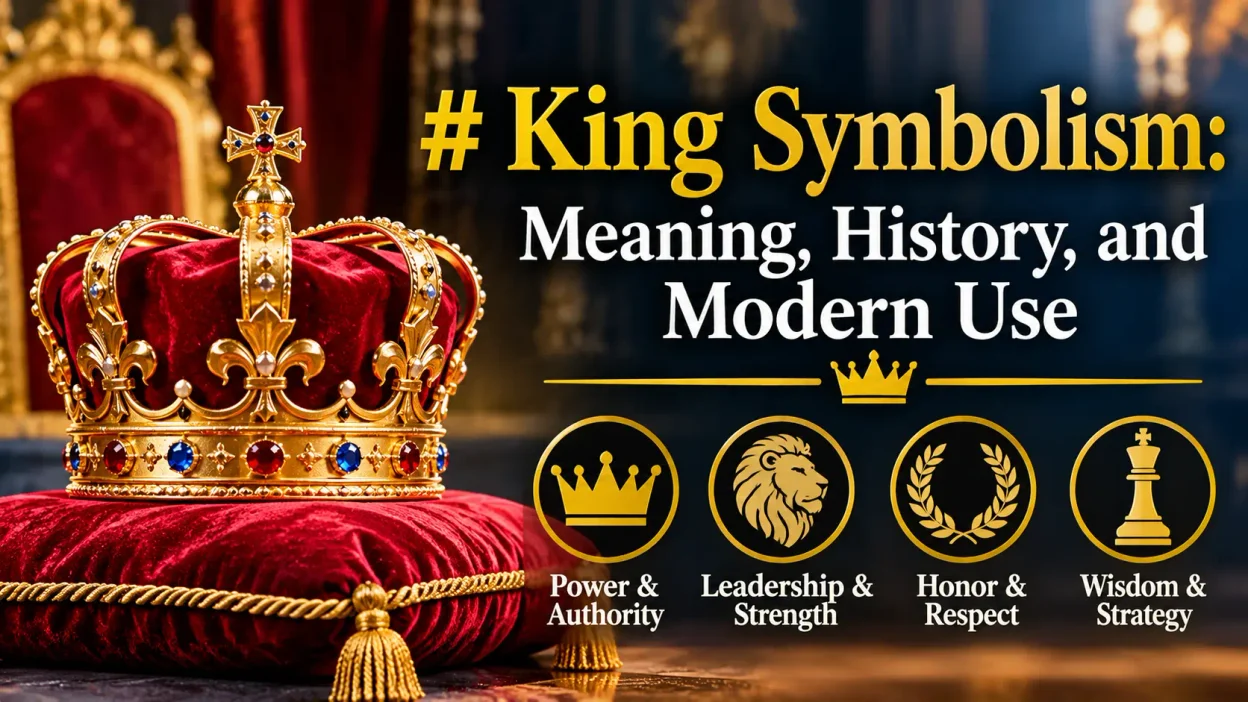
A king is one of the most recognizable figures in human history. Often depicted wearing a crown, carrying a scepter, or sitting on a throne, he represents authority, leadership, responsibility, and the power to influence an entire community. In king symbolism, however, the meaning extends beyond royal status. The king can represent wisdom, protection, ambition, justice, personal authority, and the responsibilities that accompany power.
In the United States, the image of a king carries an interesting contradiction. American political history developed around the rejection of hereditary monarchy, yet kings remain familiar figures in literature, religion, entertainment, sports, games, and popular culture. The word itself can suggest someone who has achieved exceptional success, earned respect, or established authority in a particular field.
The king also appears in dreams, tattoos, artwork, playing cards, chess, mythology, and religious traditions. Depending on the setting, he may represent a responsible leader or an arrogant ruler who places personal interests above everyone else.
Understanding this symbol requires looking at both sides of kingship: the qualities that make someone worthy of leadership and the dangers that come with unchecked authority.
Quick Answer: What Does King Symbolism Mean?
King symbolism commonly represents leadership, authority, responsibility, wisdom, protection, and personal achievement in modern American culture. Historically, kings were associated with divine authority, political legitimacy, social order, military protection, and the responsibility to govern their people.
TL;DR
- Leadership: The king represents authority, decision-making, and responsibility.
- Wisdom: An experienced king symbolizes sound judgment and mature thinking.
- Protection: Royal power historically represented the defense of communities.
- Spirituality: Religious traditions connect kingship with divine authority.
- Personal identity: Modern uses celebrate confidence, achievement, and self-respect.
- Warning: An oppressive king represents arrogance, greed, and uncontrolled power.
1. What Does a King Symbolize?
The king is traditionally a symbol of the highest position within a monarchy. His authority comes from his ability to govern, make decisions, establish laws, and represent the political identity of a kingdom.
Beyond these practical responsibilities, the king has several symbolic meanings.
Leadership and authority are perhaps the most obvious. A king stands at the top of a political hierarchy, making him an image of influence and control. In personal symbolism, this can represent someone who takes responsibility, makes difficult decisions, and guides others.
Wisdom and maturity are also associated with the king. Traditional stories frequently portray good kings as thoughtful rulers who consider the consequences of their actions. Their decisions affect entire communities, so wisdom becomes more important than personal ambition.
Protection and security come from the historical responsibilities of monarchy. Kings were expected to defend their territories, maintain peace, and protect their subjects from external threats.
Other common associations include:
- Justice and fairness
- Achievement and recognition
- Discipline and self-control
- Wealth and prosperity
- Confidence and dignity
- Family heritage and tradition
- Responsibility toward others
These meanings are not automatically positive. A king who abuses his authority can represent tyranny, selfishness, manipulation, and excessive pride.
The central idea is that leadership involves more than possessing power. It also involves how that power is used.
2. Ancient Origins of King Symbolism
The symbolic importance of kingship developed alongside some of the earliest organized civilizations.
In ancient Mesopotamia, rulers were closely connected with religious authority. Kings used relationships with the gods, divine favor, and sacred traditions to establish political legitimacy. Some rulers were even treated as divine figures during their lifetimes, although practices differed across periods and kingdoms.
In ancient Egypt, kingship had a particularly important religious dimension. The living king was associated with Horus, while the deceased king was connected with Osiris. The ruler’s central responsibility included maintaining maat, the principle of truth, justice, balance, and proper order.
This meant that the Egyptian king represented more than personal political power. He embodied an institution believed to preserve the stability of society and the relationship between humanity and the divine.
Royal crowns, ceremonial clothing, statues, temples, and monumental architecture reinforced this position.
Egyptian rulers also wore different crowns representing Upper and Lower Egypt, with the combined crown communicating the unity of the kingdom.
The Metropolitan Museum of Art explains that ancient Egyptians distinguished between the mortality of an individual ruler and the sacred character of kingship itself. The Metropolitan Museum of Art+1
These early traditions helped establish associations between kingship and divine approval, political stability, national identity, and responsibility.
3. The King as a Symbol of Leadership and Responsibility
A king traditionally carries responsibilities that extend beyond personal interests.
Unlike someone who exercises authority over only a small group, a monarch historically governed entire territories and populations. Decisions involving taxation, military defense, justice, agriculture, and diplomacy could affect thousands or millions of people.
This makes the king an important symbol of responsible leadership.
In stories and traditional literature, a good king often demonstrates several qualities:
- He listens before making important decisions.
- He protects people who depend on him.
- He maintains fairness when resolving disputes.
- He accepts responsibility for mistakes.
- He considers the future of his kingdom.
The idea also appears in modern leadership discussions. A person described as a king in a metaphorical sense may be someone who leads confidently without constantly demanding recognition.
The symbol suggests that genuine authority comes with obligations.
A king who understands his responsibilities represents stable leadership. A king who believes that everyone exists to serve him represents the opposite.
4. The Crown, Throne, and Scepter: Important Royal Symbols
The king rarely appears alone in traditional artwork. Several objects communicate his authority and help explain the broader meaning of kingship.
The crown
The crown is the most recognizable symbol of kingship. It represents royal status, legitimacy, achievement, and authority.
Because it sits above the head, it also suggests elevated responsibility and a position of distinction. In modern imagery, a crown can symbolize self-confidence, personal success, or recognition of one’s abilities.
The throne
The throne represents established authority and the institution of monarchy. It is a visual reminder that the king occupies a position of responsibility.
An empty throne can suggest a missing leader, a succession dispute, or an opportunity for someone to assume authority.
The scepter
A scepter is a ceremonial staff carried by monarchs. It communicates the right to govern, exercise judgment, and command authority.
The royal orb
The orb, often topped with a cross in European Christian royal regalia, represents sovereignty over the earthly realm under divine authority.
Together, these objects communicate that kingship involves status, institutional power, and the expectations attached to leadership.
5. King Symbolism in American Culture
The United States has a complicated relationship with royal imagery.
The American Revolution challenged the authority of the British monarchy, and independence established a political system without a hereditary king. The Constitution also prohibited the United States and individual states from granting titles of nobility.
Consequently, the king can represent something different in American culture than it does in countries with continuing royal traditions.
For many Americans, the image of a king can suggest:
- Absolute political authority
- Wealth and inherited privilege
- Historical European traditions
- Personal success and independence
- Leadership within a particular community
- The dangers of concentrated power
The American Revolution made resistance to monarchy an important part of the country’s political identity. Discussions surrounding the Constitution also reflected concern about establishing another hereditary ruling class. National Archives
However, Americans have not abandoned royal language.
People use expressions such as king of the court, king of rock and roll, and king of the hill to describe exceptional achievement or dominance within a particular area.
The word can also be used affectionately. Calling someone a king may communicate admiration, respect, confidence, or encouragement.
This contrast makes the king an especially interesting American symbol: he can represent both the authority people admire and the authority they resist.
6. The King as a Symbol of Masculinity and Personal Identity
Traditional images of kingship are strongly associated with masculinity because most historical monarchies were dominated by male rulers.
The king therefore became an image of masculine authority, maturity, independence, and responsibility.
In contemporary symbolism, however, these qualities are not limited to men. The king can represent anyone who develops confidence, exercises good judgment, and takes ownership of personal decisions.
The image often communicates a desire to become more self-directed rather than dependent on outside approval.
For some people, the king represents:
- Self-respect and confidence
- Emotional maturity
- Personal discipline
- Independence
- Courage under pressure
- The ability to guide others
In popular culture, phrases such as “know your worth” and “treat yourself like a king” use royal language to encourage confidence.
There is an important distinction between healthy self-respect and superiority. The positive king does not need to diminish others to establish his own value.
7. Religious Meaning of the King
Kingship appears in several religious traditions, although its meaning varies considerably.
Decoding Byzantine Art: Understanding Byzantine Religious Iconography | TheCollector
Unknown, Rama’s Court, Folio from a Ramayana (Adventures of Rama), 1775-1800 | LACMA Collections
That OLD Church Music: Psalms – Classic Theology
8
Christianity
Christianity frequently uses royal language to describe the authority of Jesus Christ. The title King of Kings communicates sovereignty above all earthly rulers.
The Feast of Christ the King, observed in many Christian traditions, emphasizes spiritual authority and the idea that earthly political power is not ultimate.
Christian teachings also distinguish between worldly ambition and righteous leadership. The ideal ruler serves rather than simply demands obedience.
Judaism
Kingship is important in the Hebrew Bible, particularly in accounts of Saul, David, and Solomon.
King David is associated with leadership, faith, military achievement, and the establishment of Jerusalem as a political and religious center. Solomon is frequently connected with wisdom and judgment.
These figures demonstrate that royal authority can involve both political responsibility and accountability to God.
Islam
Islamic tradition includes references to kings and rulers, but political authority is not automatically equivalent to spiritual perfection.
The Quran discusses figures such as Prophet Solomon, known in Islamic tradition as Sulayman, whose kingdom is associated with extraordinary authority, wisdom, and God’s favor.
His story illustrates that worldly power is understood as something granted by God and accompanied by responsibility.
Hindu traditions
Kingship appears in important Hindu epics, particularly the Ramayana and Mahabharata.
Rama is often presented as an example of righteous kingship, associated with duty, moral discipline, and the responsibilities of a ruler. The concept of rajadharma concerns the duties and ethical obligations of kings and political leaders.
Across these traditions, the king can represent divine responsibility, moral authority, and the challenge of governing justly.
8. King Symbolism in Mythology and Folklore
Kings occupy important positions in myths, legends, and traditional storytelling.
They frequently appear as guardians of kingdoms, representatives of divine authority, or individuals whose decisions determine the fate of entire communities.
King Arthur is one of the best-known examples in Western folklore. Associated with Camelot and the Knights of the Round Table, Arthur represents idealized leadership, loyalty, justice, and the search for a united kingdom.
His legendary sword, Excalibur, reinforces the connection between legitimate authority and exceptional responsibility.
King Midas represents a different side of kingship. His golden touch initially appears to be a gift, but it becomes a curse when his desire for wealth threatens the things he loves.
His story warns against greed and the belief that material success guarantees happiness.
King Solomon is remembered for wisdom and difficult judgments. His traditional reputation connects the king with discernment rather than simply military or political strength.
These stories reveal three different interpretations:
- Arthur represents honorable leadership.
- Midas represents the dangers of greed.
- Solomon represents wisdom and judgment.
The king is therefore not always a hero. His character determines whether royal power becomes beneficial or destructive.
9. Cross-Cultural Meanings of Kingship
The image of a king appears in many societies, but royal authority does not have one universal definition.
In European traditions, kingship has often been connected with hereditary succession, royal courts, military leadership, and the idea of divine right.
In ancient China, the emperor was traditionally associated with the Mandate of Heaven. This concept connected political legitimacy with moral responsibility. A ruler who governed unjustly could be understood as having lost the moral basis for his authority.
In Yoruba traditions of West Africa, the oba, or king, has important cultural, political, and spiritual associations.
Yoruba royal crowns, known as ade, can communicate ancestral connections, sacred authority, and the continuity of royal institutions. Their elaborate beadwork, faces, and bird imagery carry specific cultural meanings rather than serving merely as decoration. National Museum of African Art+1
In South Asian traditions, the Sanskrit term raja refers to a king or ruler. Kingship has historically been associated with protection, governance, duty, and the maintenance of social order.
These traditions demonstrate why it is important not to treat every royal symbol as interchangeable. The cultural meaning of a king depends on the beliefs, political structures, and history of the society in which he appears.
10. The Psychological Meaning of the King Archetype
The king also appears in modern discussions of personality, storytelling, and psychology.
Carl Jung’s ideas about archetypes helped popularize the interpretation of recurring symbolic figures across myths, dreams, literature, and art.
In later archetypal writing, the king is frequently interpreted as an image of mature authority, stability, order, and responsible decision-making.
This is an interpretive framework rather than a scientifically established personality classification.
From this perspective, the positive king represents someone who can organize competing responsibilities without becoming controlled by fear, insecurity, or the desire for recognition.
The negative king represents the misuse of authority.
Psychologically, these contrasting images can suggest different attitudes toward personal power:
The healthy king:
- Makes thoughtful decisions.
- Accepts responsibility.
- Creates stability.
- Respects other people’s independence.
- Uses authority constructively.
The unhealthy king:
- Demands constant admiration.
- Refuses to accept criticism.
- Controls others unnecessarily.
- Confuses authority with superiority.
- Protects personal interests at everyone else’s expense.
This interpretation can make the king a useful figure in discussions about personal growth, leadership, and emotional maturity.
11. King Symbolism in Chess and Playing Cards
The king is familiar to many Americans through two popular games: chess and traditional playing cards.
Old Playing Cards – Set of Kings
7
The king in chess
The king is the most important piece on the chessboard. Although it has limited movement, protecting it is central to the game.
This creates an interesting symbolic contrast. The king holds the highest status, but he depends on the other pieces for protection.
The chess king can therefore represent vulnerability within authority. A leader may occupy the most important position while still depending on a wider community or support system.
Chess originated in India before spreading through Persia and the Islamic world into Europe, where its pieces gradually developed recognizable royal forms. World Chess Hall of Fame & Galleries+1
The king in playing cards
A standard American deck contains four kings, one for each suit:
| Card | Common Associations | Traditional Interpretation |
|---|---|---|
| King of Hearts | Emotion and relationships | Compassion and generosity |
| King of Diamonds | Wealth and resources | Business and material success |
| King of Clubs | Knowledge and action | Enterprise and ambition |
| King of Spades | Authority and judgment | Discipline and intellectual power |
These associations are common in card-reading traditions, not fixed meanings established by the rules of playing cards.
In ordinary games, the king is simply one of the highest-ranking face cards, although its precise value depends on the game.
12. King Symbolism in Tattoos, Jewelry, and Fashion
Royal imagery remains popular in modern personal style because it communicates recognizable ideas without requiring a long explanation.
Image result for very simple crown tattoo | Crown tattoo men, Simple tattoos, Crown tattoo
30 Best King Tattoo Ideas You Should Check
Crown of Light Pendant – Adventure-Inspired Pendant Jewelry – KAIWORKS
11
King tattoos
A king tattoo can represent confidence, ambition, personal achievement, leadership, or a desire to take control of one’s life.
Some people choose a king playing card to represent strategy, strength, or a personal connection to card games.
Others combine a crown with a name, date, or family reference to honor a loved one.
King and queen tattoos
Matching king and queen tattoos often represent a romantic relationship built around partnership, commitment, and mutual respect.
The symbolism depends on the people involved. For some couples, the designs communicate affection, while others use them to celebrate a shared identity.
Royal jewelry
Crown pendants, signet rings, and royal-inspired accessories can communicate confidence, prestige, and personal style.
Fashion and streetwear
Royal imagery frequently appears in clothing, logos, sneakers, and graphic designs. The king can become a symbol of exclusivity, success, individuality, or cultural influence.
The meaning is often more personal than historical. Someone wearing a crown may simply be expressing self-worth rather than claiming superiority over others.
13. The Dark Side of King Symbolism: Pride, Greed, and Tyranny
Kingship has always carried the possibility of abuse.
A ruler who controls political institutions, wealth, military forces, and legal decisions can use that authority to protect a community or exploit it.
This explains why the king sometimes represents negative qualities.
Tyranny occurs when a ruler uses authority through oppression and intimidation rather than justice.
Pride becomes dangerous when a king believes his position makes him superior to everyone else.
Greed appears when the ruler prioritizes wealth and personal comfort over the needs of the population.
Control becomes destructive when leadership turns into an unwillingness to tolerate disagreement or independence.
These negative meanings appear in historical accounts, fairy tales, political literature, and modern films.
In American culture, the image of a king can also be used critically to question political leaders who appear to demand excessive personal loyalty or authority.
The distinction matters: the king as a symbol of leadership is not automatically a symbol of tyranny. The negative meaning emerges from the way power is exercised.
14. The Meaning of a King in Dreams and Everyday Life
Seeing a king in a dream can carry different personal associations depending on the situation.
There is no universally accepted scientific interpretation that assigns one fixed meaning to every royal dream. However, the image can provide a useful starting point for personal reflection.
Common interpretations include:
- Seeing a king: You may be thinking about authority, ambition, or an influential person.
- Becoming a king: The dream may reflect a desire for independence, recognition, or greater responsibility.
- Talking to a king: This may relate to seeking guidance or dealing with someone who holds authority.
- A kind king: The image may represent security, fairness, or confidence in leadership.
- An angry king: It may reflect concerns about control, judgment, or unequal power.
- A fallen king: The image may suggest changing circumstances, lost status, or the end of an old source of authority.
The surrounding details matter. A king sitting comfortably on a throne creates a different impression from a frightened king escaping a collapsing kingdom.
In everyday life, the king can also appear through expressions, illustrations, sports nicknames, and popular entertainment.
People often use royal language to describe someone who has reached the highest level of achievement in a particular activity.
15. How King Symbolism Has Changed in Modern Society
The meaning of kingship has evolved considerably.
In ancient societies, the king was often viewed as the central figure responsible for maintaining political and religious order. In some cultures, his authority was connected directly to divine ancestry or sacred traditions.
Medieval European monarchy developed additional associations with hereditary privilege, noble families, military obligations, and religious legitimacy.
The Enlightenment and democratic revolutions challenged the assumption that political authority should automatically pass through royal bloodlines.
In the United States, the rejection of monarchy helped establish a different interpretation of leadership. Authority became associated with constitutional government, elected office, and public accountability.
Modern entertainment has further expanded the image.
Kings appear in fantasy novels, animated films, television series, historical dramas, video games, and music. Sometimes they are noble heroes; in other stories, they are villains whose ambition destroys their kingdoms.
The king has also become a popular metaphor for personal achievement. Someone can be called a king without holding any political position.
Today, the symbol can communicate confidence, excellence, cultural influence, authority, or a warning about the misuse of power.
Its meaning depends on the context rather than the crown alone.
Frequently Asked Questions About King Symbolism
1. What does a king symbolize spiritually?
Spiritually, a king can represent divine authority, moral responsibility, wisdom, and the relationship between earthly leadership and higher principles. In Christianity, the title King of Kings expresses the supremacy of Jesus Christ over earthly rulers.
2. Is the king a positive or negative symbol?
The king is generally a positive symbol when associated with wisdom, protection, justice, and responsible leadership. However, an oppressive or greedy king can represent arrogance, tyranny, selfishness, and the abuse of authority.
3. What does a king tattoo symbolize?
A king tattoo commonly represents confidence, ambition, self-respect, leadership, and personal achievement. It can also honor a father, partner, family member, or someone the wearer considers an important influence.
4. What does a king and queen symbolize together?
A king and queen commonly represent partnership, romantic commitment, balance, and shared authority. In tattoos and matching jewelry, couples often use the imagery to express loyalty and the idea that both partners have an important place in the relationship.
5. What does a king symbolize in Christianity?
In Christianity, kingship is strongly connected with Jesus Christ, who is described as King of Kings and Lord of Lords. The imagery emphasizes spiritual sovereignty, divine authority, and a form of leadership based on service rather than worldly status.
6. What does seeing a king in a dream mean?
A king in a dream may reflect your thoughts about authority, confidence, ambition, or responsibility. Its interpretation depends on the king’s behavior, your relationship with him in the dream, and the emotions you experienced.
Conclusion
The king is a symbol of leadership, authority, wisdom, responsibility, and personal achievement. His historical role connected political power with religious traditions, national identity, and the expectation that rulers would protect and govern their communities. Across cultures, the image has represented everything from divine legitimacy to moral duty.
In modern America, king symbolism carries both admiration and caution. A crown can represent confidence and success, while an oppressive ruler can remind people of the dangers of unchecked authority. Whether encountered in religious traditions, mythology, chess, tattoos, or popular culture, the king remains an image of what it means to hold power and what a person chooses to do with it.
Ultimately, the most meaningful distinction is not between a king who wears a crown and someone who does not, but between a leader who uses authority responsibly and one who uses it only for personal gain.