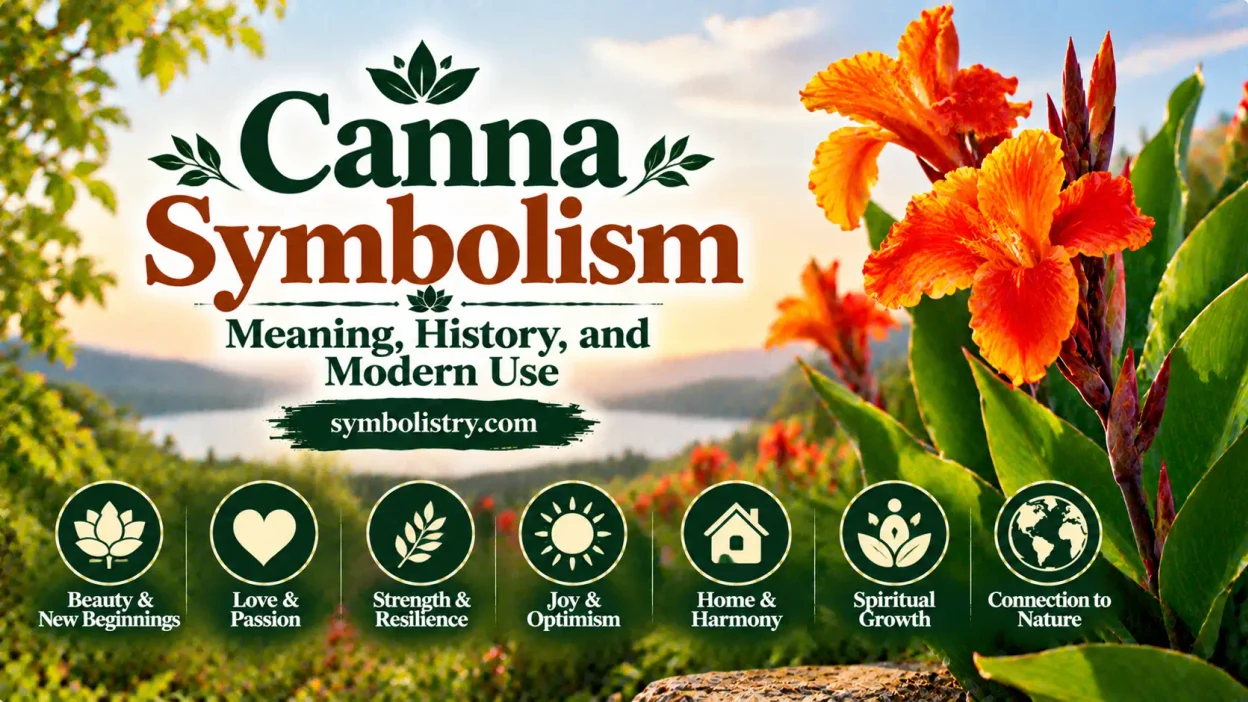
Canna symbolism centers on confidence, beauty, vitality, and the ability to stand out. The canna lily, known for its broad green leaves and dramatic flowers, brings a tropical appearance to gardens, public landscapes, and decorative displays across the United States. Its upright growth and vivid colors make it a natural subject for interpretations connected with self-assurance, energy, and personal expression.
Despite its common name, the canna lily is not a true lily. It belongs to the genus Canna, a group of flowering plants native to tropical and subtropical regions of the Americas. Gardeners value these plants for their bold foliage, bright blooms, and ability to create a strong visual presence during warm weather.
People interested in flower symbolism may encounter canna in landscaping, floral photography, botanical art, and personal gardens. Although the plant does not have one universally established symbolic meaning, its appearance, growing habits, and cultural history offer several useful ways to understand what it represents today.
Quick Answer
Canna symbolism commonly represents confidence, beauty, vitality, and bold self-expression in modern American culture, particularly through tropical gardens and ornamental landscaping. Its broader associations with abundance, resilience, and human resourcefulness reflect the plant’s long history as both a useful crop and a cultivated ornamental flower.
TL;DR
- Canna flowers commonly suggest confidence, vitality, and striking beauty.
- Their upright stems and vivid blooms communicate strength and self-expression.
- Indigenous peoples of the Americas cultivated certain canna species for practical uses.
- American gardeners associate canna with tropical landscapes and summer color.
- Red, yellow, and orange varieties create different emotional impressions.
- Modern canna symbolism depends on personal experience, setting, and cultural context.
1. What Is the Canna Flower?
Canna is a genus of flowering plants recognized for its large leaves, upright stems, and conspicuous flowers. The plants are often called canna lilies, although they are botanically distinct from true lilies. Their flowers may appear in shades of red, orange, yellow, pink, and combinations of these colors.
The foliage is another defining feature. Some varieties have green leaves, while others display bronze, burgundy, or striped patterns. This combination of height, color, and broad leaves gives canna a bold appearance that differs from the delicate look of many traditional garden flowers.
Canna plants grow from underground rhizomes and generally thrive in warm conditions with adequate moisture and sunlight. In the United States, they are especially familiar in summer gardens, public parks, botanical displays, and containers.
These physical characteristics help explain their symbolic associations. A tall, upright plant may suggest confidence, while its expansive leaves can evoke abundance and vitality. Bright flowers naturally draw attention, making canna a fitting emblem of expressive beauty.
2. The Core Meaning of Canna Symbolism
The most common modern interpretations of canna come from its appearance rather than from a single established historical tradition.
Confidence and individuality are natural associations because canna flowers are conspicuous. Their bold colors and substantial foliage make them difficult to overlook. In a symbolic arrangement or garden, they can represent someone who embraces individuality instead of blending into the background.
Vitality and enthusiasm connect with the plant’s lush growth and summer flowering. Healthy canna plants create an impression of movement and abundance, particularly when several varieties grow together.
Beauty and self-expression reflect the flower’s ornamental role. Unlike flowers commonly chosen for subtle elegance, canna makes a strong visual statement. It can suggest a willingness to celebrate color, creativity, and personal taste.
Resilience and adaptability are also reasonable interpretations. Canna rhizomes can survive dormant periods under suitable conditions, allowing plants to return when growing conditions improve. This characteristic offers a natural metaphor for persistence, although it should not be mistaken for a traditional symbolic belief shared by all cultures.
These meanings are interpretations, not a universal floral dictionary. A person may associate canna with confidence, summer memories, family gardens, or simply an appreciation of tropical plants.
3. Historical Roots in the Americas
Canna has a long history in the tropical and subtropical Americas. Different species have been cultivated for ornamental and practical purposes, and some have served as food crops.
One particularly important species is Canna indica, which has been grown in various regions for its starchy rhizomes. The plant’s edible underground parts have contributed to its value beyond decoration. Other canna species and cultivated varieties have been selected for their foliage, flower colors, and garden performance.
It is important to distinguish this botanical history from claims about symbolism. Evidence that a plant was cultivated or eaten does not automatically establish that it represented prosperity, spirituality, or a particular virtue in every society that used it.
Instead, canna’s history offers a grounded basis for broader interpretations. A plant that provides practical resources as well as visual beauty can evoke usefulness alongside ornament. Its long cultivation also illustrates the relationship between people and plants: human communities have valued vegetation not only for appearance but also for nourishment and everyday needs.
As canna spread through horticultural networks, its role increasingly included decorative planting. The plant’s modern ornamental identity developed through cultivation, selection, and the movement of garden plants between regions.
4. How Canna Became a Garden Favorite
Canna’s visual appeal made it useful in formal gardens and large landscape designs. Its height creates vertical structure, while its broad leaves add volume and texture. Bright flowers provide contrast against lawns, paths, ponds, and architectural features.
During the development of modern ornamental horticulture, gardeners selected canna varieties for differences in flower color, foliage, and overall size. These selections expanded the plant’s decorative possibilities and helped establish it as a familiar warm-season garden feature.
This history contributes to the flower’s contemporary associations with confidence and display. In landscape design, canna is often used as a focal plant rather than as a minor background accent. Its presence can define a planting bed or create a dramatic visual boundary.
The plant’s popularity does not mean that Americans traditionally assign it a single fixed message. Rather, its garden role encourages people to read it as an expression of color, creativity, tropical atmosphere, and deliberate design.
5. What Canna Represents in the United States
In the United States, canna symbolism is shaped mainly by gardening, landscaping, seasonal decoration, and individual associations with flowers.
In residential gardens, canna can communicate a preference for bold color and a lively outdoor environment. Homeowners may use it to create a tropical-inspired patio, brighten a fence line, or give a flower bed a strong focal point.
Public parks and landscaped commercial spaces also use canna for its height and visual impact. In these settings, the plant contributes to a sense of fullness and seasonal abundance. Its presence may make an area feel more welcoming, energetic, or carefully designed.
Canna is not as firmly embedded in American holiday traditions as roses, poinsettias, or lilies. It does not have one widely recognized national meaning associated with weddings, funerals, or patriotic ceremonies. Its significance is more likely to arise from personal preference and the setting in which it appears.
For an American gardener, canna might symbolize the arrival of summer. For someone who remembers a relative’s backyard, it may represent family and continuity. For a designer, it may simply be an effective way to introduce height and color into a landscape.
6. Canna, Confidence, and Personal Identity
Canna’s upright growth and eye-catching flowers lend themselves to interpretations involving confidence. The plant does not rely on a delicate or understated appearance; it creates a strong presence through size, structure, and color.
As a personal symbol, canna may appeal to people who value individuality, creativity, or the freedom to express themselves. A person who chooses it for a garden or artwork might appreciate its unusual foliage and dramatic flowers rather than a traditional romantic flower.
This makes canna an interesting alternative in visual storytelling. In a photograph, painting, or garden illustration, it can help communicate a character who is expressive, energetic, or comfortable attracting attention.
However, these meanings depend on context. A large flower does not automatically indicate confidence, and someone may choose canna simply because it grows well in a particular climate. Symbolic interpretation is most useful when it considers both the plant’s visual qualities and the intention of the person using it.
7. The Emotional and Psychological Associations of Canna
Color, shape, and personal memory all influence how people respond to flowers. Canna combines several visual features that can shape an emotional impression.
Its large leaves suggest fullness, while its upright stems create a sense of structure. Bright blooms draw the eye and can make a garden feel animated. In a dense planting, multiple flowers create a feeling of abundance; in a simple arrangement, a single bloom can become a focal point.
Color also affects interpretation. Red may be associated with passion or intensity, while yellow can suggest cheerfulness and warmth. Orange often conveys enthusiasm, and pink may appear softer or more affectionate. These are common cultural associations, not fixed psychological effects or universal rules.
Personal memories can be just as influential. Someone who grew up in a warm climate may connect canna with home, familiar gardens, or summer afternoons. Another person may associate it with travel or a favorite botanical garden.
The flower’s emotional meaning therefore emerges from a combination of visual impression, cultural expectations, and individual experience.
8. What Different Canna Colors Symbolize
Canna’s varied colors make it adaptable to different decorative and artistic purposes. Although no universal code determines what each color means, familiar color associations can help explain the impressions people may draw from the plant.
| Canna color | Common association in the United States | Possible symbolic interpretation | Typical visual effect |
|---|---|---|---|
| Red | Passion and intensity | Courage, confidence, strong feeling | Dramatic and energetic |
| Orange | Warmth and enthusiasm | Creativity, excitement, vitality | Bright and attention-grabbing |
| Yellow | Cheerfulness and optimism | Joy, openness, positive expectations | Sunny and welcoming |
| Pink | Affection and gentleness | Warmth, tenderness, personal appreciation | Softer and more delicate |
| Deep burgundy foliage | Richness and contrast | Individuality, sophistication, dramatic expression | Bold and architectural |
These associations are useful for design, but they should not be treated as official meanings attached specifically to canna. The same color can communicate different things depending on the arrangement, the surrounding plants, and the viewer’s experiences.
A red canna in a dramatic landscape may suggest intensity, while the same flower in a mixed summer border may simply provide contrast. The symbolism becomes clearer when color is considered alongside the setting.
9. Canna in Art, Photography, and Design
Canna is well suited to visual art because its leaves and flowers offer strong shapes. The contrast between broad foliage and clustered blooms creates a recognizable silhouette, even when the plant is represented with simplified forms.
In botanical illustration, canna can represent the diversity and structure of plant life. Artists may emphasize the veins in its leaves, the arrangement of its petals, or the differences between flower and foliage colors.
In photography, canna can communicate a tropical atmosphere without requiring an elaborate setting. A close-up of a bright bloom may emphasize beauty and detail, while a wider image of a garden can convey abundance and warmth.
Landscape designers use canna’s vertical form to guide the viewer’s attention. Planted near an entrance, water feature, or pathway, it can establish a visual focal point. Its strong structure can also balance lower-growing plants.
In each case, the symbolic effect comes from the plant’s physical qualities and how the creator presents them. Canna does not need an inherited cultural meaning to communicate energy, color, or individuality.
10. Canna in Tattoos, Jewelry, and Personal Style
Canna is less standardized as a tattoo symbol than roses, lotuses, or sunflowers. Nevertheless, its distinctive appearance can make it meaningful to someone seeking a floral design that feels less conventional.
A canna tattoo might represent confidence, a love of tropical plants, a memorable garden, or a personal connection to a particular place. Someone could also choose it to celebrate resilience or a return to growth after a difficult period.
Its elongated leaves and vivid flowers offer several artistic possibilities. A design may focus on a single bloom, show the entire plant, or combine the flower with other botanical elements. Color can strengthen the intended impression, while a monochrome design may emphasize structure and form.
Canna can also appear in illustrations on clothing, accessories, stationery, and home decorations. Jewelry inspired by the plant may be chosen for its shape or connection to nature rather than because the flower has an established traditional message.
For personal use, the most meaningful approach is to decide what the plant represents to you. A short explanation of a personal memory or value can make the choice more specific than relying on a generic flower-meaning list.
11. Practical Uses and the Meaning of Abundance
Canna’s history as both an ornamental plant and a useful crop adds another dimension to its interpretation. Some species have edible rhizomes, demonstrating that the genus has practical significance beyond its decorative role.
This combination can support a modern reading of canna as a symbol of abundance or resourcefulness. The plant offers visual pleasure while also illustrating how vegetation can contribute to human needs.
Still, the practical history varies by species and region. It would be misleading to assume that every canna variety was cultivated for food or that all communities attached the same cultural meaning to it.
In contemporary gardens, abundance is more often conveyed through the plant’s lush appearance. A group of tall cannas with dense foliage and many blooms can create an impression of fullness and generosity.
The idea is especially relevant in landscape design, where plants are arranged to make outdoor spaces feel complete. Canna’s size and strong growth help create that impression, whether or not the gardener consciously intends a symbolic message.
12. Canna Across Cultures and Botanical Traditions
Because canna species originated in the Americas and have been cultivated in different regions, their history crosses geographical boundaries. Plants have moved through horticultural exchange, and gardeners in warm climates have adopted them for local landscapes.
However, a shared plant does not necessarily have a shared meaning. A canna grown for food, one displayed in a formal garden, and one painted as a botanical subject may occupy very different cultural roles.
The plant’s connection to the Americas is important, but it should not be used to invent a single pan-Indigenous meaning. Indigenous communities have distinct histories, languages, and traditions. Any claim that canna represents a particular spiritual concept within a specific nation or community requires evidence tied to that community.
Likewise, canna should not automatically be assigned religious meanings simply because flowers and cultivated plants appear in ceremonies around the world. A meaningful cultural interpretation depends on documented use, not on the assumption that all flowers carry the same spiritual message.
A careful cross-cultural reading recognizes canna’s botanical history while allowing its meanings to differ from one setting to another.
13. Common Misunderstandings About Canna Symbolism
Several misconceptions can arise when readers look for a definitive meaning for a particular flower.
Canna is not a true lily. The common name canna lily refers to its flower-like appearance, but the plant belongs to a separate botanical group. Its symbolism should not automatically be borrowed from traditional interpretations of true lilies.
Its meanings are not universal. Confidence, vitality, and beauty are reasonable modern interpretations, but they are not a universally accepted symbolic code. A person’s cultural background and experiences can change how the plant is understood.
Its historical uses do not prove a specific spiritual meaning. Evidence of cultivation for food or ornament establishes practical history, not a universal religious or ceremonial role.
There is no single established canna tattoo meaning. Personal designs can represent self-expression, family memories, tropical landscapes, or other values. The meaning depends on the person who chooses the image.
Color meanings are flexible. Red may suggest passion to one viewer and simply serve as a striking garden color to another. The plant’s setting and intended message matter as much as the color itself.
These distinctions help separate documented botanical facts from modern personal interpretations.
14. How Canna Symbolism Is Evolving Today
Modern interest in gardening, houseplants, botanical illustration, and outdoor design has created new ways for people to engage with canna. The plant appears in garden photography, landscape inspiration, floral artwork, and digital images shared by gardeners.
Its symbolism is increasingly personal rather than governed by a single traditional flower-language system. Someone may use canna to express a love of tropical gardens, celebrate an outdoor space, or represent the confidence to embrace a distinctive style.
Environmental awareness can also shape how people interpret cultivated plants. A garden may represent care, patience, and a connection with the natural world. In that context, canna’s seasonal growth can become a reminder of ongoing attention and renewal, though these associations are personal rather than universal.
The plant’s practical and ornamental history remains relevant as well. Canna shows how one group of plants can serve different purposes as it moves between gardens, food traditions, artistic representations, and modern landscape design.
Its contemporary meaning is therefore flexible. Rather than carrying one fixed message, canna provides a visual language that people adapt to their own spaces, memories, and creative choices.
Frequently Asked Questions
What does canna symbolize spiritually?
Canna does not have one universally recognized spiritual meaning. Some people may interpret its growth and bright flowers as signs of vitality, renewal, or personal strength, but these readings should be distinguished from documented beliefs in specific religious or cultural traditions.
What does a canna flower tattoo mean?
A canna tattoo can represent confidence, individuality, tropical beauty, or a personal connection to a place or memory. Its meaning is usually chosen by the wearer rather than drawn from a widely established tattoo tradition.
Is canna a symbol of strength?
Canna can serve as a modern symbol of strength because of its upright stems, substantial foliage, and capacity to regrow from rhizomes under suitable conditions. This is an interpretation based on the plant’s characteristics, not a universal historical definition.
What do red and yellow canna flowers mean?
Red canna flowers may suggest passion, courage, or intensity, while yellow varieties can evoke cheerfulness and warmth. These interpretations follow familiar color associations and are not fixed meanings exclusive to canna.
Is canna associated with good luck or prosperity?
There is no single widely recognized American tradition that defines canna as a universal good-luck flower. Some people may connect its lush growth and abundance of blooms with prosperity, but that meaning depends on personal or local context.
Is canna the same as a true lily?
No. Canna lilies belong to the genus Canna and are botanically distinct from true lilies in the genus Lilium. The shared common name refers to their appearance, not a close botanical relationship.
Why is canna popular in American gardens?
Canna is popular for its bold flowers, large leaves, and ability to create strong visual structure in warm-season landscapes. Gardeners use it to add height, contrast, and a tropical atmosphere to beds, borders, and containers.
Conclusion
Canna symbolism is best understood through the plant’s appearance, practical history, and modern use. Its upright stems and vivid flowers make it a natural emblem of confidence, vitality, beauty, and self-expression, while its history as a cultivated plant adds a connection to resourcefulness and human relationships with nature.
In the United States, canna is primarily appreciated as an ornamental flower rather than as a symbol governed by a fixed tradition. Its meaning may emerge from a summer garden, a personal artwork, a tattoo, or a memory associated with a familiar landscape.
Ultimately, canna symbolism offers a flexible way to express individuality and celebrate the natural world. Its most meaningful interpretation is the one grounded in the plant’s real characteristics and the experience of the person who chooses it.