
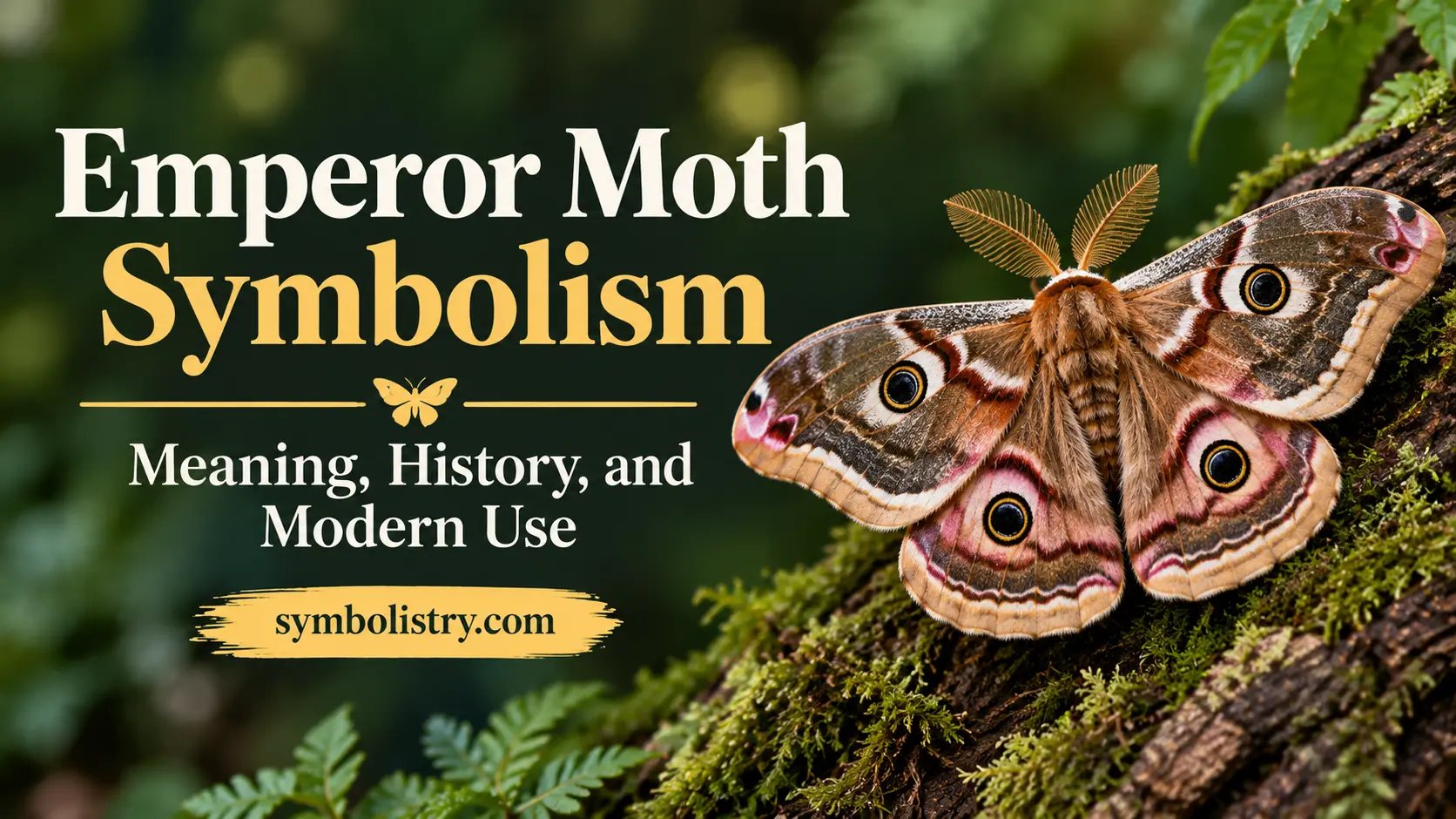
The emperor moth is one of those insects whose appearance seems almost designed for symbolism. Its broad wings carry conspicuous eyespots, while its life cycle moves from caterpillar to cocoon to adult moth. For many readers, emperor moth symbolism therefore suggests transformation, protection, awareness, and the ability to move through uncertainty without losing direction.
There is an important distinction, however, between the actual emperor moth and moth symbolism in general. The species most commonly called the emperor moth in Britain is Saturnia pavonia, a Eurasian moth rather than a native American species. In the United States, people may encounter the name through art, tattoos, books, nature imagery, or confusion with visually similar North American saturniid moths.
That distinction matters because the symbolic meaning of a particular species comes partly from its real behavior and appearance. The emperor moth’s eyespots, seasonal emergence, cocoon, sexual differences, and association with heathland all provide more specific imagery than the generic idea of a moth.
Quick Answer
Emperor moth symbolism commonly represents transformation, awareness, protection, and personal change, especially when its eyespots and metamorphosis are emphasized. Historically, its meaning is less standardized than its modern symbolic use, with much of its contemporary interpretation developing from the broader symbolism of moths, eyes, cocoons, and nocturnal insects.
TL;DR
- Emperor moths commonly symbolize transformation and heightened awareness.
- Their eyespots suggest vigilance, protection, and seeing beyond appearances.
- The cocoon reinforces patience, transition, and personal development.
- In America, the species itself is less culturally familiar than other moths.
- Tattoos and artwork often adapt broader moth symbolism to emperor moth imagery.
- Historical meanings should not be confused with modern spiritual interpretations.
What the Emperor Moth Actually Looks Like
The emperor moth, Saturnia pavonia, belongs to the Saturniidae family, the group that includes many large silk moths. It is particularly recognizable because of the prominent eyespots on all four wings.
The male is generally smaller and more strongly colored, with orange hindwings and large feathery antennae. The female is larger and usually more subdued in coloration. Depending on the individual, the wings may show combinations of gray, brown, orange, pink, white, black, and yellow.
Those eyespots are especially important for symbolic interpretation. They can resemble eyes watching from the wings, naturally encouraging associations with awareness, vigilance, observation, and protection.
The species is associated particularly with heathland, moorland, grassland scrub, woodland edges, and sandy habitats. Its caterpillar feeds on plants including heather and bramble and eventually forms a substantial cocoon before emerging as an adult.
The Core Meaning: Transformation Without Spectacle
Transformation is probably the most accessible symbolic idea attached to an emperor moth.
Like other moths, it undergoes complete metamorphosis. The caterpillar and adult are radically different forms of the same animal, separated by a pupal stage hidden inside a cocoon.
That makes the emperor moth useful as an image of change that happens privately.
A butterfly is often used to represent visible transformation: the finished wings become the focus. An emperor moth can communicate something slightly different. Its cocoon suggests that important development may happen when there is little outward evidence of progress.
For someone using the image symbolically, this can represent:
- entering a new stage of life
- developing privately before making a change public
- leaving an earlier identity behind
- accepting that growth can be gradual
- becoming something different without abandoning one’s past
This interpretation comes from observable biology rather than a specific ancient doctrine assigning one fixed meaning to the species.
Why the Eyespots Matter So Much
The emperor moth’s eyespots provide one of its clearest symbolic features.
The markings look remarkably like eyes, even though they are patterns on wings rather than actual organs of sight. Their biological function is generally understood in relation to predator interactions, and research on saturniid moths has examined how eyespots can contribute to predator deterrence.
Symbolically, however, people naturally read an eye as a sign of awareness.
An emperor moth image can therefore suggest:
- vigilance
- perception
- self-awareness
- protection
- noticing what others overlook
- looking beyond surface appearances
There is also an interesting tension here. The moth appears to be watching, but the “eyes” are not actually eyes. That makes the image particularly useful for ideas about perception and appearance: what looks threatening may not be what it seems, and what appears passive may contain its own form of defense.
Ancient Roots and the Limits of Historical Claims
It is tempting to give every distinctive insect an ancient symbolic meaning, but the historical evidence does not support a single continuous tradition of emperor moth symbolism.
Saturnia pavonia was formally described by Carl Linnaeus in 1758. Its scientific classification places it in Saturniidae, a family named in relation to Saturn, the ringed planet. The family’s name reflects the ring-like or eye-like markings characteristic of many of its members.
The species name pavonia also connects with the peacock-like appearance of its eyespots.
This gives the moth a historical connection to European scientific naming and visual comparison, but that is different from claiming that ancient Europeans universally regarded the emperor moth as a symbol of transformation or spiritual awakening.
Much of the symbolic language now attached to moths comes from later cultural associations with night, light, metamorphosis, mortality, and the unseen world rather than from a single established emperor-moth tradition.
What Its Cocoon Symbolizes
The cocoon may be the most useful feature for interpreting the emperor moth on a personal level.
The mature caterpillar eventually creates a tough, silk-containing cocoon in vegetation, where the developing pupa remains protected. In some cases, the pupal stage can last for an extended period.
Symbolically, this creates a natural metaphor for a period when outward activity slows but internal change continues.
The cocoon can represent:
Patience. Not every stage of development produces visible results.
Privacy. Some forms of growth happen away from public attention.
Protection. A vulnerable stage may require boundaries rather than exposure.
Transition. The old form has ended, but the new form has not yet appeared.
Readiness. Emergence happens when development has reached the appropriate stage, not simply because outside observers expect it.
This is particularly relevant to modern uses of moth imagery in tattoos and personal artwork, where the cocoon can represent recovery, reinvention, or an important period of change.
Emperor Moth Symbolism in the United States
The American context requires some care.
Saturnia pavonia is not a familiar native moth throughout the United States. Its documented natural range is primarily European and Eurasian, extending across much of the Palearctic.
Americans are much more likely to encounter related native saturniid species, such as luna moths, cecropia moths, polyphemus moths, and imperial moths. Consequently, an American audience may recognize the visual language of a large silk moth without having a longstanding cultural relationship with Saturnia pavonia specifically.
That means modern American interpretations are often constructed from three things:
- the emperor moth’s distinctive physical characteristics;
- broader Western moth symbolism;
- personal meanings attached to metamorphosis, darkness, nature, and change.
The result is less a traditional American folk symbol and more a contemporary symbolic image.
| Context | Meaning in the USA | Common Associations | Notes |
|---|---|---|---|
| Tattoos | Transformation and awareness | Growth, identity, survival | Meaning depends heavily on surrounding imagery |
| Artwork | Beauty with an unusual edge | Nature, eyes, mystery | Often combines moths with flowers or celestial imagery |
| Jewelry | Personal change | Protection, individuality | Usually based on visual symbolism rather than folklore |
| Home decor | Nature and nocturnal beauty | Woodland, vintage, botanical themes | Often chosen for aesthetic reasons |
| Social media art | Introspection and change | Darkness, light, self-discovery | Usually represents modern personal symbolism |
Eyes, Awareness, and the Idea of Protection
The emperor moth’s eyespots allow another interpretation that differs from simple transformation: protection.
The insect does not need to look aggressive to appear visually imposing. When its wings display their eyespots, the impression changes dramatically.
As symbolism, that can represent the idea that protection does not always mean confrontation.
Sometimes protection means:
- noticing danger early
- establishing boundaries
- appearing more formidable than one feels
- recognizing hidden risks
- preserving vulnerability rather than exposing it
This makes the emperor moth particularly appropriate for symbolic artwork about personal boundaries.
It can communicate a quiet form of strength: awareness first, confrontation second.
Daylight, Darkness, and Duality
The emperor moth also has an unusual relationship with light and darkness.
Males are active in daylight, while females are predominantly nocturnal. During spring, males can fly rapidly across suitable habitat searching for females, which remain comparatively concealed.
That difference creates a natural symbolic contrast.
The emperor moth does not belong exclusively to either darkness or daylight. Its behavior crosses the boundary between them.
In symbolic terms, this can represent:
- public and private identity
- visible and hidden aspects of life
- action and waiting
- certainty and uncertainty
- independence and connection
This duality is one reason moth imagery can work particularly well in modern art. The insect can represent a person who has learned to live with contradictions rather than forcing everything into a single category.
Emotional and Psychological Meaning
At an emotional level, the emperor moth can symbolize a quieter type of change.
Its imagery is suitable for someone who wants to express development without presenting transformation as dramatic or glamorous.
The cocoon suggests withdrawal and preparation. The emerging adult represents a changed state. The eyespots introduce awareness. The muted colors of many individuals add a sense of restraint, while the male’s orange hindwings provide an unexpected flash of color.
Together, those characteristics can communicate an emotional story such as:
“I changed, but not everyone saw the process.”
That is different from claiming that the insect has a scientifically established psychological meaning. Symbolic interpretation is personal and cultural, while the moth’s biological behavior remains observable.
Emperor Moth Tattoos and Personal Style
In American tattoo culture, moth imagery is frequently used to represent transformation, resilience, mortality, darkness, individuality, or a search for light.
An emperor moth tattoo can narrow those meanings further.
The eyespots make it especially suitable for themes of awareness and protection. A cocoon can emphasize transition. A botanical background can connect the design to nature. Moon imagery can emphasize the moth’s association with nighttime, although the emperor moth itself should not be treated as exclusively nocturnal.
Tattoo placement can also influence interpretation. A highly visible emperor moth may function as an identity statement, while a smaller private design may represent a personal chapter or experience.
There is no universal tattoo dictionary that determines what the image means. The surrounding elements and the wearer’s intention usually matter more than the species name alone.
Religious and Spiritual Interpretations
There is no single major religious doctrine that assigns Saturnia pavonia one universally accepted spiritual meaning.
Moths more broadly have accumulated different associations in folklore and spiritual traditions, particularly because of their nighttime activity and their movement between radically different life stages.
Modern spiritual interpretations may describe moths as symbols of intuition, transformation, guidance, or movement through darkness. These are contemporary interpretive frameworks rather than biological facts or universally shared religious teachings.
For that reason, an emperor moth should not automatically be presented as a Christian, Buddhist, Hindu, Indigenous, or other religious symbol without identifying a specific tradition and historical context.
That distinction prevents modern spiritual language from being incorrectly projected backward onto cultures that may never have used this particular species symbolically.
Cross-Cultural Meaning and the Peacock Connection
The emperor moth’s appearance has encouraged comparisons with peacocks because of its prominent eyespots. This visual connection is reflected in scientific and common naming surrounding Saturniidae and related moths.
But a visual resemblance should not automatically be treated as evidence that the moth inherited the religious or cultural symbolism of the peacock.
Instead, the comparison is useful because both images can suggest display, observation, beauty, and conspicuous patterning.
The emperor moth’s symbolism is therefore strongest when grounded in the insect itself: its metamorphosis, eyespots, cocoon, seasonal appearance, and relationship with light.
Common Misunderstandings About the Symbol
One common mistake is treating emperor moth as if it were simply another name for every large moth.
It is not.
Saturnia pavonia is a particular species in the Saturniidae family. North America has its own saturniid moths, including several large and visually spectacular species. Some may be called “emperor” or “imperial” in common language, but that does not make them the same species.
Another mistake is assuming that the emperor moth has one ancient, universally agreed symbolic meaning.
It does not. Modern interpretations frequently combine the biological characteristics of the species with broader moth symbolism and contemporary personal spirituality.
Finally, the eyespots should not be interpreted as literal evidence that the moth “sees” predators with those markings. Their symbolic meaning comes from human perception of the pattern, while their biological significance concerns interactions with predators and survival.
How the Meaning Has Changed Over Time
The emperor moth’s meaning has developed in layers rather than following one continuous symbolic tradition.
Scientific classification gave the species a place within Saturniidae and connected its naming to the visual language of Saturn and peacock-like eyespots. Natural-history observation then emphasized its unusual life cycle, sexual differences, habitat, and seasonal behavior.
Modern visual culture added another layer.
Moths became increasingly useful in tattoos, illustration, fashion, and alternative aesthetics because they combine beauty with darkness, fragility with survival, and transformation with mortality. Contemporary interpretations of the emperor moth can therefore be understood as a meeting point between natural history and modern visual symbolism.
The result is a symbol that feels ancient to many viewers even though much of its current symbolic vocabulary is relatively modern.
Why the Emperor Moth Still Works as a Modern Symbol
The emperor moth has an unusual advantage as a symbol: its meaning can remain grounded in observable details.
Its transformation is real.
Its cocoon is real.
Its eyespots are real.
Its contrasting male and female appearances are real.
Its seasonal emergence is real.
Those details give artists and readers enough material to construct personal meaning without requiring supernatural explanations.
For someone marking a life transition, the cocoon may matter most. For someone focused on self-protection, the eyespots may be central. For someone interested in balancing private and public life, the difference between male daytime activity and female nighttime behavior may provide the most interesting metaphor.
That flexibility is one reason species-specific nature imagery continues to work in contemporary design.
Frequently Asked Questions
What does an emperor moth symbolize?
An emperor moth can symbolize transformation, awareness, protection, patience, and adaptation. These meanings are primarily modern interpretations based on the moth’s metamorphosis, cocoon, and distinctive eyespots rather than a single historical symbolic tradition.
What does an emperor moth tattoo mean?
An emperor moth tattoo may represent personal transformation, heightened awareness, protection, or a period of private growth. Adding a cocoon, flowers, moon imagery, or other elements can shift the emphasis of the design.
Is the emperor moth a symbol of good luck?
There is no broadly established historical tradition that makes Saturnia pavonia a universal good-luck symbol. If someone uses it for luck today, that is better understood as a personal or contemporary interpretation.
Does the emperor moth have a religious meaning?
The species does not have one universally recognized religious meaning. Broader moth symbolism appears in different spiritual and folkloric contexts, but those traditions should not automatically be attributed to Saturnia pavonia.
What do the eyes on an emperor moth symbolize?
The eyespots can symbolize awareness, vigilance, perception, or protection in modern symbolic interpretation. Biologically, however, they are wing markings associated with defensive interactions with predators rather than actual eyes.
Is the emperor moth native to the United States?
The emperor moth most commonly meant by Saturnia pavonia is a Palearctic species found across Europe and parts of Eurasia, not a standard native U.S. species. Americans are more likely to encounter related native saturniid moths, which can sometimes create confusion over common names.
Conclusion
The most useful way to understand emperor moth symbolism is to begin with the insect itself. Its metamorphosis supports ideas of change, its cocoon suggests private development and patience, and its conspicuous eyespots lend themselves naturally to themes of awareness and protection.
In modern American culture, the emperor moth is better understood as a contemporary nature symbol than as a universally inherited American or religious emblem. Its meaning comes from the meeting of natural history, broader moth symbolism, visual art, and personal interpretation.
What makes the image compelling is that its symbolism does not require exaggeration. The insect already tells a clear story: change can happen out of sight, vulnerability can coexist with defenses, and an unfamiliar appearance can conceal an entirely different stage of life.



[…] is probably the most familiar modern meaning attached to butterfly […]