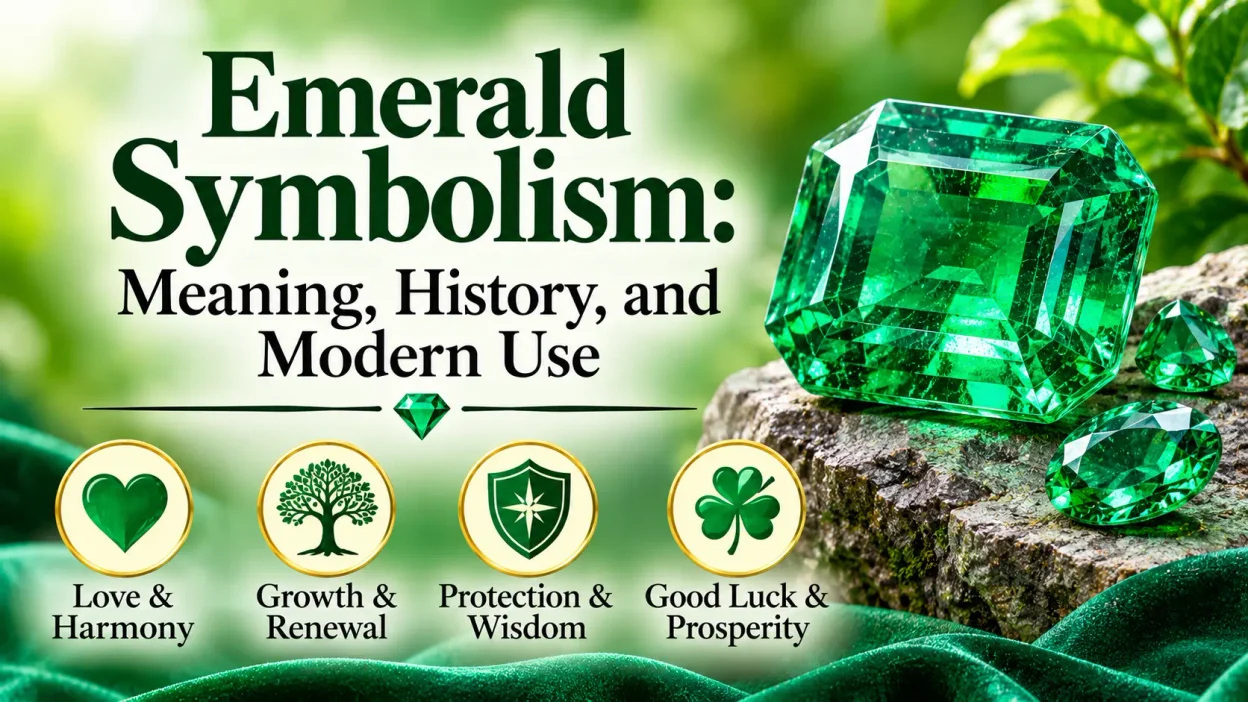
Emerald is one of the most recognizable gemstones in the world, admired for its rich green color and long association with royalty, nature, love, and renewal. For thousands of years, people have treasured this gemstone not only for its beauty but also for the ideas they believed it represented. In modern emerald symbolism, the stone most commonly represents growth, prosperity, loyalty, emotional balance, and new beginnings.
Its green color connects it naturally with spring landscapes, healthy plants, and the return of life after winter. At the same time, its rarity and historical association with powerful rulers have given emerald a reputation for wealth, prestige, and refinement.
In the United States, emerald appears in May birthstone jewelry, engagement rings, anniversary gifts, fashion, and decorative design. It also carries cultural associations with Irish heritage, environmental awareness, and the natural world.
Understanding the gemstone’s symbolism means looking beyond its appearance. Its meaning developed through ancient beliefs, religious traditions, royal collections, commercial trade, and modern personal expression.
Quick Answer: What Does Emerald Symbolize?
Emerald commonly symbolizes growth, renewal, prosperity, loyalty, and lasting love in modern American culture. Historically, it was associated with fertility, protection, wisdom, royal authority, and spiritual renewal because of its distinctive green color and rarity.
TL;DR
- Emerald represents renewal, growth, and the vitality of nature.
- Ancient Egyptians and Romans valued emeralds as precious royal gemstones.
- In the United States, emerald represents May birthdays and lasting relationships.
- Its green color connects it with prosperity, balance, and environmental awareness.
- Emerald jewelry often communicates loyalty, affection, and personal achievement.
- Historical beliefs about healing and protection belong to folklore, not medical science.
1. What Is an Emerald and Why Is It Symbolic?
Emerald is a green to bluish-green variety of beryl, a mineral that also includes aquamarine. Its color comes primarily from trace amounts of chromium and vanadium within its mineral structure. Iron can influence whether the stone appears more bluish or green.
Unlike some gemstones that are valued for exceptional clarity, emeralds commonly contain internal inclusions. Gem collectors sometimes refer to these natural patterns as a jardin, the French word for garden.
These inclusions are part of the stone’s natural character. They also provide an interesting symbolic interpretation: beauty does not always require perfection.
The gemstone is commonly cut into rectangular step-cut shapes, although oval, pear, round, and cushion cuts are also popular.
People encounter emeralds in:
- Engagement rings and wedding jewelry.
- Necklaces, bracelets, earrings, and pendants.
- Royal collections and historical museum objects.
- May birthstone gifts.
- Luxury watches and fashion accessories.
- Decorative objects and gemstone collections.
Its physical appearance helps explain its symbolism. Green is closely associated with vegetation, fertile land, and the changing seasons. Because emerald displays an especially recognizable shade of green, people have repeatedly connected it with life, abundance, and renewal.
2. The Core Symbolic Meanings of Emerald
Emerald carries several related meanings. Some come from its natural color, while others developed through religious beliefs, historical traditions, and its use as a luxury gemstone.
Growth and renewal
Green represents new leaves, growing plants, and the return of vegetation during spring. Emerald therefore suggests fresh opportunities, personal development, and the beginning of a new chapter.
Love and loyalty
Its long association with romantic devotion has made emerald a popular gemstone for anniversary jewelry and meaningful gifts. It can represent a relationship built on patience, trust, and commitment.
Prosperity and abundance
Emerald’s rarity and historical connection with wealthy rulers helped establish its association with financial success, material comfort, and good fortune.
Wisdom and clarity
Historical folklore sometimes described emerald as a stone that revealed truth or improved judgment. In modern symbolic interpretation, it can represent thoughtful decisions and a desire to understand situations clearly.
Protection and security
Various ancient and medieval traditions attributed protective qualities to emerald. Today, this association is more commonly expressed as a personal symbol of confidence, reassurance, and emotional security.
These meanings are not universal rules. Someone choosing an emerald because it represents family loyalty may understand it differently from someone who wears it to celebrate professional success.
3. Ancient Egyptian Origins and Emerald Symbolism
Ancient Egypt played an important role in establishing emerald’s historical reputation.
Archaeological and historical evidence indicates that emerald mining took place in Egypt during antiquity. The country’s eastern desert contained important deposits that became known to later generations as Cleopatra’s Mines.
Cleopatra VII, the Egyptian ruler who lived from 69 to 30 BCE, was particularly associated with emeralds. Historical accounts and later traditions describe her enthusiasm for the gemstone and its use in royal adornment.
For Egyptian culture, green had associations with vegetation, fertility, regeneration, and life. These ideas were also connected with Osiris, a deity associated with death, resurrection, and agricultural renewal.
The symbolism of green made emerald a natural choice for objects connected with royal status and religious ideas.
Egyptian beliefs about the afterlife also gave gemstones an important place in burial practices. Precious materials could be included in funerary objects because of their perceived protective and ceremonial value.
It is important to distinguish between the historical use of emeralds and later legends about their abilities. Ancient people sometimes attributed healing or protective qualities to gemstones, but these were religious and cultural beliefs rather than scientifically established properties.
The Egyptian connection helped establish emerald as more than an attractive mineral. It became a gemstone associated with life, authority, and the continuation of existence.
4. Emerald Symbolism in Ancient Greece and Rome
Greek and Roman societies further developed emerald’s reputation.
The English word emerald ultimately comes through Latin and Old French from the ancient Greek word smaragdos, meaning a green gemstone.
Roman writers described emeralds as exceptionally beautiful. Pliny the Elder, writing in the first century CE, discussed their vivid green color and the traditional belief that looking at them could comfort tired eyes.
The Romans also associated emeralds with Venus, the goddess of love and beauty. This connection helped reinforce interpretations involving romance, attraction, and affection.
The gemstone was used in jewelry, decorative objects, and luxury possessions. Its association with wealthy households and influential individuals strengthened its connection with status.
Several ideas emerged from these traditions:
- Green represented natural vitality and fertility.
- Venus connected emerald with affection and beauty.
- Luxury jewelry associated it with wealth and social standing.
- Traditional beliefs connected its color with comfort and restoration.
The Romans helped spread emerald jewelry and its associated ideas across different parts of their empire.
5. Emerald Symbolism in the United States
In the United States, emerald has developed a combination of traditional and contemporary meanings.
Americans commonly associate it with prosperity, love, personal milestones, and the natural world. Its use in jewelry makes it especially relevant to celebrations and relationships.
May birthstone traditions
Emerald is the traditional birthstone for May. It is frequently selected for birthday gifts, family jewelry, and personalized accessories.
Its association with spring makes it particularly appropriate for people born during a month when gardens, trees, and flowers are becoming increasingly green.
Wedding and anniversary gifts
Emerald is traditionally associated with the twentieth and thirty-fifth wedding anniversaries. Its connection with lasting affection makes it suitable for celebrating relationships that have developed over many years.
Luxury and personal achievement
Emerald jewelry is often used to communicate elegance, confidence, and financial success. Its association with royal collections and high-value gemstones contributes to this interpretation.
Nature and environmental identity
Green has become a familiar color in American environmental movements, sustainability campaigns, and conservation-related design. Emerald can therefore suggest an appreciation for natural landscapes and ecological responsibility.
Irish-American culture
Emerald is strongly connected with Ireland through the nickname the Emerald Isle. In the United States, this association appears in Irish-American celebrations, particularly St. Patrick’s Day.
However, emerald is not the official symbol of Ireland, nor is every green gemstone an expression of Irish identity. Its cultural meaning depends on context.
6. Emerald as a Symbol of Love, Loyalty, and Commitment
Emerald has a long-standing association with romantic relationships.
Its connection with Venus in Greco-Roman traditions contributed to its interpretation as a gemstone of love and attraction. Later jewelry traditions developed this association through engagement rings, anniversary gifts, and personal adornments.
In contemporary relationships, emerald can communicate several ideas:
- Faithfulness and emotional commitment.
- Affection that develops over time.
- Trust between romantic partners.
- Hope for a shared future.
- Appreciation for a lasting relationship.
Unlike a gemstone chosen simply because it is fashionable, an emerald can carry a personal message when given for a meaningful occasion.
Its green color also offers an interesting interpretation of love. Rather than representing only romantic excitement, it can suggest a relationship that continues to grow through shared experiences and mutual understanding.
Emerald engagement rings have become an alternative to traditional diamond rings for people who prefer colored gemstones.
However, emerald is softer and generally more vulnerable to damage than diamond. Its suitability for everyday rings depends on the stone’s quality, protective setting, and the wearer’s care habits.
7. Spiritual and Religious Meanings of Emerald
Emerald has appeared in several religious and spiritual traditions, although its interpretation differs between cultures.
Christian symbolism
Emerald appears in Revelation 21:19 as one of the gemstones associated with the foundations of the New Jerusalem.
Christian writers in later centuries interpreted gemstones through religious teachings. Emerald was sometimes associated with faith, hope, spiritual strength, and the renewal of the believer.
Its green color also offered a visual connection with life and the promise of spiritual restoration.
Jewish traditions
Emerald appears in some historical interpretations of precious stones associated with biblical descriptions of sacred objects. Traditions concerning the gemstones of the high priest’s breastplate have varied in their identification and translation.
The specific ancient mineral represented by every biblical gemstone cannot always be established with certainty.
Islamic cultural traditions
Green has an important place in Islamic visual culture and is associated in various contexts with paradise, gardens, and life. Emeralds have also been prized in Islamic royal jewelry and decorative arts.
It is important not to assume that emerald has one universally prescribed religious meaning in Islam. Its use as a gemstone is different from the broader religious significance of green.
Modern spiritual interpretations
Some contemporary spiritual communities use emerald as a symbol of compassion, emotional balance, and personal growth.
These interpretations belong to modern spiritual practice rather than universally accepted religious doctrine.
8. Emerald Symbolism in Different Cultures
Emerald’s meanings have developed across different regions, often reflecting local beliefs about green, precious stones, and royal authority.
| Cultural Context | Symbolic Meaning | Common Associations | Notes |
|---|---|---|---|
| Ancient Egypt | Renewal and fertility | Vegetation, afterlife, royal adornment | Connected with green and regeneration |
| Ancient Greece and Rome | Love and beauty | Venus, luxury, natural vitality | Valued as a precious gemstone |
| Colombia and the Andes | Prestige and ceremonial value | Royalty, trade, traditional adornment | Emeralds had cultural importance before Spanish conquest |
| India | Spiritual prestige and prosperity | Royal jewelry, sacred inscriptions | Highly valued in Mughal-era collections |
| Christian traditions | Faith and spiritual renewal | Revelation, hope, religious imagery | Interpretations developed through later religious writing |
| Modern United States | Growth and commitment | May birthdays, jewelry, Irish heritage | Used in celebrations and personal style |
Colombia
Colombia is particularly important in emerald history. Indigenous communities valued and worked with emeralds before Spanish conquest. The Spanish subsequently took control of important mining areas and introduced Colombian emeralds into international trade.
India
Emeralds became especially prominent in Mughal royal collections. They appeared in elaborate jewelry and decorative objects, sometimes bearing engraved inscriptions.
Their use communicated wealth, authority, and refined artistic taste.
Ireland
Ireland’s nickname, the Emerald Isle, comes from its green landscapes rather than its gemstone deposits. Nevertheless, the association has made emerald a recognizable visual reference to Irish identity.
These examples demonstrate that emerald’s meaning is influenced by both the gemstone itself and the cultural environment in which it is used.
9. The Psychological and Emotional Meaning of Emerald Green
Emerald’s emotional associations are closely connected with the color green.
People frequently associate green with plants, forests, gardens, and healthy natural environments. These associations can make emerald appear calming, refreshing, and optimistic.
Its emotional symbolism can be understood through several ideas.
Emotional balance
Green is often used in environments intended to feel peaceful or restorative. Emerald-colored objects can communicate stability and composure through their visual appearance.
Personal growth
A growing plant provides an accessible metaphor for learning and development. Emerald can therefore represent someone moving into a new stage of life.
Confidence and self-worth
Because emerald has a history of royal and luxury use, it can also communicate self-assurance and a sense of personal achievement.
Hope and optimism
Its association with spring makes emerald a natural symbol of possibilities and fresh opportunities.
Emotional connection
Emerald jewelry given by a family member or romantic partner may become associated with memories, relationships, and important life events.
Color psychology should not be treated as a universal formula. People respond differently to colors depending on their experiences, preferences, and cultural backgrounds.
10. Emerald as a Symbol of Wealth, Success, and Prosperity
Emerald has long been associated with wealth because of its rarity, beauty, and historical use among influential individuals.
Egyptian rulers, Roman elites, Indian emperors, and European royal families all contributed to its reputation as a prestigious possession.
Its connection with prosperity developed through two related ideas.
First, emerald was a valuable gemstone that could demonstrate financial resources and social position. Owning a remarkable emerald was a visible sign of access to rare luxury goods.
Second, its green color connected it with fertile land, growing crops, and natural abundance. In agricultural societies, successful growth often represented security and material well-being.
Modern American culture continues to use green as a color associated with money and financial success. This connection is particularly visible in business design, financial branding, and popular expressions.
Emerald combines these associations through its recognizable green appearance and luxury reputation.
For some people, wearing emerald represents ambition and achievement. For others, it communicates a desire for financial stability rather than extravagant wealth.
11. Why Emerald Is the Birthstone for May
Emerald is the traditional birthstone for May.
The connection makes sense visually because May falls during spring in the Northern Hemisphere. Trees produce fresh leaves, gardens become greener, and many landscapes move into a period of active growth.
Emerald’s color reflects this seasonal change.
As a birthstone, it commonly represents:
- New beginnings and personal development.
- Health and vitality.
- Hope and optimism.
- Love and lasting relationships.
- Appreciation for nature.
The tradition of assigning gemstones to particular months developed through older religious, cultural, and commercial practices. Modern birthstone lists were standardized through jewelry-industry conventions during the twentieth century.
Today, emerald is a popular choice for May birthday presents because it combines a recognizable birthstone tradition with associations of elegance and personal significance.
It is also traditionally given for twentieth and thirty-fifth wedding anniversaries.
12. Emerald in Tattoos, Jewelry, Fashion, and Interior Design
Emerald’s symbolism continues to appear in contemporary personal style and decorative design.
Jewelry
Emerald rings, pendants, bracelets, and earrings are used to represent affection, confidence, prosperity, and personal milestones.
Some people select emerald because it is their birthstone. Others choose it because its color complements their style or because they associate it with someone important.
Tattoos
Emerald-inspired tattoos are less common than traditional flower, animal, or celestial designs, but the gemstone can be used as a personal symbol.
Possible interpretations include:
- A green gemstone representing personal growth.
- An emerald surrounded by leaves representing renewal.
- An emerald with a crown representing achievement.
- A gemstone combined with a heart representing loyalty.
- An emerald with a snake representing transformation and renewal.
The meaning depends on the surrounding imagery and the person’s reason for choosing the design.
Fashion
Emerald green appears in evening dresses, suits, handbags, shoes, and accessories. It is often selected for its combination of sophistication and visual richness.
Unlike lighter greens, emerald can create a formal appearance without relying on black, navy, or neutral colors.
Interior design
Emerald-colored velvet, decorative cushions, wall finishes, and accessories are used to create interiors that feel elegant and visually warm.
When combined with gold, the color often suggests traditional luxury. With natural wood and plants, it can create a more organic atmosphere.
Social media and digital culture
Emerald-colored imagery appears in beauty content, gemstone collections, fashion photography, and lifestyle posts.
It is often used to communicate elegance, nature-inspired aesthetics, or an interest in precious stones.
13. Emerald in Mythology, Folklore, and Traditional Healing Beliefs
Emerald accumulated many unusual beliefs as it moved between ancient and medieval societies.
Some traditions claimed that emerald could reveal the future, expose dishonesty, or protect its wearer from harmful influences.
Other stories suggested that placing an emerald under the tongue could improve prophetic abilities or make someone more persuasive.
Historical writers also recorded beliefs that emerald could protect against particular illnesses or restore tired eyesight.
These claims should be understood as folklore. There is no reliable scientific evidence that wearing emerald can predict the future, prevent disease, or cure medical conditions.
Nevertheless, the stories reveal how people interpreted the gemstone.
Its transparency and vivid green color made it appear unusual, while its rarity encouraged beliefs that it possessed qualities beyond ordinary materials.
In some medieval Christian interpretations, emerald was connected with faith and spiritual endurance. Other traditions linked it with truthfulness and the ability to recognize deception.
These ideas helped establish emerald as a gemstone associated with both physical protection and moral understanding.
14. Common Misunderstandings About Emerald Symbolism
Although emerald has many established historical associations, some modern claims exaggerate or confuse its meaning.
Emerald does not guarantee wealth.
Its connection with prosperity comes from its rarity, color, and historical use as a luxury possession. Owning one does not produce financial success.
Emerald is not a proven healing treatment.
Traditional beliefs about improving eyesight, curing disease, or balancing the body are not supported by medical evidence.
Green gemstones are not automatically emeralds.
Emerald is a particular variety of beryl. Other green gemstones, including peridot, green tourmaline, and jade, have different mineral compositions and histories.
Emerald does not have one universal religious meaning.
Its interpretation varies between historical traditions, religious writings, and modern spiritual practices.
Its symbolism is not always romantic.
Although emerald is frequently associated with love, it can also represent growth, heritage, professional achievement, nature, or personal identity.
Separating cultural interpretation from scientific fact makes it easier to appreciate emerald without confusing folklore with reality.
15. How Emerald Symbolism Has Changed Over Time
Emerald’s meaning has developed through changing cultural priorities.
In ancient Egypt, its green appearance connected it with vegetation, regeneration, and royal identity. Greek and Roman traditions strengthened its associations with love, beauty, and luxury.
During later periods, emerald became prominent in royal jewelry, religious objects, and collections belonging to wealthy families. Medieval folklore added claims about protection, truth, and healing.
The expansion of international gemstone trade during the sixteenth century brought Colombian emeralds into European and Asian markets. This increased the stone’s availability to wealthy collectors and strengthened its position in luxury culture.
In modern America, emerald has acquired more personal and accessible meanings.
People wear it to celebrate birthdays, marriages, family relationships, and individual achievements. Its association with green landscapes also makes it relevant to environmental themes and nature-inspired design.
The gemstone has therefore moved from being primarily a possession of rulers and wealthy collectors to becoming an object of personal expression.
Its central associations with growth, beauty, and prosperity remain recognizable, but the reasons people choose emerald today are much more varied.
Frequently Asked Questions
1. What does an emerald symbolize spiritually?
Emerald is commonly associated with renewal, faith, hope, compassion, and spiritual development. Some modern spiritual traditions also interpret it as a symbol of emotional balance, although these meanings are not universal religious teachings.
2. Is emerald a symbol of love and loyalty?
Yes. Emerald has historical associations with Venus, love, and romantic devotion. Today, it is frequently used in anniversary jewelry and meaningful gifts to represent commitment, trust, and lasting affection.
3. What does wearing an emerald mean?
Wearing an emerald can communicate elegance, confidence, prosperity, personal growth, or appreciation for nature. Its meaning often depends on whether someone chooses it for its appearance, birthstone connection, family history, or personal beliefs.
4. Why is emerald associated with wealth?
Emerald became associated with wealth because ancient rulers, wealthy families, and royal collections prized the gemstone. Its green color also connects it with abundance and fertile landscapes, reinforcing its modern association with prosperity.
5. What does an emerald symbolize in Christianity?
In Christian traditions, emerald appears among the precious stones associated with the foundations of the New Jerusalem in Revelation 21. Later Christian interpretations connected it with faith, spiritual strength, hope, and renewal.
6. Is emerald a positive or negative symbol?
Emerald is generally considered a positive symbol, representing growth, love, prosperity, and renewal. However, its associations with wealth and luxury can sometimes suggest materialism or social status, depending on how it is used.
7. Why is emerald the May birthstone?
Emerald is the traditional birthstone for May because its green color reflects spring growth and renewal. It represents new beginnings, vitality, and optimism, making it a fitting gemstone for the season.
Conclusion
Emerald has maintained its appeal because its physical beauty connects naturally with ideas that matter across different cultures. Its green color suggests new growth, fertile landscapes, and the return of life, while its historical use among rulers and wealthy families established associations with prosperity, prestige, and achievement.
In modern America, emerald is especially meaningful as a May birthstone, a gift for lasting relationships, and a gemstone chosen to express personal style. Its appearance in engagement rings, anniversary jewelry, fashion, and decorative design demonstrates how traditional meanings continue to influence contemporary choices.
Ultimately, emerald symbolism brings together growth, renewal, love, loyalty, and prosperity. Whether worn as a family heirloom, given as a birthday gift, or selected simply for its color, emerald offers a meaningful reminder that beauty and personal significance often grow together.