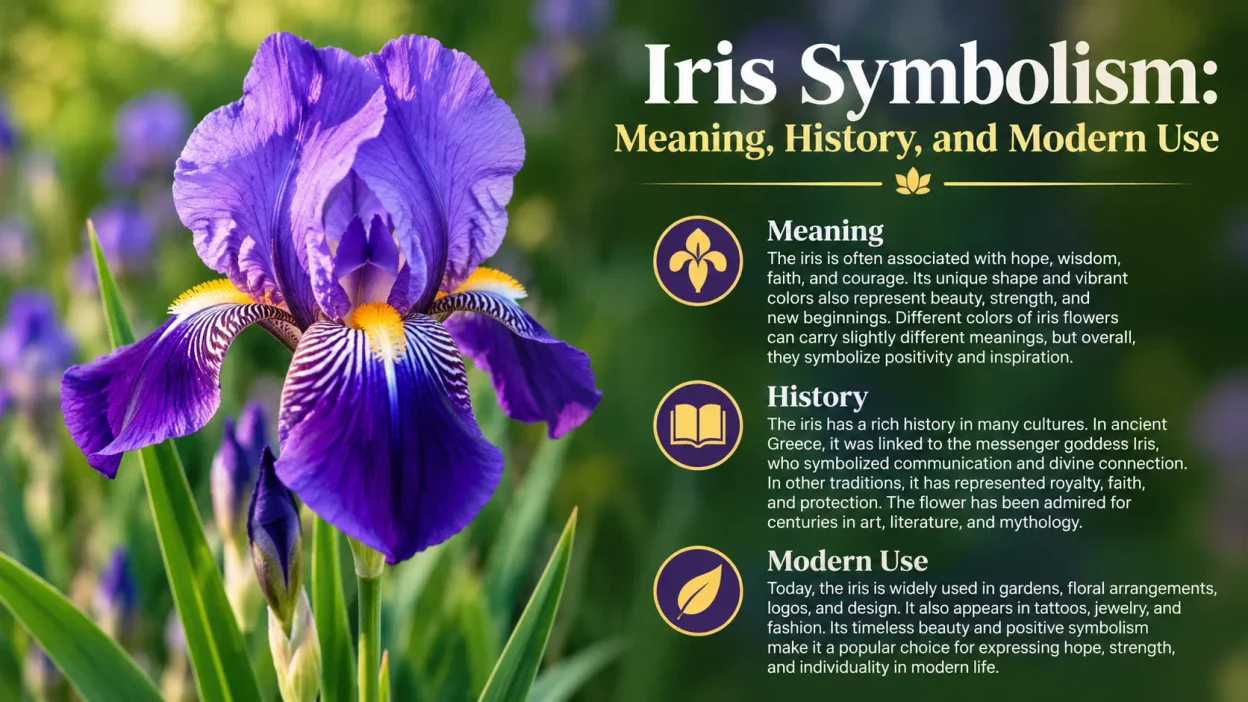
The iris is a distinctive flowering plant known for its graceful petals, intricate shapes, and striking colors, ranging from deep purple and blue to yellow, white, and pink. In iris symbolism, the flower is commonly associated with wisdom, hope, faith, courage, and communication. Its elegant appearance and long cultural history have made it a meaningful choice for gardens, floral arrangements, artwork, and personal gifts.
In the United States, irises often represent admiration, remembrance, and the hope that better days lie ahead. They appear in home gardens, public landscapes, wedding bouquets, and memorial arrangements, although their meaning can change with the occasion and the color of the bloom. A purple iris may suggest dignity or wisdom, while a yellow iris can communicate cheerfulness and friendship.
The flower’s significance also reaches beyond modern American culture. Its name comes from the Greek word associated with the rainbow, and ancient Greek mythology connected Iris, the personification of the rainbow, with communication between gods and humans. Over time, the flower acquired additional meanings through art, religion, heraldry, and floral traditions.
Understanding the iris means looking at both its historical associations and the ways people use it today. Its symbolism is not fixed or universal; it develops through the stories, colors, and personal experiences people attach to the flower.
Quick Answer
Iris symbolism commonly represents wisdom, hope, faith, courage, and admiration in modern American culture, particularly in gardens, bouquets, and meaningful gifts. Historically, the iris has also been associated with the Greek rainbow goddess Iris, divine messages, royalty, and religious ideas about faith and renewal.
TL;DR
- Irises commonly symbolize wisdom, hope, faith, courage, and admiration.
- Greek mythology connects the flower’s name with rainbows and divine communication.
- Purple irises often suggest dignity, wisdom, and respect.
- The fleur-de-lis has historical associations with the iris family of symbols.
- Americans use irises in gardens, bouquets, memorials, and personal designs.
- Their meanings depend on color, cultural background, and the occasion.
1. What Makes the Iris a Recognizable Symbol?

The iris is easy to recognize by its sculptural shape. Most familiar garden irises have six petal-like structures: three upright parts called standards and three lower, outward-drooping parts called falls. Some varieties have fuzzy, beard-like markings near the center, while others have smoother petals and different forms.
The flower grows in a wide range of colors, including blue, violet, purple, yellow, white, and combinations of several shades. This variety helps explain its association with rainbows, diversity, and the many ways people communicate emotion through flowers.
Irises also have a strong visual presence in paintings, garden borders, floral arrangements, and decorative motifs. Their upright growth can suggest dignity, while the spreading petals create an impression of openness.
The physical flower does not carry one universal message. Its meaning comes from a combination of its appearance, historical associations, color, and the circumstances in which it is given or displayed.
2. The Core Symbolic Meanings of the Iris
The iris is associated with several related ideas, but some meanings are more established in particular traditions than others.
Wisdom is a common interpretation, especially in discussions of purple irises and traditional floral symbolism. The flower’s stately appearance also makes it suitable for expressing respect for someone’s judgment, experience, or character.
Hope connects the iris with springtime and renewal. When the flower emerges after winter, it can serve as a reminder that change is possible and that difficult periods do not last forever.
Faith appears in historical religious and floral interpretations. Depending on the setting, it may refer to religious devotion, trust in another person, or confidence in a future outcome.
Courage and valor are associated with some historical interpretations of the flower, including accounts of ancient Egyptian symbolism and Japanese traditions involving blue irises.
Communication follows from the connection between the flower’s name and Iris, the Greek messenger goddess. In modern arrangements, this association can suggest understanding, reconciliation, or the expression of feelings that are difficult to put into words.
These meanings overlap, but they are not interchangeable in every situation. A flower presented at a graduation might communicate hope and admiration, while an iris placed in a memorial garden might emphasize remembrance and respect.
3. Ancient Roots and Greek Mythology
The name iris comes from the ancient Greek word for rainbow. In Greek mythology, Iris was a divine messenger who traveled between the gods and the mortal world. Artistic depictions often portray her in connection with a rainbow, sometimes with wings or a vessel associated with messages.
This myth gives the flower a natural connection to communication, transition, and the meeting of different worlds. A rainbow appears between earth and sky, making it an apt image for a messenger who carries words between divine and human realms.
The botanical genus received its name because its flowers appear in a remarkable range of colors. The relationship between the goddess and the plant is therefore rooted in both language and visual resemblance.
Historical interpretations also connect irises with burial customs and the afterlife in parts of the ancient Mediterranean world. Flowers could appear in funerary art or be planted near graves, where they represented remembrance, passage, or beliefs about what followed death. Such practices varied across periods and communities.
It is important not to treat every modern iris meaning as a direct survival of Greek mythology. The connection to communication has a clear mythological basis, but other meanings developed through separate religious, artistic, and cultural traditions.
4. Iris Symbolism in Ancient Egypt
Irises and related floral forms held significance in ancient Egyptian visual culture. Historical accounts describe iris motifs in royal and ceremonial settings, while later botanical histories connect the plant with majesty, authority, and renewal.
One recurring interpretation associates the flower’s three upright and three downward-facing structures with virtues such as faith, wisdom, and valor. These associations are often repeated in accounts of Egyptian symbolism, although the precise meanings attached to a flower’s individual parts should be treated cautiously rather than as a universally established ancient doctrine.
Egyptian gardens also included plants valued for their beauty, fragrance, and practical uses. Iris rhizomes from certain species were used historically in perfumery and other preparations. The plant therefore belonged to a world in which flowers could carry aesthetic, ceremonial, and practical value simultaneously.
For modern readers, the Egyptian connection adds an association with dignity and continuity. However, an iris in a contemporary American garden does not automatically communicate Egyptian religious beliefs. Its historical background enriches the flower’s story without dictating how everyone must interpret it.
5. The Fleur-de-Lis and Royal Symbolism
One of the best-known symbols related to the iris is the fleur-de-lis, a stylized floral emblem strongly associated with French royalty and heraldry.
The emblem became prominent in medieval European royal imagery. Its exact botanical origin is debated: it is often connected to the iris, particularly the yellow flag iris, but it has also been described as a stylized lily. Its conventional name translates from French as “flower of the lily.”
In French royal tradition, the emblem came to represent monarchy, authority, and dynastic identity. Christian interpretations also connected it with purity and religious devotion, while later heraldic traditions used it to communicate lineage, civic identity, and institutional heritage.
In the United States, the fleur-de-lis has a particularly recognizable association with New Orleans and Louisiana. It appears in regional decorations, sports imagery, architecture, and designs that reference French and Creole heritage.
The emblem should not be confused with every ordinary iris flower. A natural iris blossom and a stylized fleur-de-lis are related visually, but they have different histories and can communicate different things. One may represent hope or admiration; the other may signal heritage, authority, or a specific regional identity.
6. What Iris Symbolism Means in the United States
American interpretations of the iris are shaped by gardening traditions, floral gifting, regional identity, and the widespread practice of using flowers to express feelings.
Unlike a national emblem with a single official meaning, the iris has no one fixed interpretation across the United States. Its significance usually depends on where it appears and why someone chose it.
In home gardens, irises can represent renewal, patience, and the satisfaction of nurturing something that returns season after season. Gardeners often associate perennial flowers with family memories, former homes, or people who originally shared the plants.
In bouquets, the iris can convey admiration, respect, encouragement, or thoughtful affection. It can be appropriate for a friend, mentor, colleague, or family member without necessarily carrying a romantic message.
The iris also has an official state connection. Tennessee recognizes the iris as its cultivated state flower. Although the legislation did not specify a color, the purple iris is commonly accepted as the state’s cultivated flower.
This state association gives the plant a civic dimension, particularly for Tennessee residents. Still, most Americans encounter irises as garden flowers or floral gifts rather than as formal political symbols.
7. Iris Flower Colors and Their Meanings

Purple iris — Wisdom and dignity
Purple irises are frequently associated with wisdom, respect, admiration, and a sense of refinement. They work well in arrangements meant to honor a teacher, recognize an achievement, or express sincere appreciation.

Blue iris — Hope and faith
Blue irises can suggest calm, trust, hope, and thoughtful communication. Their cool colors make them suitable for messages of encouragement or for arrangements intended to feel peaceful and composed.

Yellow iris — Joy and friendship
Yellow flowers often communicate cheerfulness and warmth. A yellow iris can be a fitting choice for celebrating a friendship, welcoming someone, or brightening a familiar space.

White iris — Purity and remembrance
White irises can suggest sincerity, reverence, peace, or a fresh beginning. In memorial settings, they may express respect and remembrance without requiring a religious interpretation.

Multicolored iris — Diversity and individuality
Irises with contrasting colors can represent variety, creativity, and individuality. These meanings are largely interpretive rather than fixed traditional definitions, making the flowers useful for expressive garden designs and personalized gifts.
Color meanings are conventions, not universal rules. Floral traditions differ, and individual experiences often matter more than a color chart. If you are choosing irises for a gift, the recipient’s preferences and the occasion are more reliable guides than an assumed symbolic code.
8. Iris Symbolism in Christianity and Religious Art
In Christian art, the iris has sometimes been associated with the Virgin Mary, purity, and sorrow. These interpretations developed through medieval and Renaissance religious imagery, when plants and flowers frequently served as visual signs of spiritual ideas.
The iris’s pointed leaves and distinctive form could be incorporated into artistic compositions that communicated suffering or devotion. In some works, flowers helped viewers understand the spiritual significance of a scene even when the symbolism was not explained in writing.
The iris can also be interpreted through broader Christian themes of faith, hope, and renewal. However, it is not a universal Christian emblem, and its presence in an artwork does not always imply a specific theological message.
In contemporary American religious settings, the meaning of an iris depends on the congregation, the design, and the occasion. It may appear in a spring arrangement, a church garden, or a memorial service simply because it is seasonally appropriate and visually graceful.
The distinction matters: a flower can carry Christian associations without being exclusively Christian. The iris is also part of secular floral culture and traditions outside Christianity.
9. Iris Symbolism in Japanese and Other Cultural Traditions
The iris has a place in Japanese culture, where particular species have been associated with bravery and protective qualities. Blue and purple irises appear in traditional gardens and seasonal displays, and their upright leaves and distinctive flowers lend themselves to careful, formal landscaping.
In some Japanese traditions, iris plants have been connected with strength and the protection of health. The seasonal Iris Festival, traditionally observed on the fifth day of the fifth lunar month, is associated with customs involving iris leaves and the wish to protect children from illness and misfortune. Modern Children’s Day in Japan falls on May 5, although contemporary observances and historical customs are not identical.
In parts of the Middle East and Central Asia, irises have also appeared in garden traditions, decorative arts, and seasonal celebrations. Their appearance in regional art reflects local aesthetic and cultural practices rather than one shared international definition.
European traditions add further meanings through royal emblems, religious paintings, and heraldry. Meanwhile, the flower’s association with graves in certain historical Mediterranean and Ottoman contexts connects it with remembrance and the transition between life and death.
These traditions should be understood on their own terms. The same flower may represent courage in one context, religious devotion in another, and ordinary seasonal beauty elsewhere.
10. The Emotional and Psychological Meaning of the Iris
Flowers can communicate emotions because people learn to associate particular forms, colors, and occasions with personal experiences. The iris is especially well suited to meanings involving reflection, encouragement, and respect because of its distinctive appearance and long-standing cultural associations.
A purple iris may feel formal or dignified to someone who associates purple with ceremony and prestige. A blue iris may feel calming because cool colors are often used in designs intended to create a peaceful atmosphere. These responses are influenced by personal experience and cultural expectations, not by a universal psychological law.
The flower’s seasonal appearance can also encourage thoughts of change. Seeing irises emerge in spring may remind someone of recovery after a difficult period, the beginning of a new project, or a garden inherited from a family member.
For people who associate the iris with a particular person, its meaning can be more intimate. A familiar variety growing in a parent’s yard may evoke childhood, family continuity, or grief. Another person may simply appreciate its shape and color.
There is no need to choose between personal meaning and cultural history. Both can contribute to the significance of a flower, and neither interpretation has to apply to everyone.
11. Why Irises Appear in Art, Literature, and Design
Artists have long used irises because their layered petals, strong lines, and contrasting colors create visually compelling subjects. The flowers appear in European decorative arts and in paintings by artists such as Vincent van Gogh and Claude Monet.
Van Gogh’s iris paintings are particularly recognizable for their energetic forms and contrasting colors. Viewers may interpret these works through ideas of vitality, isolation, beauty, or emotional intensity, but such interpretations should not be mistaken for a single established meaning intended by the artist.
In graphic design, the iris and iris-inspired motifs can suggest elegance, heritage, or refinement. The fleur-de-lis is especially common in formal emblems, architectural decoration, and designs that refer to French history.
In literature, an iris may function as a seasonal detail, a marker of place, or an image associated with a character’s memory. Its significance depends on the surrounding story. A flower in a graveyard scene, for example, may communicate mourning, while one in a spring garden may suggest recovery.
Designers often use the flower for its visual qualities even when no symbolic message is intended. Recognizing the iris in art therefore requires attention to both its appearance and the context in which it is presented.
12. Iris Tattoos, Jewelry, and Personal Style
An iris tattoo can represent wisdom, hope, faith, courage, or remembrance. For someone who values communication, it might also stand for the importance of speaking honestly or maintaining a connection across distance.
The choice of color and design influences the impression. A fine-line iris may emphasize delicacy and personal reflection, while a large, vividly colored bloom can express confidence and individuality. A tattoo paired with a date, name, or other flower often carries a specific personal story.
Iris imagery also appears on pendants, brooches, scarves, stationery, and decorative objects. In jewelry, the flower may serve as a reminder of a loved one, a meaningful period in life, or a quality the wearer hopes to cultivate.
Birth-flower traditions provide another reason for choosing the iris. The iris is commonly listed as February’s birth flower in American floral references, making it a popular option for birthday gifts and personalized jewelry.
There is no official meaning that every iris tattoo or accessory must follow. The most accurate interpretation often comes from the person who chose it.
13. Irises in Weddings, Memorials, and Everyday Gifts
The iris is versatile enough for occasions that call for celebration as well as those that require restraint.
At weddings, irises can contribute blue, purple, white, or yellow accents to a bouquet or ceremony arrangement. Depending on the couple’s preferences, they may communicate hope for the future, admiration, faith, or a connection to a family garden. Their inclusion does not imply a standard wedding tradition.
For graduations and career milestones, the flower’s associations with wisdom and achievement make it a thoughtful gift. It can honor a teacher, celebrate a completed degree, or recognize someone who has overcome a difficult challenge.
In memorial arrangements, irises may express remembrance, respect, or peaceful reflection. Their historical presence in funerary traditions can add context, but modern families often choose flowers for personal reasons or simply because the deceased loved them.
For ordinary gifts, the iris can be a less conventional alternative to a rose. It can communicate appreciation without making an explicitly romantic statement.
The message ultimately depends on the relationship, the occasion, and the recipient’s understanding of flowers. A short personal note will usually communicate intention more clearly than the bloom alone.
14. Common Misunderstandings About Iris Symbolism
Several popular claims about the iris deserve a little care.
First, there is no universal meaning for each color. Purple may be associated with wisdom in one floral tradition, but it does not carry that message in every culture or personal setting.
Second, the fleur-de-lis is not simply another name for any iris. The stylized emblem has a distinct history in French heraldry and has also been described as a lily-inspired form. Its connection to the iris is important, but its historical origin is not entirely settled.
Third, not every iris represents a religious belief. Although the flower appears in Christian art and other spiritual traditions, many people grow or give irises for their beauty, seasonal timing, or personal associations.
Fourth, the flower is not exclusively positive. Historical contexts have linked irises with graves, mourning, and the afterlife. These associations do not make the flower an omen of death; they reflect particular funerary practices and artistic conventions.
Finally, modern symbolism websites and gift guides sometimes present color meanings as if they were universal facts. In reality, flower language varies across periods, cultures, and publications. Historical evidence, popular convention, and personal interpretation should be kept distinct.
15. How Iris Symbolism Has Evolved Over Time
The iris has accumulated meaning through several overlapping histories rather than following one unbroken symbolic tradition.
In ancient settings, the plant was valued for its appearance and practical uses, while mythological and funerary contexts connected it with communication, transition, and remembrance. Egyptian traditions added associations with royal display and authority.
Medieval European art and heraldry helped establish the iris’s relationship with faith, purity, and royal identity. The fleur-de-lis gave the flower-inspired motif a life of its own, allowing it to appear on banners, coats of arms, civic designs, and decorative objects.
As flower-giving became a popular way to express personal sentiments, the iris acquired additional associations in floral language. Modern gardeners and gift-givers often draw on these conventions while adapting them to contemporary relationships and experiences.
Today, an iris may be a state flower, a memorial plant, a tattoo, a piece of jewelry, or simply a favorite bloom. Its symbolic flexibility is part of its appeal: the flower has enough historical depth to invite interpretation without requiring a single correct message.
Iris Symbolism at a Glance
| Context | Common Meaning | Typical Associations | Important Note |
|---|---|---|---|
| Greek mythology | Communication | Rainbow, divine messages | Rooted in the goddess Iris |
| Purple iris | Wisdom and dignity | Respect, admiration | Color meanings vary |
| Blue iris | Hope and faith | Trust, encouragement | Not a universal code |
| Christian art | Purity and devotion | Mary, spiritual reflection | Depends on artwork and period |
| French heraldry | Royal authority | Fleur-de-lis, heritage | Emblem is distinct from a natural bloom |
| American gardens | Renewal and remembrance | Spring, family, continuity | Often personally meaningful |
Frequently Asked Questions
1. What does an iris symbolize spiritually?
The iris may symbolize faith, hope, wisdom, renewal, or communication in spiritual interpretations. Its meaning depends on the tradition: some Christian artworks connect it with purity and devotion, while Greek mythology links its name to the divine messenger Iris.
2. What does an iris tattoo mean?
An iris tattoo often represents wisdom, courage, hope, admiration, or remembrance. Some people choose it as a birth-flower tattoo for February, while others use the design to honor a loved one or mark a personal transition.
3. What does a purple iris symbolize?
A purple iris is commonly associated with wisdom, dignity, admiration, and respect. It can make a thoughtful gift for a mentor, graduate, family member, or friend, although the intended message depends on the relationship.
4. Is the iris a symbol of death or mourning?
The iris has appeared in certain historical funerary traditions and has been connected with remembrance and the afterlife. Today, it can be used in memorial arrangements, but it does not universally symbolize death or predict misfortune.
5. What does a blue iris mean?
A blue iris may communicate hope, faith, calm, or trust. Its association with communication also makes it a fitting choice when expressing understanding, encouragement, or a desire to reconnect with someone.
6. Why is the iris associated with the fleur-de-lis?
The fleur-de-lis is a stylized floral emblem traditionally linked with French royalty and often interpreted as an iris-inspired design. Its precise botanical origin is debated, and its historical meanings include authority, heritage, and religious associations.
7. Is the iris the February birth flower?
Yes, the iris is widely recognized as one of February’s birth flowers in American floral traditions. Giving an iris to someone born in February can make a birthday gift more personal, especially when the recipient appreciates the flower’s colors or symbolism.
Conclusion
The iris is associated with wisdom, hope, faith, courage, admiration, and communication, but its meaning changes with its history and setting. Greek mythology connects it with rainbows and divine messages, European heraldry links iris-inspired imagery with royalty, and religious art has used the flower to express devotion and purity. In American life, it is equally at home in gardens, gifts, memorials, and personal designs.
Understanding iris symbolism means recognizing both the traditions behind the flower and the intentions people bring to it. Its color, cultural background, and personal associations can all shape the message it conveys.
Whether planted to celebrate a new beginning, given to honor someone important, or chosen for a lasting tattoo, the iris offers a thoughtful way to express an idea that words alone may not fully capture.