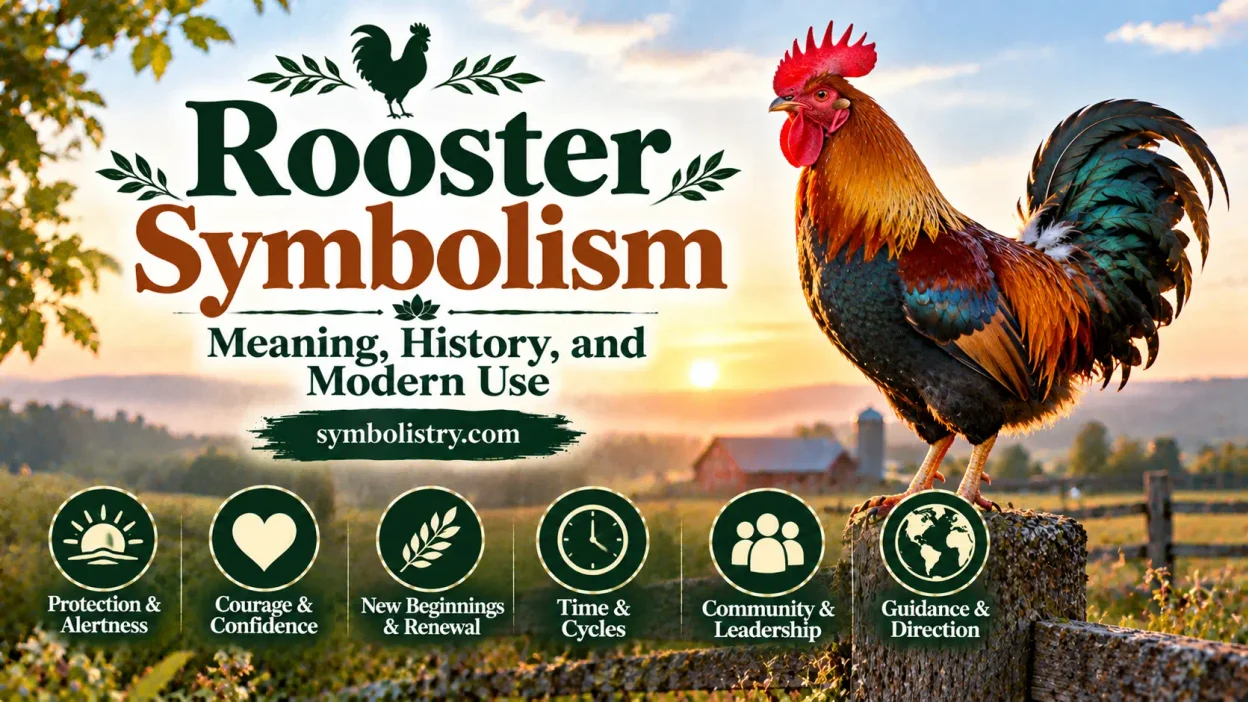
The rooster is a familiar sight in farmyards, rural artwork, decorative kitchens, and cultural celebrations. Recognized by its upright posture, bright comb, colorful feathers, and distinctive crow, this male chicken often represents confidence, vigilance, courage, and the arrival of a new day. Rooster symbolism draws much of its meaning from the bird’s behavior: it announces the morning, protects its place within a flock, and makes its presence unmistakably known.
In the United States, roosters appear on farmhouse signs, weather vanes, kitchen towels, folk-art paintings, and agricultural emblems. Their image can suggest rural independence, hard work, hospitality, or a connection to traditional farming life. At the same time, the rooster’s reputation for loudness and territorial behavior gives it associations with pride, competitiveness, and masculine confidence.
The bird also carries a long history in religious traditions, mythology, and folklore around the world. Understanding these associations helps explain why an ordinary farm animal can communicate so many different ideas, from spiritual awakening to stubborn pride.
Quick Answer
Rooster symbolism commonly represents confidence, courage, vigilance, masculinity, and new beginnings in modern American culture. Historically, roosters have also been associated with dawn, protection, spiritual alertness, and the struggle between darkness and light in several religious and cultural traditions.
TL;DR
- Core meaning: Confidence, courage, alertness, and renewal.
- Historical roots: Dawn, timekeeping, and protective symbolism.
- American culture: Farm life, independence, hospitality, and rural heritage.
- Religious associations: Spiritual vigilance, repentance, and awakening.
- Personal expression: Tattoos and artwork can represent pride and resilience.
- Less favorable meaning: Boastfulness, aggression, and excessive self-confidence.
1. What Makes the Rooster a Recognizable Symbol?
A rooster is an adult male chicken, distinguished by its prominent comb, wattles, often colorful plumage, and characteristic crow. Many roosters also have long tail feathers and an upright stance that makes them appear alert and assertive.
These physical characteristics contribute directly to the bird’s symbolic meaning. Its raised head suggests confidence, its crow announces a change in the day, and its territorial behavior creates an association with defending boundaries. Unlike symbols whose meanings depend almost entirely on stories or artistic conventions, the rooster offers several visible behaviors that people can interpret for themselves.
The bird’s appearance varies by breed. Some roosters have vivid red, orange, and golden feathers, while others display black, white, or iridescent plumage. Artists often exaggerate these colors to communicate energy, pride, and vitality.
Roosters are therefore recognizable symbols of both the natural world and human character. They can represent admirable qualities, such as alertness and determination, as well as less flattering traits, including vanity and aggression.
2. The Rooster as a Symbol of Dawn and New Beginnings
One of the rooster’s oldest and most enduring associations is the arrival of morning. Its crowing often coincides with the early hours of daylight, making it a familiar sound at the boundary between night and day.
Before electric lighting and modern timekeeping became widespread, people in agricultural communities paid close attention to natural signs of the coming morning. Rooster calls could help mark the beginning of daily work, even though roosters do not crow exclusively at sunrise.
This connection gives the bird a natural place in symbolism associated with fresh starts, renewed effort, and the movement from uncertainty toward clarity. A rooster on a wall hanging or greeting card may suggest a household ready to begin another day.
The same meaning can apply to personal experiences. Someone recovering from a difficult period might choose a rooster image to represent renewed confidence or the decision to start again.
The rooster does not promise that circumstances will improve automatically. Rather, its association with dawn suggests that a new opportunity has arrived and that it is time to respond.
3. Courage, Confidence, and Standing Your Ground
Roosters are often portrayed as bold, self-assured animals. Their upright posture, conspicuous displays, and willingness to challenge rivals have made them natural symbols of courage and determination.
In everyday American language and imagery, a rooster may represent a person who refuses to disappear into the background. Its symbolism can suit someone who values independence, speaks directly, or takes pride in being noticed.
This interpretation appears in folk art, character illustrations, sports-related imagery, and personal designs. The rooster’s stance can communicate readiness without requiring additional words.
However, courage and confidence are not identical to aggression. A rooster’s territorial behavior is part of its biology, not evidence of a human-like moral code. When people use the bird as a personal emblem, they decide which qualities they want it to represent.
A balanced interpretation emphasizes standing firm when necessary while recognizing that genuine confidence does not always require confrontation.
4. Rooster Symbolism in American Rural Life
In the United States, the rooster is closely associated with farming, country living, and the traditions of the American countryside. Chickens have long played a practical role in household and commercial agriculture, providing eggs, meat, and a manageable source of food.
The rooster’s image consequently carries associations with farmyards, family routines, self-sufficiency, and the labor required to maintain a household. Its presence in rural artwork can evoke an idealized picture of life close to the land.
Rooster imagery is also common in farmhouse-style interiors. It appears on ceramic containers, wooden signs, textiles, kitchen accessories, and vintage-inspired prints. In these settings, the bird may communicate warmth, familiarity, and an appreciation for traditional domestic life.
Not every rooster decoration expresses a specific belief. Sometimes the choice is simply aesthetic: the bird has a distinctive silhouette, bright colors, and a recognizable connection to country living.
Still, its continued popularity shows how an agricultural animal can become a broader emblem of home, continuity, and practical independence in American culture.
5. Religious Meaning: The Rooster in Christianity
The rooster has a particularly recognizable place in Christian symbolism because of the Gospel accounts of Peter’s denial of Jesus.
According to the biblical narrative, Jesus predicts that Peter will deny knowing him before the rooster crows. After Peter makes the denials, the crowing reminds him of the prediction, and he recognizes what he has done. The episode is associated with regret, human weakness, and the possibility of repentance.
Because of this story, the rooster can symbolize spiritual alertness, conscience, and the need to examine one’s actions. Its crow becomes a reminder that people may recognize their mistakes only after they have acted.
The bird is also associated more broadly with vigilance and the transition from darkness to light. These interpretations fit naturally with Christian themes of awakening and remaining spiritually attentive, although their prominence varies among communities and historical periods.
In some Christian art and church traditions, rooster imagery has served as a reminder of Peter’s story or the importance of watchfulness. Its religious meaning should not be reduced to bad behavior: the episode also emphasizes remorse and the possibility of restoration.
6. Ancient Greece and Rome: The Rooster as a Sacred Bird
Roosters had religious and cultural significance in the ancient Mediterranean world. Their crowing at daybreak connected them with light, daily rhythms, and the division between night and morning.
In ancient Greek traditions, roosters were associated with several deities, including Asclepius, the god of healing. Ancient literary and philosophical texts also record the use of roosters in religious offerings. One well-known example appears in Plato’s Phaedo, where Socrates’ final words mention owing a rooster to Asclepius. The passage has prompted different interpretations concerning healing, death, and the soul.
Roosters were also connected with Ares, the Greek god of war, and with martial qualities such as aggression and competitive spirit. These associations reflect the bird’s fighting behavior and its conspicuous displays.
In Roman culture, roosters were used in practices involving religious observance and divination. Their behavior could be interpreted as an omen in certain contexts, particularly when public decisions were believed to require divine approval.
These traditions demonstrate that the rooster did not possess one universal ancient meaning. Its symbolism depended on the deity, ritual, story, or social setting in which it appeared.
7. Roosters in Chinese Zodiac Tradition
The rooster occupies the tenth position in the twelve-animal cycle of the Chinese zodiac. In Chinese cultural traditions, the animal is commonly associated with diligence, punctuality, confidence, and observant behavior.
Its habit of crowing at the beginning of the day supports associations with order and timekeeping. The rooster’s conspicuous appearance also lends itself to interpretations involving presentation, pride, and the ability to make one’s qualities visible.
People born in a Rooster year may encounter descriptions emphasizing organization, directness, reliability, or ambition in popular zodiac interpretations. These descriptions belong to a traditional system of cultural symbolism; they are not scientifically established personality assessments.
Rooster imagery also appears in Chinese art and folk traditions, sometimes in connection with protection or the wish for good fortune. Specific meanings can depend on the image, wording, setting, and regional tradition.
For American readers, this is an important distinction: the rooster’s meaning in Chinese zodiac culture is not simply an extension of American farmhouse symbolism. It comes from a separate cultural framework with its own associations and history.
8. The Rooster in Japanese and Other Asian Traditions
In Japan, the rooster is connected with the Shinto tradition and the myth of Amaterasu, the sun goddess. In the well-known myth, Amaterasu withdraws into a heavenly cave, plunging the world into darkness. The other deities attempt to draw her out, and a rooster’s crowing forms part of the efforts associated with her return.
This story places the rooster within a narrative of sunlight returning after darkness. Its crow can therefore be understood in relation to awakening, the restoration of light, and the renewal of the world.
Roosters also appear in other Asian cultural traditions, though their meanings vary. In some settings, the bird is valued for its association with the morning, vigilance, good fortune, or protection.
It is important not to treat Asian cultures as a single symbolic system. Chinese zodiac interpretations, Japanese mythology, and other regional traditions have distinct histories. Even where the same bird appears, its significance may come from different stories and practices.
The recurring association with dawn is understandable across cultures, but the religious or moral meaning attached to it is culturally specific.
9. What the Rooster’s Colors Can Communicate
Color can influence how people interpret rooster imagery, particularly in decorative art, tattoos, and illustrations. These associations are flexible rather than universal rules.
| Color or appearance | Common symbolic associations | Typical use |
|---|---|---|
| Red comb and wattles | Vitality, boldness, alertness | Traditional rooster artwork |
| Golden or orange feathers | Warmth, energy, optimism | Kitchen decor and folk art |
| Black plumage | Strength, mystery, dramatic presence | Tattoos and stylized illustrations |
| White feathers | Clarity, simplicity, cleanliness | Minimalist art and decorative designs |
| Multicolored plumage | Individuality, abundance, liveliness | Folk painting and expressive artwork |
The rooster’s natural coloring is often more significant to the artist’s visual choices than to any fixed symbolic code. A red rooster may simply reflect a recognizable breed, while a black rooster might be chosen for contrast against a light background.
In American home decor, bright red and gold tones can create a warm, traditional atmosphere. In personal artwork, darker colors may emphasize seriousness or independence.
The most reliable interpretation considers the entire image rather than assigning a rigid meaning to a single feather color.
10. Emotional and Psychological Associations
People often respond to the rooster as a symbol of visibility and self-expression. It is not a quiet or inconspicuous animal, and its crow makes its presence known. For that reason, the bird can appeal to people who want to express confidence, independence, or a willingness to speak up.
Its morning association may also suggest structure and responsibility. The rooster can represent someone who values routine, meets obligations, and approaches each day with purpose.
There is a more complicated side to this imagery. The same assertiveness that appears courageous in one setting may seem arrogant in another. A rooster that dominates a composition can communicate pride or a desire for recognition rather than humility.
Psychologically, symbols do not have a universal effect on every observer. A person who grew up on a farm may associate roosters with family memories and daily chores, while someone else may connect them with noise, competition, or cartoon characters.
Personal history therefore shapes the emotional meaning of the bird. Cultural traditions provide a shared vocabulary, but individual experience determines which parts of that vocabulary feel most relevant.
11. Why People Choose Rooster Tattoos and Jewelry
Rooster tattoos can express several different ideas, depending on the person’s intentions and the design.
A standing rooster with its head raised may represent confidence, determination, or a refusal to back down. A rooster beside a rising sun can emphasize renewal, hope, or a new chapter in life. A traditional folk-art design may communicate family heritage, an appreciation for rural culture, or a preference for vintage imagery.
The bird’s recognizable outline also works well in different tattoo styles. Realistic illustrations can highlight feather detail, while traditional designs often use bold outlines and saturated colors. Simple silhouettes offer a more understated option.
Rooster motifs can appear on pendants, rings, brooches, and other accessories, although their meaning depends heavily on the wearer. Someone might select a rooster because it represents personal confidence; another person may simply appreciate its connection to farming or decorative art.
A rooster tattoo does not automatically indicate aggression, masculinity, or a particular cultural affiliation. When the symbol is chosen for personal reasons, the wearer’s explanation is more informative than a generalized interpretation.
12. Rooster Symbolism in Home Decor and Popular Culture
Rooster designs have an established place in American decorative culture, especially in kitchens and country-style interiors. Their association with food production and farm life makes them a natural fit for spaces centered on cooking, gathering, and hospitality.
The bird appears in ceramics, painted signs, linens, serving dishes, wall art, and vintage-inspired collectibles. Sometimes it serves as a visual reminder of rural life; sometimes it is simply a cheerful decorative motif.
Roosters also appear in cartoons, children’s stories, advertising, and entertainment. Their crow can signal morning, their bright appearance makes them easy to recognize, and their assertive behavior creates opportunities for comic or competitive characters.
One famous example is the rooster used as a symbol of the French national identity, a historical association that sometimes appears in American discussions of international sports and culture. This association is distinct from the bird’s more familiar role in American farmhouse decor.
Digital illustrations and social media posts continue to use rooster imagery for humor, confidence, wake-up messages, and country-inspired aesthetics. In these settings, context often matters more than historical symbolism.
13. When Rooster Symbolism Becomes Negative
The rooster’s most favorable qualities have corresponding disadvantages. Confidence can become arrogance, vigilance can become suspicion, and determination can turn into needless confrontation.
Because roosters are associated with displays of dominance and competition, they can also symbolize boastfulness or exaggerated masculinity. In cartoons and everyday comparisons, a strutting rooster may represent someone who is showing off or trying too hard to establish authority.
These negative associations do not make the rooster an inherently bad symbol. They reflect the way people interpret the same visible behaviors differently depending on the situation.
There is also a difference between historical symbolism and modern insult. Calling someone a rooster might be intended as a joke about pride or loudness, but the expression does not carry a single universal meaning across every community.
The bird’s image can be used to celebrate confidence without endorsing aggression. A thoughtful interpretation acknowledges both sides instead of treating assertiveness as automatically admirable or automatically harmful.
14. Common Misunderstandings About Rooster Meaning
Several assumptions can make rooster symbolism seem more rigid than it really is.
First, a rooster does not always crow only at sunrise. Roosters may crow at different times of day in response to internal rhythms, environmental conditions, or other stimuli. Its association with dawn is culturally meaningful, but it is not a complete description of the animal’s behavior.
Second, rooster imagery does not have one universal religious meaning. Christian traditions may connect the bird with Peter’s denial, while Japanese mythology places it within a story involving the return of the sun. Chinese zodiac symbolism follows another distinct tradition.
Third, a rooster image is not necessarily a sign of aggression or masculine identity. It may represent farming, family memories, personal style, good fortune, or simple visual appeal.
Finally, not every decorative object or tattoo carries an elaborate symbolic message. Sometimes a rooster is simply a rooster, chosen because it looks distinctive or reminds someone of a particular place.
The most accurate interpretation considers the image’s setting, cultural background, and intended audience.
15. How Rooster Symbolism Has Evolved
The rooster’s symbolic history reflects the changing relationship between people, animals, and everyday life. In agricultural communities, its behavior made it a practical marker of morning and a familiar presence around the household.
Religious and mythological traditions added further meanings, connecting the bird with spiritual vigilance, sacred stories, warfare, the sun, and the rhythms of nature. These associations developed in different places and should not be treated as a single continuous tradition.
In modern America, the rooster has become especially recognizable as an emblem of country living and traditional domestic design. Its use in folk art and home decoration preserves an association with agriculture, even for people who have never raised chickens.
At the same time, tattoos, fashion, cartoons, and digital culture allow the bird to communicate personal identity, humor, and confidence in new ways.
The rooster remains recognizable because its basic traits are easy to observe. People continue to draw meaning from its crowing, posture, and bright appearance, adapting those qualities to the concerns and tastes of their own time.
Frequently Asked Questions
What does a rooster symbolize spiritually?
A rooster may symbolize spiritual alertness, awakening, protection, or the movement from darkness toward light. In Christian contexts, it is also associated with Peter’s denial of Jesus and the recognition of personal wrongdoing.
Is a rooster a sign of good luck?
In some cultural traditions, rooster imagery is associated with good fortune, protection, or positive beginnings. Whether a rooster is considered lucky depends on the cultural context and the beliefs of the person interpreting it.
What does a rooster tattoo mean?
A rooster tattoo can represent confidence, courage, independence, resilience, or a connection to rural life. The surrounding imagery, artistic style, and wearer’s personal intentions help determine its meaning.
What does a rooster symbolize in Christianity?
The rooster is associated with the Gospel story in which Peter denies knowing Jesus before the bird crows. It can serve as a reminder of conscience, repentance, spiritual vigilance, and the opportunity to recognize one’s mistakes.
Why is the rooster associated with the sun?
Roosters often crow around the beginning of daylight, creating a natural connection with dawn. In Japanese mythology, a rooster also appears in the story of Amaterasu and the return of sunlight after the world falls into darkness.
Is rooster symbolism positive or negative?
It can be either. Courage, vigilance, renewal, and confidence are positive interpretations, while arrogance, aggression, and boastfulness are common negative associations.
What does a rooster represent in American home decor?
In American farmhouse and country-style interiors, the rooster commonly evokes rural heritage, household warmth, food traditions, and a connection to agricultural life. It may also be chosen simply for its bright colors and familiar appearance.
Conclusion
Rooster symbolism brings together several recognizable ideas: confidence, vigilance, renewal, pride, and the arrival of a new day. Its associations with American farm life give it a familiar domestic character, while religious stories and international traditions add meanings connected to conscience, protection, and the return of light.
The bird’s meaning depends on where it appears and why someone chooses it. A rooster painted on a kitchen sign may suggest hospitality, a tattoo may express independence, and a religious image may encourage spiritual reflection. None of these interpretations cancels out the others.
Ultimately, rooster symbolism remains relevant because it connects observable animal behavior with familiar human experiences. Its crow announces a new morning, but what that morning represents—another day’s work, a fresh beginning, or an opportunity to stand with confidence—is left to the person who encounters the symbol.