
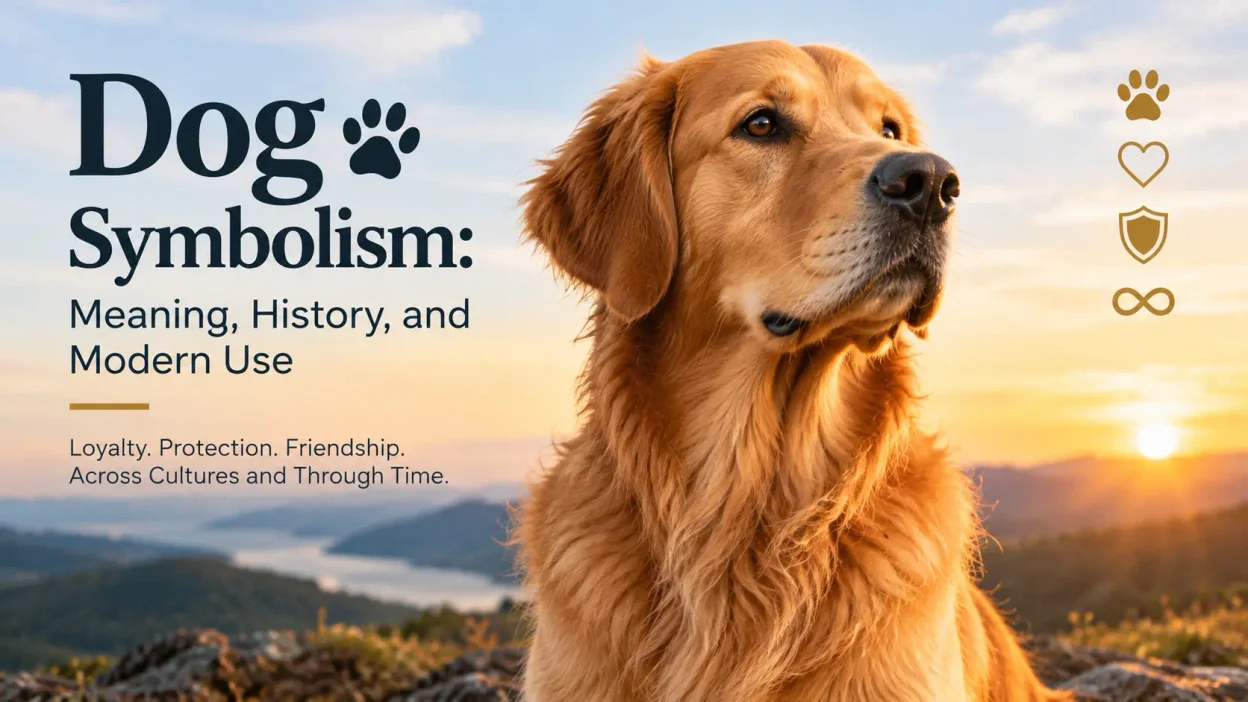
Dogs are among the most familiar animals in American life, appearing in homes, family photographs, memorials, advertisements, tattoos, stories, and public service. Because humans have lived alongside dogs for thousands of years, dog symbolism is closely connected to ideas such as loyalty, companionship, protection, trust, and devotion.
The meaning of a dog symbol depends heavily on context. A family dog may represent unconditional affection, while a guard dog suggests protection and vigilance. A hunting dog can symbolize cooperation and skill, while a black dog in folklore may carry associations with death, warning, or the unknown.
For Americans today, the dog is usually understood in positive and personal terms. Dogs are companions, working partners, service animals, military animals, and members of households. Yet the history behind these associations is much older and more complicated than the modern image of a beloved pet.
Quick Answer
Dog symbolism commonly represents loyalty, companionship, protection, trust, and devotion in modern American culture. Historically, dogs have also been associated with hunting, guardianship, death, the afterlife, spiritual protection, and cooperation between humans and animals.
TL;DR
- Dogs commonly symbolize loyalty, friendship, protection, and trust.
- Ancient societies connected dogs with hunting, guardianship, and the afterlife.
- American culture strongly emphasizes dogs as companions and family members.
- Working dogs add meanings of service, discipline, courage, and responsibility.
- Tattoos and artwork often personalize dogs as symbols of memory or identity.
- Folklore also gives dogs darker associations with death and supernatural boundaries.
What a Dog Represents in Everyday Symbolism
The simplest dog symbol is one of relationship.
Unlike many wild animals that are admired from a distance, dogs have lived alongside humans as partners. They have hunted with people, guarded settlements, pulled loads, herded livestock, assisted people with disabilities, served in war, and provided companionship.
That long partnership helps explain why dogs are commonly used to represent loyalty. A dog waiting for its owner, protecting a home, or staying close to a person creates a recognizable image of commitment.
Dogs can also symbolize:
- Friendship
- Faithfulness
- Protection
- Dependability
- Family
- Trust
- Playfulness
- Service
- Courage
- Emotional attachment
The particular breed, posture, setting, and artistic style can change the meaning. A relaxed golden retriever communicates something different from a snarling guard dog or a hunting hound.
Ancient Roots of Dog Symbolism
The relationship between dogs and humans reaches deep into prehistory. Current archaeological and genetic research places domesticated dogs alongside humans thousands of years before modern agriculture, although scientists continue to investigate exactly when and where domestication began.
Dogs were not simply decorative animals. Their usefulness shaped their cultural meaning.
A dog could help humans hunt, alert them to danger, protect settlements, and assist with transportation or other work. These practical roles gave dogs symbolic associations with alertness, cooperation, courage, and protection.
Archaeological evidence also shows that the human-dog relationship could be deeply personal. Dogs were sometimes buried with humans, suggesting that at least some communities regarded them as more than useful animals.
This long history matters because many modern meanings are extensions of very old relationships. Loyalty, protection, and companionship are not arbitrary ideas attached to dogs. They developed partly from the ways humans actually depended on them.
Dogs in Ancient Egyptian Symbolism
Ancient Egypt provides one of the clearest examples of dogs and dog-like animals carrying religious meaning.
The god Anubis was represented with a jackal or jackal-like canine form and was associated with mummification and the care of the dead. The connection likely reflected the Egyptians’ observation of wild canids around desert burial grounds.
This created an unusual symbolic relationship between the canine and death. The animal could represent a guardian of the boundary between life and the afterlife rather than simply something frightening.
Egyptian art also shows dogs in ordinary roles. Dogs were used for hunting, guarding, companionship, and status. Some artistic representations suggest that individual dogs were valued personally, not only symbolically.
That combination is important: ancient Egyptian dog symbolism included both everyday affection and religious ideas about death and protection.
Dogs in Greek and Roman Traditions
In ancient Greek mythology, dogs could have both familiar and supernatural roles.
Cerberus, the multi-headed guardian of the underworld, is perhaps the most famous example. His job was to prevent the dead from leaving and the living from entering freely. In this setting, the dog becomes a guardian of a boundary.
Other Greek traditions associated dogs with hunting and with deities connected to the natural world. Dogs could therefore represent useful companionship, hunting skill, vigilance, and the border between ordinary human life and the supernatural.
Roman culture inherited and adapted many Greek ideas while also treating dogs as household companions and working animals. Archaeological evidence and surviving art show that dogs could appear in domestic settings as well as hunting and protective contexts.
The contrast is striking. A dog could be the affectionate animal beside a household member and, in mythology, the terrifying guardian of the dead.
Dogs in Indigenous North American History
There is no single Indigenous American interpretation of dogs. Different nations developed different relationships with dogs, shaped by geography, livelihood, history, and cultural traditions.
Dogs were present in the Americas long before European colonization. They served practical roles in transportation, hunting, companionship, and other forms of work.
One especially distinctive example comes from Coast Salish communities of the Pacific Northwest. Long-haired woolly dogs were deliberately maintained for their fiber, which was used in textiles. Historical and genetic research has shown that these dogs represented a specialized Indigenous tradition rather than simply a variation of European dog breeds.
This history expands the symbolism of dogs beyond loyalty and companionship. In this context, a dog could represent craft, status, resourcefulness, cultural continuity, and careful human stewardship.
It is important not to reduce diverse Indigenous traditions to a single generalized “Native American dog meaning.” Dog symbolism varied considerably between communities.
What Dogs Symbolize in the United States
Modern American culture tends to place companionship at the center of canine symbolism.
Dogs frequently appear as members of the family rather than merely working animals. Expressions such as “family dog” and “man’s best friend” reflect a cultural expectation that dogs provide affection, familiarity, and emotional connection.
At the same time, Americans recognize several distinct canine identities.
| Context | Meaning in the USA | Common Associations | Notes |
|---|---|---|---|
| Family pet | Love and companionship | Home, children, friendship | Often treated as part of the family |
| Guard dog | Protection | Safety, vigilance, strength | Common in property and security imagery |
| Service dog | Assistance and independence | Trust, responsibility, dignity | Represents trained partnership |
| Hunting dog | Cooperation and skill | Outdoors, tradition, discipline | Often connected to rural culture |
| Military dog | Courage and service | Duty, loyalty, sacrifice | Connected to working-dog history |
| Memorial dog | Remembrance and affection | Grief, memory, family | Common in personal memorials |
The American meaning of the dog is therefore not limited to friendliness. The animal can represent many forms of partnership between people and animals.
Loyalty, Trust, and Devotion
Loyalty is probably the most recognizable symbolic quality associated with dogs.
The reason is straightforward: dogs are highly social animals whose behavior has been shaped through a long relationship with humans. People often interpret their attachment and responsiveness as signs of faithfulness.
In symbolism, this makes a dog appropriate for representing:
- Staying beside someone during hardship
- Faithfulness in relationships
- Trust between companions
- Commitment to family
- Dependability
- Emotional attachment
A dog depicted sitting beside a person can communicate companionship without words. A dog accompanying a traveler can suggest faithful friendship. Two dogs together may emphasize partnership.
This symbolism is especially common in gifts, portraits, jewelry, greeting cards, and personalized artwork.
Protection and Guardianship
The protective dog is another major symbolic image.
Historically, dogs could alert people to approaching strangers or animals. That practical role became a cultural shorthand for vigilance.
A dog standing at a doorway, barking, or watching over a sleeping child can therefore symbolize security and guardianship.
This symbolism appears in architecture, logos, military imagery, security businesses, and personal artwork.
The guardian dog also has a psychological dimension. The image suggests that someone or something is watching when a person cannot. That makes the dog a natural symbol for safety, boundaries, and watchfulness.
In mythology, this idea becomes even more dramatic. Cerberus guards the underworld, while Anubis is connected with funerary protection. Across very different traditions, the canine can occupy the role of a watcher at an important boundary.
Dogs as Symbols of Service and Duty
Modern America has expanded canine symbolism through working and service dogs.
Guide dogs, mobility-assistance dogs, medical alert dogs, and other trained service animals represent a relationship based on skill and cooperation. Their symbolism is not simply affection. It includes independence, responsibility, trust, and practical assistance.
Military dogs add another layer. Dogs have served alongside American military personnel in different capacities, including formal military roles and earlier unofficial roles as mascots and companions.
The symbolism of the working dog is consequently different from that of a household pet. The working dog represents an animal using specialized abilities in partnership with a human.
That distinction matters because it shows how flexible canine symbolism can be. The same species can represent tenderness in one context and discipline in another.
Emotional and Psychological Meaning
Dogs often symbolize emotional security because people experience them as predictable sources of companionship.
A dog waiting at the door can represent belonging. A sleeping dog can suggest safety and peace. A puppy can symbolize innocence and playfulness. An older dog may represent maturity, memory, and enduring companionship.
The emotional meaning can also become more complicated when a dog appears in memorial art.
After a beloved pet dies, people may use a portrait, collar, paw print, statue, or tattoo to preserve the relationship symbolically. In these cases, the dog can represent memory rather than simply an animal.
This is why dog imagery frequently appears in personal memorials. The symbol stands for a specific relationship that continues emotionally even after the animal is gone.
Dog Symbolism in Tattoos
Dog tattoos are usually highly personal.
Someone may choose a realistic portrait of a deceased pet as a memorial. Another person may use a paw print to represent childhood, family, or a long-standing connection with animals.
Common interpretations include:
- Loyalty to a loved one
- Memorial and remembrance
- Family attachment
- Protection
- Friendship
- Personal identity
- Love of a particular breed
- Connection to outdoor life
The breed can also add meaning. A German shepherd might suggest protection or working partnership, while a hunting breed may reflect family tradition or an outdoor lifestyle.
There is no universal tattoo dictionary, however. A dog tattoo’s meaning ultimately depends on the person who chose it and the story behind it.
Dogs in Fashion, Decor, and Popular Culture
Dog imagery is widespread in American consumer culture because dogs are familiar and emotionally recognizable.
Home decor may use dogs to create an atmosphere of warmth, humor, rustic life, or family comfort. Clothing can use breed-specific images to communicate personal identity or affection for a particular type of dog.
In advertising, dogs are frequently used to make a product feel friendly, trustworthy, domestic, or approachable. Their presence can soften an otherwise impersonal message.
Popular culture has also created many memorable fictional dogs. From animated characters to film companions and heroic working dogs, these representations reinforce different aspects of canine symbolism: humor, courage, friendship, intelligence, loyalty, or adventure.
Digital culture has made this even more visible. Dog photographs and videos are commonly shared because their expressions and behavior are easy to interpret and emotionally engaging.
Positive and Negative Dog Symbolism
Dog symbolism is overwhelmingly positive in contemporary American culture, but it has never been exclusively positive.
A friendly dog can represent loyalty and affection. A snarling dog can represent aggression, danger, or uncontrolled instinct.
Certain expressions in English also give dogs negative associations. Calling someone a “dirty dog,” for example, can suggest dishonesty or bad behavior. The phrase “underdog,” by contrast, usually describes someone facing unfavorable circumstances and often carries an encouraging tone.
Folklore creates another set of darker associations. Black dogs appear in European supernatural traditions as ominous or ghostly figures. These traditions should not be confused with ordinary modern black dogs, whose symbolic meaning depends on context.
The distinction is important because color, breed, posture, and cultural setting can transform the interpretation of the same animal.
Dogs, Death, and the Afterlife
The connection between dogs and death may seem surprising to modern Americans, but it has a long cultural history.
Ancient Egyptian traditions connected canine imagery with Anubis and funerary practices. Greek mythology placed Cerberus at the entrance to the underworld. Other folklore traditions developed stories about spectral or supernatural dogs.
Why does the dog appear so often at boundaries involving death?
Part of the answer may be practical. Dogs were familiar guardians and watchers in ordinary life, so they could naturally become symbolic guardians of extraordinary boundaries.
A dog at a gate protects an entrance. A mythological dog at the entrance to the underworld performs a similar symbolic function on a cosmic scale.
Modern American memorial symbolism usually moves in a gentler direction. A dog may represent the continuing memory of someone who has died rather than the frightening side of death itself.
Common Misunderstandings About Dog Symbolism
One common mistake is assuming that every dog image has the same meaning.
A puppy, hunting hound, guard dog, service dog, and mythological guardian belong to very different symbolic traditions. Treating them as interchangeable removes much of the cultural context.
Another misunderstanding is the idea that there is one universal dog meaning shared by every society. Dog symbolism has developed differently across cultures.
It is also misleading to assume that all historical cultures viewed dogs as beloved pets. Dogs have served as working animals, food sources, hunting partners, religious symbols, guardians, and companions in different times and places.
Modern American affection for dogs is real, but it should not be projected backward onto every historical society.
How Dog Symbolism Has Changed
The symbolism of dogs has expanded as the human-dog relationship changed.
Early relationships were strongly connected to survival and practical cooperation. Hunting, guarding, transportation, and protection shaped the animal’s place in human society.
Religious traditions then gave dogs and related canids additional roles, including guardianship of sacred or funerary spaces.
In modern America, companionship has become especially prominent. Dogs are frequently treated as family members, while specialized working dogs represent assistance, service, and partnership.
The result is a symbol with unusually broad emotional range. A dog can represent childhood memories, professional duty, family loyalty, military service, grief, humor, protection, or simple affection.
The underlying theme is often the relationship between humans and dogs rather than the animal alone.
Frequently Asked Questions
What does a dog symbolize spiritually?
Dogs can symbolize protection, loyalty, guidance, and guardianship in spiritual traditions. In some ancient religious systems, canine figures were connected with death and the afterlife, while modern spiritual interpretations are often more personal.
What does a dog tattoo usually mean?
A dog tattoo commonly represents loyalty, friendship, family, remembrance, or love for a particular animal. When it depicts a deceased pet, it often functions as a memorial to that relationship.
What does a dog symbolize in American culture?
In the United States, dogs commonly symbolize companionship, loyalty, family, protection, and trust. Working and service dogs also represent duty, assistance, discipline, and partnership.
Is dog symbolism always positive?
No. Dogs can also symbolize aggression, danger, warning, death, or supernatural guardianship. The meaning depends on the dog’s behavior, setting, cultural tradition, and artistic context.
What does a black dog symbolize?
A black dog can represent loyalty, protection, mystery, grief, or strength, depending on context. In some European folklore, black dogs have darker supernatural associations, but modern American representations are often much more varied.
Why are dogs associated with loyalty?
Dogs have shared close working and domestic relationships with humans for thousands of years. Their roles as companions, hunters, guards, and service animals helped create the cultural association between dogs and faithfulness.
What do dogs symbolize in dreams or personal artwork?
A dog may represent companionship, trust, protection, instinct, or a specific personal relationship. Personal associations matter more than any fixed symbolic dictionary, especially when the image relates to a particular dog or memory.
Conclusion
Dogs symbolize much more than simple friendship. In modern America, they most often represent loyalty, companionship, protection, trust, and family, while working and service dogs add ideas of duty, independence, courage, and cooperation.
Historically, canine imagery has also carried more complex meanings. Ancient religious traditions connected dogs with hunting, guardianship, burial, and the afterlife, while Indigenous communities in North America developed their own diverse relationships with dogs as working and culturally important animals.
The lasting appeal of dog symbolism comes from the unusually close relationship between humans and dogs. Whether shown in a family portrait, memorial tattoo, military image, service-dog story, or ancient artwork, the dog often symbolizes a relationship built through trust and shared life.