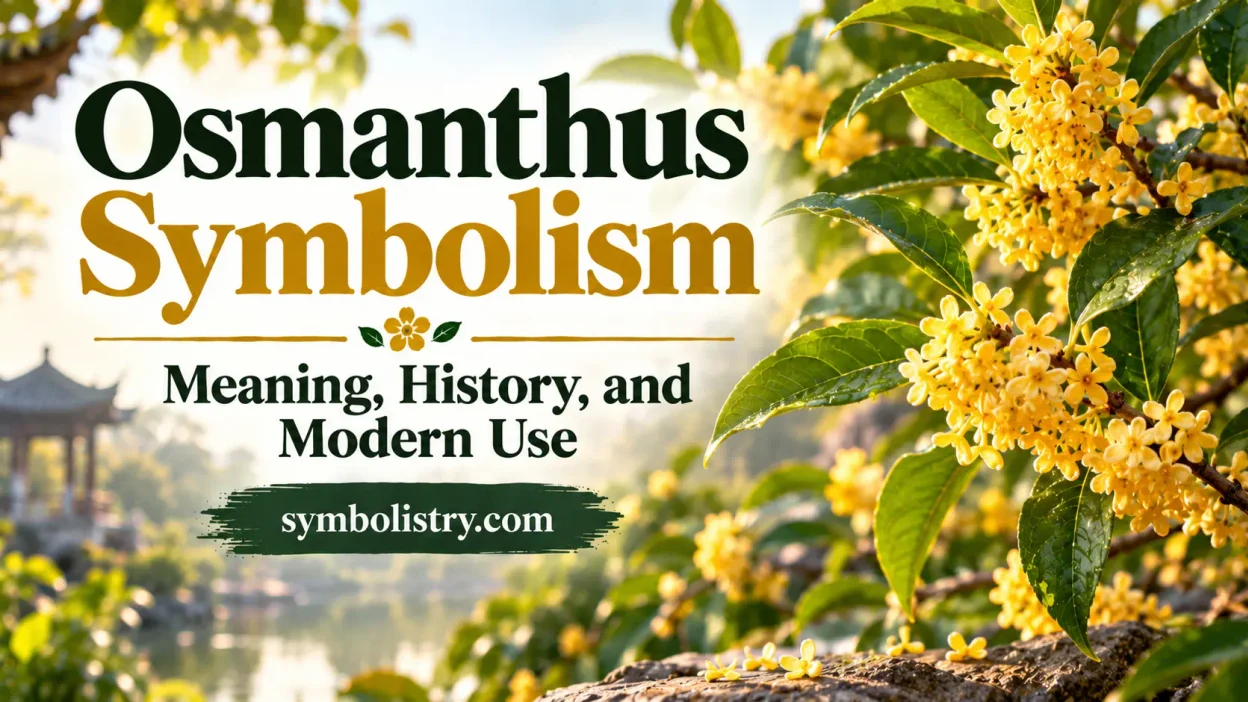
Osmanthus is a small-flowered, intensely fragrant plant best known in the United States as tea olive or sweet olive. Its flowers may be white, yellow, or orange, while the evergreen foliage stays attractive through much of the year. In the American landscape, it is often planted near patios, entrances, windows, and walkways specifically so people can notice its fragrance.
The cultural story is more distinctive than the plant’s modest appearance suggests. In Chinese traditions, sweet osmanthus has long been connected with autumn, the moon, the Mid-Autumn Festival, good fortune, and achievement. Its associations also developed through poetry, folklore, seasonal customs, and the language of academic success.
For American readers, however, there is an important distinction: osmanthus does not have one universally recognized symbolic meaning in the United States. Someone may encounter it as an ornamental shrub, a tea ingredient, a fragrance note, or an intentional reference to Chinese culture. Its meaning therefore depends heavily on context.
Quick Answer
Osmanthus symbolism commonly represents autumn, fragrance, prosperity, achievement, and reunion, particularly in Chinese cultural traditions. Its historical associations with the moon and Mid-Autumn Festival add meanings of seasonal celebration and family gathering, while modern American uses often emphasize fragrance, beauty, memory, and intentional cultural connection.
TL;DR
- Osmanthus commonly represents autumn, fragrance, prosperity, and achievement.
- Chinese traditions connect the flower with the moon and Mid-Autumn Festival.
- Its examination symbolism developed from traditional associations with honor and success.
- Americans often encounter osmanthus as tea olive or sweet olive.
- Fragrance makes osmanthus especially suitable for memory and personal symbolism.
- Modern designs can preserve its East Asian cultural associations.
What Osmanthus Looks Like and Why Fragrance Matters
Osmanthus belongs to the olive family, Oleaceae. The genus contains numerous evergreen shrubs and small trees, but Osmanthus fragrans is the species most closely associated with sweet osmanthus symbolism.
The flowers are surprisingly small. They appear in clusters among glossy green leaves and may be creamy white, yellow, or orange depending on the variety. What the flowers lack in size, they make up for with scent. Their fragrance has been compared with peach, orange blossom, jasmine, and other sweet floral aromas.
That contrast between appearance and fragrance helps explain one of the plant’s most useful symbolic qualities: what is subtle can still leave a strong impression.
Osmanthus does not announce itself with enormous blossoms. Instead, people often notice it because they suddenly smell something sweet while walking past a shrub. This makes fragrance central to both its practical appeal and its emotional associations.
The plant’s name itself reflects this characteristic. “Osmanthus” comes from Greek roots associated with fragrance and flower.
The Ancient Chinese Roots of Osmanthus Meaning
The strongest historical symbolism surrounding osmanthus developed in China, where sweet osmanthus has been cultivated and appreciated for centuries.
One reason is seasonal. Osmanthus commonly flowers around early autumn, making its scent a recognizable part of the season in regions where it grows well. In Chinese cultural traditions, that timing became closely associated with the eighth lunar month and the Mid-Autumn Festival.
Historical art preserves this connection. An eighteenth-century Chinese embroidered scene in the Metropolitan Museum of Art shows a rabbit looking toward the moon, with blossoming osmanthus and autumn foliage identifying the seasonal setting as the Moon Festival.
The symbolism therefore did not arise simply because someone assigned an abstract meaning to a flower. It developed through repeated connections among season, moonlight, fragrance, mythology, and festival life.
That distinction matters. Osmanthus symbolism is strongest when those cultural associations are considered together rather than treated as an isolated list of “flower meanings.”
Osmanthus and the Moon
The moon is one of the most recognizable symbols associated with osmanthus in Chinese folklore.
Traditional stories describe an osmanthus tree associated with the lunar realm. One well-known legend tells of Wu Gang, a figure condemned to repeatedly cut down an osmanthus tree on the moon. Because the tree continually regenerates, his task can never be permanently completed.
The story gives the plant an unusual connection with persistence, renewal, and the unreachable. Yet those meanings should not be treated as universal definitions of every osmanthus image. They belong specifically to a body of Chinese lunar folklore.
The lunar connection became especially prominent because osmanthus blooms around the season of the Mid-Autumn Festival. In traditional imagery, an osmanthus branch beside a full moon can therefore communicate much more than “a pretty flower.” It can immediately establish an autumnal and lunar setting.
For readers familiar with Chinese cultural imagery, the combination can suggest the moon, seasonal celebration, folklore, and family gathering at the same time.
Why Osmanthus Represents Autumn and Mid-Autumn Celebration
The connection with autumn is one of the most straightforward meanings of osmanthus.
Its flowering season overlaps with the Mid-Autumn period, and its fragrance can become especially noticeable during that time. Traditional celebrations have included appreciating the flowers and consuming foods and drinks flavored with osmanthus. Osmanthus wine, for example, has been associated with Mid-Autumn celebrations.
This creates an important distinction between symbolism and custom.
The flower does not inherently mean “family reunion.” Rather, it became associated with a festival in which reunion and shared celebration are important themes. The flower then participates in that larger cultural setting.
That is why osmanthus imagery can suggest:
- autumn
- harvest-season celebration
- moon viewing
- family gatherings
- traditional foods and drinks
- seasonal beauty
The meaning becomes particularly clear when osmanthus appears beside mooncakes, lanterns, a full moon, or other Mid-Autumn imagery.
Achievement, Honor, and Academic Success
Another distinctive association comes from the Chinese cultural history of academic examinations.
The Chinese imperial examination system gave education and examination success enormous social importance. Osmanthus became connected with achievement and distinction through traditional literary and linguistic associations surrounding the flower and the word gui, which can carry multiple meanings depending on the character and context.
This produced symbolic associations between osmanthus and success, recognition, honor, and advancement.
The meaning is particularly interesting because it differs from the way many Western flower traditions work. In the United States, a flower associated with academic achievement is more likely to be interpreted through graduation ceremonies, school colors, diplomas, or congratulatory bouquets. With osmanthus, the achievement association has a much older cultural and linguistic background.
This makes an osmanthus motif appropriate for artwork about scholarship or accomplishment when the designer is intentionally drawing from Chinese cultural traditions.
It should not, however, be presented as though every American viewer automatically recognizes the flower as a symbol of academic success.
What Osmanthus Means in the United States
Osmanthus has a different symbolic status in American culture.
There is no single standardized American meaning comparable to the widely recognized associations of roses with romantic love or poppies with remembrance. Many Americans encounter osmanthus primarily as tea olive, sweet olive, or a fragrant landscape shrub.
Southern gardening traditions are especially important here. Tea olive is valued for its evergreen foliage and strong fragrance and is commonly used as a hedge, screen, specimen plant, or planting near areas where people can enjoy its scent.
As a result, American interpretations tend to develop through personal experience.
A tea olive growing beside a childhood home may come to symbolize home and familiarity. A perfume containing osmanthus may evoke intimacy or memory. An osmanthus plant in an Asian-inspired garden may communicate a deliberate connection with East Asian aesthetics.
In the United States, then, the most accurate interpretation is often contextual rather than universal.
| Context | Meaning in the USA | Common Associations | Notes |
|---|---|---|---|
| Southern garden | Fragrance and welcome | Home, hospitality, beauty | Often encountered as tea olive |
| Chinese-inspired design | Cultural connection | Moon, autumn, reunion | Meaning depends on surrounding imagery |
| Perfume | Sensory memory | Elegance, intimacy, nostalgia | Fragrance is the main signal |
| Tea or food | Traditional flavor | Hospitality, seasonal enjoyment | Often connected with East Asian cuisine |
| Academic artwork | Achievement | Scholarship, distinction | Usually reflects Chinese cultural symbolism |
Osmanthus and Emotional Memory
Fragrance gives osmanthus a special psychological dimension.
Visual symbols can remind us of people or places, but scent is particularly effective at triggering autobiographical memories. A familiar fragrance may bring back a garden, a particular season, a home, or a person without requiring a conscious effort to remember.
Osmanthus is therefore well suited to symbolism involving memory and presence.
This does not mean that osmanthus has a fixed psychological meaning. Rather, its physical characteristic makes certain interpretations especially plausible. A flower whose most noticeable feature is its scent naturally lends itself to ideas of remembrance, atmosphere, intimacy, and emotional association.
In personal symbolism, someone might choose osmanthus because its fragrance reminds them of a family garden or an important period of life. In that case, the flower’s meaning is autobiographical rather than inherited from traditional flower-language dictionaries.
Fragrance, Elegance, and Understated Beauty
Osmanthus can also represent a type of beauty that does not depend on visual extravagance.
Its flowers are tiny and can be easy to overlook. Yet a mature plant can fill a garden with fragrance. That physical reality makes it a useful metaphor for quiet beauty, subtle influence, and understated elegance.
This interpretation is especially relevant in contemporary design.
An osmanthus illustration may appeal to someone who wants floral imagery without the conventional romantic associations of roses or the ceremonial associations of lilies. The flower can feel more unusual and restrained.
Its evergreen foliage also gives it a visual character different from flowers that appear briefly and then disappear. The plant can remain structurally present while its flowers provide seasonal fragrance.
That combination can support symbolic themes of continuity and seasonal renewal, although these are interpretive associations rather than universal traditional definitions.
Osmanthus in Tea, Food, and Hospitality
Osmanthus is not merely ornamental.
Its dried flowers are used to scent tea and other foods and beverages, particularly in East Asian culinary traditions. North Carolina State University Extension notes that dried flowers can be added to black tea for fragrance, while osmanthus extracts are also valued in perfumery.
This edible use adds another dimension to the plant’s symbolism: hospitality through fragrance and flavor.
A flower that becomes part of tea, sweets, wine, or other shared foods naturally participates in social rituals. The symbolic meaning comes not just from the plant but from the act of preparing and sharing something scented with it.
For Americans encountering osmanthus in a tea shop, dessert, or specialty beverage, the first association may therefore be culinary rather than mythological. Yet the traditional cultural context can still be present beneath that everyday experience.
Osmanthus in Perfume and Personal Style
Osmanthus has a particularly important role in fragrance culture.
Its flowers are used for extracts and fragrance materials, and its scent is valued for its distinctive fruity-floral character. This has helped move osmanthus beyond gardens into perfumes and other scented products.
In personal style, osmanthus can therefore symbolize refinement without obvious display.
Someone choosing an osmanthus-based fragrance may not be communicating a traditional Chinese symbolic message at all. They may simply like the scent. But in a more intentional design context, the fragrance can suggest memory, softness, autumn, gardens, or East Asian cultural references.
This is an important principle when interpreting modern symbolism: not every use is a coded message. Sometimes an aesthetic choice begins with sensory preference and acquires symbolic meaning through personal association.
Osmanthus in Gardens and American Home Design
In the United States, landscaping may be the place where people encounter osmanthus most frequently.
Tea olives are particularly useful in warmer regions because they combine evergreen foliage with strong fragrance. They can be planted as hedges, screens, specimens, or near outdoor living spaces. Southern extension programs describe them as long-lived landscape plants appreciated for their scent and appearance.
This practical use creates a distinctly American layer of meaning.
An osmanthus hedge can suggest privacy and enclosure. A plant beside an entrance can become associated with welcome. A shrub beside a patio can become part of the sensory identity of a home.
The symbolism is therefore often created by place and repeated experience rather than by formal cultural tradition.
That is one reason osmanthus can have different meanings for different American households.
Tattoos, Jewelry, and Contemporary Symbolism
Osmanthus is less common in American tattoo culture than roses, chrysanthemums, lotus flowers, or cherry blossoms. That relative rarity can itself make it attractive to someone seeking a less conventional botanical image.
An osmanthus tattoo may represent:
- a connection to Chinese heritage or culture
- autumn or the Mid-Autumn Festival
- academic achievement
- a meaningful fragrance or memory
- a particular person or place
- appreciation for understated beauty
Context changes the reading.
A full moon beside osmanthus suggests lunar folklore or Mid-Autumn traditions. A book or graduation date can emphasize achievement. Initials or a personal date can transform the flower into a private memorial or memory symbol.
Jewelry and small botanical motifs work similarly. The flower’s delicate appearance allows it to function as a subtle personal emblem rather than an immediately recognizable public symbol.
Osmanthus in Art, Decor, and Digital Culture
Modern osmanthus imagery can move between traditional and contemporary aesthetics.
In East Asian-inspired interior design, the flower may appear alongside moon imagery, autumn foliage, rabbits, lanterns, ceramics, or traditional patterns. In a Western botanical setting, it may simply function as an elegant floral motif.
Digital culture has made these distinctions more important because images can travel far beyond their original cultural context.
A moon-and-osmanthus illustration might be used by one person because it represents Mid-Autumn traditions and by another because they simply like the visual combination. Neither interpretation should automatically be assumed without context.
For designers and writers, the safest approach is to identify cultural references clearly rather than attaching a generic “Asian meaning” to the flower.
Common Misunderstandings About Osmanthus Symbolism
One common mistake is treating every symbolic meaning found online as an ancient universal tradition.
Osmanthus has genuine historical associations with autumn, the moon, Mid-Autumn traditions, and achievement, particularly in Chinese cultural contexts. But claims that it universally represents every positive quality—such as love, wealth, healing, longevity, or spiritual protection—should be treated cautiously.
Another misunderstanding is confusing osmanthus with unrelated plants that share similar common names or historical terminology. “Tea olive,” “sweet olive,” and “osmanthus” can refer to several related landscape plants, while the strongest traditional cultural symbolism generally concerns specific species and Chinese uses.
It is also important not to confuse modern American interpretation with Chinese historical symbolism. An American gardener may value the plant primarily because it makes a fragrant hedge. That is a legitimate modern meaning, but it is different from the lunar folklore surrounding osmanthus in China.
How Osmanthus Symbolism Has Changed Over Time
The symbolic history of osmanthus shows how meanings accumulate.
Its earliest significance was closely tied to the plant itself: fragrance, flowering season, cultivation, and appearance. Cultural traditions then connected those physical characteristics with autumn festivals, moon imagery, folklore, and social aspirations.
Later, those meanings entered paintings, embroidery, literature, food traditions, gardens, and decorative arts. The plant became recognizable not merely as vegetation but as part of a cultural vocabulary.
In the modern United States, another layer has developed. Osmanthus now exists simultaneously as a traditional East Asian symbol and as a practical Southern landscape plant. It can also appear in tea, fragrance, botanical art, and personal design.
The result is not one replacement meaning but several overlapping ones.
For someone familiar with Chinese traditions, osmanthus may immediately suggest the moon and autumn. For a Southern gardener, it may suggest the scent of tea olive after rain. For a perfume enthusiast, it may suggest a particular fruity-floral note. For someone with a personal connection to the plant, it may simply mean home.
FAQ
What does osmanthus symbolize in Chinese culture?
Osmanthus is strongly associated with autumn, the moon, Mid-Autumn traditions, fragrance, and achievement. Its meaning is especially visible in lunar folklore and cultural traditions surrounding the eighth lunar month.
What does an osmanthus flower symbolize in the United States?
There is no single standardized American meaning for osmanthus. Americans commonly encounter it as tea olive or sweet olive, so fragrance, garden beauty, home, memory, and hospitality can become important modern associations.
Does osmanthus symbolize good luck?
Osmanthus can carry auspicious and prosperous associations in Chinese cultural traditions, particularly in connection with festival customs and positive social aspirations. However, “good luck” is too broad to describe every appearance of the flower.
Why is osmanthus associated with the moon?
Chinese lunar folklore includes an osmanthus tree connected with the moon, and the plant also blooms around the Mid-Autumn season. These two traditions reinforced the flower’s connection with moon imagery.
What does an osmanthus tattoo mean?
An osmanthus tattoo can represent autumn, Chinese cultural heritage, achievement, fragrance, memory, or a personal connection to a place or person. The surrounding imagery often provides the clearest clue to the intended meaning.
Is osmanthus associated with academic success?
Yes, especially within Chinese cultural traditions. Historical associations involving the flower and the language of honor and distinction helped make osmanthus imagery suitable for representing examination success and achievement.
Is osmanthus a romantic flower?
Osmanthus is not primarily a traditional Western symbol of romantic love in the way a red rose is. Its fragrance can create romantic or intimate associations in modern use, but that meaning usually comes from personal interpretation rather than a universal flower-language rule.
Conclusion
Osmanthus carries several layers of meaning because its cultural history grew from very concrete qualities: its intense fragrance, autumn flowering, evergreen form, culinary uses, and place in traditional celebrations. In Chinese culture, these characteristics became connected with the moon, Mid-Autumn traditions, achievement, auspiciousness, and seasonal beauty.
In the United States, the plant has developed a quieter and more contextual identity. Gardeners know it as tea olive, fragrance enthusiasts encounter it in perfume, and people interested in East Asian culture may recognize its lunar and autumn associations. Understanding osmanthus symbolism therefore requires looking at both the inherited tradition and the setting in which the flower appears today.
Its most interesting quality may be the simplest one: osmanthus is often noticed because of something people cannot see. Its fragrance reaches them first, creating a memory or impression before they even identify the plant. That makes it an especially fitting symbol for meanings that are felt through experience rather than announced by appearance.