
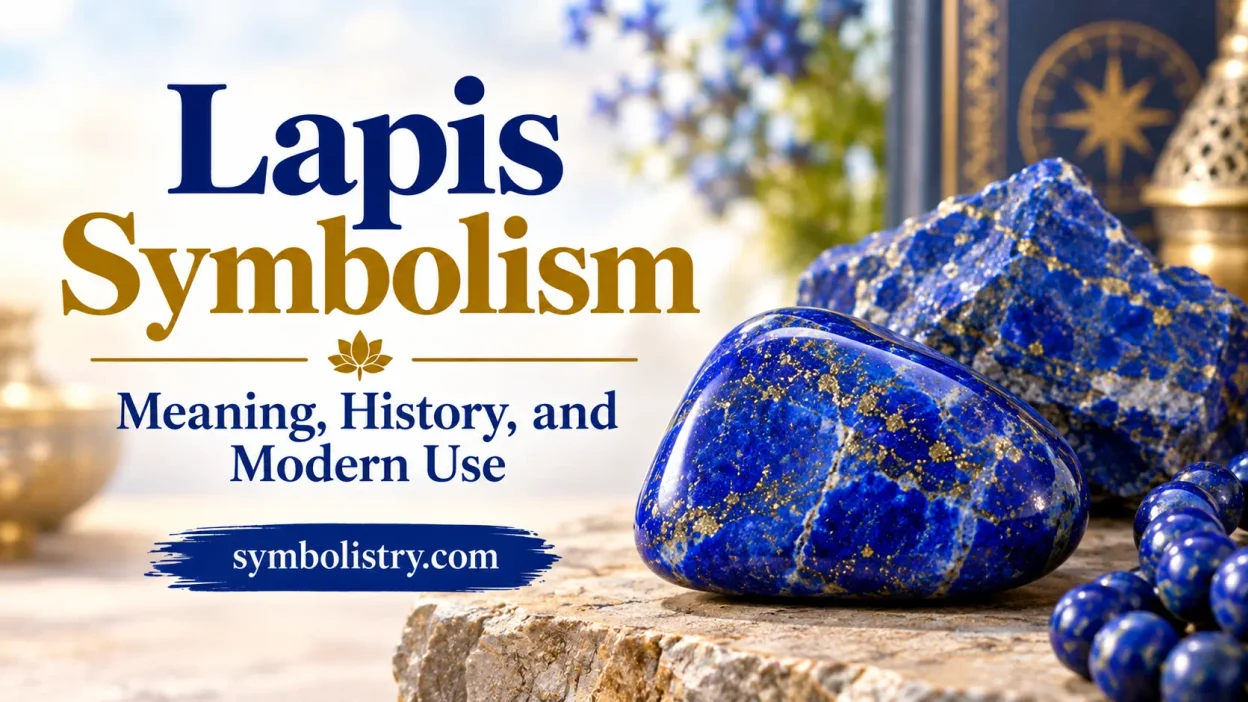
Lapis symbolism is closely associated with wisdom, truth, dignity, self-expression, and spiritual devotion, but those meanings did not appear all at once. They developed from the stone’s striking blue color, rarity, use in royal and religious objects, and long history of trade between Central Asia, the Middle East, North Africa, and Europe.
Today, lapis lazuli is most familiar to Americans as a gemstone used in jewelry, decorative objects, art, and personal gifts. Its deep blue surface, often marked with gold-colored pyrite, gives it an unmistakable appearance that can suggest confidence and calm without requiring a supernatural interpretation.
Quick Answer
Lapis symbolism commonly represents wisdom, truth, confidence, and meaningful self-expression in modern American culture, especially in jewelry, personal style, and decorative art. Historically, the stone was associated with status, sacred objects, protection, and the prestige of distant trade networks.
TL;DR
- Lapis commonly symbolizes wisdom, truth, confidence, and honest expression.
- Ancient societies valued it for rarity, color, craftsmanship, and status.
- Egypt connected blue stones with religious objects, amulets, and burial traditions.
- Mesopotamian elites used lapis in jewelry and prestigious objects.
- Modern Americans often wear it for beauty, identity, and personal meaning.
- Its symbolism varies depending on culture, setting, and individual interpretation.
What Lapis Lazuli Looks Like and Why It Stands Out
Lapis lazuli is an opaque blue metamorphic rock rather than a single mineral. Its best-known appearance is a rich blue body color scattered with tiny flecks of golden pyrite and sometimes streaks or patches of white calcite.
That visual combination matters to its symbolism. The blue can suggest sky, water, distance, calm, and seriousness, while the metallic-looking pyrite creates a contrast that makes the stone appear almost starry.
Most lapis used historically came from the Badakhshan region of present-day Afghanistan. That geographic fact is important because ancient communities in places such as Mesopotamia and Egypt had no local supply comparable to it. Obtaining the stone required long-distance trade, which added rarity and prestige to objects made from it.
This helps explain why lapis became more than an attractive material. A piece of it could represent access to distant resources, skilled artisans, wealth, and social position.
Wisdom and Knowledge as the Central Modern Meaning
One of the most recognizable modern associations of lapis is wisdom.
The connection is partly visual and partly historical. Its dark blue color has long been used in settings associated with authority and sacred art, while its rarity made it appropriate for objects that were not ordinary household possessions.
In contemporary American culture, this meaning often appears in jewelry and gifts. Someone may choose a lapis pendant, bracelet, or stone for a person who values learning, reflection, teaching, or intellectual independence.
The symbolism is especially suitable when the gift is meant to recognize someone’s experience rather than simply celebrate romance or physical attractiveness.
Lapis can therefore communicate an idea such as:
Wisdom is something acquired through experience and carried with you.
That interpretation is modern rather than a single universal ancient doctrine, but it fits the stone’s long association with valuable objects and distinguished people.
Truth, Honesty, and Clear Expression
Lapis is also frequently associated with truth and honest communication.
This interpretation has become especially popular in contemporary gemstone culture. Blue is commonly connected with openness, reliability, and communication, while lapis’s historical prestige gives those ideas an additional sense of seriousness.
In the United States, this can make lapis appealing as a personal symbol for someone entering a new stage of life, speaking publicly, establishing boundaries, or trying to communicate more directly.
Its symbolism is less about simply “speaking more” and more about speaking with intention.
That distinction is useful. Lapis does not inherently symbolize honesty in every culture or historical period. Rather, modern symbolic traditions have combined its blue appearance, historical associations, and contemporary ideas about communication into a recognizable meaning.
Ancient Roots and the Importance of Long-Distance Trade
Lapis has one of the clearest examples of how geography can shape symbolism.
The finest ancient sources were located in what is now northeastern Afghanistan, far from the major urban centers of ancient Mesopotamia and Egypt. Archaeological discoveries show that lapis traveled enormous distances thousands of years ago.
At the Sumerian city of Ur, for example, lapis was used alongside gold and carnelian in elite jewelry. Objects from royal burials demonstrate that the stone was not an everyday material. Its presence communicated access to valuable resources and sophisticated craftsmanship.
This history gives lapis an important symbolic dimension that is sometimes overlooked: connection.
The stone physically moved between cultures through trade networks. Its history is therefore also a story about merchants, artisans, rulers, travelers, and the exchange of materials across regions.
Lapis symbolism cannot be separated entirely from that history of movement.
Lapis in Ancient Egypt
Ancient Egypt provides another important chapter in the stone’s symbolic history.
Egyptians used lapis in beads, amulets, jewelry, figurines, and other objects. Archaeological examples include lapis objects associated with tombs and religious traditions. Because the stone was imported, it carried an element of rarity and prestige.
Egyptian jewelry was not merely decorative. Jewelry could communicate social status and could also have protective or religious purposes. Lapis therefore appeared in a cultural environment where beautiful materials could carry several meanings at once.
Blue itself had important visual associations in Egyptian art, although it would be misleading to assume that every blue object had exactly the same symbolic meaning.
The most accurate interpretation is contextual: lapis was a rare, valued material incorporated into objects connected with status, religion, burial, and personal adornment.
Lapis and Mesopotamian Prestige
In ancient Mesopotamia, lapis was particularly important among elite objects.
The royal cemetery at Ur produced jewelry made from gold, lapis lazuli, and carnelian. These materials created strong contrasts of blue, red, and gold, producing an appearance suited to high-status burial goods.
The stone’s value was not simply its color. Its distant origin made it evidence of an extensive trading network.
For ancient Mesopotamian communities, lapis could consequently suggest wealth, social distinction, craftsmanship, and access to distant lands.
This is one reason modern claims that lapis had one fixed “ancient meaning” should be treated cautiously. Its symbolism was embedded in specific objects and cultural settings rather than operating like a universal dictionary definition.
What Lapis Represents in Modern American Culture
In the United States today, lapis is primarily encountered through jewelry, decorative objects, art, fashion, and gemstone collecting.
Its meanings are generally personal rather than institutional. A person might wear lapis because they associate it with wisdom, confidence, calm communication, or simply because they appreciate its color.
Several modern interpretations are especially common:
| Context | Meaning in the USA | Common Associations | Notes |
|---|---|---|---|
| Jewelry | Wisdom and confidence | Personal identity, style | Often worn as a meaningful accessory |
| Gifts | Respect and appreciation | Friendship, achievement | Suitable for someone associated with learning |
| Home decor | Calm sophistication | Blue, natural beauty | Often used as a visual accent |
| Art | Prestige and color | Craftsmanship, history | Historically important as a pigment source |
| Tattoos | Individual meaning | Truth, identity, wisdom | Interpretation depends heavily on the wearer |
The important shift is from socially assigned meaning to personal symbolism. Ancient rulers and elites used rare materials partly because society recognized their value. Modern Americans can choose lapis simply because its meaning resonates with their own identity.
Why Lapis Became Important in Art
Lapis has another symbolic connection that comes from its use as a source of the blue pigment known as ultramarine.
Historically, high-quality natural ultramarine was made by processing lapis lazuli. The pigment was extraordinarily expensive in medieval and Renaissance Europe because the raw material had to travel from Central Asia and undergo careful processing.
Artists therefore did not treat this blue as an ordinary color.
In European religious painting, ultramarine was sometimes used for important garments and passages. Its expense could make blue itself communicate prestige and importance. The color associated with lapis consequently entered the visual language of European art.
This history also explains why the stone can symbolize value expressed through color. Its importance was not limited to being worn as a gem; it helped shape the appearance of major works of art.
Lapis in Religion and Sacred Imagery
Lapis has appeared in religious and ceremonial contexts across different cultures, but its meaning should not be reduced to a single religious doctrine.
Ancient Egyptian objects made from lapis include amulets associated with gods and protective traditions. In Mesopotamia, the material appeared in elite and ceremonial objects. Later European artists used ultramarine made from lapis in Christian religious paintings.
These examples show an important pattern: rare blue materials were often suitable for things considered socially or spiritually important.
However, the exact meaning depended on the culture.
It is therefore inaccurate to say that lapis universally means a particular deity, prayer, or religious principle. The broader historical pattern is stronger: the stone repeatedly entered settings where beauty, rarity, status, and sacred significance overlapped.
Emotional and Psychological Meaning
Modern symbolic interpretations often connect lapis with emotional qualities such as calmness, confidence, introspection, and authenticity.
These associations are understandable from a color perspective. Dark blue is frequently perceived as composed, serious, stable, or restrained. Lapis adds visual complexity through its irregular natural patterns and metallic inclusions.
For someone choosing the stone personally, it can represent a desire to remain composed while still expressing individuality.
Its emotional symbolism can be especially relevant to people who dislike highly ornamental gemstones. Lapis has character without looking overly delicate, which allows it to communicate both refinement and individuality.
These are symbolic interpretations, not scientific claims about the psychological effects of wearing a stone.
Why People Choose Lapis Jewelry
Lapis works particularly well in jewelry because its appearance is distinctive without depending on transparency or intense sparkle.
A polished cabochon can show broad fields of blue, while visible pyrite creates small golden contrasts. The result is recognizable even when the piece is relatively simple.
In American fashion, lapis jewelry can therefore signal several things at once:
- appreciation for natural materials
- interest in history and craftsmanship
- preference for strong colors
- individuality without excessive ornament
- personal associations with wisdom or truth
Necklaces and bracelets are particularly common choices because the stone’s color can become the central visual feature of an outfit.
Men’s jewelry also frequently uses lapis because the stone’s dark blue appearance works easily with leather, silver, steel, and understated clothing.
Lapis in Tattoos and Personal Identity
A lapis tattoo can carry meanings that differ significantly from gemstone traditions.
Some people choose a lapis image to represent wisdom, truth, communication, self-knowledge, or a period of personal growth. Others simply like the stone’s color and natural pattern.
The design can change the interpretation considerably.
A realistic blue stone may emphasize natural beauty. Lapis combined with stars can suggest the night sky or exploration. A pendant, ancient artifact, or geometric design can shift the focus toward history or personal identity.
Unlike an established cultural emblem, a gemstone tattoo rarely has one universally accepted meaning. The wearer’s story is usually the most important part.
Common Misunderstandings About Lapis Symbolism
Modern gemstone culture sometimes presents lapis as though ancient societies universally believed it possessed a specific set of supernatural powers. Historical evidence does not support such a simple picture.
Ancient people certainly used lapis in amulets, religious objects, jewelry, and burials, but that does not mean every piece was understood in the same way.
Another common misunderstanding is treating all blue stones as interchangeable. Lapis, turquoise, Egyptian blue, azurite, and other blue materials have different compositions, histories, and cultural contexts.
It is also important to distinguish symbolism from medical claims. Wearing lapis can be personally meaningful, but claims that the stone cures disease, changes bodily functions, or guarantees emotional outcomes belong to modern belief systems rather than established medical evidence.
The most useful way to understand lapis is to separate documented cultural history from later spiritual or commercial interpretations.
How the Meaning Has Changed Over Time
Lapis symbolism has gradually shifted from rarity and elite status toward personal identity and aesthetic meaning.
In ancient societies, possession of lapis could demonstrate access to international trade and expensive craftsmanship. In medieval and Renaissance Europe, its powdered pigment could signify the importance of an artistic or religious subject because ultramarine was costly.
In modern America, the emphasis is much more personal.
A person may select lapis because it represents wisdom. Another may associate it with honesty. Someone else may simply value its deep blue color or connection to ancient history.
The material has stayed recognizable while its social context has changed.
That flexibility is one reason lapis continues to appear in contemporary jewelry, art, interiors, and personal symbolism.
Positive and Negative Associations
Lapis is predominantly associated with positive qualities in modern Western gemstone culture, particularly wisdom, honesty, dignity, confidence, and thoughtful communication.
There is no universally established negative meaning attached to the stone.
However, any symbol can acquire negative associations through context. An object made from lapis could represent excessive wealth or social privilege if it is used specifically to emphasize luxury. A tattoo or design can also take on meanings unrelated to traditional gemstone symbolism.
This distinction matters because the material itself does not determine the message.
Setting, surrounding imagery, cultural background, and the person’s intention all influence interpretation.
How to Use Lapis Symbolism Today
People who want to use lapis as a personal symbol can do so without adopting every historical or spiritual claim associated with the stone.
For jewelry, it can represent wisdom, honest communication, or appreciation for history.
For home decor, its blue color can contribute a sense of composure and visual richness.
For artwork, lapis can reference ancient trade, craftsmanship, luxury, or the history of ultramarine pigment.
For a gift, it can communicate respect for someone’s knowledge, maturity, creativity, or individuality.
The strongest modern use is usually the most specific one. Instead of saying that lapis represents everything from healing to protection to prosperity, it is more meaningful to choose one or two qualities that genuinely fit the person or occasion.
Frequently Asked Questions
What does lapis symbolize spiritually?
In modern spiritual and gemstone traditions, lapis is often associated with wisdom, truth, intuition, and self-expression. These interpretations vary by tradition and should be distinguished from the documented historical uses of the stone.
What does a lapis tattoo mean?
A lapis tattoo can symbolize wisdom, honesty, self-knowledge, communication, or personal growth. Because gemstone tattoos are highly individual, the surrounding design and the wearer’s intention usually determine the specific meaning.
Is lapis associated with protection?
Lapis has been used in historical amulets and religious objects, including ancient Egyptian examples. Modern gemstone traditions therefore sometimes interpret it as protective, although claims about supernatural protection are matters of belief rather than established historical or scientific fact.
Why was lapis so valuable in ancient times?
Its major ancient source was far from many of the civilizations that used it, especially in Mesopotamia and Egypt. Long-distance transportation, rarity, attractive color, and skilled craftsmanship made lapis a prestigious material.
What does blue lapis mean in American culture?
Modern Americans commonly associate its dark blue color with calmness, wisdom, confidence, and authenticity. Its meaning is usually personal rather than tied to a formal national tradition.
Is lapis a religious symbol?
Lapis itself is not exclusively a symbol of one religion. It has appeared in religious and ceremonial objects in several cultures, but the specific meaning depended on the society, object, and historical setting.
Why does lapis have gold-colored spots?
The gold-colored flecks are usually pyrite, a naturally occurring mineral within the rock. They contribute to lapis’s distinctive appearance and are one reason the stone can look like a blue surface scattered with tiny metallic stars.
Conclusion
Lapis has accumulated meaning through a combination of color, rarity, craftsmanship, trade, religion, art, and personal use. Ancient communities valued it as an imported luxury material, while European artists later transformed it into one of the most prized blue pigments.
In modern America, lapis symbolism is more personal. It can represent wisdom, truth, confidence, thoughtful communication, individuality, or an appreciation for history and natural beauty. The stone does not need a supernatural explanation to be meaningful; its documented history already gives it a remarkable story.
Ultimately, lapis remains compelling because its symbolism can connect something ancient with something personal: a natural stone shaped by distant landscapes and human craftsmanship, now worn or displayed according to an individual’s own meaning.