
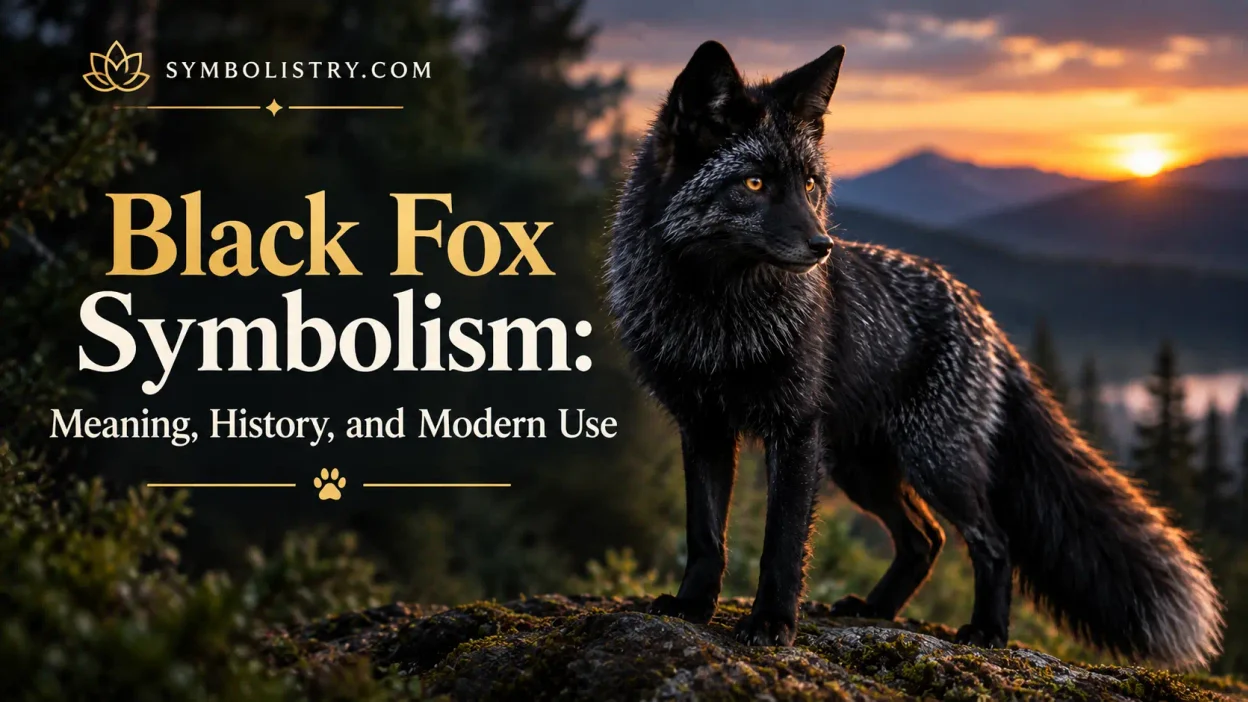
A black fox is an unusual and striking animal, and black fox symbolism commonly represents intelligence, independence, adaptability, mystery, and the ability to move carefully through uncertain situations. In modern American culture, the image often appeals to people who identify with quiet confidence rather than obvious displays of strength.
The meaning is not based on one ancient tradition with a single definition. Instead, the symbolism of the black fox developed through a combination of ordinary fox folklore, associations with the color black, the rarity of dark-colored foxes, and modern artistic interpretation.
That makes the black fox especially interesting as a symbol. A red fox may immediately suggest familiar woodland imagery, while a black or silver fox often feels less predictable. Its appearance can shift the familiar meaning of the fox toward privacy, individuality, darkness, elegance, or resilience.
Quick Answer
Black fox symbolism commonly represents intelligence, independence, adaptability, and quiet strength in modern American culture, often with an added sense of mystery because of the animal’s dark coloring and relative rarity. Historically and across different cultural traditions, foxes have also been associated with cleverness, transformation, protection, deception, and the ability to cross boundaries between the familiar and unknown.
TL;DR
- Black foxes often symbolize intelligence and strategic thinking.
- Dark coloring adds associations with privacy and mystery.
- Fox folklore differs significantly across cultures.
- Americans often use the image for individuality and resilience.
- Tattoos and fashion emphasize instinct and quiet confidence.
- A black fox is not universally a negative symbol.
What Does a Black Fox Look Like?
The phrase “black fox” generally refers to a dark-colored form of the red fox, often called a silver fox when the fur includes silver or white-tipped hairs. Some individuals appear nearly black, while others have a mixture of black, charcoal, gray, and silver across their coats.
That appearance matters symbolically. People often respond to symbols visually before they know anything about their history. A familiar animal in an unusual color can seem more dramatic or rare than the same animal in its expected appearance.
The black fox therefore combines two layers of visual meaning:
- The fox brings established associations with cleverness and adaptability.
- The dark coat introduces ideas connected with the unknown, privacy, seriousness, and individuality.
This combination explains why the black fox appears so often in tattoos, illustrations, fantasy art, gaming culture, and personal design.
Its Most Common Meaning in the United States
In the United States today, a black fox most often represents being clever without being loud. The image can suggest someone who observes carefully, trusts their judgment, and adapts rather than forcing every situation.
Several meanings appear repeatedly in modern interpretations:
Intelligence. The fox has long been associated with cleverness. A black fox often gives that traditional trait a more serious or private character.
Adaptability. Foxes survive in forests, fields, suburbs, and other changing environments. Symbolically, this makes them useful images for people who value flexibility and resourcefulness.
Independence. The fox is commonly imagined as self-reliant and alert. A black fox can strengthen this impression by suggesting someone who is comfortable standing apart.
Mystery. The dark coat makes the animal visually connected to shadows, nighttime, and things that are not immediately understood.
Quiet strength. Unlike symbols such as lions or eagles, the fox does not traditionally represent dominance through size. Its strength is more often associated with awareness, timing, and intelligence.
For many Americans, these meanings are personal rather than religious. Someone may choose a black fox simply because it represents the way they want to move through life: carefully, independently, and intelligently.
Why the Color Black Changes the Meaning
Color changes symbolism because people attach cultural associations to color as well as to the object itself.
In American culture, black can suggest seriousness, elegance, rebellion, formality, mourning, privacy, sophistication, or the unknown. The meaning depends heavily on context. A black suit communicates something different from a black leather jacket, and both differ from a black animal in a forest.
When black is combined with a fox, several associations become stronger.
The fox already has a reputation for being difficult to predict. Dark coloring can make it appear more elusive. The fox already suggests intelligence; black can make that intelligence seem more private or controlled. The animal may also seem more unusual because people are accustomed to seeing foxes in reddish-orange tones.
Importantly, black does not automatically mean evil or danger. Modern symbolism sometimes treats darkness as a sign of secrecy or threat, but it can just as easily represent self-possession, protection, sophistication, or individuality.
That distinction is especially important when interpreting personal artwork. A black fox tattoo may represent resilience after hardship, for example, rather than anything sinister.
Where Fox Symbolism Began
The fox gained symbolic meaning largely through human observation and storytelling. People living near foxes noticed their quick movements, cautious behavior, hunting ability, and tendency to appear unexpectedly at the edges of human settlements.
Those observations encouraged storytellers to turn the fox into a character.
In many European stories, the fox became a clever trickster. It survived by thinking faster than larger or stronger animals. This helped establish one of the animal’s most lasting symbolic associations: intelligence as an alternative to physical power.
But “clever” has never been entirely positive. A clever character can solve problems, yet also deceive others. That ambiguity became part of fox symbolism.
The black fox inherited these associations rather than creating an entirely separate historical tradition. Its distinctive color then encouraged later interpretations involving darkness, secrecy, rarity, and hidden knowledge.
The Fox as a Trickster and Problem-Solver
The trickster is one of the most important ideas connected with fox symbolism. A trickster is not simply a villain. In folklore, trickster characters often break rules, expose foolishness, challenge authority, or survive through wit.
That makes the fox a complicated symbol.
A black fox may represent:
- Finding unconventional solutions
- Seeing opportunities others miss
- Refusing to be underestimated
- Adapting quickly to changing circumstances
- Recognizing when direct confrontation is unnecessary
The negative side of the trickster tradition involves manipulation, dishonesty, or selfishness. This is why fox symbolism can sometimes carry a warning about appearances or misplaced trust.
Modern American interpretations tend to favor the positive version. The fox is frequently presented as resourceful rather than dishonest, especially in personal art and tattoo culture.
What the Black Fox Can Symbolize Emotionally
Symbols often communicate emotional identity as much as historical meaning. People may feel connected to an animal because its imagined traits reflect qualities they recognize in themselves.
Emotionally, the black fox can represent a person who is:
- Reserved but observant
- Independent without being isolated
- Careful about trust
- Adaptable during change
- Comfortable with complexity
- Strong without needing attention
The symbol can also appeal to people who dislike simple categories. Foxes are often portrayed as playful but cautious, attractive but wild, intelligent but unpredictable. The black coloration adds another contrast between visibility and concealment.
Psychologically, this can make the black fox an appealing symbol of boundaries. It suggests the ability to decide what to reveal and what to keep private.
That is different from secrecy for its own sake. In modern personal symbolism, privacy can represent self-protection and emotional maturity.
Black Fox Symbolism and Personal Identity
Animal symbols are often used as shorthand for identity. Someone who displays a black fox may be communicating personality without directly explaining it.
In American design culture, the image can suggest a preference for subtlety over spectacle. A roaring predator announces itself immediately. A fox is more often imagined watching first and acting when necessary.
This makes the black fox especially suited to identities built around independence, creativity, strategic thinking, or nonconformity.
It can also represent reinvention. Because foxes appear in stories about disguise, transformation, and changing circumstances, the animal can become a personal symbol for someone entering a new phase of life.
The color black may reinforce that message when a person wants the image to feel more mature, dramatic, or individual than a traditional orange fox.
Symbolism in American Culture
Fox symbolism in the United States comes from several overlapping sources: European storytelling traditions, Indigenous traditions specific to individual nations, popular entertainment, wildlife imagery, fantasy, and contemporary personal symbolism.
The result is not one official American meaning.
In everyday U.S. culture, the fox often represents cleverness and adaptability. Children’s stories and cartoons have helped reinforce the animal’s reputation as smart, mischievous, and quick.
The black fox is less common in mainstream wildlife imagery, which gives it a distinctive appeal. In American art and personal design, unusual animal colors are often used to signal individuality. A dark fox can therefore function almost like a customized version of a familiar symbol.
It may appear in:
- Tattoos
- Streetwear and graphic clothing
- Gaming profiles
- Fantasy illustrations
- Jewelry
- Home decor
- Social media avatars
- Band and artistic branding
The meaning often depends more on the user than on a fixed tradition.
Indigenous Traditions Require Careful Interpretation
Fox figures appear in stories from numerous Indigenous North American cultures, but there is no single Indigenous meaning of the fox.
This is an important distinction. Different nations developed their own stories, languages, ceremonial practices, and relationships with local animals. In some traditions, foxes may be associated with intelligence, observation, humor, or problem-solving. In others, their role may be quite different.
Modern websites sometimes reduce these diverse traditions to a generic claim that “the fox is a Native American spirit animal.” That description is inaccurate and can flatten many distinct cultures into one invented system.
The black color itself also does not create a universal Indigenous interpretation.
For an American reader, the most respectful approach is to distinguish between general modern fox symbolism and the specific traditions of individual Indigenous peoples. If a particular tribal story is being referenced, its cultural context should remain attached to it.
Japanese Fox Traditions and the Kitsune
Japanese fox traditions have had a major influence on how Americans encounter fox symbolism today, particularly through animation, games, fashion, tattoos, and popular art.
The Japanese word kitsune means fox. In folklore, supernatural foxes can take on many roles. Depending on the story, a fox may be helpful, deceptive, protective, dangerous, or transformative.
Foxes are also associated with Inari traditions, where they are understood as messengers or attendants rather than simply as ordinary animals with magical powers.
Modern American pop culture often blends these different ideas together. A fox mask, multiple tails, shrine imagery, and supernatural transformation may all be treated as part of one general “kitsune” aesthetic even when they come from different stories or religious contexts.
A black fox can therefore be used in Japanese-inspired art, but it should not automatically be described as having one universal kitsune meaning. Japanese fox traditions are varied, and color alone does not produce a single interpretation.
European Folklore and the Dark Fox Image
European storytelling helped establish the fox as a clever and sometimes morally ambiguous animal.
The fox frequently appears as a character who wins through deception or observation rather than force. This tradition shaped the modern English-language association between foxes and cunning.
Dark-colored animals also acquired their own folklore in many places. Black animals could be treated as unusual omens, creatures of the night, or simply striking natural rarities. These interpretations varied by region and period.
The modern black fox image often combines these separate traditions. People see a clever animal associated with darkness and naturally interpret it as secretive or supernatural.
That interpretation is culturally understandable, but it should not be mistaken for a single ancient belief. Much of today’s black fox symbolism is a modern combination of older ideas.
A Comparison of Common Meanings
| Context | Meaning in the USA | Common Associations | Notes |
|---|---|---|---|
| Personal identity | Quiet intelligence | Independence, awareness | Often highly individual |
| Tattoo | Adaptability | Instinct, resilience | Design changes the meaning |
| Fantasy art | Mystery | Magic, transformation | Often influenced by folklore |
| Fashion and decor | Individuality | Elegance, darkness | Usually aesthetic and personal |
| Folklore-inspired art | Cleverness and ambiguity | Trickster, disguise | Cultural context matters |
Why Black Foxes Appear in Tattoos
The black fox has become a popular tattoo subject because it offers flexibility. It can work as a realistic animal portrait, a simple silhouette, a geometric design, or a larger fantasy composition.
A black fox tattoo commonly represents intelligence and adaptability, but details can change the message.
A fox facing forward may suggest alertness or confidence. A running fox can emphasize movement and freedom. A fox surrounded by plants may strengthen a connection to nature. A fox combined with the moon can create a stronger nighttime or introspective atmosphere.
Black ink also has a practical visual effect. A fox rendered in dark linework or black-and-gray shading can feel more serious and graphic than a brightly colored animal.
Someone choosing this design may want to express:
- Personal independence
- Survival through difficult change
- Trust in instinct
- Intelligence and strategy
- A private or introspective personality
- Connection with wildlife and nature
The meaning ultimately belongs to the wearer. Personal symbolism can be more important than folklore.
Jewelry, Fashion, and Home Decor
Outside tattoo culture, black fox imagery often functions as a style symbol.
In jewelry, a fox may be simplified into a face, tail, or silhouette. The dark color can create an elegant or minimalist appearance. In fashion, the image may communicate independence, wilderness, alternative style, or playful intelligence.
Home decor uses fox imagery differently. A black fox illustration can create a woodland atmosphere while avoiding the bright, rustic look associated with traditional orange fox decor.
The same symbol can therefore communicate different things depending on where it appears.
A delicate necklace might emphasize individuality. A large wall illustration might emphasize fantasy or nature. A graphic T-shirt might lean toward rebellion or alternative culture.
Context determines whether the viewer reads the black fox primarily as an animal, a personality symbol, or a decorative image.
The Black Fox in Digital and Pop Culture
Digital culture has made symbolic images easier to personalize.
A black fox can appear as a username, avatar, game character, profile image, logo, or digital artwork. Online, animal imagery often allows people to construct an identity that feels expressive without revealing personal information.
The black fox works particularly well for this purpose because its symbolism includes privacy.
A person may choose the image to suggest that they are observant, creative, or difficult to categorize. Others simply like the visual contrast between dark fur and bright eyes.
Fantasy and gaming culture also amplify the supernatural side of the fox. Shape-shifting, magical abilities, transformation, and hidden identities are common fictional themes.
These modern uses are important because they continue to change the symbol’s meaning. For many younger Americans, the black fox may be encountered first through digital art rather than traditional folklore.
Is a Black Fox a Symbol of Good Luck?
A black fox can be interpreted as lucky in some modern contexts, but there is no universal rule that makes every black fox a symbol of good fortune.
The association with luck often comes from two ideas: rarity and cultural traditions involving foxes as beneficial or protective beings. Rare animals can be viewed as special, while foxes in some stories serve helpful or auspicious roles.
In modern American symbolism, however, the black fox is more consistently associated with individuality and intelligence than with luck alone.
If someone uses it as a lucky symbol, that is a valid personal interpretation, but it should not be presented as a universal historical meaning.
Positive and Negative Interpretations
The black fox is neither entirely positive nor entirely negative.
Its positive meanings include intelligence, adaptability, independence, awareness, creativity, and resilience.
Its more challenging meanings include deception, secrecy, unpredictability, and distrust.
This duality comes from the fox itself as a folklore character. Cleverness can help a person survive, but cleverness can also be used to manipulate. Privacy can protect someone, but secrecy can create suspicion.
That complexity is part of the symbol’s appeal.
A black fox can represent someone learning to trust their instincts while also recognizing that intelligence carries responsibility. It can symbolize caution without cowardice and independence without emotional isolation.
Common Misunderstandings About the Symbol
One common misunderstanding is that every black animal symbolizes evil. In American popular culture, dark colors are often used for villains or threatening imagery, but symbolism is never that simple.
A second misunderstanding is that black fox symbolism comes from one ancient belief system. It does not. Modern interpretations combine ordinary fox folklore, color associations, artistic imagination, and traditions from multiple cultures.
Another mistake is treating all fox traditions as interchangeable. A European trickster story, an Indigenous story from a particular nation, and a Japanese kitsune tale should not be blended into one supposed universal mythology.
Finally, some modern descriptions use terms such as “spirit animal” or “totem” as generic labels for any animal someone likes. These terms have specific meanings in particular cultural contexts and should not automatically be applied to a black fox as a decorative form of symbolism.
How the Meaning Has Changed Over Time
Fox symbolism has shifted as the relationship between people and wildlife has changed.
Older stories often focused on the fox as a creature encountered near farms, forests, and villages. Its symbolic character grew from practical observations and storytelling.
Modern Americans are more likely to encounter foxes through photographs, suburban wildlife sightings, entertainment, tattoos, and digital art. The animal has become less tied to a single type of story and more available as a personal symbol.
The black fox represents an even more modern layer of interpretation.
Today, people often use unusual animal coloration to express individuality. The black fox has therefore evolved into a symbol that combines old ideas about cleverness with contemporary ideas about identity, privacy, style, and self-definition.
That evolution explains why two people can use the same image while meaning very different things by it.
Frequently Asked Questions
What does a black fox symbolize?
A black fox commonly symbolizes intelligence, adaptability, independence, and mystery. Its dark coloring often adds associations with privacy, individuality, quiet strength, and the unknown.
What does a black fox tattoo mean?
A black fox tattoo often represents cleverness, resilience, instinct, or personal independence. The surrounding design can change the meaning significantly, especially when combined with moons, masks, flowers, or other cultural imagery.
Is a black fox a good or bad symbol?
Neither interpretation is universal. The symbol can represent positive qualities such as awareness and adaptability, while folklore also connects foxes with deception and unpredictability.
Does a black fox have a spiritual meaning?
Some people give black foxes personal spiritual meanings involving guidance, transformation, or intuition. However, there is no single religious interpretation shared across all cultures or belief systems.
What does the black fox mean in American culture?
In modern American culture, the black fox is commonly used as a symbol of individuality, intelligence, privacy, and alternative style. Its meaning is usually personal and artistic rather than part of an official national tradition.
Is black fox symbolism connected to Japanese kitsune?
Japanese fox traditions have influenced modern black fox artwork, especially in fantasy and tattoo culture. However, a black fox is not automatically a kitsune, and Japanese fox symbolism includes many different roles and stories.
Conclusion
The appeal of the black fox comes from contrast. It combines a familiar animal associated with cleverness and adaptability with a dark appearance that suggests privacy, individuality, and uncertainty. The result is a symbol that can feel intelligent and guarded without automatically becoming negative.
In modern American culture, black fox symbolism is most often personal rather than fixed. Whether it appears in a tattoo, artwork, piece of jewelry, or digital identity, it usually points toward some combination of independence, instinct, resilience, and thoughtful self-definition. Its lasting appeal lies in a simple idea: not every kind of strength needs to announce itself.



[…] for the Doberman comparable to animals with long-standing roles in religious traditions. In modern personal symbolism, people may use the breed to represent protection, loyalty, vigilance, courage, or […]