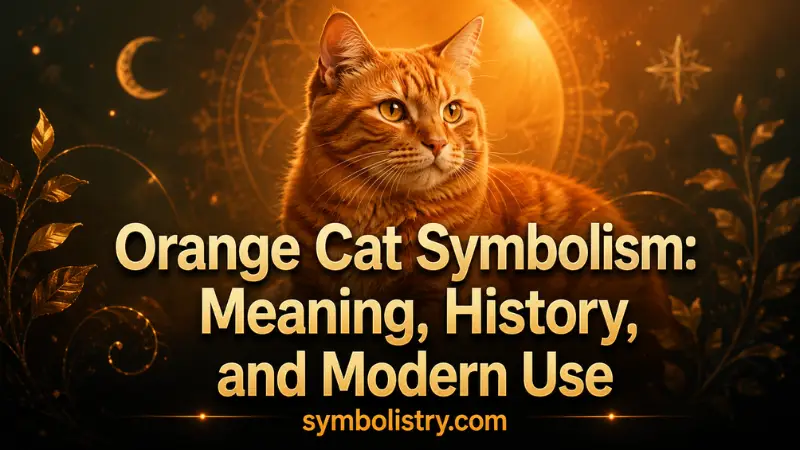
Orange cats are instantly recognizable for coats that range from pale cream and golden yellow to deep ginger and reddish orange. In modern American culture, orange cat symbolism is most often connected with warmth, friendliness, confidence, curiosity, humor, comfort, and an independent personality.
Unlike symbols with a clearly documented religious or ceremonial origin, however, the orange cat does not carry one fixed meaning inherited from antiquity. Its symbolism developed from several overlapping influences: humanity’s long relationship with domestic cats, the emotional associations of warm orange coloring, popular fictional cats, and more recent internet culture.
That distinction matters. An orange cat can represent optimism and companionship without implying that every historical culture assigned those meanings specifically to orange-colored cats.
Quick Answer
Orange cat symbolism commonly represents warmth, friendliness, curiosity, confidence, humor, and cheerful individuality in modern American culture. Historically, these meanings draw more from broader cat symbolism and the visual associations of orange and gold than from any single ancient tradition devoted specifically to ginger cats.
TL;DR
- Orange cats commonly represent warmth, friendliness, confidence, and individuality.
- Their symbolism is mainly modern rather than an ancient fixed tradition.
- Cat imagery historically carried associations with independence, protection, and companionship.
- American pop culture strengthened their humorous, relaxed, mischievous image.
- Coat color does not reliably determine an individual cat’s personality.
- Modern uses include tattoos, art, memorials, decor, and online culture.
What an Orange Cat Looks Like and Why Color Matters
An orange cat is not a separate breed. Orange, ginger, marmalade, red, and sometimes yellow are informal descriptions of coat color found across different kinds of domestic cats.
Many orange cats display tabby markings. Depending on the animal, these may appear as narrow stripes, broad swirls, spots, or faint markings across an otherwise nearly solid-looking coat.
The color itself contributes heavily to symbolic interpretation. Orange sits visually between red and yellow, so people commonly associate it with sunlight, firelight, autumn leaves, warmth, enthusiasm, and visibility. When those associations are combined with a familiar household animal, the result feels less aggressive than fiery red and more lively than soft yellow.
That helps explain why orange cats are often interpreted as comforting but energetic figures: warm enough to suggest home and affection, yet bright enough to suggest personality and movement.
What Orange Cats Commonly Mean in the United States
In the United States, orange cats tend to carry positive and informal meanings rather than solemn ceremonial ones.
| Context | Common U.S. Meaning | Typical Association | Important Note |
| Household pet | Companionship | Affection, home, comfort | Often based on personal experience |
| Art and illustration | Warmth | Sunlight, autumn, coziness | Color strongly shapes interpretation |
| Social media | Mischief and humor | Chaotic or silly behavior | Mostly a modern stereotype |
| Tattoo | Individuality | Independence, affection, memory | Meaning varies by wearer |
| Memorial imagery | Lasting bond | Loyalty, grief, remembrance | Often represents a specific pet |
| Spiritual interpretation | Luck or positive change | Confidence, opportunity | Not a universal religious teaching |
For many Americans, an orange cat therefore feels approachable rather than ominous. That differs noticeably from some superstitions historically attached to black cats.
Researchers studying human perceptions of cat color have found that people often describe orange cats as friendly, although perception should not be mistaken for a proven biological personality rule.
Why Warmth and Optimism Became Central Meanings
Much of the orange cat’s symbolism comes from visual psychology rather than ancient folklore.
Golden and orange shades resemble several pleasant sources of warmth: afternoon sunlight, fireplaces, autumn foliage, pumpkins, and glowing lamps. In an American setting, they can also evoke fall traditions and the cozy indoor atmosphere associated with cooler weather.
An orange cat resting on a blanket or sitting in a sunlit window naturally reinforces those associations.
As a result, artwork featuring ginger cats often communicates:
- emotional warmth
- cheerfulness
- comfort
- sociability
- familiarity
- optimism
These meanings are contextual rather than supernatural. An artist can use an orange cat to make an otherwise ordinary domestic scene feel warmer, more playful, or more inviting.
Independence, Curiosity, and Self-Confidence
The second major layer comes from the cat rather than the color.
Domestic cats live closely with people while retaining behaviors that humans perceive as highly self-directed. A cat may seek affection one moment and choose solitude the next. It can appear relaxed for hours before suddenly becoming intensely alert to a sound, toy, insect, or movement outside a window.
That mixture has made cats useful symbols of independence and curiosity.
When represented in orange, those qualities often feel more outgoing than mysterious. A dark-colored cat in an illustration may be used to create secrecy or nighttime tension; a bright ginger cat is more likely to suggest confidence, curiosity, humor, or friendly defiance.
For someone choosing an orange cat as a personal emblem, the message may be simple: maintain your independence without withdrawing from affection or community.
Why Orange Cats Became Symbols of Humor and Chaos
One of the most distinctly modern meanings is playful disorder.
Online communities frequently portray ginger cats as impulsive, ridiculous, fearless, or temporarily lacking common sense. The stereotype has become so widespread that veterinary organizations now acknowledge the internet’s image of orange tabbies as comic “agents of chaos.”
The joke should not be treated as a scientific description of orange cats.
Research on coat color and behavior remains mixed, and environmental conditions, early socialization, sex, individual temperament, health, and life experience can all influence how a cat behaves. Current evidence does not justify assuming that orange coloring automatically produces a silly, affectionate, aggressive, or unintelligent personality.
Symbolically, however, the stereotype has become important. Orange cats now represent the kind of lovable unpredictability that disrupts daily life without feeling threatening.
How American Pop Culture Shaped the Modern Image
American entertainment helped turn the orange cat into a recognizable personality type.
The clearest example is Garfield, Jim Davis’s orange feline character, who entered newspaper comics in 1978. Garfield’s appetite, laziness, sarcasm, stubbornness, love of comfort, and exaggerated self-confidence gave generations of readers a memorable orange-cat archetype.
Not every modern ginger-cat stereotype comes directly from Garfield, but the character helped make a large orange cat culturally legible as humorous, opinionated, food-loving, and unapologetically comfortable.
Internet culture later added another layer. Short videos, photographs, memes, and pet accounts transformed real orange cats into recurring comic characters. Instead of representing supernatural mystery, they frequently represent everyday absurdity.
That is a significant evolution: the modern orange cat is often funny precisely because it combines dignity with ridiculous behavior.
The Historical Roots Come From Cats More Broadly
It is easy to assume that every popular modern animal symbol must have an ancient equivalent. In this case, that would be misleading.
Humans have lived alongside cats for thousands of years. Archaeological and genetic evidence connects the development of domestic cats with early agricultural communities in the Near East, where wildcats benefited from rodents attracted to stored grain. Human-cat relationships later developed in Egypt and spread through trade and migration.
Those societies created important meanings around cats, but surviving evidence generally concerns cats as animals—not a separate symbolic tradition centered on orange cats.
It is therefore more historically responsible to trace modern ginger-cat meaning through broader feline symbolism and later color associations rather than claiming an unbroken ancient tradition.
Ancient Egypt and the Limits of the Connection
Ancient Egypt is frequently mentioned whenever cat symbolism is discussed, but the connection needs precision.
Cats became closely associated with Bastet, an Egyptian goddess whose feline form could emphasize peacefulness, protection, fertility, and prosperity. Cat statuettes and mummified cats were also used in religious settings connected with her cult.
This history supports associations between cats and protection, domestic well-being, alertness, and fertility.
It does not, however, establish a special ancient Egyptian doctrine saying that an orange cat specifically represented happiness, money, courage, or spiritual transformation.
Modern interpretations sometimes take genuine Egyptian cat symbolism and attach it too narrowly to ginger cats. The more accurate distinction is that ancient Egyptian feline imagery contributes to the symbolic history of cats generally.
The Genetics Behind the Orange Coat
The orange coat has a real biological history as well as a symbolic one.
Scientists had known for more than a century that orange coloring in domestic cats behaved differently from many other mammalian coat colors because it was linked to the X chromosome. In 2025, researchers identified the molecular mechanism involving altered activity near the ARHGAP36 gene.
The X-linked inheritance pattern also helps explain why fully orange cats are more commonly male. A male cat generally needs the orange-associated variant on its single X chromosome, while a female generally needs the relevant form on both X chromosomes to become fully orange. Females carrying different color versions on their two X chromosomes may instead develop tortoiseshell or calico coloring.
Researchers believe the orange trait is old. Historical evidence of multicolored cats indicates that the underlying genetic mechanism existed many centuries ago, although its exact point of origin remains uncertain.
Genetics explains the coat. It does not establish the symbolic meaning people assign to it.
Cross-Cultural Meanings of Cats, Luck, and Protection
No worldwide tradition gives orange cats one shared interpretation.
Different societies have built very different stories around cats. Ancient Egyptian religious imagery connected felines with figures such as Bastet, while Japanese traditions include both fortunate and unsettling cat imagery.
One well-known Japanese example is the maneki-neko, the raised-paw “beckoning cat” widely associated with good fortune. The tradition became established centuries ago and remains visible in businesses, homes, souvenirs, and popular culture.
Modern decorative versions appear in many colors, and people sometimes transfer lucky-cat associations to golden or orange cats.
That does not mean every orange cat is traditionally a Japanese symbol of wealth. Instead, contemporary imagery sometimes blends the familiar form of a lucky cat with warm gold and orange coloring to strengthen ideas of prosperity and welcome.
This is a good example of symbolism evolving through visual association rather than following one universal rule.
Emotional and Psychological Meaning
For people who have lived with a ginger cat, symbolism is often personal before it is cultural.
A particular orange cat may represent childhood, a first apartment, companionship during a difficult period, family life, or years spent with a beloved pet. In those cases, the animal’s color becomes a visual shortcut for memory.
Orange cats can therefore communicate:
Comfort. Their warm coloring fits naturally with domestic scenes and feelings of safety.
Affection. Popular perceptions often cast them as sociable companions, even though individual temperament varies.
Confidence. Bright coloring makes the animal visually noticeable, supporting interpretations of boldness.
Curiosity. The broader symbolism of cats contributes associations with observation, exploration, and alertness.
Resilience. Someone who associates a pet with surviving change or hardship may use that animal as a personal symbol of endurance.
These meanings do not need to be universal to be legitimate. Personal symbolism often works because one specific image carries a concentrated set of memories.
Orange Cats in Tattoos and Memorial Art
Orange cat tattoos commonly fall into two categories: personal portraits and symbolic designs.
A portrait may commemorate a living or deceased pet. Details such as a collar, name, paw print, favorite toy, flower, or sleeping pose can make the tattoo less about “cats” in general and more about one relationship.
More stylized designs may emphasize independence, humor, luck, warmth, or curiosity.
An alert cat with upright ears can suggest awareness. A sleeping ginger cat may represent comfort or emotional security. A cat walking away with its tail raised can communicate independence. A playful design may intentionally use the modern chaotic-orange-cat stereotype.
Because tattoo symbolism is highly personal, context matters more than any supposed dictionary definition.
Orange Cats in Decor, Art, Fashion, and Digital Culture
The orange cat works especially well as a modern decorative symbol because its color is visually flexible.
In fall decor, a ginger cat can sit naturally among pumpkins, leaves, candles, and earth tones. In children’s illustration, its bright coat can make it cheerful and easy to distinguish. In humorous art, the same color makes exaggerated facial expressions and chaotic scenes more noticeable.
Clothing, mugs, stickers, phone cases, greeting cards, and home accessories often use orange cats to communicate an informal combination of coziness and personality.
Digital culture pushes the comic side further. Photos and videos frequently frame ginger cats as dramatic household characters: stealing food, squeezing into impossible spaces, confronting objects they do not understand, or confidently causing problems.
As a result, the modern symbol often represents affection for imperfection—the idea that someone or something can be troublesome and lovable at the same time.
Positive and Negative Interpretations
Most contemporary American interpretations are positive, but not every symbolic reading is flattering.
Positive meanings include warmth, optimism, independence, companionship, curiosity, confidence, humor, creativity, and good fortune.
Negative or playful interpretations can include impulsiveness, stubbornness, excessive confidence, attention-seeking, mischief, and unpredictability.
These negative meanings are usually humorous rather than ominous. Unlike animals traditionally associated with serious danger or death, the ginger cat is often portrayed as causing small-scale domestic disorder.
A knocked-over plant or stolen sandwich fits the modern stereotype better than any sinister supernatural role.
Common Misunderstandings About Orange Cats
The biggest mistake is presenting recent folklore as ancient fact.
There is no strong historical basis for claiming that all ancient cultures viewed orange cats as symbols of wealth, fire, transformation, solar power, or divine messages.
A second mistake is turning personality stereotypes into biology. People may perceive ginger cats as friendly or chaotic, but scientists have not established coat color as a reliable personality test. Research on the recently identified orange-color mechanism has likewise not demonstrated that the mutation creates the famous internet personality attributed to these cats.
A third misconception is treating an orange cat as a breed. The coloring can occur in cats with different ancestry and physical characteristics.
Separating biology, history, personal interpretation, and internet folklore makes the symbolism more interesting—not less.
How the Meaning Has Changed Over Time
The evolution of the orange cat’s image shows how modern symbolism is actually created.
Its oldest foundations come from the long human relationship with domestic cats. Cats could protect food stores from rodents, live close to households, and eventually become companions as well as working animals. Some cultures incorporated them into religious or folkloric traditions.
Later artistic and cultural interpretations emphasized feline independence, elegance, watchfulness, and domestic comfort.
In the United States, entertainment characters such as Garfield strengthened the idea of the orange cat as a funny, food-motivated, highly opinionated companion. Digital culture then turned ordinary ginger pets into recurring meme characters.
The result is a symbol that feels ancient because cats have lived beside humans for millennia, yet much of its specifically orange personality is surprisingly modern.
FAQs
What does an orange cat symbolize spiritually?
In personal spiritual interpretation, an orange cat may represent confidence, warmth, independence, curiosity, or a positive transition. These meanings are modern and personal rather than teachings shared by all religions or cultures.
Are orange cats considered lucky?
They can be interpreted as lucky, particularly when orange or golden coloring is combined with broader cat imagery associated with prosperity or good fortune. However, there is no universal tradition declaring ordinary orange cats inherently lucky.
What does an orange cat tattoo mean?
An orange cat tattoo can symbolize independence, warmth, humor, companionship, curiosity, or affection for a specific pet. Memorial tattoos often carry a much more personal meaning than general feline symbolism.
Do orange cats symbolize money or wealth?
Not traditionally in any universal sense. Golden coloring can visually suggest prosperity, and some lucky-cat traditions use gold imagery, but claims that orange cats historically represented wealth everywhere are overstated.
Why are orange cats associated with being friendly?
People consistently report a cultural perception that orange cats are friendly, and this stereotype has been reinforced by pets, entertainment, and online content. Scientific evidence does not show that coat color alone reliably determines friendliness.
What does seeing an orange cat mean?
In ordinary life, seeing one does not have an established supernatural meaning. If someone chooses to treat the encounter symbolically, warmth, confidence, curiosity, independence, or good humor are reasonable modern interpretations.
Are orange cats mostly male?
Orange coloring is more common in male cats because the responsible coat-color mechanism is located on the X chromosome. Females generally require the orange-associated form on both X chromosomes to have a fully orange coat.
Conclusion
The modern meaning of the ginger cat comes from several layers rather than one ancient belief. Warm coloring contributes associations with optimism, comfort, and visibility; broader feline symbolism adds independence and curiosity; American entertainment adds humor and self-confidence; and internet culture contributes the affectionate image of lovable chaos.
At its most grounded, orange cat symbolism represents warmth, individuality, companionship, curiosity, and the humor found in unpredictable everyday life. For people who have loved a particular ginger cat, however, the strongest meaning may be simpler: a familiar color that immediately brings one unmistakable personality back to mind.