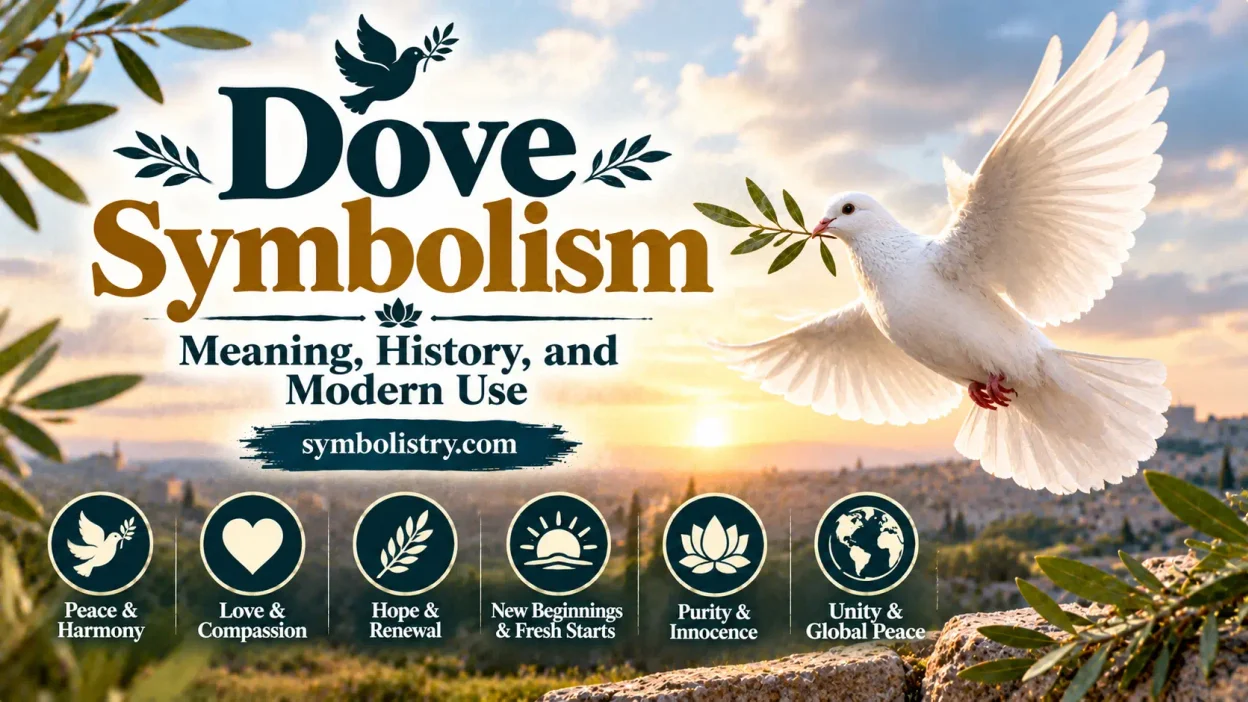
Doves are among the most recognizable symbols of peace, love, hope, and reconciliation. In modern America, their image appears on wedding stationery, memorial artwork, religious imagery, charity campaigns, tattoos, jewelry, and public messages calling for peace. Dove symbolism remains familiar because the bird itself has qualities that easily lend themselves to human interpretation: a soft appearance, gentle behavior, and a long association with home and companionship.
The dove’s meaning, however, did not come from a single tradition. Ancient Mediterranean religions, Judaism, Christianity, European art, and modern political culture all contributed different layers of interpretation. Some associations are religious, some emotional, and others are products of modern visual culture.
Today, an image of a white dove can communicate something immediately without words. Depending on the setting, it may suggest peace after conflict, spiritual presence, devotion between partners, remembrance of someone who has died, or hope for a better future.
Quick Answer
Dove symbolism commonly represents peace, love, hope, and reconciliation in modern American culture, especially in weddings, religious imagery, memorials, and peace campaigns. Historically, doves have also been connected with fertility, devotion, sacrifice, purity, and divine presence in Mediterranean and Abrahamic traditions.
TL;DR
- Doves commonly symbolize peace, love, hope, and reconciliation.
- Ancient Mediterranean traditions connected doves with love and fertility.
- Christianity gave the dove strong associations with the Holy Spirit.
- American culture uses doves in weddings, memorials, and peace imagery.
- White doves often emphasize innocence, purity, and peaceful intentions.
- Modern tattoos and artwork personalize the bird’s traditional meanings.
What a Dove Represents in Modern American Culture
In the United States, the dove’s most familiar meaning is peace. A white dove flying with open wings is frequently used to represent the end of violence, reconciliation between opposing groups, or a desire for peaceful cooperation.
Love is another common association. Doves can represent romantic commitment because many species form long-term pair bonds and are often seen as devoted partners. This makes dove imagery especially appropriate for weddings and anniversary designs.
The bird can also symbolize hope and renewal. A dove appearing after hardship suggests that conflict or grief does not have to define what comes next. This interpretation explains why dove imagery appears in memorials, religious ceremonies, humanitarian messages, and artwork about recovery.
The exact meaning depends heavily on context. A dove at a wedding is likely to suggest love and fidelity, while a dove on a memorial may represent peace, the soul, remembrance, or spiritual comfort.
Ancient Roots and Early Symbolism
The dove’s symbolic history reaches back thousands of years. In the ancient Mediterranean world, pigeons and doves were associated with several goddesses connected with love, fertility, sexuality, and motherhood.
In ancient Mesopotamian and later Mediterranean traditions, the bird became associated with Inanna and Aphrodite, among other divine figures. Its connection with these goddesses helped establish associations between doves, romantic love, fertility, and feminine beauty.
Doves also had practical religious significance. They could serve as offerings in ancient religious rituals. Because they were accessible domestic birds, their symbolic role was not limited to elaborate ceremonies involving rare animals.
This early history is important because it shows that the dove did not originally mean only peace. Its symbolic vocabulary was broader, including love, fertility, devotion, and religious offering.
The Dove in Jewish Tradition
The dove has several important appearances in Jewish scripture and tradition. One of the best-known is the story of Noah and the Flood.
After the waters began to recede, Noah sent out a dove to determine whether the land had become habitable again. The bird eventually returned carrying a freshly plucked olive leaf, providing evidence that dry land was reappearing.
This episode helped establish one of the most enduring symbolic combinations in Western culture: the dove and olive branch as signs of peace and restoration.
The significance goes beyond peace in the narrow sense. The returning dove indicates that destruction is ending and ordinary life can begin again. Its image therefore carries ideas of relief, renewal, safety, and the restoration of the natural world.
Christian Symbolism and the Holy Spirit
Christianity gave the dove another major symbolic role: the representation of the Holy Spirit.
In accounts of Jesus’ baptism, the Spirit is described as descending like a dove. Christian artists subsequently used the bird as a visual representation of the Holy Spirit, particularly in paintings, stained glass, church decoration, baptismal imagery, and religious literature.
This association explains why the dove can mean something different from ordinary peace imagery in a Christian setting. It may represent God’s presence, spiritual guidance, baptism, divine grace, or the activity of the Holy Spirit.
Christian art also reinforced associations between the dove and purity. White became especially significant in religious imagery because it could visually distinguish the bird from its surroundings while reinforcing ideas of innocence and holiness.
Why White Doves Became So Strongly Associated With Peace
Not every dove is white, but popular symbolic imagery often presents the dove as bright white. That visual choice matters.
White has long been associated in Western cultures with cleanliness, innocence, simplicity, and purity. Combining a white bird with the graceful flight of a dove produces an image that feels visually removed from violence and aggression.
The white dove therefore became an especially effective peace symbol.
The association was strengthened by modern European art and political imagery, particularly during the 20th century. Artists and peace movements used simplified dove imagery because it could be understood quickly across language barriers.
This helped transform an older religious and cultural symbol into a widely recognizable secular emblem.
The Dove and the Olive Branch
The dove carrying an olive branch is one of the clearest peace symbols in American visual culture.
Its roots lie in the biblical account of Noah, but its modern interpretation became broader. The combination now communicates peace after conflict, reconciliation, negotiation, and the possibility of rebuilding.
The two elements work together:
| Context | Meaning in the USA | Common Associations | Notes |
|---|---|---|---|
| Dove alone | Peace and hope | Calm, reconciliation | Meaning depends on surrounding imagery |
| White dove | Peace and purity | Innocence, goodwill | Common in ceremonies and memorial art |
| Dove with olive branch | Peace after conflict | Reconciliation, diplomacy | One of the most recognizable combinations |
| Dove at a wedding | Love and commitment | Fidelity, partnership | Often paired with floral imagery |
| Dove in Christian art | Holy Spirit | Faith, baptism, divine presence | Primarily religious rather than secular |
| Flying dove at a memorial | Peace and remembrance | Release, comfort, spiritual hope | Often reflects personal rather than universal beliefs |
The olive branch adds an important idea: peace is not merely the absence of fighting. It can also mean reconciliation and the restoration of ordinary life.
Doves in American Weddings
Doves have a natural place in American wedding symbolism because several traditional meanings overlap.
They can represent:
- lifelong partnership
- affection
- fidelity
- peace within a relationship
- new beginnings
- family formation
- shared commitment
Wedding invitations and decorations sometimes use paired doves to represent two people entering a partnership. Two birds facing each other can communicate mutual devotion without requiring an explicit romantic message.
Historically, the bird’s connection with love and fertility also contributes to this use, although modern couples may choose dove imagery simply because it looks graceful and conveys peace.
Live dove releases have sometimes been included in wedding ceremonies, although concerns about animal welfare and the practical risks of releasing domesticated birds have made the practice less common in some settings.
Doves in Mourning and Memorials
A dove can carry a particularly gentle meaning in memorial culture.
In American funerary and remembrance imagery, a flying dove may suggest the peaceful departure of a loved one, spiritual release, or hope beyond death. In Christian contexts, it may additionally refer to the presence of the Holy Spirit and the promise of spiritual life.
Importantly, these meanings are not universal beliefs about death. A secular memorial may use a dove simply to represent peace, love, remembrance, or the end of suffering.
The direction and posture of the bird can also influence interpretation. A dove flying upward may suggest transcendence or departure, while a resting dove can communicate stillness and peace.
Emotional and Psychological Meaning
People often respond to dove imagery because it combines softness with movement.
The bird’s rounded body, smooth feathers, and relatively gentle visual appearance contrast sharply with symbols associated with war, danger, or aggression. When depicted in flight, the dove adds a sense of freedom and release.
This makes dove imagery useful when people want to express emotions that are difficult to state directly.
A person choosing a dove tattoo after a difficult period may be communicating recovery. Someone placing dove artwork in a home may be emphasizing calm and harmony. A family using a dove on a memorial may be expressing remembrance without relying on explicitly religious language.
The symbol works because its associations are flexible enough to accommodate both personal and shared meanings.
Dove Symbolism in Tattoos and Personal Style
Dove tattoos are common because the bird can represent several different personal stories.
A person may choose a dove to commemorate:
- a deceased family member
- recovery from hardship
- religious faith
- a marriage or relationship
- personal freedom
- peace after a difficult period
- hope for a new chapter
The surrounding elements usually clarify the intended meaning.
An olive branch emphasizes peace. A cross can make the religious meaning more explicit. Flowers may emphasize love or remembrance. A pair of doves can suggest partnership. A dove emerging from clouds can create a stronger association with spiritual release or transcendence.
Because the image is recognizable without being excessively complicated, it also works well in both minimalist and detailed tattoo styles.
Doves in American Art, Media, and Public Life
Modern American culture uses the dove as a visual shorthand. A viewer generally does not need an explanation to understand a white dove in a peace poster or humanitarian campaign.
The symbol became particularly influential in 20th-century art and political communication. Simplified dove illustrations could be reproduced easily on posters, banners, publications, and signs.
The bird also appears in popular culture whenever a story involves peace, reconciliation, innocence, or transformation. Filmmakers, designers, musicians, and advertisers can use a dove to communicate these ideas quickly.
This is one reason symbolic images survive even when people are unfamiliar with their original history. The viewer may not know the Noah story or Christian theology but still recognize a dove as an image of peace.
Cross-Cultural Meanings of the Dove
Although American interpretations dominate contemporary popular use, the dove has symbolic roles in many cultural traditions.
Ancient Mediterranean cultures associated the bird with deities of love and fertility. Jewish and Christian traditions gave it important religious meanings, including restoration, sacrifice, peace, and the Holy Spirit.
In broader European artistic traditions, doves could represent love, innocence, devotion, and the soul. Their meaning changed according to whether the image appeared in a religious painting, romantic artwork, funerary setting, or political message.
These traditions overlap but should not be treated as one universal interpretation. The same bird can communicate different ideas depending on the culture, historical period, and surrounding symbols.
Common Misunderstandings About Dove Symbolism
One common misconception is that doves have always symbolized peace and nothing else. Historically, their meanings were much broader, including love, fertility, religious devotion, sacrifice, purity, and divine presence.
Another misunderstanding is that a white dove has an inherently universal meaning. Color, setting, and cultural background can change interpretation considerably.
It is also important to distinguish symbolic tradition from claims about actual animal behavior. People sometimes describe doves as universally monogamous or perfectly peaceful, but real bird behavior is more complicated than symbolic imagery suggests.
Finally, using a dove does not automatically make a message religious. In contemporary America, dove imagery is equally common in secular peace campaigns, memorial designs, humanitarian communication, and personal art.
How Dove Symbolism Has Changed Over Time
The dove’s symbolic evolution can be understood as a series of overlapping meanings rather than a single transformation.
In ancient Mediterranean traditions, the bird was strongly connected with love and fertility. Jewish scripture added the imagery of restoration and the olive branch. Christianity gave the dove a central role as a representation of the Holy Spirit.
Modern Western culture gradually expanded the symbol into secular territory. By the 20th century, the dove had become a widely recognizable emblem of peace, especially in political and artistic contexts.
Today, these meanings coexist. A dove can be religious, romantic, political, emotional, or purely decorative. Its flexibility is one of the main reasons it remains recognizable across generations.
Dove Symbolism in Everyday American Design
Dove imagery appears in many ordinary visual settings, including greeting cards, home décor, stationery, jewelry, memorial products, wedding materials, and seasonal decorations.
Designers often choose the bird because it creates a calm visual impression without requiring a complex explanation. A small dove can soften an otherwise formal design, while a group of flying doves can suggest movement, celebration, or freedom.
The symbol is especially effective when combined with other familiar imagery. Flowers can emphasize love and remembrance. Olive branches emphasize peace. Clouds can create a spiritual interpretation. Hearts make the romantic meaning more obvious.
The surrounding design therefore matters almost as much as the dove itself.
What the Dove Means in Different Contexts
The most useful way to interpret a dove is to consider where it appears and what accompanies it.
A dove on a wedding invitation usually points toward partnership and affection. A dove holding an olive branch strongly suggests peace. A dove in a church is likely to carry Christian meaning. On a memorial plaque, it may represent remembrance or spiritual peace.
On social media, dove imagery can be used more casually. People may post a dove emoji or illustration to express calm, condolences, hope, or support for peace.
The symbol has therefore moved comfortably between formal religious settings and everyday digital communication.
Frequently Asked Questions
What does a dove symbolize in the United States?
A dove most commonly symbolizes peace, especially when it is white or shown carrying an olive branch. It can also represent love, hope, reconciliation, spiritual faith, and remembrance depending on the context.
What does a dove tattoo mean?
A dove tattoo can represent peace, freedom, faith, love, remembrance, or recovery from a difficult period. The meaning often becomes more specific through accompanying elements such as an olive branch, flowers, dates, or religious symbols.
Why is the dove associated with Christianity?
Christian tradition connects the dove with the Holy Spirit because the Spirit is described as descending like a dove during Jesus’ baptism. Christian art adopted this imagery as a recognizable representation of divine presence and spiritual guidance.
What does a white dove symbolize?
A white dove commonly represents peace and purity in modern Western culture. In religious settings, it may additionally suggest innocence, holiness, the Holy Spirit, or spiritual hope.
Why does a dove carry an olive branch?
The image comes primarily from the biblical story of Noah, where a dove returns with a fresh olive leaf after the Flood. In modern culture, the combination represents peace, restoration, reconciliation, and the end of conflict.
Does a dove always symbolize peace?
No. Peace is its best-known modern association, but the dove has also symbolized love, fertility, devotion, sacrifice, purity, divine presence, and remembrance. Context determines which meaning is most appropriate.
What does a dove symbolize at a funeral?
At a funeral or memorial, a dove can represent peace, release, remembrance, spiritual hope, or the end of suffering. Its meaning may be religious or secular depending on the beliefs and intentions of the people using the image.
Conclusion
Doves have accumulated meanings from several different traditions rather than receiving their symbolism from one source. Ancient associations with love and fertility, biblical imagery of restoration, Christian representations of the Holy Spirit, and modern peace movements all contributed to the symbol people recognize today.
In contemporary America, dove symbolism most often communicates peace, love, hope, reconciliation, or spiritual comfort. Its meaning becomes clearer when the setting is considered: a wedding, memorial, church, peace campaign, tattoo, or piece of home décor can each emphasize a different part of the symbol’s history.
The enduring appeal of the dove comes from that flexibility. A simple image can carry a message of peace, remembrance, devotion, or hope without requiring many words.