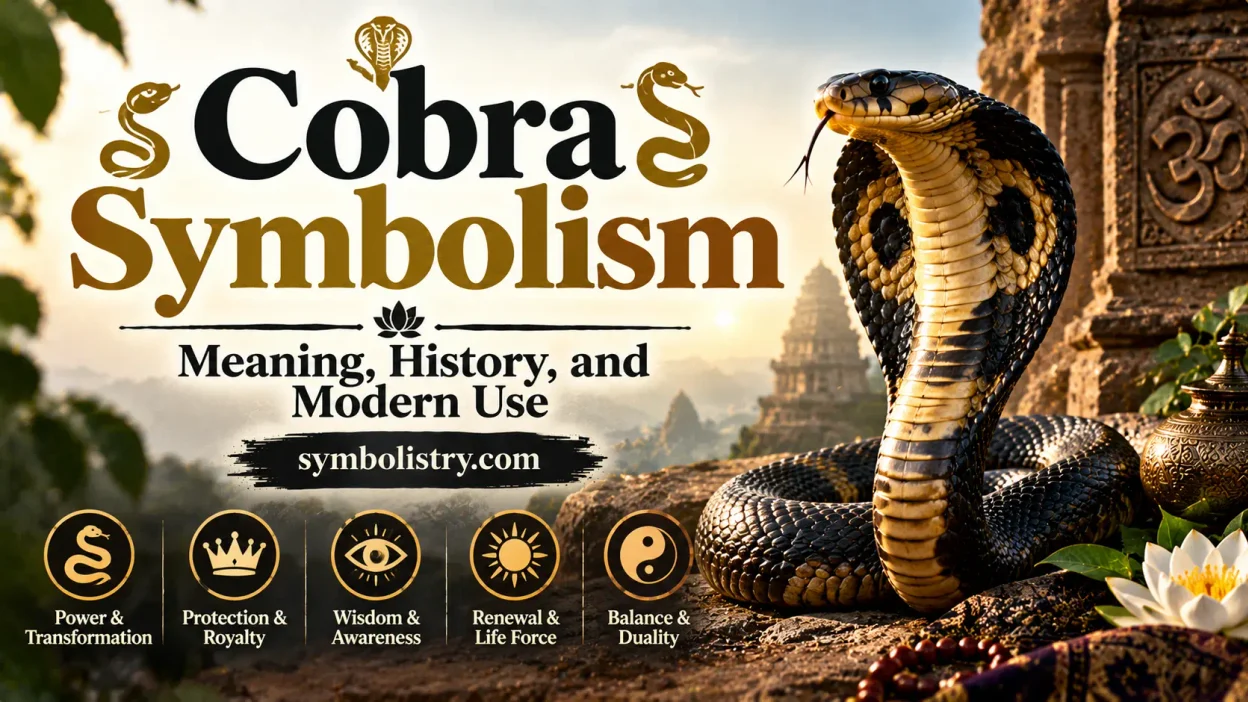
The cobra is one of the most recognizable snake forms in human culture, identified by the raised body and expanded hood that make the animal appear larger and more imposing. Cobra symbolism often centers on protection, danger, authority, vigilance, and controlled power, but its meaning changes considerably depending on the culture and setting.
For many Americans, the cobra carries an immediate visual message: warning, strength, independence, or the ability to defend oneself. It appears in tattoos, logos, clothing, entertainment, artwork, and military-inspired imagery. At the same time, the cobra has much older associations that have little to do with modern American ideas of toughness.
Ancient Egyptian rulers used the rearing cobra as a sign of royal protection, while South Asian traditions connected cobra and serpent figures with water, fertility, divine beings, and religious protection. These older meanings help explain why the cobra can represent both danger and guardianship rather than simply evil or aggression.
Quick Answer
Cobra symbolism commonly represents protection, vigilance, danger, authority, and self-defense in modern American culture, especially in tattoos, logos, and bold visual design. Historically, cobras also represented royal power and divine protection in ancient Egypt and sacred serpent beings associated with water, fertility, and protection in South Asian traditions.
TL;DR
- Cobras commonly symbolize protection, danger, vigilance, and authority.
- Ancient Egyptians associated the rearing cobra with kingship and protection.
- South Asian traditions often connect cobras with sacred serpent beings and water.
- American popular culture frequently uses cobras to signal toughness and defiance.
- Cobra tattoos can represent defense, transformation, independence, or personal strength.
- Modern interpretations depend heavily on design, context, and cultural background.
What a Cobra Symbol Actually Represents
A cobra is not simply a generic snake with a different appearance. Its distinctive hood gives it a visual language of confrontation and defense.
When threatened, many cobras raise the front of the body and spread the neck ribs into a hood. The posture makes the snake appear larger and communicates a warning before an actual strike. The Smithsonian’s National Zoo notes that king cobras can raise a substantial portion of their bodies while displaying the hood when threatened.
That behavior helps explain several common symbolic associations:
- Protection: the cobra warns an approaching threat away.
- Vigilance: its raised posture suggests readiness.
- Danger: venom gives the image a serious warning quality.
- Authority: an upright, imposing cobra can communicate dominance.
- Self-defense: the snake does not need to attack to establish a boundary.
- Transformation: as a snake, the cobra can participate in broader serpent imagery involving renewal and change.
The meaning is therefore often about controlled danger rather than uncontrolled violence. The cobra’s visual message is frequently, “Do not cross this boundary.”
Ancient Egyptian Roots of Cobra Symbolism
Some of the oldest and clearest cobra symbolism comes from ancient Egypt.
The rearing cobra was known as the uraeus, a royal and protective emblem frequently placed on the forehead of a pharaoh’s headdress. Egyptian art connected the uraeus with Wadjet, an ancient goddess associated with Lower Egypt and royal protection.
The cobra’s threatening posture was central to this imagery. Rather than portraying the snake merely as a dangerous animal, Egyptian artists transformed its defensive behavior into a supernatural protective function. The uraeus was imagined as capable of attacking enemies of the king, sometimes represented as spitting fire or venom.
This explains an important historical distinction: the cobra was not inherently a symbol of evil in ancient Egyptian royal imagery. Its danger was useful. A creature capable of destroying an enemy could also serve as the guardian of a ruler.
Archaeological objects show the cobra appearing on royal crowns, forehead ornaments, shrines, amulets, architectural decoration, and other objects associated with protection and authority. The Met also records uraeus imagery in funerary contexts, showing that the symbol was not restricted to a single object or period.
The Cobra as a Sign of Royal Authority
The cobra’s connection with Egyptian kingship developed into a visual shorthand for legitimate authority.
A pharaoh wearing a uraeus was not simply being portrayed with a snake on his forehead. The cobra communicated status, protection, and the supernatural authority associated with kingship. The image effectively placed a guardian at the ruler’s most visible point of vulnerability.
Some Egyptian objects even place multiple uraei around royal names, extending the protective role from the individual ruler to his identity and royal status.
This historical background gives cobra imagery a meaning that differs from a simple “dangerous animal” interpretation. In its Egyptian context, danger was transformed into defensive authority.
That distinction still matters when interpreting modern cobra artwork. A cobra design may suggest power without necessarily celebrating aggression.
Cobra and Serpent Traditions in South Asia
South Asian traditions provide another major layer of cobra symbolism.
The Sanskrit term naga refers to serpent beings that appear in Hindu, Buddhist, and Jain traditions. They are often represented with cobra hoods and may appear as human-serpent figures or supernatural snakes. The British Museum notes that naga figures have been associated with protection and sacred spaces, while the Met describes nagas as connected with water, agricultural abundance, and natural forces.
This creates a more complicated picture than the common Western assumption that snakes necessarily symbolize evil.
Nagas could be protective and life-giving, yet they could also be dangerous. Their relationship with water is especially important because water brings fertility and agricultural abundance but can also bring floods and destruction. The cobra therefore becomes an appropriate image for a force that must be respected rather than simply conquered.
In Hindu imagery, cobras are also associated with Shiva. Museum examples depict Shiva with a naga, reinforcing associations between the deity and serpent imagery.
These traditions show why cobra symbolism can contain apparently opposite ideas: danger and protection, destruction and fertility, fear and reverence.
What Cobra Symbolism Means in the United States
In the United States, the cobra does not have one universally agreed symbolic meaning. Its interpretation usually comes from visual context.
A cobra used in a tattoo may suggest personal toughness or self-defense. A cobra on a clothing design may communicate rebellion or an intimidating aesthetic. A stylized cobra in a logo may be intended to make a brand appear alert, formidable, fast, or difficult to challenge.
American interpretations are also shaped by broader Western associations with snakes. Biblical and European traditions have contributed to the tendency to view snakes negatively in some contexts, although those associations should not be treated as the universal meaning of every snake or cobra image.
The American meaning is therefore often a mixture of animal behavior, popular culture, historical imagery, and personal interpretation.
Protection, Warning, and Personal Boundaries
One of the most useful ways to understand the cobra is through the idea of a warning.
A cobra’s hood is visually defensive. It announces that approaching further could have consequences. That makes the animal an effective symbol for someone who wants an image of boundaries without necessarily depicting an attack.
A cobra tattoo, for example, can communicate:
- “I protect myself.”
- “I am alert to danger.”
- “I have boundaries.”
- “I can defend myself when necessary.”
- “I should not be underestimated.”
These meanings are personal rather than universal. The same cobra can communicate something very different when combined with a skull, flower, crown, dagger, religious symbol, or another animal.
Cobra Symbolism and Authority
The cobra’s upright posture naturally lends itself to ideas of authority.
Its hood creates a distinctive silhouette, and its position above the ground makes the animal appear larger than it actually is. In ancient Egypt, this visual quality became part of royal imagery. In modern design, the same visual features can create an impression of confidence and command.
This is particularly useful in logos and graphic design. A cobra facing forward can look confrontational. A coiled cobra can suggest readiness. A cobra surrounding another symbol can suggest guardianship.
The difference is subtle but important: authority is not necessarily the same thing as aggression.
A cobra can represent the capacity to act rather than a desire to attack.
Cobra Symbolism in Tattoos
Cobra tattoos are especially open to individual interpretation.
Some people choose the image because they admire snakes. Others use it to express independence, resilience, danger, transformation, or personal boundaries. The design itself often changes the message.
| Tattoo or Design Context | Common Meaning in the USA | Common Associations | Notes |
|---|---|---|---|
| Hooded cobra facing forward | Defense and intimidation | Strength, warning | Emphasizes confrontation |
| Coiled cobra | Readiness and vigilance | Protection, patience | Suggests controlled action |
| Cobra with a crown | Authority and status | Leadership, royalty | Can echo Egyptian imagery |
| Cobra with flowers | Contrast and balance | Beauty, danger, renewal | Meaning depends on flowers |
| Cobra with skull imagery | Mortality and danger | Death, risk, fear | Often a darker aesthetic |
Tattoo symbolism should not be treated like a dictionary. The person’s reason for choosing the image is usually more important than any generalized interpretation.
Cobra Symbolism in Jewelry and Fashion
In jewelry, the cobra can become less threatening and more decorative.
A curved cobra may form the outline of a bracelet, necklace, ring, or pendant. Gold and jeweled versions can emphasize luxury and authority, while dark metal designs tend to create a more aggressive or gothic appearance.
The ancient Egyptian connection also makes the cobra particularly suited to jewelry inspired by pharaonic imagery. Historically, uraeus forms were used in precious materials and personal ornaments, including pendants and amulets.
In contemporary fashion, however, a cobra does not automatically indicate an Egyptian reference. Sometimes it is simply chosen because the hooded snake has a recognizable and dramatic silhouette.
Cobra Symbolism in Popular Culture
American entertainment has helped make snake imagery familiar to audiences who may have no connection to its older religious or historical meanings.
The cobra often appears in stories involving martial arts, crime, danger, villains, rebellion, survival, or competition. Such uses reinforce associations with intimidation and toughness.
This can create a feedback loop: popular culture repeatedly presents cobras as dangerous, and audiences then bring those expectations to unrelated designs.
That is why context matters. A cobra appearing in a historical Egyptian artwork should not be interpreted using the same framework as a cobra appearing on a sports logo or fictional villain.
Emotional and Psychological Associations
The cobra can evoke strong feelings because its physical characteristics are easy to recognize.
A hooded cobra may produce:
- caution
- fear
- respect
- curiosity
- alertness
- fascination
- confidence
- tension
These reactions are not purely symbolic. They are also connected to the animal’s real defensive display and reputation as a venomous snake.
For some people, the cobra represents an emotion they want to communicate publicly: confidence under pressure, independence, or readiness to defend themselves.
For others, the same image represents something they want to avoid, such as betrayal or danger.
The important point is that symbolism does not operate independently of personal experience.
Positive and Negative Meanings of the Cobra
Cobra symbolism contains both positive and negative associations.
Positive interpretations often include:
- protection
- courage
- authority
- vigilance
- independence
- resilience
- self-defense
Negative interpretations can include:
- danger
- intimidation
- aggression
- fear
- deception
- death
- threat
Neither list is universally correct. Historical context can reverse an apparent meaning. Ancient Egyptian royal imagery, for example, used a dangerous cobra as a guardian rather than as a representation of moral evil.
This duality is one of the defining features of cobra imagery: the same danger that creates fear can also create a sense of security when the cobra is positioned as a protector.
Common Misunderstandings About Cobra Symbolism
One common mistake is assuming that every cobra represents evil.
That interpretation overlooks major traditions in which serpents serve protective, sacred, royal, or life-associated roles. Ancient Egyptian uraeus imagery is a clear example, while naga traditions in South Asia provide another.
Another mistake is treating all snakes as symbolically interchangeable. A cobra’s hood, upright defensive posture, and venomous reputation give it a different visual vocabulary from a rattlesnake, python, or boa.
It is also important not to confuse the king cobra with every other cobra. The king cobra is a distinct species found across parts of Asia, and the Smithsonian notes that despite its dangerous reputation, it generally prefers to escape and often bites defensively when cornered or protecting its eggs.
Symbolic interpretation becomes more accurate when the actual animal and cultural context are considered.
How Cobra Meaning Has Changed Over Time
The cobra has moved through several major symbolic frameworks.
In ancient Egypt, its imagery was closely tied to divine and royal protection. In South Asian traditions, serpent beings developed associations with water, fertility, sacred places, and religious narratives. In modern American culture, the cobra is more commonly encountered through entertainment, fashion, tattoos, logos, and graphic design.
The underlying idea of danger has remained remarkably useful, but its interpretation has changed.
A threatening animal can represent fear in one setting, protection in another, and personal independence in a third. Modern designers frequently rely on the cobra’s silhouette without intending to reproduce any specific ancient tradition.
That separation between historical symbolism and modern visual shorthand is important. A contemporary cobra image may borrow the appearance of an ancient emblem without carrying its original religious meaning.
Cobra Symbolism in Modern American Design
Today, the cobra works particularly well as a graphic symbol because it remains recognizable even when heavily stylized.
Designers can reduce the animal to a hood, eyes, curved body, or fangs and still communicate the basic idea. This makes the cobra useful for logos, apparel, posters, album artwork, gaming imagery, tattoos, and digital graphics.
A forward-facing cobra tends to feel more confrontational. A side profile can feel more elegant. A coiled snake can suggest patience or readiness. A cobra surrounding another object can suggest protection.
Color also changes the impression. Black may emphasize menace or sophistication, gold can connect the image with luxury or royalty, and bright colors can move it toward contemporary pop design.
Why the Cobra Remains a Strong Symbol
The cobra continues to work as a symbol because its physical behavior already resembles a visual message.
The raised body says attention.
The expanded hood says warning.
The venom says consequence.
Its defensive behavior suggests boundaries.
Its historical use adds associations with authority and protection.
Different cultures have built different meanings around those characteristics, but the basic visual language remains understandable.
That is why a cobra can function equally well in an ancient royal emblem, a religious sculpture, a tattoo, or a modern graphic.
FAQ: Cobra Symbolism
What does a cobra symbolize spiritually?
Spiritual meanings vary by tradition. In ancient Egyptian religion, the rearing cobra was connected with divine and royal protection, while South Asian naga traditions associate serpent beings with sacred water, fertility, protection, and religious stories.
What does a cobra tattoo mean?
A cobra tattoo can represent self-defense, vigilance, independence, courage, danger, or personal boundaries. The surrounding imagery and the wearer’s own reason for choosing the design usually determine its most specific meaning.
Is a cobra a symbol of protection?
Yes, in several important historical traditions. Ancient Egyptian uraeus imagery specifically used the rearing cobra as a protective emblem for kings and gods, while naga imagery has also been associated with protection of sacred spaces.
Is cobra symbolism positive or negative?
It can be either. The cobra may represent protection, authority, and vigilance, but it can also symbolize danger, fear, intimidation, or death depending on the context.
What does a cobra symbolize in ancient Egypt?
The rearing cobra, or uraeus, was strongly associated with royal authority and protection. It represented Wadjet and appeared on royal headdresses and other objects connected with kingship and divine protection.
What does a cobra symbolize in Hindu traditions?
Cobra and naga imagery can carry several meanings, including sacred protection, water, fertility, and supernatural power. Cobras are also associated with deities such as Shiva in Hindu visual traditions.
Does a cobra always symbolize danger?
No. Its venomous nature makes danger an important association, but historical examples show that danger can be transformed into an image of guardianship, authority, or sacred protection.
Conclusion
Cobra symbolism brings together two ideas that are often treated as opposites: danger and protection. The animal’s defensive posture naturally communicates warning and vigilance, while ancient traditions transformed that same threatening appearance into a symbol of royal authority, sacred protection, and supernatural guardianship.
In the United States today, the cobra is often used more personally. A tattoo, piece of jewelry, logo, or artwork may communicate independence, self-defense, toughness, authority, or simply an attraction to the snake’s distinctive appearance. Its meaning depends on the surrounding design and the person using it.
Understanding cobra symbolism therefore requires more than assigning one definition to the animal. The cobra has served as a guardian, a sacred serpent, a royal emblem, and a modern visual statement—and each use reveals something about the culture giving the image its meaning.