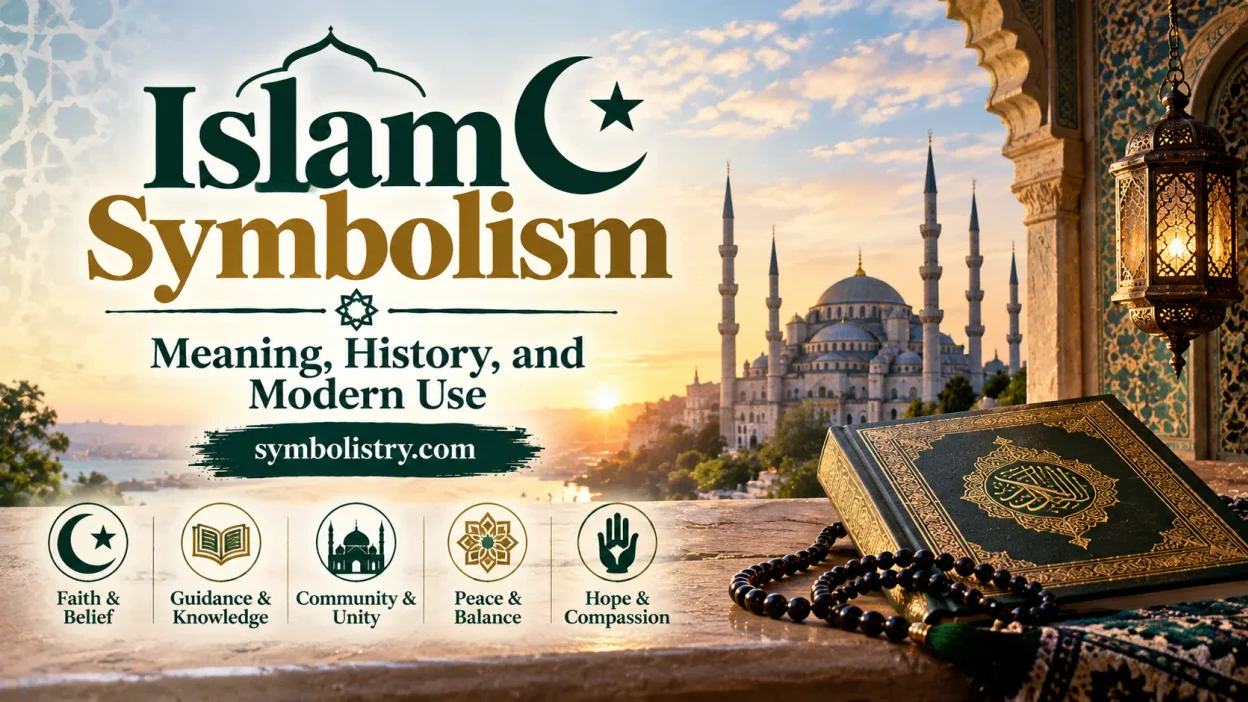
Islam symbolism encompasses a wide range of religious ideas, visual forms, colors, words, architectural features, and cultural traditions associated with Islam. Unlike some religions with a single universally recognized emblem, Islam has no one official symbol accepted by all Muslims. Instead, islam symbolism appears through the Qur’an, Arabic calligraphy, mosques, geometric patterns, the crescent and star, prayer practices, and other visual traditions.
This distinction matters because many symbols commonly identified as “Islamic” developed at different times and in different societies. Some are directly connected to Islamic belief, while others became associated with Muslim communities through history, art, architecture, or political identity.
In the United States, these symbols can carry several meanings at once. A crescent may identify a mosque or Muslim organization, Arabic calligraphy may express devotion or cultural heritage, and geometric designs may communicate an aesthetic connection to Islamic art. Understanding the difference between religious teaching and later cultural symbolism makes these traditions easier to interpret respectfully.
Quick Answer
Islam symbolism commonly represents faith in one God, devotion, community, moral guidance, and Muslim identity in modern American culture. Historically, these ideas have been expressed through Qur’anic calligraphy, mosque architecture, geometric ornament, and later symbols such as the crescent and star, whose widespread association with Islam developed after Islam’s earliest period.
TL;DR
- Islam has no single universally accepted religious symbol.
- Calligraphy gives visible form to Qur’anic and devotional language.
- Geometric art often emphasizes order, repetition, and unity.
- The crescent and star became associated with Islam relatively late.
- Muslim Americans use symbols for faith, heritage, identity, and community.
- Some symbols are cultural traditions rather than requirements of Islam.
Why Islam Does Not Have One Universal Symbol
One of the most important facts about Islamic symbolism is that Islam does not have an equivalent of a single universally required emblem.
The religion is centered on tawhid, the oneness of God. Islamic belief emphasizes worship of one God, known in Arabic as Allah, rather than devotion to physical representations of the divine. This theological foundation helps explain why Islamic visual culture developed differently from traditions in which sacred figures or icons became central religious images.
The absence of one official emblem has not prevented Muslims from developing recognizable visual traditions. Instead, Islamic identity has often been expressed through words, architecture, patterns, sacred spaces, and objects.
That distinction is especially important when interpreting the crescent and star. They are widely recognized today, but they are not foundational symbols prescribed by the Qur’an.
The Qur’an and the Symbolism of the Written Word
Arabic calligraphy occupies a special place in Islamic visual culture because written language can communicate religious meaning without depicting God or sacred figures.
Verses from the Qur’an, devotional phrases, and the shahada—the Islamic profession of faith—have appeared in manuscripts, architecture, textiles, ceramics, metalwork, and other objects. The Metropolitan Museum of Art describes calligraphy as one of the defining achievements of Islamic civilization, with examples spanning many centuries and regions.
This makes writing more than decoration.
A Qur’anic inscription can remind viewers of worship, ethical instruction, gratitude, remembrance of God, or particular religious teachings. The visual treatment can also communicate reverence. Elaborate scripts, gold illumination, carefully balanced compositions, and architectural placement have historically helped distinguish sacred writing from ordinary text.
For many Muslims, however, the meaning ultimately comes from the words themselves rather than the beauty of the lettering. A decorative Arabic phrase may look “Islamic” to an outside observer while having little religious significance if the viewer cannot read it.
The Shahada as a Statement of Faith
Among the most recognizable forms of Islamic religious expression is the shahada, the profession of faith affirming the oneness of God and Muhammad as God’s messenger.
Because it summarizes a central principle of Islamic belief, the shahada frequently appears in calligraphic art. It may be displayed in homes, mosques, manuscripts, educational settings, or personal objects.
Its symbolism is therefore more direct than that of many decorative motifs. It communicates religious identity through language.
The shahada also illustrates why Islamic symbolism cannot always be understood simply by looking at an image. A pattern, emblem, or script may have cultural associations, but the underlying words can carry a specific theological meaning that is invisible to someone unfamiliar with Arabic.
Ancient Roots and the Development of Islamic Art
Islamic visual culture developed after the emergence of Islam in seventh-century Arabia, but its artistic vocabulary did not appear from nowhere.
Muslim-ruled societies inherited and adapted artistic traditions from cultures including the Byzantine and Sasanian worlds. Geometric motifs, plant forms, architectural techniques, manuscript traditions, and decorative methods were transformed within new Islamic cultural settings.
The Metropolitan Museum of Art notes that geometric patterns associated with Islamic art draw on shapes and techniques that existed in late antiquity, while Islamic artists developed them into increasingly complex systems emphasizing repetition, symmetry, and ordered relationships.
This history is important because “Islamic art” does not describe a single ethnic or national style. Muslim societies extended across Spain and North Africa, the Middle East, Persia, Central Asia, South Asia, Southeast Asia, and other regions. Their artistic traditions differed considerably.
Islamic symbolism therefore reflects a large family of cultures rather than one visual language.
What Geometric Patterns Represent
Geometric patterns are among the most recognizable features of Islamic art.
Circles, squares, stars, polygons, interlocking lines, and repeating grids can be combined into highly intricate compositions. The resulting designs often appear on mosque walls, ceilings, tiles, manuscripts, carpets, screens, ceramics, and architectural surfaces.
It is tempting to assign a fixed spiritual meaning to every shape, but that can oversimplify Islamic art. Not every eight-pointed star, circle, or repeated pattern has a specific religious definition.
Instead, geometric ornament can communicate ideas through its overall visual structure: order, proportion, repetition, balance, continuity, and mathematical organization. The ability of patterns to extend beyond their visible boundaries can also create an impression of an arrangement that is not confined to a single frame.
The result is a visual language in which mathematics and decoration work together.
The Crescent and Star: Familiar but Not Foundational
The crescent and star is probably the image most Americans recognize as an “Islamic symbol.”
Yet its history is more complicated than that assumption suggests.
The crescent existed as a symbol in cultures before Islam, and its later association with Muslim societies was strongly influenced by political and imperial history. The Ottoman Empire became particularly important in establishing the crescent as a recognizable emblem connected with Muslim identity. Over time, the crescent and star appeared in flags, public buildings, organizations, and other contexts associated with Muslim-majority societies.
This does not mean the symbol is meaningless to Muslims today. It is widely recognizable and can function as a marker of Muslim identity, especially in public and cultural settings.
But it should not be presented as though Muhammad or the earliest Muslims established the crescent and star as Islam’s official religious emblem.
That distinction is one of the most common points of confusion surrounding Islamic symbolism.
Mosques as Symbols of Muslim Community
The mosque itself is one of the strongest symbols of Islam in everyday American life.
Architectural features vary widely, but domes, minarets, arches, prayer halls, mihrabs, calligraphy, and geometric ornament are frequently associated with mosque design.
A mosque symbolizes more than worship. It can represent community, education, charity, family life, social connection, and collective identity.
In the United States, mosques can also serve as important community institutions. A building may contain prayer spaces alongside classrooms, meeting areas, offices, dining facilities, or spaces for community events.
The visual presence of a mosque can therefore communicate both religious devotion and the existence of an organized Muslim community.
Colors and Their Islamic Associations
Colors are sometimes presented online as though each has a universally fixed Islamic meaning. The reality is more nuanced.
Green is particularly associated with Islam in many cultural contexts and has historical connections to Muslim rulers, flags, religious traditions, and popular representations of Islamic identity. White, black, and other colors also appear frequently in Islamic art, architecture, clothing, flags, and ceremonial contexts.
But there is no universal Islamic color code in which every color has one official theological definition.
A green dome, for example, can be culturally recognizable without every Muslim understanding green as a required symbol of faith. Color meanings also change according to geography, historical period, national identity, and individual interpretation.
Common Islamic Visual Symbols at a Glance
| Context | Meaning in the USA | Common Associations | Notes |
|---|---|---|---|
| Qur’anic calligraphy | Faith and religious devotion | Scripture, remembrance, worship | Meaning depends on the actual text |
| Crescent and star | Muslim identity | Mosques, flags, organizations | Historical association developed later |
| Geometric patterns | Islamic artistic heritage | Order, repetition, architecture | Not every pattern has a fixed religious meaning |
| Mosque architecture | Community and worship | Prayer, gathering, education | Styles differ across cultures |
| Shahada calligraphy | Profession of faith | Belief in one God and Muhammad’s prophethood | A direct religious statement |
Islam Symbolism in the United States
American interpretations of Islamic symbols are shaped by both religious understanding and the country’s diverse Muslim population.
Muslim Americans come from many ethnic, cultural, and national backgrounds. Islamic identity in the United States therefore cannot be reduced to one visual style.
A mosque in an American city may incorporate architectural elements inspired by South Asia, the Middle East, Africa, Turkey, Southeast Asia, or contemporary American design. A Muslim family’s home may contain Arabic calligraphy alongside modern American furnishings. A young Muslim American may use traditional symbols while expressing identity through contemporary fashion, graphic design, or social media.
The result is a distinctly American environment in which Islamic symbols can function simultaneously as religious markers and expressions of cultural heritage.
Public understanding has also been shaped by difficult historical circumstances. Pew Research Center reported in 2026 that the September 11 attacks continued to influence how some Americans view Muslims and Islam, while also describing Muslim Americans as an increasingly visible part of the country’s religious landscape.
That context helps explain why symbols can sometimes carry meanings beyond their religious origins. A crescent, hijab-related imagery, Arabic lettering, or mosque silhouette may communicate identity and belonging in addition to faith.
Emotional and Psychological Meaning
Islamic symbols can carry personal meanings that vary substantially from one individual to another.
For some people, Qur’anic calligraphy evokes prayer, family, religious education, or memories of home. For others, a mosque represents belonging and community. A familiar geometric pattern may evoke childhood, a cultural heritage, or a particular country.
For Muslim Americans, visible religious symbols can also communicate identity in environments where they may be part of a minority population.
At the same time, not every Muslim relates emotionally to the same symbols. Some people strongly value calligraphy and traditional architecture, while others express their faith primarily through behavior, prayer, family, community service, or personal practice.
Symbolism should therefore be understood as a possible expression of identity, not a substitute for knowing an individual’s beliefs.
Why Calligraphy Appears in Homes and Personal Objects
Islamic calligraphy has moved far beyond manuscripts and mosque interiors.
In contemporary homes, people may display framed Qur’anic verses, Arabic names, devotional phrases, or stylized calligraphic compositions. Jewelry can incorporate Arabic lettering or the names of God. Clothing and accessories sometimes use calligraphic motifs, while contemporary artists reinterpret traditional scripts in paintings and digital media.
The appeal is partly aesthetic, but the religious content can be equally important.
A calligraphic piece containing a Qur’anic verse may be treated with greater respect than ordinary wall art because the object carries sacred text. This is one reason that using Arabic simply because it “looks Islamic” can be culturally careless when the creator does not know what the words actually say.
Islamic Symbolism in Tattoos and Personal Style
Islamic imagery occasionally appears in tattoo culture, graphic design, jewelry, and fashion, particularly among people interested in Arabic calligraphy or Middle Eastern visual traditions.
However, tattoos have a complicated relationship with Islamic religious practice. Many Muslim scholars and communities consider permanent tattooing impermissible, based on interpretations of Islamic teachings and hadith. Muslims do not all approach religious practice identically, so personal choices vary.
For designers and non-Muslims, the more important point is that Arabic script should not be treated merely as decorative shapes. A tattoo or fashion design using Qur’anic text can involve religious content that the wearer or designer may not fully understand.
Non-sacred geometric patterns generally raise different questions because they can be cultural or artistic rather than explicitly devotional.
Cross-Cultural Interpretations of Islamic Symbols
Islamic symbolism changes noticeably across regions.
Persian traditions contributed distinctive approaches to manuscript illumination, poetry, architecture, and decorative arts. Ottoman culture developed its own calligraphic and architectural vocabulary. Mughal India produced elaborate combinations of geometry, vegetal ornament, calligraphy, stone carving, and architectural design. North African, Andalusian, Central Asian, and Southeast Asian Muslim communities developed further variations.
The diversity can be seen in surviving Islamic art collections. The Metropolitan Museum of Art’s Islamic art holdings range from the seventh through the twenty-first century and represent traditions extending from Spain and Morocco to Central Asia and Indonesia.
This diversity prevents a single symbol from having exactly the same cultural meaning everywhere.
The crescent may carry national associations in one country, religious associations in another, and primarily decorative associations somewhere else.
Common Misunderstandings About Islamic Symbols
One frequent misunderstanding is that the crescent and star is the original symbol of Islam. It is better understood as a later emblem that became strongly associated with Muslim societies, particularly through political and cultural history.
Another misconception is that every geometric Islamic pattern has a secret religious meaning. Many patterns are better understood as sophisticated artistic systems involving symmetry, repetition, proportion, and ornament.
A third misunderstanding concerns figurative art. Islamic cultures have never followed one completely uniform rule about images of people and animals. Religious settings often developed strong preferences for nonfigural decoration, while illustrated manuscripts and secular objects demonstrate considerable variation across periods and regions. The Met notes that Islamic art includes calligraphy, vegetal forms, geometric designs, and figural representation, with practices differing according to context.
Finally, it is misleading to treat “Islamic” as synonymous with “Arab.” Islam originated in Arabia, but Muslim communities have existed across an enormous geographical and cultural range for centuries.
How Islamic Symbolism Has Changed in the Digital Age
Digital culture has made Islamic visual language more accessible than ever.
Arabic calligraphy, mosque silhouettes, crescent imagery, geometric backgrounds, Ramadan graphics, and Qur’anic quotations are widely used in digital greetings and social media posts. During Ramadan and Eid, these elements frequently appear in invitations, advertisements, educational materials, nonprofit campaigns, and personal posts.
Digital design also creates new challenges.
A sacred phrase can be copied into a graphic without context, translated inaccurately, or used alongside unrelated decorative elements. At the same time, digital artists have created sophisticated new forms of Islamic typography that combine traditional scripts with contemporary visual design.
This is part of a broader evolution: Islamic symbolism is no longer confined to manuscripts, mosques, textiles, and physical objects. It now exists in interfaces, logos, illustrations, animations, and online communities.
When Islamic Symbols Are Misused
Islamic symbols can be misunderstood or deliberately used in ways that have little connection to their religious meaning.
One example is the use of Arabic writing as visual decoration without understanding the text. Another is treating every crescent, star, or geometric pattern as interchangeable with Islam itself.
Commercial use can also create tension when sacred language is placed on products without considering religious sensitivities.
There is an important difference between cultural borrowing and intentional hostility, however. A designer unfamiliar with Islamic traditions may make an innocent mistake, while another person may deliberately distort a religious symbol. The appropriate interpretation depends on context.
Respect generally begins with learning what an image actually represents before using it.
What Islamic Symbols Mean Today
Modern Islamic symbolism combines religious belief, cultural memory, artistic tradition, and personal identity.
For one person, calligraphy may primarily mean devotion. For another, it may represent family heritage. A mosque can symbolize prayer, community, or belonging. A geometric pattern can be appreciated for its mathematical beauty without carrying a specific theological message.
This flexibility is not a contradiction. Religious symbols often gain additional cultural meanings as they move between generations, countries, artistic traditions, and social settings.
In the United States, that process is especially visible because Muslim communities include people with roots in many parts of the world. Islamic visual culture has therefore become part of America’s broader religious and cultural landscape while retaining connections to older traditions.
Frequently Asked Questions
What is the main symbol of Islam?
Islam does not have one universally required official symbol. The crescent and star is widely recognized today, but Qur’anic calligraphy, the shahada, mosque architecture, and other visual traditions can have more direct connections to Islamic belief.
What does the crescent and star mean in Islam?
The crescent and star commonly represents Muslim identity in modern public culture, but it is not a symbol prescribed by the Qur’an. Its association with Islam developed through later historical and political traditions, including the Ottoman world.
Why is Arabic calligraphy important in Islam?
Arabic calligraphy became especially important because the Qur’an was revealed in Arabic and written language provided a way to present sacred text visually. Calligraphy consequently became one of the central artistic traditions of many Muslim societies.
What do geometric Islamic patterns symbolize?
Geometric patterns can suggest order, balance, repetition, continuity, and mathematical organization, but individual shapes do not necessarily have fixed religious meanings. Their significance often comes from the structure of the complete design rather than from one isolated symbol.
Is green an official Islamic color?
Green has strong cultural associations with Islam in many societies, but Islam does not establish a universal official color system. Its meaning varies according to historical, national, and cultural context.
Do all Muslims use the same symbols?
No. Muslim communities differ across regions, cultures, schools of thought, and personal practice. A symbol that is especially prominent in one Muslim society may be less important or even unfamiliar in another.
Can Islamic symbols be used in modern design?
Yes, but context matters. Designers should understand the meaning of Arabic text, Qur’anic passages, religious phrases, and sacred imagery before incorporating them into fashion, advertising, artwork, or commercial products.
Conclusion
Islamic symbolism is less a single collection of official emblems than a broad visual language shaped by faith, writing, architecture, mathematics, history, and cultural identity. The crescent and star may be the most recognizable modern image, but it is only one part of a much larger tradition that includes Qur’anic calligraphy, geometric ornament, mosque architecture, and devotional expression.
In the United States, islam symbolism can communicate religious commitment, cultural heritage, community belonging, or personal identity depending on the person and setting. Its history also shows why familiar images should not automatically be treated as universal religious rules.
The most accurate way to understand Islamic symbols is to look beyond the image itself and ask what tradition produced it, what text or practice it represents, and how the people using it understand its meaning.