
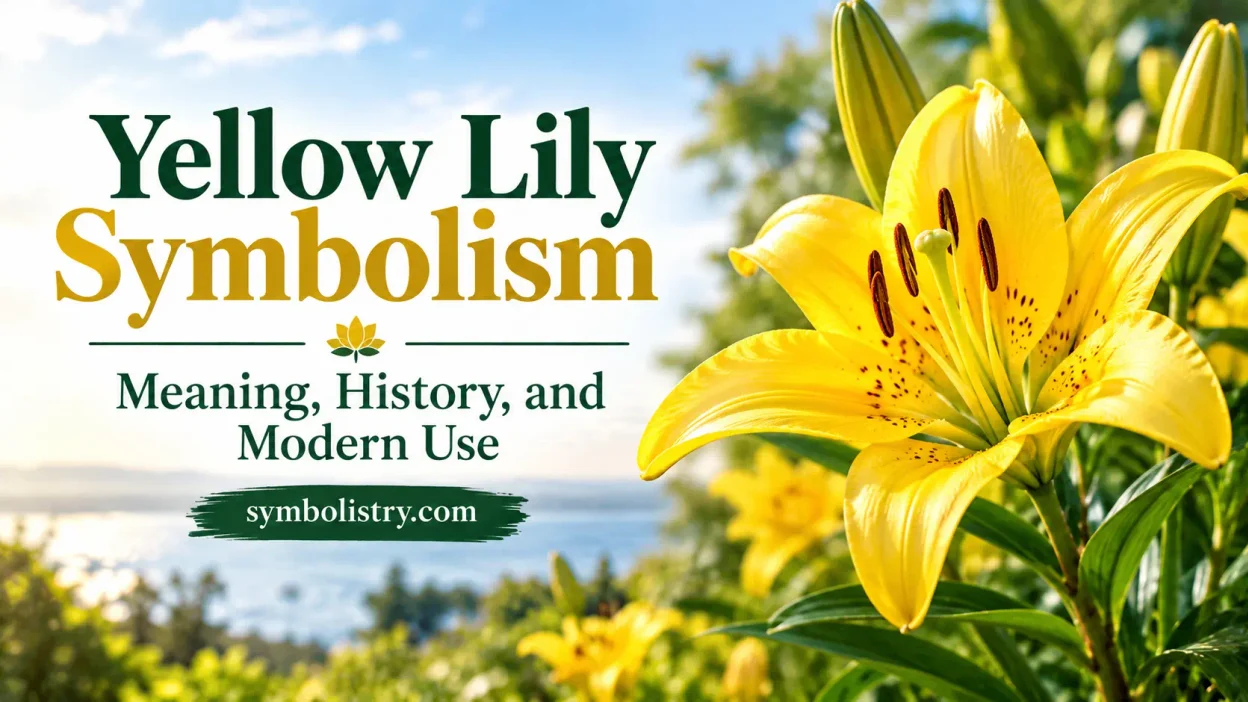
A yellow lily combines two layers of visual meaning: the traditional symbolism of the lily and the emotional associations attached to the color yellow. The result is a flower commonly connected with joy, gaiety, warmth, and positive feeling, although older flower-language traditions also gave yellow lilies a less flattering meaning: falsehood.
That contrast makes yellow lilies especially interesting. The lily has long appeared in religious art, literature, gardens, and ceremonial settings, while yellow has often been associated with sunlight, brightness, celebration, and sociability. Yet symbolic meanings are not fixed rules. They change according to culture, historical period, flower variety, and the situation in which the flower appears.
For Americans today, a yellow lily is generally more likely to be understood as a cheerful or appreciative flower than as a coded accusation of dishonesty. Its historical associations still matter, however, particularly when interpreting Victorian flower dictionaries, older literature, or symbolic artwork.
Quick Answer
Yellow lily symbolism commonly represents joy, gaiety, friendship, gratitude, and cheerful affection in modern American flower culture. Historically, Victorian flower-language traditions also associated the yellow lily with falsehood and gaiety, giving the flower a more complicated symbolic history.
TL;DR
- Yellow lilies commonly suggest joy, warmth, gratitude, and friendship.
- Victorian flower dictionaries sometimes linked yellow lilies with falsehood.
- Lily symbolism has strong roots in European religious art.
- Yellow changes the lily’s traditional association with purity.
- Modern Americans usually read yellow lilies as cheerful and celebratory.
- Context matters more than any single fixed flower meaning.
What a Yellow Lily Looks Like and Why Color Matters
The term “yellow lily” can describe several flowering plants and cultivated lily varieties with yellow or golden blooms. True lilies belong to the genus Lilium, although everyday flower language has historically used “lily” for unrelated plants as well.
The flowers are often trumpet-shaped, star-shaped, or recurved, depending on the variety. Their yellow coloring can range from pale lemon and cream-yellow to rich gold or yellow-orange.
That color is important to the symbolism. A lily without a color designation carries one set of cultural associations, while a yellow lily introduces another. White lilies, for example, became strongly associated with purity in Christian European art. Yellow shifts the emotional impression toward brightness, sociability, happiness, and—in some older traditions—ambiguity or deception.
This is why interpreting a flower by species alone can be misleading. Color is part of the symbolic vocabulary.
What Yellow Lilies Commonly Mean in the United States
In contemporary American flower culture, yellow lilies are most naturally associated with happiness, appreciation, friendship, encouragement, and celebration.
They can work particularly well when the sender wants to communicate affection without making the gesture strongly romantic. A bouquet of yellow lilies may feel appropriate for a birthday, congratulations, a thank-you, a housewarming, or a gesture intended to brighten someone’s day.
The meaning is partly practical. Yellow is visually bright and highly noticeable, while lilies have large, distinctive blooms. Together they create an impression of abundance and cheerfulness.
Modern interpretation therefore tends to emphasize what the flower looks like and how it is used rather than treating an old flower dictionary as a universal code.
A yellow lily in a contemporary American florist’s arrangement is unlikely to be interpreted automatically as “falsehood.” Most recipients will see the color first and understand the flower through the surrounding occasion.
The Lily’s Older Symbolism Before Yellow Became the Focus
The lily has a much longer symbolic history than the modern language of flower colors.
In European religious art, the white lily became particularly associated with the Virgin Mary, purity, chastity, and innocence. Medieval artists frequently used botanical imagery as a visual shorthand for moral and religious ideas. The Metropolitan Museum of Art notes that the white lily became an important Marian symbol, particularly through Christian interpretations of biblical and theological imagery.
That tradition matters when interpreting yellow lilies because it establishes a symbolic baseline: the lily itself was not inherently associated with deception or frivolity.
The color could modify the message.
Yellow lilies consequently occupy an interesting position in symbolic history. They retain the visual dignity of the lily while departing from the white flower’s strongest associations with purity.
Ancient and Classical Connections to Lily Imagery
Lily-like flowers appear in ancient art and mythology, although caution is necessary because ancient writers and artists did not always distinguish plants according to modern botanical classifications.
The ancient Greeks associated lilies with Hera in later mythological traditions, and lilies became connected with divine beauty and fertility in classical storytelling. In ancient Egypt, water lilies—botanically distinct from true lilies—had an especially important symbolic role.
The Metropolitan Museum of Art documents the significance of the water lily, or lotus, in ancient Egyptian art. Because the flower opened with the morning and closed at night, it became associated with creation, renewal, and rebirth.
This distinction is important: the ancient Egyptian symbolism of the water lily should not simply be transferred to a modern yellow garden lily. Similar names do not mean identical cultural histories.
Still, these traditions demonstrate why lilies and lily-like flowers acquired such strong symbolic associations across different civilizations.
How Christian Art Changed the Lily’s Meaning
Christian art gave the lily one of its most recognizable Western meanings.
The white Madonna lily became closely associated with the Virgin Mary, purity, chastity, and sacred innocence. Medieval artworks frequently placed lilies beside Mary or incorporated them into scenes of the Annunciation and Paradise.
The important point for yellow lily symbolism is that color created a contrast.
White could communicate moral purity and sacred innocence. Yellow, by comparison, had a broader and less stable emotional vocabulary. In later European flower symbolism, yellow could be cheerful but could also be associated with jealousy, suspicion, or other negative ideas depending on the flower and the dictionary.
The result was not a single universal rule. Rather, different symbolic systems assigned different meanings to different colors and flowers.
Victorian Floriography and the Meaning of Falsehood
One of the most frequently repeated historical meanings of the yellow lily is falsehood.
This comes from the Victorian-era tradition known as floriography, or the language of flowers. During the nineteenth century, flower dictionaries and sentimental floral books presented flowers as carriers of coded emotional messages. These books were especially popular in Britain and the United States.
Kate Greenaway’s The Language of Flowers, one of the best-known examples of the genre, lists the yellow lily as meaning “Falsehood” and “Gaiety.”
A California State University, Northridge library resource also documents the role of nineteenth-century American flower books in constructing this symbolic language and shows the yellow lily appearing in a nineteenth-century floral message.
The apparent contradiction is revealing. How could the same flower represent gaiety and falsehood?
Victorian flower dictionaries were not standardized scientific systems. Different books could assign different meanings, and flowers could carry several associations at once. Symbolic interpretation depended on the author, cultural setting, and combination of flowers.
So “yellow lily means falsehood” is historically documented, but it should not be presented as an eternal or universally accepted definition.
Why Yellow Could Suggest Both Cheerfulness and Deception
Yellow’s symbolic history helps explain the contradiction.
Bright yellow naturally evokes sunlight, warmth, gold, ripeness, and celebration. Those associations make gaiety an understandable interpretation.
At the same time, older Western symbolic traditions sometimes gave yellow less positive meanings, including jealousy, instability, or insincerity. When combined with the formal symbolism of the Victorian flower dictionary, yellow could therefore become a visual suggestion of behavior that looked cheerful on the surface but was not necessarily sincere underneath.
The yellow lily’s historical pairing of gaiety and falsehood captures that tension.
It should be treated as a historical example of symbolic thinking rather than as a psychological fact about yellow flowers or the people who give them.
Yellow Lily Symbolism in Modern American Culture
The contemporary United States does not generally use flowers as a standardized secret language.
People still associate flowers with particular emotions, but those meanings are usually informal. The occasion, relationship, color, and personal preference matter more than an entry in an old floral dictionary.
For yellow lilies, the modern interpretation is therefore usually positive.
| Context | Meaning in the USA | Common Associations | Notes |
|---|---|---|---|
| Friendship | Warm appreciation | Joy, companionship | Usually non-romantic |
| Thank-you gift | Gratitude | Appreciation, generosity | Especially suitable for cheerful occasions |
| Birthday | Celebration | Happiness, optimism | Bright color suits festive arrangements |
| Get-well gesture | Encouragement | Warmth, positive feeling | Often chosen to brighten a room |
| Home décor | Cheerfulness | Sunshine, freshness | Symbolism is often secondary to aesthetics |
This modern usage represents a shift away from the coded Victorian system. Someone buying yellow lilies today is generally choosing them because they look bright, welcoming, and celebratory—not because they intend to communicate “falsehood.”
Yellow Lilies and Emotional Meaning
The emotional symbolism of a yellow lily is largely created by the combination of color, form, and context.
Yellow tends to attract attention and create a visually sunny impression. The large scale of many lily flowers adds formality and presence. The combination can communicate something more substantial than a casual yellow flower while remaining lighter than a solemn white arrangement.
That makes yellow lilies useful for emotions such as:
- appreciation
- encouragement
- happiness
- friendship
- gratitude
- optimism
- celebration
- affectionate support
They can also communicate emotional warmth without necessarily implying romantic love.
For this reason, yellow lilies can fit relationships that would make a romantic red flower inappropriate: friendships, family relationships, professional appreciation, or community celebrations.
Yellow Lilies in Weddings, Celebrations, and Décor
Yellow lilies can contribute a distinctly cheerful quality to weddings and other celebrations.
In a wedding arrangement, their meaning is usually created by the broader floral design rather than by an inherited Victorian definition. Combined with white flowers, greenery, or softer colors, yellow lilies can suggest optimism and a joyful beginning.
They are also effective in home décor because their color catches natural light. A vase of yellow lilies can make a room feel more open and lively, especially during spring and summer.
For Americans using flowers primarily as decoration, this visual function may be more important than historical symbolism.
That distinction is useful: a flower can have a historical meaning without that meaning controlling its modern use.
Yellow Lily Symbolism in Tattoos and Personal Style
A yellow lily tattoo can carry more individualized meaning than a bouquet.
Someone might choose a yellow lily to represent happiness after a difficult period, gratitude toward a loved one, friendship, a fresh beginning, or simply an appreciation for the flower itself.
The design can also change the message. A realistic botanical tattoo emphasizes the flower’s physical identity, while an abstract or highly stylized lily may function primarily as an aesthetic symbol.
Someone interested in historical floriography could intentionally use the older meaning of falsehood. In that case, the historical association becomes part of the tattoo’s personal story rather than a universally recognized message.
This is an important difference between cultural symbolism and personal symbolism. A person can deliberately give a familiar image a private meaning.
Yellow Lily Symbolism Across Cultures
Yellow lilies do not have one global meaning.
In Chinese art, yellow lily imagery has a documented artistic history. The Metropolitan Museum of Art holds an eighteenth-century Chinese painting manual image titled Yellow Lily (Hemereallis), demonstrating that yellow lily imagery was part of established Chinese botanical-art traditions.
Elsewhere, yellow flowers can carry meanings connected with prosperity, celebration, friendship, or happiness. But these associations should not be automatically generalized across every country or tradition.
The same caution applies to claims that yellow lilies universally mean betrayal, lies, jealousy, or romance.
Flower symbolism is culturally constructed. A meaning documented in a Victorian British or American flower dictionary does not automatically describe the meaning of the same flower in contemporary China, Japan, Vietnam, or the United States.
Common Misunderstandings About Yellow Lily Symbolism
The biggest misunderstanding is treating flower symbolism like a dictionary with one permanent answer.
It is tempting to say, “Yellow lilies mean falsehood,” because that statement appears in historic flower-language sources. But the historical record is more complicated. Victorian floral dictionaries offered multiple meanings, and different books did not always agree.
Another misconception is that every “lily” shares the same history. Water lilies, lily of the valley, daylilies, irises sometimes called lilies, and true lilies belong to different botanical categories.
The fleur-de-lis provides an especially useful example. Although its name suggests a lily, the stylized heraldic flower may have developed from or resembled the yellow flag iris rather than a true lily. The Metropolitan Museum of Art discusses this long-standing identification debate.
Finally, modern flower gifting should not be interpreted exclusively through Victorian symbolism. A yellow lily bouquet given today is usually understood through its occasion and the relationship between the giver and recipient.
How the Meaning of Yellow Lilies Has Changed
The evolution can be summarized as a movement from coded symbolism toward flexible personal expression.
In medieval Christian art, the lily’s strongest Western associations centered on purity and religious devotion, particularly through the white Madonna lily.
During the nineteenth century, flower dictionaries transformed individual flowers and colors into a more elaborate vocabulary of interpersonal messages. In this environment, yellow lilies could represent both gaiety and falsehood.
In contemporary American culture, that formal code has largely faded. Yellow lilies are more likely to communicate happiness, appreciation, friendliness, and celebration.
The historical meaning has not disappeared, but it has become one possible interpretation rather than the default interpretation.
FAQ
What do yellow lilies symbolize?
Yellow lilies commonly symbolize joy, happiness, friendship, gratitude, appreciation, and encouragement in modern American floral culture. Historic Victorian flower dictionaries also associated them with gaiety and falsehood.
Are yellow lilies a good choice for a friend?
Yes. Their bright color and non-romantic associations make them suitable for friendship, appreciation, congratulations, and encouragement. The exact message depends on the occasion and the rest of the arrangement.
Do yellow lilies symbolize falsehood?
Historically, yes. Several nineteenth-century flower-language sources assigned yellow lilies the meaning of “falsehood,” sometimes alongside “gaiety,” but this is not their dominant modern American interpretation.
Are yellow lilies associated with Christianity?
The lily has strong Christian symbolism, especially the white lily’s association with the Virgin Mary and purity. That symbolism should not automatically be transferred to yellow lilies, whose color developed different associations in later flower-language traditions.
What does a yellow lily tattoo mean?
A yellow lily tattoo can represent happiness, gratitude, friendship, encouragement, or a new beginning. Someone interested in historical symbolism might also use it to reference the older Victorian association with falsehood or gaiety.
Are yellow lilies romantic?
They can express affection, but they are generally less strongly romantic than red roses or traditionally romantic-colored flowers. In the United States, yellow lilies more often communicate warmth, friendship, celebration, and appreciation.
Why do yellow lilies have both positive and negative meanings?
Their mixed symbolism comes partly from the nineteenth-century language of flowers, where yellow lilies were associated with both gaiety and falsehood. Flower symbolism was never completely standardized, so contradictory meanings could coexist in different books and traditions.
Conclusion
Yellow lilies carry a more complicated history than their cheerful appearance might suggest. In modern American culture, they most often communicate joy, gratitude, friendship, encouragement, and celebration, while older Victorian traditions connected them with both gaiety and falsehood.
The history also shows why flower symbolism should be interpreted with context. The lily’s religious associations, the cultural meaning of yellow, Victorian floriography, and modern American gifting traditions all contribute different layers to yellow lily symbolism.
Today, the flower’s brightest message is usually the simplest one: appreciation expressed with color, warmth, and a sense of celebration.

[…] with complete certainty is difficult. Historical discussions have also proposed other plants, which means modern illustrations should not automatically be treated as scientifically exact depictions of the […]