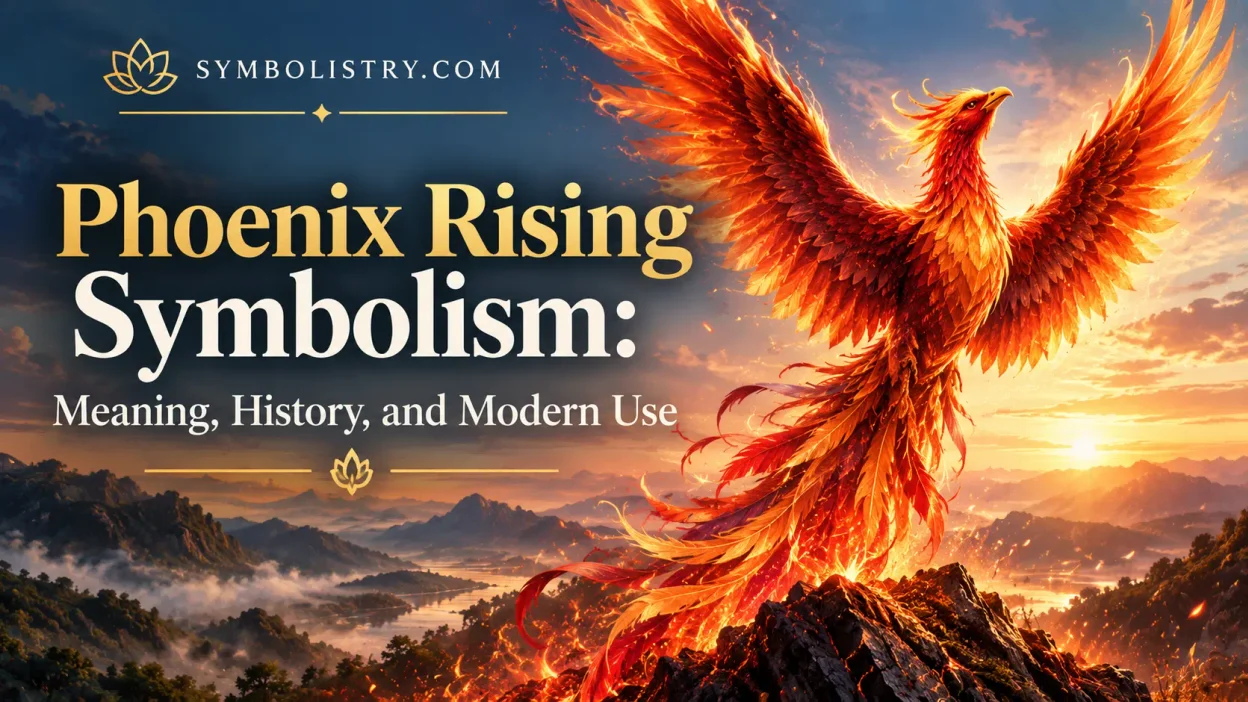
The image of a phoenix rising from flames has become one of the clearest visual symbols of phoenix rising symbolism in modern American culture. A bird emerging from fire suggests that destruction does not necessarily mark an ending; it can also represent renewal, recovery, and the beginning of a different life.
That idea explains why the phoenix appears so often in tattoos, jewelry, artwork, fiction, personal mottos, and stories about overcoming major setbacks. For many Americans, the image represents a person or community that has experienced loss and deliberately rebuilt.
The symbol, however, is older and more complicated than the familiar phrase “rising from the ashes.” Its roots reach into ancient Egyptian religious imagery, Greek and Roman accounts of a legendary bird, and later Christian interpretations of resurrection. Over time, these traditions blended with newer ideas about personal transformation and resilience.
Quick Answer
Phoenix rising symbolism commonly represents rebirth, recovery, and starting again after destruction or major hardship in modern American culture. Historically, the phoenix was associated with renewal, the sun, cyclical life, and resurrection in traditions connected to ancient Egypt, the Greco-Roman world, and later Christianity.
TL;DR
- The phoenix commonly symbolizes rebirth after destruction or major personal change.
- Ancient Egyptian Bennu imagery influenced later Greek ideas about the phoenix.
- Early Christians used the phoenix as an image of resurrection.
- Americans often associate it with resilience, recovery, and reinvention.
- Tattoos frequently use the phoenix to mark survival or a new chapter.
- The “ashes” story became more prominent in later versions of the myth.
What the Phoenix Looks Like and Why Its Appearance Matters
The phoenix is usually imagined as a large, elegant bird with dramatic red, orange, gold, or crimson feathers. Artists often surround it with flames, smoke, glowing embers, or an explosion of light.
There is no single ancient description that fixes the phoenix’s appearance. Classical accounts vary, and some describe a bird resembling an eagle with red and gold coloring. Modern popular culture has made the fiery version especially recognizable.
The visual sequence is important. A phoenix is rarely shown simply as a beautiful bird. Instead, it is usually depicted at a moment of transition: burning, emerging, spreading its wings, or climbing upward.
That movement gives the image its modern emotional vocabulary. A phoenix facing upward can suggest progress. A bird emerging from ashes can represent recovery. Flames surrounding it can indicate that the difficult experience has not been erased but has become part of the story.
What the Phoenix Commonly Means in the United States
In contemporary American culture, the phoenix most commonly communicates rebirth after hardship.
This can refer to many kinds of change. Someone might choose a phoenix tattoo after recovering from a difficult period, ending an important relationship, leaving an unhealthy environment, rebuilding a career, or beginning a new stage of life.
The symbol can also represent collective recovery. Cities, organizations, schools, and creative projects sometimes use phoenix imagery to express renewal after destruction or decline.
Importantly, the phoenix does not necessarily mean that the past was meaningless. Its symbolism works partly because something has been lost. The new life matters because it follows an ending.
This distinguishes the phoenix from symbols that primarily represent stability or continuity. The phoenix is about change through disruption.
Ancient Roots and the Egyptian Bennu Bird
The history of the phoenix is closely connected to the ancient Egyptian Bennu bird, although the two should not be treated as exactly the same creature.
The Bennu was a sacred bird associated with Egyptian creation traditions and with deities including Atum, Ra, and Osiris. Egyptian imagery connected the bird with creation, renewal, and the recurring movement of the sun.
The Met notes that the Bennu was represented as a heron and associated with acts of creation and renewal. Greek observers later assimilated aspects of this Egyptian imagery into their own concept of the phoenix.
That distinction matters because the familiar story of a bird literally burning itself and returning from its ashes is not a straightforward summary of ancient Egyptian religion. The Egyptian tradition had its own religious meanings and imagery.
The later phoenix became a more specific legendary creature whose identity centered on extraordinary longevity, death, and renewal.
How Greek and Roman Writers Changed the Story
Greek and Roman writers helped transform the phoenix into the form that became influential in European literature.
Herodotus described an account he had heard from Egyptian priests involving a phoenix returning at long intervals and transporting the remains of its parent to Heliopolis. He also made clear that he had not personally seen the bird.
Later writers developed different versions. Some accounts emphasized a cycle lasting hundreds of years. Others described the bird dying and being renewed, sometimes through fire or a nest of aromatic materials.
This variation is important. The popular modern image of a phoenix deliberately burning itself and then rising directly from its ashes is the result of a long literary evolution rather than a single ancient story preserved unchanged.
By the Roman period, the phoenix had become a recognizable symbol of renewal, rarity, longevity, and cyclical existence.
Why Fire Became Central to Phoenix Symbolism
Fire gives the phoenix its most recognizable modern meaning.
Fire can destroy almost everything associated with an earlier state: a building, possession, landscape, or physical form. In the phoenix story, however, destruction becomes the setting for another beginning.
That creates a symbolic sequence:
life → destruction → ashes → renewal
The sequence is more significant than fire by itself.
Fire can symbolize anger, danger, purification, destruction, passion, or transformation depending on context. When combined with the phoenix, it usually emphasizes the transition between an old identity and a new one.
This is why phoenix imagery often appears after experiences described as “burning everything down” or “starting over.” The metaphor suggests that rebuilding is not a return to exactly what existed before. The renewed form is something that follows the ending.
Phoenix Symbolism and Christian Resurrection
Early Christianity gave the phoenix another important layer of meaning.
Writers such as Clement of Rome and Tertullian used the legendary phoenix as an analogy for resurrection. The idea was straightforward: if a creature could be imagined as dying and returning to life, it could serve as a visual comparison for the Christian belief in resurrection.
The phoenix therefore appeared in early Christian discussions and artistic traditions associated with renewal and resurrection.
But the phoenix was not originally a Christian symbol. Christian writers adopted an existing classical image and interpreted it through Christian theology.
That distinction helps explain why phoenix imagery can appear in both religious and secular contexts today. Someone using a phoenix may intend a specifically Christian reference to resurrection, while another person may be thinking only about personal recovery.
Phoenix Rising and the American Idea of Reinvention
The phoenix fits especially well with an American cultural idea: reinvention.
American stories frequently celebrate people who leave behind an earlier identity and create a new one. The phoenix provides a compact visual metaphor for that process.
It can represent:
- rebuilding after failure
- recovery after loss
- starting a new career
- leaving an earlier identity behind
- recovering from a personal crisis
- rebuilding a family or community
- beginning again after a major life transition
The symbolism is particularly visible in personal storytelling. Someone may describe themselves as having “risen from the ashes” after a period that changed their life.
The phrase is powerful because it does not require the person to claim that nothing happened. Instead, it acknowledges the destruction and emphasizes what came afterward.
Phoenix, Arizona: A Real American Example of the Metaphor
One of the most interesting American connections is the city of Phoenix, Arizona.
The city was named Phoenix in the nineteenth century because its founders envisioned a new settlement developing from the remains of an earlier civilization and its irrigation infrastructure. The city itself explains that Darrell Duppa proposed the name because the settlement would “spring from the ruins” of a former civilization.
The historical reality is more complicated than the popular metaphor. The Salt River Valley had been home to Hohokam communities whose sophisticated canal systems supported agriculture for centuries. Modern settlers later reused portions of those canals.
The National Park Service describes Hohokam culture as a long-standing tradition in the region, while the American Society of Civil Engineers recognizes the ancient canal system as an extraordinary preindustrial irrigation achievement.
This makes Phoenix an especially useful example of how the phoenix metaphor can operate in American civic identity: a modern city adopted the name of a mythical bird to express renewal from an earlier landscape.
It is also important not to turn that naming story into the claim that the earlier Native communities simply “disappeared” and left an empty landscape. The history of the region includes Indigenous peoples and continuing Native communities.
Phoenix Symbolism Across Cultural Traditions
The phoenix is often described as a universal symbol, but that description can flatten important cultural differences.
In ancient Egypt, the Bennu was associated with creation, solar cycles, and renewal. Greek and Roman traditions developed their own phoenix narratives. Early Christian writers interpreted the bird through resurrection theology.
Other cultures have birds associated with transformation, immortality, fire, or renewal, but they should not automatically be labeled “phoenixes.” The Chinese fenghuang, for example, has its own history and symbolism and should not simply be treated as the Chinese version of the Western phoenix.
This distinction matters when discussing symbolism responsibly. Similar ideas can arise in different cultures without the symbols having identical origins or meanings.
What the Phoenix Can Represent Emotionally
At a personal level, the phoenix often communicates a mixture of grief and hope.
It acknowledges that something has ended while refusing to define the person entirely by that ending.
That makes the symbol particularly suitable for experiences involving identity change. A phoenix can say, in effect, “I am not who I was before this happened.”
It can also communicate persistence without suggesting that recovery was easy. The flames and ashes remain part of the visual story.
For some people, this makes the phoenix more emotionally appropriate than a symbol of uninterrupted strength. The bird does not represent someone who was never broken or changed. It represents someone who went through destruction and emerged differently.
Why Phoenix Tattoos Carry Such Personal Meaning
Phoenix tattoos are among the clearest modern examples of symbolic storytelling.
A tattoo may commemorate survival, recovery, a major transition, or the decision to begin again. Some people choose a rising bird after a period they regard as permanently changing their identity.
Design choices can alter the message.
A phoenix surrounded by flames emphasizes transformation. A bird emerging from dark ashes can emphasize survival. A bright, upward-moving phoenix can focus on optimism and forward movement. A smaller phoenix may communicate a private or understated meaning rather than a dramatic declaration.
Because tattoos remain on the body, the phoenix can function almost like a personal historical marker: an image representing a particular chapter and the life that followed it.
Phoenix Jewelry, Decor, Fashion, and Digital Culture
Outside tattoos, phoenix imagery appears in pendants, rings, wall art, clothing, illustrations, logos, fantasy fiction, video games, films, and online artwork.
In jewelry, the phoenix often works as a compact personal emblem. A pendant can symbolize a new beginning without requiring an explanation.
In home decor, the image may communicate transformation, ambition, or dramatic visual movement. In fantasy and gaming, the phoenix often retains the traditional association with resurrection, sometimes becoming a literal creature capable of returning after death.
Social media has also made the “rebirth” interpretation easier to communicate. A phoenix can accompany posts about changing careers, recovering from difficult periods, leaving an old identity behind, or celebrating a fresh start.
The modern meaning is therefore less dependent on mythology than it once was. Many people recognize the visual message even if they know little about the ancient stories.
Phoenix Symbolism in Art, Literature, and Popular Culture
Artists and writers use the phoenix because it provides a ready-made narrative structure.
A character who becomes a phoenix does not merely become stronger. The character passes through destruction and emerges transformed.
This makes the phoenix especially useful in stories about redemption, resurrection, revolution, magical transformation, and second chances.
Popular culture has also expanded the creature’s visual identity. Contemporary phoenixes may be enormous, glowing, winged, feathered, mechanical, supernatural, or abstract. Yet the basic story usually remains recognizable: an ending leads to another beginning.
The symbol survives partly because it is visually understandable without explanation.
Positive and Negative Interpretations
Phoenix symbolism is usually positive, but it does not have to be.
The most common interpretations involve renewal, survival, courage, and transformation. Yet the image can also represent destruction, grief, loss, or the painful cost of change.
There is another potential problem: the phoenix can encourage an overly simple view of recovery. Real people do not always emerge from hardship completely renewed, and not every loss produces a better outcome.
For that reason, the phoenix is best understood as a metaphor rather than a promise. It can represent hope after destruction without claiming that suffering is necessary, beneficial, or easily overcome.
Common Misunderstandings About the Phoenix
One widespread misunderstanding is that there is one ancient phoenix story with a fixed set of details. There is not. Ancient accounts differ considerably.
Another is that the phoenix originated entirely within ancient Egypt. Egyptian Bennu traditions are important, but the Western phoenix developed through interaction between Egyptian imagery and Greek and Roman traditions.
A third misunderstanding is that the phoenix always represents immortality. It can symbolize longevity or cyclical renewal, but in modern American use it more often represents rebirth after hardship than literal eternal life.
Finally, “rising from the ashes” is not the only historical form of the story. The famous fire-and-ashes version became especially influential through later literary development.
How Phoenix Rising Symbolism Has Evolved
The meaning has gradually shifted from cosmic and religious renewal toward personal transformation.
In ancient Egyptian traditions, renewal was connected with creation, the sun, and divine cycles. Classical writers emphasized the extraordinary life cycle of a legendary bird. Christian writers used the phoenix as an analogy for resurrection.
Later European literature increasingly treated the phoenix as a metaphor for renewal and restoration. In modern American culture, the metaphor has become highly personal.
Today, the phoenix can represent a person rebuilding after divorce, illness, professional failure, grief, addiction recovery, displacement, or another major life transition. It can also represent institutional or civic renewal.
The central idea has remained recognizable while the setting has changed: an ending does not necessarily have the final word.
Phoenix Symbolism at a Glance
| Context | Meaning in the USA | Common Associations | Notes |
|---|---|---|---|
| Personal tattoos | Rebirth after hardship | Recovery, identity, new beginnings | Often connected to a specific life transition |
| Jewelry | Personal renewal | Hope, change, resilience | Usually more subtle than tattoo imagery |
| Christian imagery | Resurrection | New life, renewal, faith | Draws on early Christian interpretation |
| Civic identity | Rebuilding or renewal | Recovery, growth, reinvention | Phoenix, Arizona is a notable example |
| Fantasy and pop culture | Resurrection and transformation | Magic, immortality, regeneration | Often expands the traditional mythology |
| Art and decor | Change after destruction | Fire, movement, renewal | Meaning depends heavily on design |
Is the Phoenix a Symbol of Hope or Transformation?
It can represent both, but transformation is usually the more precise description.
Hope points toward a better future. Transformation emphasizes that the person or thing emerging from the experience has changed.
The phoenix combines these ideas. Its future is hopeful because it has another life, but its identity is also different because it has passed through destruction.
That combination explains why the image remains useful for people marking major turning points. It does not simply say “things will get better.” It says that a new chapter can follow an ending.
FAQs About Phoenix Rising Symbolism
What does a phoenix symbolize spiritually?
Spiritually, the phoenix can symbolize resurrection, renewal, purification, and the continuation of life after death. Its meaning varies by tradition, so a Christian interpretation should not automatically be treated as the meaning in every spiritual context.
What does a phoenix tattoo mean?
A phoenix tattoo commonly represents survival, personal transformation, recovery, or beginning a new chapter. The meaning can become more specific through the tattoo’s flames, colors, direction, and surrounding imagery.
Is the phoenix a Christian symbol?
The phoenix is not originally a Christian symbol, but early Christian writers adopted it as an analogy for resurrection. It therefore became part of Christian artistic and theological symbolism while retaining older pre-Christian associations.
Does the phoenix always represent rebirth?
No. Depending on context, it can represent renewal, resurrection, longevity, cyclical existence, destruction, or transformation. Modern American usage most often emphasizes starting again after hardship.
What does a phoenix rising from ashes symbolize?
A phoenix rising from ashes usually represents rebuilding after destruction. The ashes represent what has ended, while the rising bird represents a new identity, renewed life, or another beginning.
Is the phoenix the same as the Egyptian Bennu bird?
They are closely related in the history of symbolism but are not simply identical. The Egyptian Bennu was a sacred bird associated with creation and renewal, while Greek and Roman traditions developed the distinct legendary phoenix.
Why is the phoenix associated with resilience?
The phoenix survives symbolically by passing through destruction and appearing again. That narrative makes it a natural metaphor for people and communities that rebuild after serious setbacks.
Conclusion
The phoenix represents one of the clearest symbolic ways to describe change after destruction. Its modern American meaning centers on rebirth, recovery, resilience, and the decision to begin again, while its older history connects it with Egyptian renewal imagery, classical mythology, and Christian resurrection symbolism.
Phoenix rising symbolism remains relevant because it gives people a way to describe transformation without pretending that the difficult past never happened. The ashes are part of the image, but they are not the final image.
That is what makes the phoenix useful as a symbol today: it represents not a return to exactly what existed before, but the possibility of becoming something new after an ending.