Although the plant is now strongly connected with modern interiors and lifestyle culture, its story begins in the tropical forests of Mexico and Central America. Its climbing habit, changing foliage, and unusual mature leaves provide the physical traits behind many of the meanings people attach to it today.
In the United States, the plant is especially popular in homes, offices, gardens, tattoos, artwork, fashion, and social media. Because of this wide use, its symbolism has developed into something flexible: one person may see a monstera as a sign of personal growth, while another may simply appreciate its tropical appearance.
Quick Answer
Monstera symbolism commonly represents growth, abundance, resilience, longevity, transformation, prosperity, and connection with nature in modern American culture. Its tropical origins, climbing growth, and changing leaf structure have helped create these associations, particularly in home decor, plant culture, art, and personal expression.
TL;DR
- Monstera symbolizes growth, abundance, resilience, longevity, and transformation.
- Its unusual leaves represent adaptation and mature development.
- The plant originated in tropical Mexico and Central America.
- American culture often connects it with thriving homes and natural beauty.
- Monstera appears widely in decor, tattoos, fashion, and artwork.
- Prosperity is a modern association rather than a universal ancient meaning.
What Is a Monstera and Why Is It Symbolic?
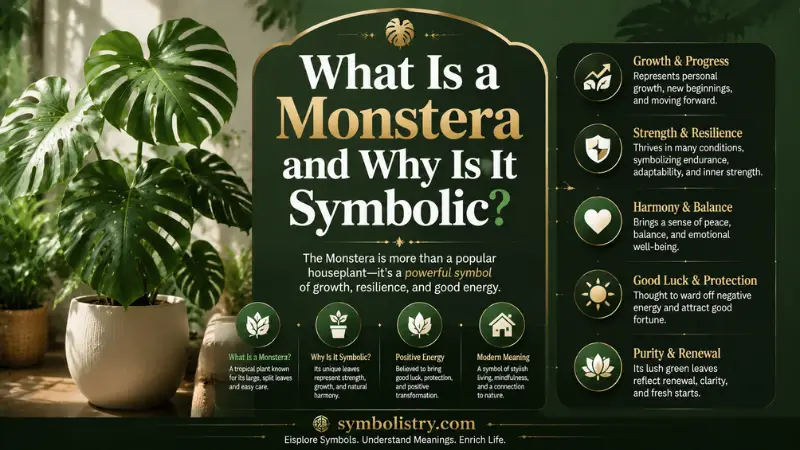
The plant commonly called monstera is usually Monstera deliciosa, a tropical climbing vine belonging to the arum family. It is recognized by its large, glossy, heart-shaped leaves that develop dramatic splits and openings as the plant matures.
Young plants can look quite different from mature specimens. Over time, the leaves become larger and develop fenestrations, the botanical term for the characteristic holes.
This natural transformation is one reason monstera symbolism is closely connected with development. The plant visibly changes as it grows, making it an easy metaphor for people moving through different stages of life.
Monstera also produces aerial roots that help it climb. In a natural forest environment, it can use nearby trees and structures for support while moving toward better light.
That growth pattern gives the plant another symbolic message: progress does not always happen alone. Sometimes growth requires support, patience, and an environment that allows development.
7 Powerful Meanings of Monstera Symbolism
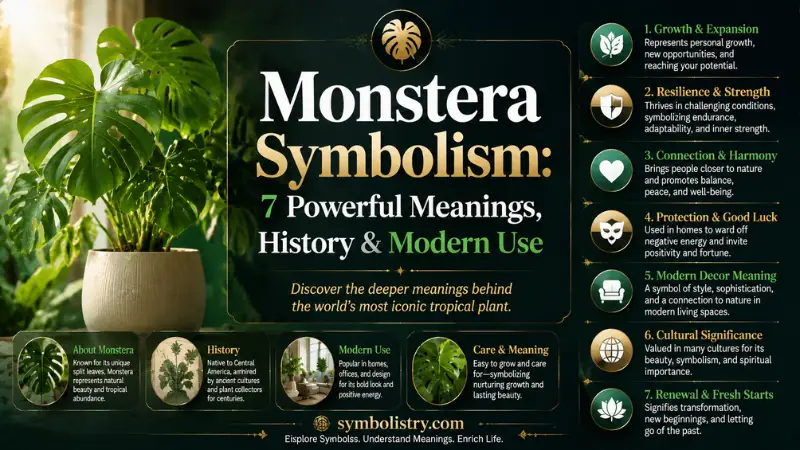
The seven most common interpretations come directly from the plant’s appearance, growth behavior, and modern cultural use. These meanings are not fixed rules, but they provide a useful framework for understanding why monstera has become such a popular symbolic plant.
1. Growth and Personal Development
Growth is arguably the clearest meaning associated with the plant.
A young monstera begins with relatively simple foliage and gradually produces larger, more complex leaves. Its climbing habit reinforces the visual idea of upward movement and continued development.
For this reason, monstera symbolism often fits major life transitions. Someone beginning college, changing careers, moving into a new home, or entering a new stage of adulthood may see the plant as a reminder that development happens gradually.
The important point is that monstera does not symbolize instant success. Its growth suggests patience and visible progress over time.
A monstera in a home office, for example, can serve as a simple reminder to keep developing skills and working toward long-term goals.
2. Abundance and Fullness
The plant’s enormous leaves naturally create an impression of fullness. A mature monstera can occupy considerable visual space, making it an intuitive symbol of abundance.
In modern monstera symbolism, abundance can mean more than financial wealth. It may refer to a home filled with life, healthy relationships, creative opportunities, comfort, or personal fulfillment.
This interpretation is especially common in interior design. A single large plant can make an otherwise plain room look greener and more established.
As a housewarming gift, monstera can therefore communicate a wish for a new home to become a place of comfort, growth, and plenty.
3. Resilience and Adaptability
Monstera is also associated with resilience because of the way it grows in its natural environment.
Rather than remaining a small, isolated plant, it climbs and uses surrounding structures for support. It adjusts its growth as it develops and produces foliage suited to its mature form.
This makes monstera symbolism particularly useful when discussing adaptation. The plant suggests that resilience does not necessarily mean refusing help or remaining unchanged.
Instead, resilience can mean finding suitable support, responding to circumstances, and continuing to develop.
That interpretation can be meaningful for someone recovering from a difficult period or beginning again after a major change.
4. Longevity and Endurance
Monstera is a perennial plant capable of living and growing for many years when properly cared for. Unlike cut flowers, it can continue developing long after the occasion when it was received.
This gives the plant an association with longevity and endurance.
In monstera symbolism, longevity may represent a lasting friendship, a long-term relationship, a stable home, or a commitment that becomes stronger with time.
The meaning is especially appropriate for gifts marking anniversaries, housewarmings, new businesses, or other occasions where someone wants to express hopes for a lasting future.
The plant’s continued growth also makes the symbolism practical. A healthy monstera provides a visible reminder that something given attention can continue developing.
5. Connection With Nature
Monstera is strongly connected with nature in contemporary American culture.
Its large tropical leaves bring an obvious natural element into apartments, offices, restaurants, hotels, and other built environments. This makes it especially popular among people interested in indoor plants and nature-inspired interiors.
Monstera symbolism can therefore express a desire to maintain a connection with the natural world even while living in an urban environment.
The meaning does not have to be spiritual. Someone may simply use a monstera to make a room feel more alive, relaxed, and connected to greenery.
Its popularity also fits the broader interest in bringing natural materials and plants into indoor spaces.
6. Prosperity and Good Fortune
Prosperity is another modern interpretation of the monstera leaf.
A healthy plant with large, abundant foliage creates an intuitive visual association with flourishing conditions. As a result, people sometimes use monstera in homes or businesses as a decorative symbol of prosperity and favorable growth.
However, this part of monstera symbolism should be described carefully.
Monstera is not universally recognized across ancient cultures as a traditional wealth symbol. Much of its prosperity association comes from modern plant culture, interior design, and interpretations of vigorous growth.
For that reason, it is more accurate to call prosperity a contemporary symbolic meaning rather than an ancient universal belief.
7. Transformation and Change
Transformation is especially connected with the difference between young and mature monstera leaves.
Early foliage can be relatively simple. Mature leaves become larger and develop the splits and openings that make the plant instantly recognizable.
This gives monstera symbolism a useful connection with personal transformation.
The plant demonstrates that becoming mature can involve substantial physical change. What looks unusual in its mature form is not necessarily a defect; it is part of the plant’s natural development.
For people, this can represent learning from experience, changing direction, becoming more confident, or accepting that personal growth may change how life looks.
The symbolism is therefore less about becoming someone completely different and more about developing into a fuller version of yourself.
What Monstera Symbolism Means in the United States
In the United States, monstera is primarily known as an ornamental houseplant and a popular botanical design motif.
American homeowners commonly use the plant to create a tropical, contemporary, bohemian, minimalist, or nature-inspired atmosphere. Its distinctive leaves are also widely reproduced in artwork and home accessories.
This makes monstera symbolism unusually flexible.
A plant owner may associate it with growth or prosperity, while an interior designer may select it simply because its leaves provide a strong visual shape. Someone buying a monstera tattoo may attach a completely personal meaning to it.
Modern American culture therefore tends to treat the plant as a symbolic object rather than a plant with one official definition.
The most common interpretations are positive because they reflect qualities people generally want in their lives: development, stability, abundance, resilience, and natural connection.
Tropical Origins and the Roots of Its Meaning
Monstera deliciosa is native to tropical regions of Mexico and Central America. In its natural habitat, it grows as a climbing vine in warm, humid forest environments.
Its biology helps explain why certain meanings developed around it.
The plant climbs toward available light, changes substantially as it matures, produces large leaves, and uses aerial roots and surrounding structures for support.
These traits provide the physical basis for modern associations with growth, adaptability, endurance, and connection with nature.
The plant’s tropical appearance also matters in the American context. For many people in the United States, a monstera represents an exotic form of greenery associated visually with warm climates and lush forests.
That association has helped make the leaf a familiar symbol of tropical style.
Why Monstera Leaves Have Holes
The holes in mature monstera leaves are called fenestrations. They are a normal feature of mature Monstera deliciosa and are one of the main reasons the plant is so recognizable.
The openings are not simply random damage. Mature leaves naturally develop splits and holes as the plant grows.
Scientists have proposed several possible biological advantages for fenestration, including relationships to water movement, wind exposure, and light within the plant’s natural environment. The precise explanation is more complex than a single popular claim.
Symbolically, however, the meaning is straightforward.
The leaf’s unusual openings have encouraged people to see beauty in an unconventional form. This is one reason monstera symbolism is sometimes connected with resilience, individuality, and accepting imperfection.
The plant does not need a perfectly solid leaf to look healthy or attractive.
Monstera as a Symbol of Adaptation
Adaptation is an important theme because monstera changes according to its stage of development and growing conditions.
Its climbing nature also demonstrates the importance of using available support. In nature, surrounding trees and structures can become part of the plant’s path toward light.
This makes monstera symbolism relevant to the idea that successful growth may require flexibility.
People often face situations where an old approach no longer works. They may need to learn something new, accept assistance, change their surroundings, or adjust their expectations.
The monstera offers a simple visual metaphor for that process.
Its lesson is not that change automatically produces success. Instead, it suggests that adapting to circumstances can be part of healthy development.
Monstera in Home Decor and Interior Design
Few plants have become as recognizable in contemporary interior design as monstera.
Its large leaves can create a focal point in a living room, bedroom, office, restaurant, or entryway. The shape works particularly well in tropical, modern, minimalist, and botanical-inspired spaces.
Artificial monstera leaves have also become common in printed and decorative products. They appear on wallpaper, bedding, curtains, ceramics, artwork, stationery, and textiles.
This has expanded monstera symbolism beyond living plants.
Someone does not need to own a real monstera to use its visual meaning. A printed leaf can communicate freshness, nature, tropical style, or a preference for greenery.
In many cases, aesthetics come first and symbolism comes second. That distinction is important when interpreting modern plant culture.
Monstera as a Housewarming Gift
A monstera can be a thoughtful housewarming gift because its common meanings naturally fit the idea of starting a new chapter.
Growth can represent hopes for a successful future. Longevity can suggest a stable home. Abundance can express wishes for comfort and prosperity.
This makes monstera symbolism particularly suitable for people moving into a first apartment, buying a home, starting a business, or creating a new living environment.
The fact that a potted monstera can continue growing also gives the gift a lasting quality.
Rather than being useful only on the day it is received, the plant can become part of the recipient’s home and develop over the years.
Monstera in Tattoos and Personal Art
Monstera leaves have become popular in botanical tattoos because their shape is immediately recognizable.
A person may choose a monstera tattoo to represent personal growth, transformation, resilience, tropical memories, a love of plants, or appreciation for natural design.
Some people focus specifically on the fenestrations. The openings may symbolize surviving difficult experiences, accepting imperfections, or becoming comfortable with personal change.
Others choose the design simply because they like its appearance.
There is no official tattoo dictionary that determines one fixed interpretation. Monstera symbolism becomes personal when someone incorporates the leaf into a tattoo, painting, illustration, or other artwork.
The individual’s story is therefore more important than a generic symbolic definition.
Monstera in Fashion and Digital Culture
The monstera leaf is particularly effective as a graphic design because its silhouette remains recognizable even when simplified.
It appears in clothing, accessories, phone cases, stationery, packaging, posters, social-media graphics, and other products.
Its popularity has grown alongside indoor plant culture and the broader interest in botanical aesthetics.
On social media, a monstera may communicate several things at once: an interest in plants, interior design, tropical style, wellness-oriented living, or a carefully designed home.
This demonstrates how monstera symbolism has evolved through repeated visual use rather than through one formal religious tradition.
The leaf has become culturally recognizable because people repeatedly encounter it in lifestyle and design settings.
Monstera and Modern Feng Shui Interpretations
Some modern discussions of plant placement include monstera within broader feng shui-inspired interior practices.
People may associate lush plants with harmony, growth, balance, or favorable household conditions. However, these modern interpretations should not be presented as universal rules of traditional feng shui.
Feng shui is a specific Chinese tradition with its own historical concepts and practices. Online discussions sometimes blend those ideas with generalized plant symbolism.
Therefore, monstera symbolism in a feng shui-inspired home is best understood as one modern interpretation rather than a universal religious meaning.
An American homeowner can appreciate the plant as a visual representation of growth and natural balance without claiming that it has one guaranteed spiritual effect.
Emotional and Psychological Meaning
At an emotional level, monstera often appeals to people who like the idea of growth without perfect symmetry.
Its mature leaves are attractive partly because they are unusual. The splits and holes become defining characteristics rather than things that need to be hidden.
This makes monstera symbolism useful for expressing acceptance of change and individuality.
The plant can also represent the importance of environment. Monstera requires suitable light, moisture, warmth, space, and support to thrive.
As a metaphor, that can remind people that development is influenced by circumstances. A person may have strong potential but still need the right environment and support to flourish.
This interpretation keeps the symbolism grounded in something observable rather than relying on supernatural claims.
Cultural Context Beyond the United States
Monstera’s native range gives it a direct connection with tropical regions of Mexico and Central America.
In places closer to its natural habitat, people may have a more practical relationship with the plant than Americans who primarily encounter it as an ornamental houseplant.
This difference matters when discussing monstera symbolism.
A plant can have one visual meaning in an American apartment and another practical significance in a region where it grows naturally. Modern internet culture can sometimes make contemporary interpretations appear older or more universal than they actually are.
The plant’s fruit also has culinary significance when properly ripened and prepared, although unripe portions can contain irritating substances and should not be treated as casually edible.
Its identity therefore extends beyond decoration.
Common Misunderstandings About Monstera Symbolism
One common misconception is that monstera has one ancient and universal symbolic meaning.
It does not.
Many popular associations with prosperity, personal growth, and good fortune are modern interpretations based on the plant’s appearance, growth behavior, and use in contemporary interiors.
Another misunderstanding involves the leaf holes. Some people assume they are evidence of disease or insect damage, but fenestration is a normal characteristic of mature Monstera deliciosa.
The plant is also sometimes confused with philodendrons because both belong to the same plant family and can have large tropical leaves. They are different plants.
Finally, the word “monstera” should not be interpreted as evidence that the plant is inherently dangerous or frightening. Its unusual appearance influenced the botanical naming, but the name itself does not establish a negative symbolic tradition.
Is Monstera Symbolism Positive or Negative?
Modern monstera symbolism is overwhelmingly positive.
The plant is most often connected with growth, abundance, resilience, longevity, transformation, prosperity, and nature. These ideas generally represent qualities people view favorably.
There is no major Western tradition in which monstera is widely established as a symbol of death, bad luck, betrayal, or misfortune.
Some people may find the large leaves or unusual openings visually strange, but personal reactions are different from established cultural symbolism.
The most balanced interpretation is therefore positive but flexible. A monstera can represent flourishing and adaptation without claiming that every person must interpret it in exactly the same way.
How the Meaning of Monstera Has Evolved
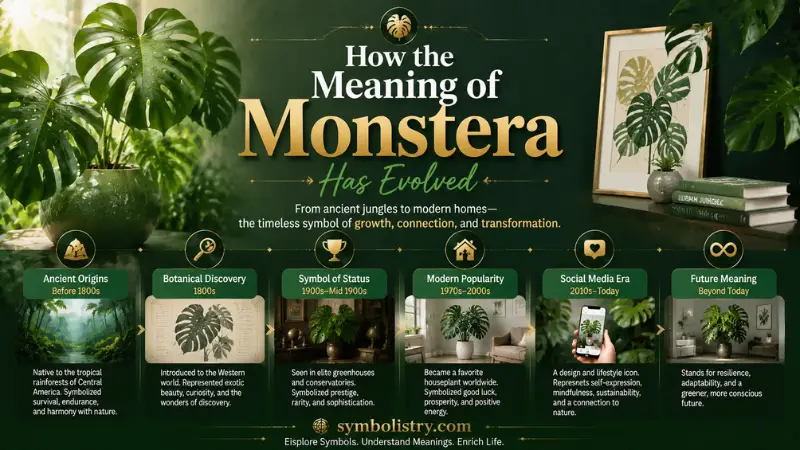
The symbolic history of monstera is relatively modern compared with plants that have long-established traditions of flower symbolism.
Its earliest identity was botanical. It was a tropical climbing plant with distinctive foliage and fruit.
As horticulture spread the plant into gardens and indoor collections, its unusual leaves became a major part of its visual identity. Later, interior design transformed the leaf into a recognizable decorative motif.
Today, monstera symbolism can represent personal development, a thriving home, natural beauty, tropical style, prosperity, or a love of plants.
Social media has accelerated this process by repeatedly displaying monstera leaves in interiors, lifestyle photography, fashion, and artwork.
Its development can therefore be understood as a progression from natural form to horticulture, then from horticulture to design and personal identity.
Monstera Symbolism by Context
| Context | Meaning in the USA | Common Associations | Notes |
|---|---|---|---|
| Home decor | Growth and natural beauty | Greenery, comfort, tropical style | Often aesthetic first |
| Housewarming | New beginnings | Growth, longevity, abundance | Suitable as a living gift |
| Tattoo | Personal transformation | Resilience, individuality, nature | Meaning depends on the wearer |
| Business space | Prosperity and growth | Success, abundance, vitality | Usually a modern interpretation |
| Fashion and art | Tropical identity | Nature, freshness, creativity | Often used as a visual motif |
Frequently Asked Questions
Why does monstera symbolize growth?
The plant changes dramatically as it matures, producing larger leaves with distinctive splits and fenestrations. Its climbing habit also creates an obvious visual association with upward movement and continued development.
Is monstera a symbol of good luck?
Monstera is sometimes associated with good fortune and prosperity in modern plant and home-decor culture. However, it is more accurate to describe this as a contemporary interpretation than as a universal ancient belief.
What does a monstera tattoo symbolize?
A monstera tattoo can represent growth, resilience, transformation, individuality, or appreciation for nature. The characteristic leaf openings may also represent accepting imperfections or changing through difficult experiences.
What does a monstera plant symbolize?
A monstera commonly symbolizes growth, abundance, resilience, longevity, transformation, prosperity, and connection with nature. In modern American culture, it is especially associated with thriving homes and personal development.
Are monstera leaves a symbol of prosperity?
They can represent prosperity because their large, healthy foliage creates a visual impression of flourishing and abundance. The association is mainly modern rather than a single established ancient tradition.
Does monstera have spiritual symbolism?
Modern interpretations sometimes connect monstera with harmony, prosperity, growth, and natural balance. These meanings vary by cultural and personal context and should not be treated as universal religious beliefs.
What does a monstera mean as a housewarming gift?
A monstera can represent growth, longevity, abundance, and hopes for a thriving new home. Because it can continue growing for years, it also represents a lasting beginning rather than a temporary decoration.
Conclusion
Monstera symbolism centers on growth, abundance, resilience, longevity, transformation, prosperity, and connection with nature. These meanings are easy to understand when the plant itself is considered: it climbs, changes as it matures, develops distinctive leaves, and continues growing with appropriate support.
For Americans today, the monstera has become much more than a tropical houseplant. Its leaf is a familiar design element in homes, tattoos, fashion, artwork, offices, and digital culture, where it can communicate everything from natural beauty to personal development.
Its most useful symbolic lesson is also its simplest: growth does not always produce a perfect or predictable shape. Sometimes the changes that make something unusual are exactly what make it recognizable.