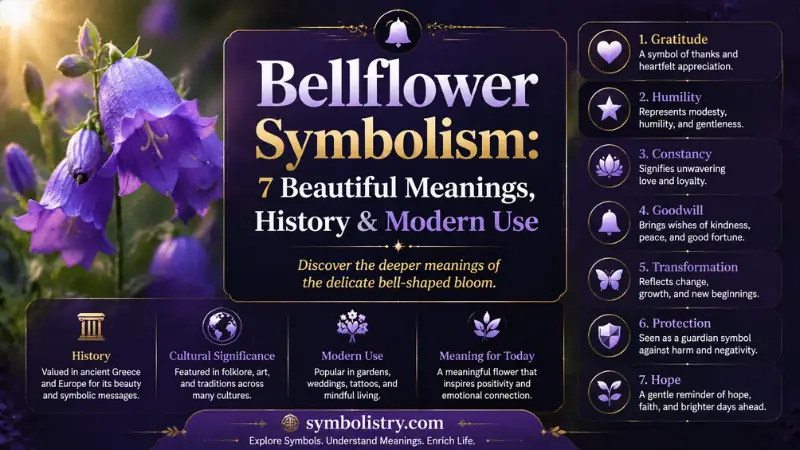
Bellflowers are delicate flowering plants known for their bell-shaped blooms, most commonly in shades of blue, purple, pink, and white. Bellflower symbolism is often associated with gratitude, humility, constancy, affection, and gentle remembrance, although the exact meaning can change with the species, color, and cultural tradition.
The name bellflower covers plants in the genus Campanula, a large group that includes annuals, biennials, and perennials. Their flowers can be upright, nodding, tubular, or star-like, and they are widely grown in gardens and containers. The genus name comes from the Latin campana, meaning “bell,” referring to the flowers’ distinctive shape.
For Americans today, bellflowers are more likely to appear in gardens, bouquets, wedding arrangements, floral artwork, and decorative designs than in formal symbolic ceremonies. Yet older flower-language traditions give the plant a particularly clear message: appreciation expressed quietly rather than dramatically.
Quick Answer
Bellflower symbolism commonly represents gratitude, humility, loyalty, constancy, and gentle affection, especially when the flower is used in bouquets or personal gifts. Historically, different bellflowers and colors carried different meanings in European flower-language traditions, while folklore also connected some species with fairies, magic, and remembrance.
TL;DR
- Bellflowers commonly symbolize gratitude and quiet appreciation.
- Their nodding blooms can suggest humility and modesty.
- Victorian flower language connected some bellflowers with constancy.
- Scottish harebell folklore includes fairies, witches, and magical associations.
- White bellflowers traditionally carry a message of gratitude.
- Modern Americans use bellflowers in gardens, gifts, tattoos, and decor.
What Does the Bellflower Look Like?
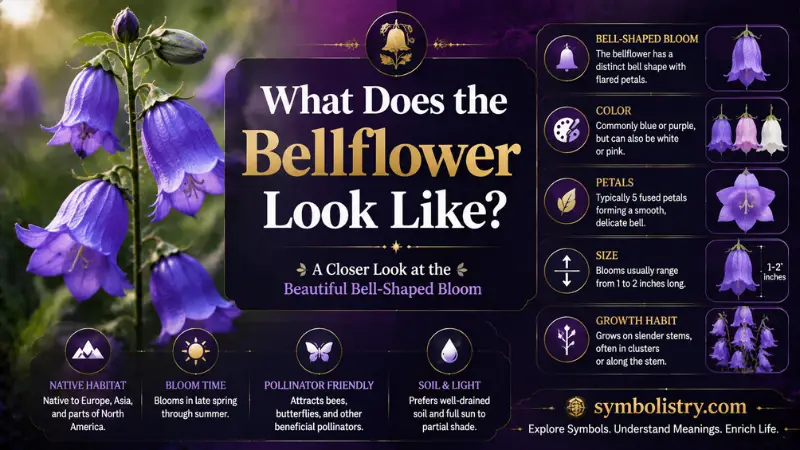
Bellflower is a common name for plants in the Campanula genus. The group contains hundreds of species and forms, so there is no single appearance that represents every bellflower.
Many varieties have flowers shaped like small bells or cups. Depending on the species, blossoms may face upward, spread outward, or hang downward from slender stems.
Blue and purple are especially familiar colors, but bellflowers can also be white, pink, lilac, and other pale shades. Some varieties form low mats, while others grow into taller clumps suitable for flower borders and cottage gardens.
The physical form helps explain some of the plant’s symbolism. A nodding bell can look as though it is gently bowing, which lends itself naturally to ideas of humility, respect, and quiet appreciation.
The flowers are also useful to pollinators. Many Campanula varieties attract bees and other beneficial insects, giving the plant a practical place in modern gardens as well as a symbolic one.
7 Positive Meanings of Bellflower Symbolism
Bellflowers have accumulated several meanings through flower language, folklore, appearance, and modern interpretation. The seven meanings below are among the most useful for understanding what the flower can communicate.
1. Gratitude
Gratitude is the clearest traditional meaning associated with Campanula.
Historical flower-language material specifically connected the white bellflower with gratitude. That makes it a natural choice when someone wants to say thank you without the stronger romantic message associated with certain other flowers.
A bellflower bouquet can therefore work for a teacher, friend, mentor, family member, caregiver, or anyone whose support deserves recognition.
The message is particularly appropriate when appreciation is sincere but understated.
2. Humility
The bellflower’s gently hanging flowers can suggest humility and modesty.
A blossom that appears to bow naturally creates a visual association with respect. Unlike a large, dramatic flower that demands attention, the bellflower can communicate appreciation in a quieter way.
This interpretation is useful when the flower represents someone who is gracious, unassuming, or willing to help without seeking recognition.
In modern floral design, humility is rarely a formal coded message, but it remains a useful personal interpretation of the flower’s shape.
3. Constancy
Another important historical meaning is constancy, or remaining steady over time.
Nineteenth-century flower-language traditions did not always assign exactly the same meaning to every bellflower. Some specifically connected the pyramidal bellflower with constancy, while broader lists associate bellflowers with a constant heart.
This gives the flower a useful message for long-lasting relationships and commitments.
Rather than expressing intense passion, constancy suggests something steadier: I remain loyal, dependable, and present.
4. Loyalty
Because constancy involves staying faithful to someone or something, bellflowers can also symbolize loyalty.
This interpretation works particularly well for friendships and long-term relationships. A bellflower gift can express appreciation for someone who has remained dependable through difficult circumstances.
The meaning is softer than an oath or formal declaration. It suggests an affection that has proven itself through time.
For a friendship, this can be more fitting than a strongly romantic flower.
5. Gentle Affection
Bellflowers can symbolize quiet affection rather than dramatic romance.
Their delicate appearance and soft colors make them suitable for expressing care, tenderness, friendship, or appreciation. A pink or purple bellflower arrangement may feel personal without carrying the unmistakable romantic message of red roses.
This makes bellflowers versatile in modern floral arrangements.
They can be given to someone you love, someone you admire, or someone whose presence you simply value.
6. Remembrance
Some bellflower traditions connect particular species with grief, remembrance, or mourning.
This is especially relevant to the harebell, Campanula rotundifolia, whose folklore and historical flower-language associations differ from those of cultivated Campanula varieties.
That distinction is important. Bellflower does not universally mean mourning, and most Americans encountering a garden Campanula would not automatically interpret it that way.
In memorial settings, however, the flower can represent a gentle memory of someone who remains emotionally important.
7. Hope and Grace
Modern interpretations sometimes extend bellflower symbolism toward hope, grace, peace, and emotional gentleness, especially when pale or blue varieties are used.
These meanings are less firmly established across historical flower-language systems than gratitude and constancy, so they are best treated as interpretive rather than universal.
Still, they fit the flower’s appearance. Soft colors, slender stems, and open bell-shaped blooms can create a visual impression of calm and quiet optimism.
For modern artwork, gardens, or personal gifts, this interpretation allows the bellflower to represent a hopeful presence without requiring a specific traditional code.
What Bellflower Symbolism Means in the United States
In the United States, bellflowers are primarily encountered as ornamental garden plants and cut flowers rather than as formal symbolic objects.
They are used in cottage gardens, flower borders, woodland-style plantings, containers, rock gardens, and naturalistic landscapes. Different Campanula species can vary considerably in size and growth habit, making the name familiar to gardeners even when the symbolic meaning is not.
The flower’s symbolic message is more likely to appear in personal or decorative contexts.
Someone might choose bellflowers for a bouquet because they want to communicate gratitude. A gardener might select them because their relaxed shape creates a gentle, informal feeling. An artist may use the flower simply because its hanging bells create an attractive visual pattern.
This makes modern American bellflower symbolism flexible rather than fixed.
Why Bellflowers Are Associated With Gratitude
The gratitude association has stronger historical grounding than many modern claims about flower symbolism.
Flower-language traditions from the nineteenth century assigned specific messages to individual flowers. One historical source identifies the pyramidal bellflower as an emblem of gratitude, while modern educational material on flower meanings also lists white Campanula with gratitude.
The meaning should not be presented as an eternal universal definition. Victorian flower language varied between books, countries, species, and colors.
Still, gratitude remains one of the most defensible traditional interpretations of Campanula.
That history explains why bellflowers can be especially appropriate when the intended message is “Thank you for being there” rather than “I am passionately in love with you.
Bellflowers, Bells, and the Meaning of Humility
The flower’s shape gives it an unusually direct symbolic connection to bells.
The botanical name Campanula comes from Latin campana, meaning bell. The name reflects the physical appearance of many species rather than a particular religious story.
The downward-facing form of some varieties adds another visual association. A hanging flower can resemble a small bell suspended from a stem, while its bowed position may suggest modesty or reverence.
That makes bellflowers particularly effective in designs intended to look peaceful and understated.
Their symbolism comes partly from cultural traditions and partly from what the human eye naturally sees in the plant.
Bellflower Folklore and Fairy Associations
Not every bellflower tradition is sentimental.
The harebell, Campanula rotundifolia, has a particularly interesting history of folklore in Britain and Scotland. In Scotland, the harebell is commonly called a bluebell, although it is a different plant from the English bluebell.
Local names for the harebell include terms such as “witch bells” and “fairy bells.” These names reflect older folklore connecting small bell-shaped flowers with supernatural beings and magical landscapes.
Such stories should be treated as folklore rather than historical evidence that people literally heard flowers ringing or encountered fairies among them.
The important symbolic point is that the tiny bells created an easy imaginative connection with invisible or magical worlds.
This gives the bellflower a second personality: it can represent gratitude and humility in flower language while appearing mysterious and enchanted in folklore.
Bellflowers in European Flower Language
The Victorian language of flowers, often called floriography, helped turn individual flowers into symbolic messages.
Different handbooks did not always agree, and that is especially important when discussing Campanula. Some records emphasize gratitude, while others attach meanings such as constancy to particular forms.
This variation means that a claim such as “every bellflower has one exact meaning” is too simplistic.
Species and color matter. Historical context matters. The intended occasion matters.
For modern readers, the most reliable approach is to treat gratitude and constancy as established traditional associations while presenting other interpretations as context-dependent.
That keeps the symbolism useful without pretending that flower language was ever a single standardized dictionary.
Bellflower Colors and Their Symbolic Meanings
Color can change the emotional impression of a bellflower even when there is no universally accepted symbolic code for every shade.
| Bellflower Color or Form | Common Symbolic Reading | Typical Emotional Tone | Best Modern Use |
|---|---|---|---|
| White | Gratitude | Sincere, peaceful | Thank-you gifts |
| Blue | Calm and gentle affection | Serene, thoughtful | Friendship and decor |
| Purple | Constancy and dignity | Elegant, steady | Long-term affection |
| Pink | Tender affection | Warm, gentle | Personal gifts |
| Pyramidal form | Constancy | Faithful, dependable | Commitment-themed arrangements |
White has the strongest traditional connection with gratitude in the sources used for flower-language interpretation.
Other colors are more dependent on modern floral conventions and personal interpretation. A blue bellflower, for example, may feel calm and peaceful even when that exact meaning is not historically universal.
Bellflower Symbolism in Love and Friendship
Bellflowers work particularly well for relationships where steadiness matters more than drama.
For romantic partners, the flower can suggest lasting affection, loyalty, gratitude, and a desire to remain connected. It is a softer message than the traditional symbolism of a red rose.
For friends, the meaning may be even more natural. Gratitude and constancy both fit friendships that have survived distance, difficult periods, or major changes in life.
A bouquet of bellflowers can therefore communicate appreciation without forcing the recipient to interpret the gesture as romantic.
That flexibility makes the flower useful for modern relationships, where the boundaries between friendship, admiration, gratitude, and affection are not always represented by a single traditional flower.
Bellflowers in Weddings and Celebrations
Bellflowers can suit weddings because their symbolism fits themes of lasting affection, gratitude, and commitment.
They can be incorporated into bouquets, table arrangements, floral arches, or small decorative displays. Their loose bell-shaped flowers also work well with informal garden-style wedding designs.
The symbolism can be especially meaningful when the couple wants flowers that communicate appreciation for the people supporting them.
Rather than representing only romantic passion, bellflowers can express the broader idea that a lasting relationship depends on loyalty and gratitude.
They are also visually adaptable, working with both soft pastel arrangements and more colorful garden-inspired designs.
Bellflowers in Tattoos, Jewelry, and Personal Art
Bellflower tattoos are less standardized than rose, lotus, or sunflower tattoos, which can make them more personal.
Someone might choose a bellflower tattoo to represent gratitude toward a loved one, a lasting friendship, humility, remembrance, or a connection with nature.
A cluster of small blue bells can create a delicate botanical design, while a single detailed flower can serve as a minimalist symbol.
The surrounding imagery changes the message. A bellflower paired with a name may emphasize remembrance. Combined with a date, it may commemorate a relationship or important life event. Paired with other flowers, its meaning may become part of a larger botanical story.
There is no single official tattoo meaning.
Bellflowers in American Gardens and Decor
Modern American use is strongly connected with gardening.
Campanula varieties are commonly used in borders, cottage gardens, rock gardens, woodland settings, containers, and naturalized plantings. Some species stay low to the ground, while others produce tall stems carrying numerous flowers.
Their practical garden value can reinforce their symbolic appeal. A flower that returns season after season may feel like an appropriate image for constancy or continuity, even when that interpretation is personal rather than historically documented.
Bellflowers also work well in decorative art because their shape is immediately recognizable.
They can appear on stationery, botanical prints, fabric patterns, ceramics, wall art, and garden-themed designs.
Emotional and Psychological Meaning of Bellflowers
At an emotional level, the bellflower tends to communicate quiet feelings rather than dramatic ones.
A large red rose can announce passion. A sunflower can create an impression of cheerfulness. A bellflower often feels more restrained.
That makes it suitable for emotions such as appreciation, tenderness, loyalty, humility, and remembrance.
The flower can also appeal to someone who prefers understated symbols. A person may want to express gratitude without making a public declaration, or remember someone without choosing imagery strongly associated with mourning.
Its small scale and hanging flowers support that quiet emotional quality.
Religious and Spiritual Associations
Bellflowers do not have one universal religious meaning.
Some species and folk traditions have acquired Christian or spiritual associations, while European folklore has connected others with fairies and magical beings. These traditions should not be combined into one symbolic system.
The safest interpretation is that bellflowers can participate in religious or spiritual art when a particular community gives them that meaning, but the plant itself is not a universally recognized religious symbol.
In modern America, a bellflower in a spiritual or memorial design is more likely to communicate a personal idea—gratitude, remembrance, peace, or renewal—than membership in a specific faith.
Common Misunderstandings About Bellflower Symbolism
The biggest misunderstanding is treating bellflower as if it refers to one single species.
Campanula is a large genus with many different plants. Harebell, Canterbury bells, peach-leaved bellflower, Korean bellflower, and other plants have different appearances, habitats, and cultural histories.
Another mistake is claiming that every bellflower has exactly the same symbolic meaning. Historical flower-language sources sometimes assigned different meanings to different forms or colors.
It is also misleading to say that bellflowers universally symbolize death. Some harebell traditions involve grief or folklore, but that does not make mourning the standard meaning of every Campanula.
Finally, modern color meanings should not be presented as ancient facts unless there is clear historical evidence for the specific association.
How Bellflower Meaning Has Evolved
Bellflower symbolism developed from several sources rather than one original definition.
The flower’s shape encouraged associations with bells and modesty. Victorian floriography gave certain Campanula varieties specific messages, most notably gratitude and constancy. Regional folklore added stories about fairies, witches, and magical landscapes.
Modern culture has simplified these traditions.
Today, people generally choose bellflowers because they like the flower, want a gentle botanical design, or connect with ideas such as gratitude and lasting affection. Most do not expect the flower to function as a strict coded message.
The result is a symbol that has retained older meanings while becoming more personal and flexible.
Is Bellflower Symbolism Positive or Negative?
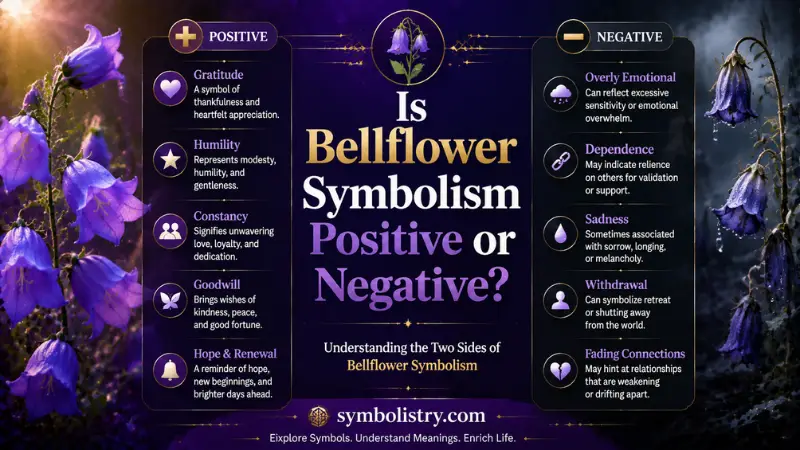
Bellflower symbolism is generally positive, especially when the flower represents gratitude, loyalty, humility, affection, and constancy.
Some folklore gives particular bellflower species darker associations, including grief, witches, or supernatural danger. These meanings belong to specific cultural traditions and should not be treated as the universal meaning of the flower.
For modern American use, the positive interpretation is usually the most relevant.
A bellflower tends to suggest appreciation and steady affection rather than conflict, aggression, or misfortune.
Frequently Asked Questions
Are bellflowers associated with love?
Yes, bellflowers can represent affection, loyalty, and constancy. Their romantic meaning is generally gentler and more understated than flowers traditionally associated with passionate love.
What color bellflower symbolizes gratitude?
White Campanula is traditionally associated with gratitude in flower-language references. Color symbolism can vary by tradition, so white is the safest choice when gratitude is the intended message.
What does a bellflower tattoo mean?
A bellflower tattoo can represent gratitude, loyalty, remembrance, humility, or lasting affection. The meaning becomes more specific when the flower is combined with names, dates, other flowers, or memorial imagery.
What does a bellflower symbolize?
A bellflower most commonly symbolizes gratitude and constancy in traditional flower language. Depending on the species and context, it can also represent humility, loyalty, affection, remembrance, or gentle hope.
What is the spiritual meaning of a bellflower?
A bellflower may be interpreted spiritually as a symbol of gratitude, humility, remembrance, peace, or faithful connection. There is no single universal spiritual meaning, so personal belief and cultural context matter.
Why are bellflowers associated with fairies?
Some European folklore gave small bell-shaped flowers names such as “fairy bells” and “witch bells.” The association comes from the flowers’ tiny bell-like appearance and traditional stories about magical beings living in wild landscapes.
Do bellflowers symbolize death or mourning?
Some traditions surrounding particular bellflowers, especially harebells, include grief and mourning. However, death is not the universal meaning of Campanula, and most modern uses emphasize gratitude, beauty, or lasting affection.
Conclusion
Bellflower symbolism is most strongly associated with gratitude and constancy, while the flower’s delicate form supports additional meanings such as humility, loyalty, affection, remembrance, and hope. Its history becomes more interesting when different Campanula species are separated from one another instead of being treated as one universal symbol.
For Americans today, the bellflower is both a beautiful garden plant and a subtle language of appreciation. Whether used in a bouquet, wedding arrangement, tattoo, memorial design, or garden, it can express something simple and lasting: thankfulness for a connection that matters.