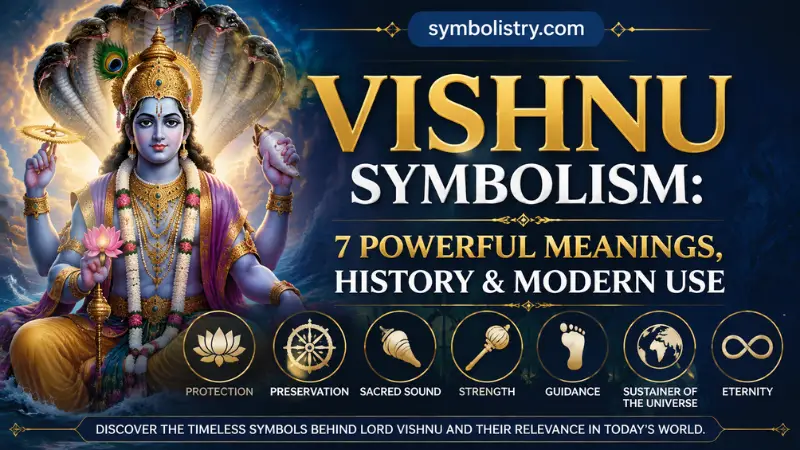
Vishnu is one of the principal deities of Hindu traditions and a central figure in Vaishnavism. Vishnu symbolism is most closely associated with preservation, protection, cosmic order, and the restoration of balance when disorder threatens the world. His familiar four-armed form, along with the conch, discus, mace, lotus, and Garuda, gives these ideas a recognizable visual language.
For American readers, Vishnu imagery can appear in museums, yoga and meditation spaces, jewelry, tattoos, books about Hinduism, home decor, and popular culture. Yet the image has a specific religious history that goes beyond a general idea of peace or spirituality.
Understanding Vishnu symbolism means looking at both the deity and the details surrounding him. His weapons, posture, color, companions, avatars, and vehicle each contribute to an iconography that developed across many centuries.
Quick Answer
Vishnu symbolism commonly represents preservation, protection, cosmic order, and the restoration of balance, particularly within Hindu traditions and modern discussions of Hindu spirituality. Historically, it also includes divine intervention through avatars such as Rama and Krishna, while the conch, discus, mace, and lotus express different aspects of Vishnu’s protective and cosmic role.
TL;DR
- Vishnu represents preservation, protection, order, and restoration.
- His four arms display several sacred attributes simultaneously.
- The conch, discus, mace, and lotus have distinct meanings.
- Rama and Krishna are among Vishnu’s best-known avatars.
- Americans encounter Vishnu imagery through religion, art, yoga, and design.
- Modern decorative use can differ from Hindu devotional meaning.
What Vishnu Symbolism Represents in Hindu Traditions
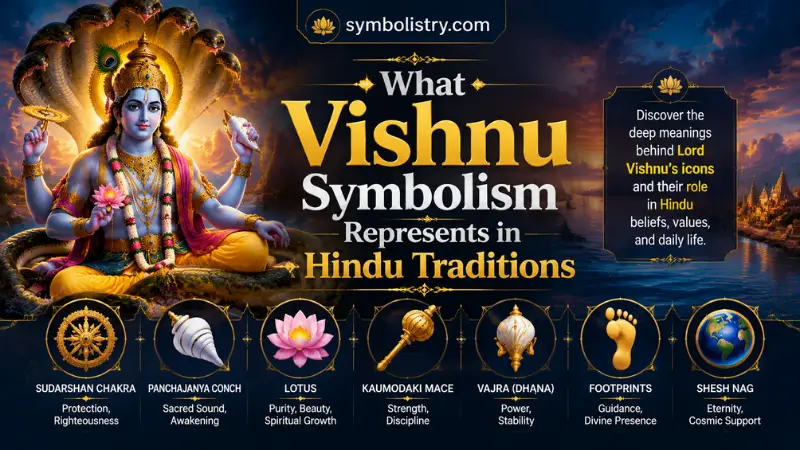
At its foundation, Vishnu symbolism centers on preservation and protection. Vishnu is traditionally understood as a deity who sustains the cosmic order and helps restore dharma when that order is threatened.
Preservation does not necessarily mean keeping everything exactly as it is. In Hindu narratives, protecting order can require intervention. When destructive forces disrupt dharma, Vishnu may appear through an avatar or another divine manifestation to restore balance.
This helps explain why Vishnu is frequently represented with martial attributes. His weapons are not simply signs of violence. They communicate his ability to confront forces that threaten the order of the world. The Metropolitan Museum of Art similarly identifies Vishnu as a protector of cosmic order whose iconography includes weapons and a battle trumpet.
For Vaishnavas, Vishnu holds an especially important theological position, although different Vaishnava traditions explain the relationship between Vishnu, Krishna, and ultimate reality in different ways. It is therefore more accurate to speak of several related Hindu interpretations rather than one universal doctrine.
The central idea remains clear: Vishnu symbolism connects divine protection with the continuing maintenance or restoration of cosmic order.
What Vishnu Looks Like and Why the Details Matter
Traditional representations usually show Vishnu as a regal, four-armed figure wearing a tall crown, jewelry, and elaborate clothing. His skin is commonly represented as blue or blue-black, a convention also associated with important avatars such as Krishna and Rama.
The four arms are one of the easiest ways to recognize Vishnu. They allow the artist to show several sacred attributes at once: the shankha, or conch; the chakra, or discus; the gada, or mace; and the padma, or lotus. Smithsonian and Metropolitan Museum collections both identify these four objects as central elements of Vishnu’s iconography.
These objects make Vishnu symbolism visually distinctive. Even when artistic styles change from one region or period to another, the recognizable attributes help viewers identify the deity.
Vishnu may stand, sit on a lotus, or appear with divine companions. Lakshmi is frequently associated with him, while Garuda serves as his traditional vehicle. Some regional traditions also include other divine figures, demonstrating that Vishnu imagery has never followed one completely fixed artistic formula.
The Conch Shell and Sacred Sound
The conch, known as the shankha, is one of Vishnu’s most recognizable attributes. It can function as a trumpet, connecting the object with proclamation, ritual sound, and the announcement of divine presence.
Its spiral form has also been given symbolic interpretations connected with creation and the origins of existence. Museum educational materials describe Vishnu’s conch as a battle trumpet whose spiral form can symbolize the origin of existence.
Within Vishnu symbolism, the conch therefore represents more than a decorative shell. It can suggest sacred sound, communication, and the calling of attention to divine order.
For an American viewer unfamiliar with Hindu iconography, a conch may initially appear to be an ordinary seashell. In Vishnu’s imagery, however, it has a specific religious identity and function.
The Sudarshana Chakra and Divine Protection
The chakra is Vishnu’s circular discus and one of his most recognizable weapons. It is often depicted with sharp edges or flames and is strongly connected with his role as a protector.
The circular shape can also suggest movement and cosmic order, although interpretations vary by tradition and context. In some forms of Vishnu imagery, the chakra is even personified as a divine figure.
The Smithsonian notes that the chakra in particular forms part of Vishnu’s standard set of attributes, while one representation of Keshava identifies the discus with universal supremacy.
This makes the chakra an important part of Vishnu symbolism because it communicates the ability to confront forces that threaten dharma.
The idea is worth emphasizing: Vishnu is not represented only as peaceful or passive. His role as preserver can involve decisive action when the cosmic order has been disrupted.
The Mace and the Authority to Defend Order
Vishnu’s gada, or mace, is another important martial attribute. It is associated with strength, authority, and the ability to defend the established order.
The mace gives Vishnu symbolism a different quality from the lotus or conch. While the lotus introduces ideas of purity and creation, the mace emphasizes strength and power.
Smithsonian materials identify Vishnu’s mace as a symbol of strength and power.
Together, the mace and discus show that preservation is not necessarily passive. Vishnu’s traditional imagery presents protection as an active responsibility.
In some artistic traditions, Vishnu’s weapons are personified. This demonstrates how central these attributes became to his visual identity. They are not simply accessories added to a portrait; they help define the deity himself.
The Lotus and the Meaning of Life and Purity
The padma, or lotus, introduces a gentler dimension to Vishnu’s imagery. Unlike the discus and mace, it is not primarily a weapon.
The lotus is widely used in South Asian religious art and can be associated with purity, creation, beauty, and spiritual development. In Vishnu imagery, it balances the martial qualities of his other attributes.
The Smithsonian identifies the lotus in Vishnu’s iconography with purity and, in another representation, with creation.
This makes the lotus an important part of Vishnu symbolism because it shows that preservation involves more than defending against threats. It also involves sustaining life and the conditions in which life can flourish.
The combination of lotus, conch, discus, and mace gives Vishnu’s iconography a deliberate balance between creation, order, communication, strength, and protection.
Vishnu, Lakshmi, and Divine Partnership
Vishnu is frequently depicted with Lakshmi, a goddess strongly associated with prosperity, fortune, beauty, and abundance.
Their pairing adds another dimension to Vishnu symbolism. A stable world is not simply one in which danger has been defeated. It is also one in which people, communities, and the natural world can flourish.
Artworks from medieval India often place Vishnu alongside Lakshmi and other divine figures. A 12th-century sculpture in the Smithsonian collection, for example, shows Vishnu with Lakshmi and Sarasvati and includes his traditional conch, discus, mace, and lotus.
Modern audiences sometimes reduce Vishnu and Lakshmi to symbols of “success” or “wealth.” That interpretation is incomplete. Their relationship belongs to a broader religious framework involving preservation, prosperity, order, and the continuation of life.
Vishnu’s Avatars and Divine Intervention
One of the most important elements of Vishnu symbolism is the concept of the avatar, meaning a divine manifestation or descent into the world.
Vishnu is traditionally associated with numerous avatars. Among the best known are Rama and Krishna, while other forms include Matsya, Kurma, Varaha, Narasimha, Vamana, and Parashurama. Lists of the ten principal avatars vary somewhat by tradition, with some traditions including Buddha and others differing in their selections.
The avatar concept changes the meaning of preservation. Vishnu does not simply watch worldly events from a distance. In traditional narratives, divine manifestations appear when circumstances require intervention.
This explains why Vishnu symbolism often communicates restoration rather than passive preservation. The deity protects order by responding when disorder becomes severe.
Rama and Krishna are especially important because their stories have become major parts of Hindu religious and cultural traditions. They also demonstrate how Vishnu’s identity can be expressed through different personalities, narratives, and historical settings.
Vishnu and Garuda
Garuda is Vishnu’s vahana, or vehicle, and is usually represented as a powerful bird-like being. In some descriptions, Garuda combines human and bird characteristics.
Garuda adds movement and strength to Vishnu symbolism. As a divine vehicle, he represents Vishnu’s ability to move between the earthly and divine realms.
Images of Vishnu riding Garuda became important in South and Southeast Asian art. The pairing presents Vishnu as an active divine figure rather than a deity confined to a static throne.
For American audiences, Garuda may initially resemble an eagle. The visual similarity is understandable, but Garuda belongs to a specific mythological tradition and should not automatically be interpreted as a generic eagle symbol.
Ancient Roots and the Development of Vishnu’s Image
Vishnu’s history reaches into the Vedic tradition, although his role and prominence developed significantly over time. As Hindu devotional traditions evolved, Vishnu became increasingly important within traditions centered on his worship.
By the early centuries of the Common Era, devotion to Vishnu and Shiva had become especially prominent. Museum scholarship also documents the increasingly elaborate iconography associated with Vishnu during this period.
Over the centuries, artists across India created regional versions of Vishnu. Kashmir, Bengal, South India, Kerala, and other regions developed distinctive artistic approaches while maintaining recognizable attributes.
An eighth-century Kashmiri sculpture at the Metropolitan Museum, for example, shows a complex four-faced form of Vishnu that incorporates his Varaha and Narasimha aspects. The work demonstrates how varied Vishnu symbolism could become within specific theological and artistic traditions.
Vishnu’s imagery also traveled beyond India into parts of Southeast Asia. Cambodian, Indonesian, Thai, and other artistic traditions incorporated Vishnu-related religious and visual ideas, often adapting them to local artistic cultures.
There is therefore no single universal “Vishnu style.” His imagery has changed across time and place while retaining a recognizable religious identity.
Vishnu Symbolism in the United States
In the United States, Vishnu symbolism appears in several different settings, and those settings should not be treated as interchangeable.
For practicing Hindus and Vaishnava communities, Vishnu imagery can have devotional and theological importance. It may appear in temples, home worship spaces, religious education, festivals, and personal devotional practice.
Outside explicitly Hindu settings, Americans may encounter Vishnu through museums, university courses, yoga communities, meditation culture, comparative religion, South Asian art exhibitions, and books about Hindu traditions.
There is also a commercial and decorative use of Hindu imagery. Statues and images of Vishnu can appear in home interiors, wellness spaces, clothing, jewelry, and artwork. In these settings, the image may be selected because of associations with protection, balance, or spirituality rather than as an expression of Hindu devotion.
That difference matters. The same image can function as a devotional object for one person and as an artistic or cultural reference for another.
How Americans Commonly Interpret Vishnu Imagery
There is no single American interpretation of Vishnu symbolism. Different audiences encounter the figure through different cultural channels.
| Context | Meaning in the USA | Common Associations | Notes |
|---|---|---|---|
| Hindu religious practice | Divine protection and preservation | Vishnu, dharma, devotion | Religious context is central |
| Museums and education | Hindu theology and Indian art | Iconography, mythology, history | Usually presented comparatively |
| Yoga and wellness | Balance and spiritual order | Meditation, harmony, mindfulness | May simplify traditional theology |
| Tattoos and jewelry | Personal protection or identity | Vishnu, lotus, chakra | Meaning varies by wearer |
| Home decor | Spiritual or artistic symbolism | Peace, balance, Indian aesthetics | May be devotional or decorative |
For a general American audience, the most familiar interpretation may be “protection and balance.” That is a reasonable starting point, but Vishnu symbolism has a broader religious meaning tied to the preservation and restoration of cosmic order.
Emotional and Psychological Meaning
People who choose Vishnu imagery may respond to ideas of stability, protection, responsibility, and restoration.
Modern Vishnu symbolism can therefore serve as a personal reminder that stability sometimes requires action. Someone may connect with Vishnu because his stories frame adversity as something that can be confronted rather than simply feared.
The imagery can represent steadiness during change, responsibility toward others, or a desire to restore order after a difficult period.
At the same time, these psychological interpretations are modern personal readings. They should not be presented as universal Hindu doctrine. A person who uses Vishnu imagery as a reminder of resilience is making a contemporary connection to an older religious symbol.
Why Vishnu Appears in Tattoos and Personal Style
Vishnu imagery can be visually striking as a tattoo because the deity has a recognizable form and several distinctive attributes.
A four-armed figure may be chosen to represent protection, order, devotion, or a personal connection to Hindu culture. Others may select one element, such as the chakra or lotus, instead of the complete figure.
The exact design matters. A tattoo showing Vishnu himself carries a different cultural and religious message from an abstract geometric design inspired by a chakra.
For someone considering Vishnu symbolism as body art, learning the religious context can prevent the image from being treated as a generic symbol of “good energy” or exotic spirituality.
Respectful use does not require every person to be Hindu, but it does require understanding what the image represents within the tradition from which it comes.
Vishnu in Art, Museums, and Popular Culture
American museums have introduced many audiences to Vishnu symbolism through sculptures, paintings, manuscripts, and decorative objects.
Museum collections are especially useful because they preserve the visual details that identify Vishnu: the four arms, crown, conch, discus, mace, lotus, Garuda, and associated deities. These objects also demonstrate how the iconography changed between regions and historical periods.
Popular culture is less consistent. Vishnu may appear in fantasy art, video games, books, animation, fashion, and social media alongside other Hindu deities and mythological figures.
Such appearances can encourage curiosity about Hindu traditions, but they can also simplify religious ideas for entertainment. A fictional representation should not automatically be treated as an accurate explanation of Vishnu symbolism.
The distinction between artistic inspiration and traditional religious representation is therefore important.
Common Misunderstandings About Vishnu Symbolism
One common misunderstanding is that Vishnu simply represents “peace.” Protection is certainly important, but traditional representations also emphasize weapons, authority, intervention, and the defense of dharma.
Another mistake is treating all Hindu deities as interchangeable symbols. Vishnu has a particular theological identity, and his attributes distinguish him from Shiva, Brahma, Devi, Ganesha, and other Hindu figures.
It is also inaccurate to assume that every Vishnu image has exactly one fixed interpretation. Regional traditions, sectarian beliefs, artistic periods, and devotional practices can affect the details.
Another misunderstanding involves the word “preserver.” Some modern explanations make preservation sound passive, as though Vishnu merely maintains whatever already exists. In traditional narratives, preservation can involve confronting threats and restoring a disrupted order.
Finally, decorative use can separate sacred imagery from its original context. That does not automatically make every nonreligious use disrespectful, but understanding Vishnu symbolism makes it easier to avoid careless or inaccurate representations.
How Vishnu’s Meaning Has Evolved Over Time
The meaning of Vishnu’s imagery has changed as Hindu traditions, artistic practices, and cultural settings have developed.
Ancient and medieval representations could emphasize divine authority, cosmic sovereignty, protection, royal power, or the relationship between Vishnu and his consorts. Some sculptures also incorporated multiple forms or avatars into a single composition.
The twenty-four forms of Vishnu provide an especially clear example of this development. In some Vaishnava traditions, different arrangements of the four main attributes create distinct forms, demonstrating how much meaning can be communicated through seemingly small changes in iconography.
In modern America, Vishnu symbolism can function simultaneously as religious imagery, a subject of art history, a cultural reference, a tattoo design, or a personal symbol.
The central themes of preservation and protection remain recognizable, but the surrounding context determines how much of the original religious meaning is present.
Frequently Asked Questions About Vishnu Symbolism
What does the Vishnu chakra symbolize?
The chakra is Vishnu’s discus and an important symbol of protection and authority. It is associated with confronting forces that threaten cosmic order and, in some traditions, with universal supremacy.
What do Vishnu’s four arms represent?
The four arms allow Vishnu to display several important attributes simultaneously, especially the conch, discus, mace, and lotus. They also distinguish the deity from an ordinary human figure and communicate his divine nature.
What does Vishnu symbolism mean in a tattoo?
Vishnu symbolism in a tattoo may represent protection, stability, preservation, devotion, or a personal connection to Hindu traditions. The meaning ultimately depends on the wearer, while the traditional significance comes from Vishnu’s religious identity and iconography.
What does Vishnu symbolize?
Vishnu primarily symbolizes preservation, protection, and the maintenance or restoration of cosmic order. His avatars demonstrate how divine intervention can restore dharma when it is threatened.
Is it appropriate to use Vishnu imagery as decoration
Context and intention matter. Because Vishnu is a living religious figure for many Hindus, treating his image only as exotic decoration can be insensitive, while informed artistic or cultural use can acknowledge the religious tradition behind the imagery.
Is Vishnu the same as Krishna?
The relationship depends on the Hindu tradition. Many traditions understand Krishna as an avatar or manifestation of Vishnu, while some Vaishnava traditions place Krishna at the highest theological position and understand Vishnu as an expansion or manifestation of Krishna.
Is Vishnu a symbol of good luck?
Vishnu is not simply a “good luck symbol.” He is a major Hindu deity associated with preservation, protection, cosmic order, and divine intervention, while prosperity and fortune are more specifically associated with Lakshmi.
Conclusion
Vishnu symbolism represents preservation, protection, cosmic order, and the restoration of balance, but those ideas are expressed through a detailed visual system. The conch, chakra, mace, lotus, four arms, avatars, Lakshmi, and Garuda each add a different dimension to Vishnu’s identity.
For Americans, Vishnu can appear in religious practice, museums, education, personal art, tattoos, wellness culture, and popular media. The meaning changes with the setting, but understanding the Hindu traditions behind the image provides a more accurate interpretation.
At its core, Vishnu symbolism presents preservation as an active responsibility: when order is threatened, protection may require intervention. That idea explains why Vishnu remains recognizable not simply as a peaceful figure, but as a guardian of order who restores balance when it is disrupted.