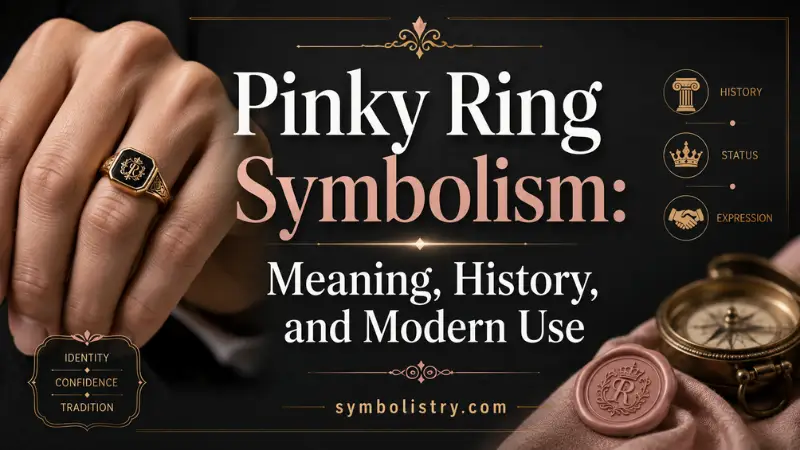
A ring worn on the smallest finger can attract more attention than jewelry placed almost anywhere else on the hand. Pinky ring symbolism today commonly centers on individuality, confidence, family heritage, achievement, and personal style, although its meaning changes considerably depending on the design and the person wearing it.
The little finger has hosted everything from engraved family signets to diamond statement pieces and professional rings. Because it sits apart from the traditional American wedding-ring finger, it also gives wearers room to use jewelry without automatically suggesting marriage or engagement.
That flexibility explains why the pinky ring remains recognizable while continually changing meaning. It can preserve a family connection, celebrate a career, display wealth, reference a cultural tradition, or simply complete an outfit.
Quick Answer
Pinky ring symbolism commonly represents individuality, confidence, status, or personal identity in modern American culture. Historically, rings on the little finger have also been connected with signet seals, family heritage, professional affiliation, wealth, and, in some communities, discreet identity signaling.
TL;DR
- Modern pinky rings often express confidence and individual style.
- Signet rings historically represented identity, authority, or family heritage.
- American pop culture added associations with wealth and toughness.
- Some U.S. engineers wear professional rings on the little finger.
- Queer communities once used pinky rings as discreet identity signals.
- Left-versus-right placement has no single modern American meaning.
What a Pinky Ring Commonly Means Today
In the United States, there is no single message that every little-finger ring communicates. The most common modern interpretation is intentional self-expression.
Unlike an engagement ring, whose placement usually carries a widely recognized social message, a pinky ring gives its wearer more freedom. A plain gold band may feel minimalist and confident. An engraved signet may suggest family history. A large diamond can communicate luxury, while an unusual handmade ring may emphasize artistic taste.
Modern meanings commonly include:
- individuality
- confidence
- status or success
- family heritage
- professional pride
- independence
- fashion-conscious self-expression
The ring itself matters as much as its location. An inherited crest and a contemporary diamond solitaire occupy the same finger but can tell completely different stories.
Why the Little Finger Makes Such a Distinct Statement
The pinky is visually separate from the center of the hand, which makes jewelry placed there look deliberate. A substantial ring can appear especially noticeable because the finger itself is small.
There is also a cultural reason the placement feels different in the United States. Engagement and wedding rings are strongly associated with the fourth finger of the left hand. Moving jewelry one finger outward removes much of that automatic marital interpretation.
As a result, the little finger has become useful for people who want a meaningful ring without copying the visual language of engagement jewelry.
It can also signal independence simply because it is an unconventional placement. That does not mean every wearer intends a rebellious message, but choosing the pinky often feels more personal than following a standard jewelry convention.
Signet Rings Gave the Pinky Much of Its Historical Meaning
One of the most important influences on the symbolism of little-finger jewelry is the signet ring.
A traditional signet has a broad surface engraved with an emblem, monogram, coat of arms, or other identifying design. Earlier signets were functional objects as well as jewelry. Engraved rings could be pressed into wax or another material to authenticate documents and identify the person responsible for them.
Ancient civilizations used rings and engraved gems in sealing practices long before the modern pinky-ring tradition developed. Roman signet rings, for example, could contain carved gemstones used to secure documents.
Because a seal represented its owner, signet rings naturally acquired associations with identity, authority, legitimacy, and ownership.
Over time, their practical role declined, but the symbolic language survived.
From Personal Seal to Family Heritage
Once handwritten signatures and other methods replaced everyday seal use, signet rings did not disappear. Instead, many became heirlooms.
Initials, family emblems, school insignia, professional symbols, and personal monograms transformed the signet into a compact statement of belonging.
This history helps explain why an inherited pinky ring can symbolize continuity between generations. A person wearing a grandfather’s signet, for example, may care less about displaying wealth than about preserving a visible family connection.
The tradition has particularly strong associations with Britain and European aristocratic culture, where signets became closely linked with lineage and social position. American jewelry culture later adopted and adapted many of these conventions.
Modern signets no longer require an old family crest. People now engrave dates, initials, personal symbols, animals, birthstones, or entirely new emblems, turning inherited symbolism into individual storytelling.
What It Symbolizes in the United States
American meanings are unusually varied because the pinky ring sits at the intersection of European tradition, professional custom, celebrity fashion, music, film, and personal jewelry.
A modern American wearer might choose one to represent:
| Context | Meaning in the USA | Common Associations | Notes |
| Family signet | Heritage and continuity | Initials, crests, heirlooms | Often passed between generations |
| Statement jewelry | Confidence and individuality | Gold, diamonds, bold shapes | Usually fashion-driven |
| Professional ring | Responsibility and achievement | Engineering tradition | Meaning depends on organization |
| Music and pop culture | Success and visibility | Luxury, performance, status | Especially noticeable in hip-hop imagery |
| Personal keepsake | Memory or identity | Dates, symbols, gemstones | Meaning may be private |
| Queer history | Recognition and community | Discreet signaling | Historical, not a universal modern code |
The important point is context. Americans generally do not see every pinky ring and assume the same social identity or message.
Wealth, Success, and the American “Statement Ring”
Pinky rings acquired a particularly visible relationship with wealth during the twentieth century.
Gold, diamonds, and large engraved designs made the small finger an ideal place for conspicuous jewelry. Entertainers, performers, nightlife figures, businessmen, and later hip-hop artists helped make the ring a symbol of having achieved visible success.
Within parts of Black American music culture, especially hip-hop, gold and diamond jewelry could communicate financial achievement, self-definition, and the ability to display prosperity publicly. Contemporary fashion coverage still recognizes this connection between pinky jewelry, success, and musical style.
The meaning is not simply “rich person,” however. Jewelry can also turn wealth into a statement about overcoming exclusion, claiming visibility, or celebrating professional success.
For many other wearers, a gold pinky ring is simply an attractive accessory with no financial message at all.
The Engineer’s Ring Gives the Pinky a Professional Meaning
One of the clearest formal meanings in the United States comes from engineering.
Members of the Order of the Engineer who accept its professional obligation receive a stainless-steel Engineer’s Ring. It is worn on the fifth finger of the working hand and serves as a reminder of professional responsibility and the consequences engineering decisions can have for society.
That makes this type of pinky ring fundamentally different from a fashion signet.
Its symbolism centers on:
- professional ethics
- responsibility
- accountability
- service
- commitment to engineering standards
Someone seeing a simple metal ring on an engineer’s little finger should therefore avoid assuming that it represents wealth, family lineage, or romantic status.
Queer History and Discreet Identity Signaling
Pinky rings have also appeared in queer history, particularly during periods when openly identifying as gay could carry serious social or legal consequences.
Historical accounts describe some gay men in the mid-twentieth century using pinky signet rings as subtle signals that could be recognized by people familiar with the code while appearing like ordinary jewelry to everyone else. Museum material documenting LGBTQ+ visual language notes this practice in the 1950s and 1960s.
This history matters because clothing and jewelry have often provided discreet ways for marginalized groups to find community.
It should not, however, be turned into a modern stereotype. Wearing a pinky ring today does not reliably indicate someone’s sexual orientation.
Some LGBTQ+ wearers intentionally reference this history. Others wear the same jewelry for completely unrelated reasons.
Does the Left or Right Pinky Change the Meaning?
Modern American culture does not have a universally accepted system in which the left pinky means one thing and the right pinky means another.
Older traditions can be more specific. British signet customs, for example, are strongly associated with the left little finger. Professional rings may have their own placement rules. Personal family traditions can also dictate a particular hand.
Outside those contexts, hand choice is often practical.
A person may select the nondominant hand to reduce wear. Someone stacking rings with a watch may prefer the opposite hand for visual balance. Others simply choose whichever finger fits an inherited ring.
Claims that every left pinky ring means marriage, criminal affiliation, wealth, or a specific personality trait should therefore be treated cautiously.
Masculinity, Femininity, and Changing Gender Expectations
Pinky rings were once particularly visible in Western men’s fashion. Heavy signets, gold bands, and engraved stones became associated with masculine dress, business attire, aristocratic style, entertainers, and fictional gangsters.
That gender boundary has weakened considerably.
Women now wear slim diamond bands, chunky signets, gemstone rings, stacks, and oversized statement pieces on the little finger. Recent fashion has increasingly treated the pinky as a gender-neutral place for jewelry rather than a specifically male tradition.
This shift changes the symbolism.
A ring that once might have suggested male status or inherited authority can now communicate independence, self-purchase, glamour, or experimentation with traditional jewelry rules.
For younger wearers especially, design often matters more than old gender conventions.
Independence and Self-Gifting
One of the most interesting modern meanings is the idea of buying significant jewelry for yourself.
Diamonds were historically marketed heavily around engagements, anniversaries, and romantic gifts. Putting a substantial diamond on the pinky separates it visually from the conventional American engagement ring.
That can turn the jewelry into a symbol of personal achievement rather than relationship status.
Someone might buy one after:
- reaching a career milestone
- completing a degree
- starting a business
- recovering from a difficult period
- celebrating a birthday
- marking financial independence
The symbolism comes from the wearer’s decision: “I chose this for myself.”
That interpretation has become especially visible as women increasingly wear expensive or engagement-style stones on unconventional fingers.
Emotional and Psychological Meaning
Jewelry often works as a form of autobiographical memory.
A pinky ring inherited from a relative can become a portable reminder of family. A ring purchased after graduation can reinforce a sense of competence. An engraved date may keep a particular relationship or life event psychologically close.
Because the little finger is outside the strongest American marriage convention, it provides unusual freedom for this kind of personal symbolism.
Common emotional associations include:
Confidence: A bold ring attracts attention without needing explanation.
Continuity: Heirloom signets connect the wearer with earlier generations.
Autonomy: Self-purchased jewelry can mark independence or achievement.
Belonging: Professional or community-related rings can express membership.
Memory: Engraving and inherited materials can turn the ring into a keepsake.
These meanings are created by the wearer’s story rather than by the finger alone.
What Different Pinky Ring Designs Can Suggest
The design often provides better clues than placement.
Signet rings
These commonly suggest heritage, identity, initials, institutional affiliation, or classic style.
Gold bands
Gold can read as traditional, luxurious, understated, or celebratory depending on thickness and design.
Diamond rings
Diamonds tend to emphasize luxury, glamour, accomplishment, and statement dressing.
Gemstone rings
Birthstones may connect the jewelry with birth dates or family members. Other stones are often chosen primarily for color or personal preference rather than any fixed symbolic system.
Engraved rings
Dates, initials, coordinates, words, or private symbols make the meaning highly personal.
Vintage or inherited rings
Age and provenance can make continuity, memory, and family connection more important than monetary value.
A wearer can also deliberately contradict these expectations. A new ring can be designed to look inherited, while an old signet may be worn purely because it suits someone’s style.
Pop Culture, Gangsters, and the Mafia Stereotype
American movies and television gave the pinky ring one of its most recognizable—and exaggerated—associations.
Flashy rings became part of the visual language used for mobsters, nightclub figures, hustlers, and other characters meant to project wealth, danger, or authority. Twentieth-century portrayals helped make the gold or diamond pinky ring shorthand for organized crime.
That connection has some historical basis in the style worn by certain real-life figures, but popular entertainment greatly amplified it. Fashion writing has documented how both actual gangsters and fictional characters contributed to the image.
A pinky ring is not evidence of criminal affiliation.
Today, the gangster association functions mainly as a pop-cultural reference. Some wearers intentionally borrow its swagger; many others have no connection with it whatsoever.
Pinky Rings in Current Fashion
By 2025–2026, little-finger jewelry had become highly visible again in mainstream fashion.
Contemporary versions range from traditional gold signets to stacked bands, sculptural designs, enamel pieces, colored gemstones, and large solitaire diamonds. Fashion coverage during this period has highlighted the style on both men and women and framed the pinky as a place for highly personal jewelry choices.
This revival differs from older signet traditions because lineage is no longer required.
A person can commission a new crest, wear an abstract design, place an engagement-style diamond on the pinky, or mix an inherited ring with contemporary jewelry.
The modern emphasis is less about following one rule and more about deliberately choosing what the ring communicates.
Common Misunderstandings About Wearing One
Several supposed “rules” about pinky rings circulate online, but many oversimplify complicated traditions.
“It always means the wearer is wealthy”
No. Precious metals and diamonds can suggest wealth, but inexpensive silver, steel, vintage, and costume rings are also common.
“A left pinky ring means someone is unmarried”
Historical customs sometimes connected little-finger rings with marital or social status, but this is not a dependable modern American code.
“It means someone belongs to the Mafia”
This is primarily a historical and entertainment stereotype.
“Only men wear pinky rings”
Modern fashion is strongly gender-inclusive.
“Every signet represents an aristocratic family”
Modern signets frequently display initials, schools, businesses, symbols, dates, or entirely invented designs.
“The finger has one spiritual meaning”
Popular palmistry and metaphysical systems sometimes assign planetary or personality meanings to individual fingers. Those interpretations belong to particular belief systems and should not be presented as universal historical facts.
How the Meaning Has Evolved
The history of the pinky ring is really a history of changing identity.
Early engraved rings could function as practical seals. Later signets became increasingly connected with family names, inheritance, rank, and social belonging. In modern America, professional groups gave some little-finger rings formal ethical meanings, while entertainment and music added images of wealth, masculinity, success, and toughness.
Queer communities also used the ring at times as discreet visual communication.
Contemporary fashion has loosened nearly all of those boundaries.
Today, a woman can wear a large diamond pinky ring as a symbol of self-purchase. A man can inherit his grandfather’s signet. An engineer can wear a plain stainless-steel professional ring. Another person can choose a colorful enamel design simply because it fits their style.
The shared feature is no longer one prescribed meaning. It is intentional identity expressed through a highly visible but unconventional jewelry placement.
FAQs
What does wearing a ring on your pinky symbolize?
It most often suggests individuality, confidence, personal style, heritage, or achievement. The exact meaning depends more on the ring’s design and the wearer’s reason for choosing it than on the finger itself.
Does a pinky ring mean someone is single?
Not reliably. Although some historical customs linked little-finger jewelry with marital availability, modern Americans generally do not use pinky rings as a standard way to announce whether they are single.
What does a pinky ring mean on a man?
For a man, it may represent traditional style, family heritage, professional affiliation, success, or simply a preference for jewelry. Older associations with masculinity, entertainers, and gangster imagery still influence how some designs are perceived.
What does a pinky ring mean on a woman?
It can symbolize confidence, independence, self-purchase, fashion, or personal achievement. Modern women’s pinky rings range from traditional signets to diamonds and delicate stacks, so there is no single female-specific meaning.
Do pinky rings have an LGBTQ+ meaning?
They have a place in queer history because some gay men used pinky or signet rings as subtle identity signals during parts of the twentieth century. Wearing one today does not automatically indicate that someone is LGBTQ+.
Is a pinky ring a symbol of wealth?
It can be, particularly when made from heavy gold or set with large diamonds. However, the association developed partly through fashion, entertainment, and music, and many modern pinky rings carry sentimental or stylistic meanings instead.
What does a pinky ring mean for engineers?
Some American engineers wear the Engineer’s Ring on the little finger of their working hand after accepting the Obligation of an Engineer. In that context, the ring represents professional responsibility, ethical conduct, and awareness of engineering’s effect on society.
Conclusion
The small size of the finger has never limited the number of meanings attached to its jewelry. Signet traditions connected it with identity and heritage; professional customs added responsibility; American music and entertainment contributed ideas of success, toughness, and status; and modern fashion expanded it into a flexible form of self-expression.
Today, pinky ring symbolism is best understood through context rather than rigid rules. The design, history, community, and intention behind the ring usually reveal far more than whether it appears on the left or right hand.
That freedom may be the pinky ring’s most lasting modern characteristic: it gives people a familiar piece of jewelry without requiring them to inherit anyone else’s meaning.