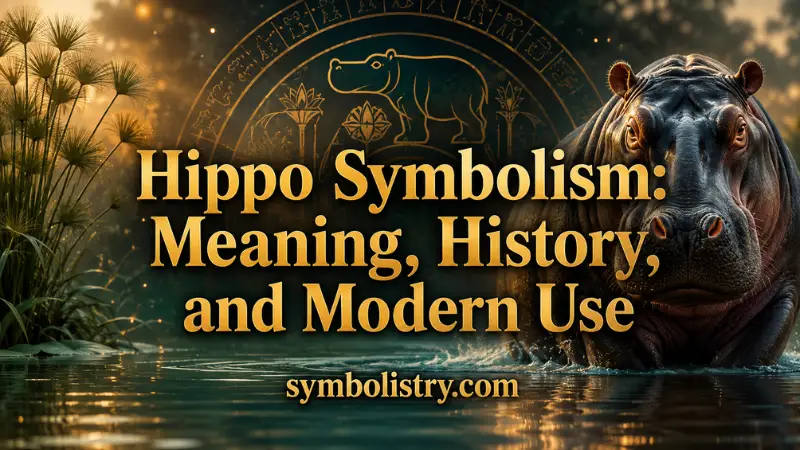
Hippo symbolism often centers on strength, protection, confidence, resilience, and the contrast between calm appearance and formidable power. That combination makes the hippopotamus unusually expressive as a symbol: it can seem relaxed and almost playful while possessing the size, speed, and defensive ability to command its environment.
For Americans, the hippo is encountered mostly through zoos, children’s media, toys, documentaries, museum collections, tattoos, and online culture rather than everyday wildlife. Those settings have produced a modern image that ranges from lovable and humorous to fiercely protective.
The animal also carries a much older symbolic history. In ancient Egypt, hippopotamuses could represent dangerous chaos, regeneration, royal power, motherhood, and protection depending on the context. That complexity matters because the hippo was never simply a symbol of brute strength.
Quick Answer
Hippo symbolism commonly represents strength, protection, confidence, resilience, and strong personal boundaries in modern American interpretation. Historically, especially in ancient Egypt, the hippopotamus could also represent danger and chaos as well as motherhood, protection, life, regeneration, and rebirth.
TL;DR
- Hippos commonly suggest strength, confidence, protection, and firm boundaries.
- Mothers with calves reinforce associations with fierce parental protection.
- Ancient Egyptians connected hippos with both chaos and regeneration.
- Taweret linked hippopotamus imagery with childbirth and family protection.
- American culture often presents hippos as lovable, humorous, and resilient.
- Modern meanings should not be mistaken for universal ancient traditions.
What a Hippo Represents at a Glance
The hippo’s symbolic range comes from an unusual combination of physical traits. It is massive but spends much of the day partly submerged. It can appear still and relaxed, yet it responds aggressively when its territory or young are threatened. Mothers and calves also maintain close bonds.
Those characteristics help explain why modern interpretations frequently emphasize contained strength rather than constant aggression. The hippo does not need to look busy or intimidating every moment to remain formidable.
| Context | Common Meaning in the USA | Associations | Important Note |
| Personal symbolism | Strength | Confidence, presence, endurance | Usually a modern interpretation |
| Family imagery | Protection | Motherhood, loyalty, defense | Reinforced by maternal behavior |
| Water imagery | Emotional depth | Calm exterior, hidden force | Interpretive rather than universal |
| Egyptian-inspired art | Rebirth and protection | Taweret, Nile, regeneration | Meaning depends on historical context |
| Pop culture | Humor and affection | Playfulness, appetite, charm | Often very different from wild behavior |
Why Real Hippo Behavior Influences Its Meaning
Symbolism often grows from what people notice about an animal, and hippos provide plenty of striking material.
Common hippos are semiaquatic mammals that spend much of the daytime in or near water and typically leave it to feed after dark. Despite their heavy bodies, they can move rapidly on land. Males can defend stretches of water, while females with young can respond aggressively to perceived threats.
That combination creates several natural symbolic associations.
A resting hippo can suggest composure. Its sheer mass suggests physical presence and stability. Territorial behavior lends itself to ideas about boundaries, while maternal defense supports associations with family protection.
These meanings do not constitute a universal symbolic code. They are interpretations humans have developed by translating noticeable animal behavior into human qualities.
Strength Without Constant Display
The hippo is especially suited to representing strength that does not require constant performance.
Unlike animals commonly portrayed in pursuit or flight, hippos are frequently pictured standing in water, resting near a riverbank, or watching their surroundings. Their appearance can communicate solidity before any action occurs.
For that reason, a hippo can symbolize someone who is:
- secure without needing attention
- difficult to intimidate
- patient until action becomes necessary
- comfortable occupying space
- capable of defending personal limits
In modern American personal symbolism, this makes the animal a useful alternative to more familiar strength symbols such as lions, bears, or wolves. A lion often implies visible authority, whereas a hippo can suggest quiet authority backed by considerable force.
There is also a caution within this meaning. Confidence and healthy boundaries can become stubbornness or hostility when every challenge is treated as a threat.
Protection, Motherhood, and Family Bonds
One of the most historically grounded positive meanings attached to the hippopotamus is protection, particularly maternal protection.
Female hippos can be highly defensive around calves, and close mother-calf relationships are well documented. This observable behavior appears to have contributed to ancient Egyptian associations between female hippopotamuses and protective motherhood.
The symbolism therefore extends naturally to ideas such as:
Protective love. Caring for someone sometimes requires firmness rather than softness.
Family loyalty. The hippo can represent a person who takes responsibility for the safety of loved ones.
Maternal courage. In Egyptian religious imagery, protection of mothers and children became especially important.
For a modern necklace, illustration, tattoo, or keepsake, a mother and calf can therefore communicate family attachment more clearly than a lone aggressive hippo.
Water, Land, and the Idea of Two Worlds
Hippos inhabit an environmental boundary between water and land. That physical reality has encouraged modern symbolic interpretations involving emotional balance, adaptability, and the difference between what is visible and what remains beneath the surface.
Water is frequently used in art and psychology as a metaphor for emotion or the less visible parts of experience. A mostly submerged hippo fits that imagery almost perfectly: only part of an enormous animal may be visible.
A person choosing that image might use it to express:
- more strength than others initially recognize
- a private emotional life beneath a calm exterior
- comfort moving between different roles or environments
- the need for both retreat and outward action
These are modern metaphorical readings, not documented universal beliefs about hippos. The distinction is important whenever personal symbolism is presented alongside historical tradition.
Ancient Egypt: Chaos, Danger, and Royal Control
Ancient Egyptian attitudes toward hippopotamuses were notably ambivalent.
The animals lived in and around the Nile and could threaten people, boats, crops, and river activity. Their dangerous nature contributed to an association with uncontrolled force and chaos. From around 3000 B.C., royal imagery could show a ruler hunting a hippopotamus, turning the hunt into an image of the king overcoming disorder and maintaining cosmic and social order.
By the New Kingdom, the hippopotamus could also be linked with Seth, a deity who came to occupy increasingly hostile roles in Egyptian religious narratives. Later ritual scenes could portray Horus defeating Seth in hippopotamus form.
This is why describing the ancient Egyptian hippo simply as a “good luck animal” is misleading.
Its dangerous side mattered. In certain contexts, the animal represented exactly the kind of destructive force that human or divine authority needed to control.
Life, Regeneration, and Rebirth Along the Nile
The same Egyptians who feared hippos also associated them with life and renewal.
The Nile supported agriculture and human settlement, making its waters central to Egyptian ideas about fertility and continuity. Hippos disappeared beneath the water and surfaced again, behavior that could be understood through themes of disappearance, return, regeneration, and rebirth.
Faience hippopotamus figures from the Middle Kingdom provide some of the most recognizable examples.
Many were decorated with lotus flowers and other river plants. Lotuses themselves were associated with regeneration because of their daily cycle of opening and closing. Hippo figures placed in tombs could therefore combine the regenerative symbolism of the animal, water, plants, and the Nile environment.
The famous blue faience hippopotamus known as William, now at The Metropolitan Museum of Art in New York, comes from this tradition. Its pleasant modern appearance can obscure a historical tension: such figures embodied life-giving qualities while still representing an animal whose destructive potential had to be controlled.
Taweret and the Protective Hippopotamus Goddess
The clearest connection between hippos and protective motherhood comes through Taweret, an ancient Egyptian goddess associated with pregnancy, childbirth, women, and children.
Taweret was not simply depicted as an ordinary hippo. Her composite form incorporated traits associated with several formidable animals, including the hippopotamus, crocodile, and lion. That frightening appearance had a protective purpose: dangerous power could be turned against forces believed to threaten a mother or child.
Images and amulets of Taweret were used in domestic and personal religious life. Her association with childbirth helps explain why the female hippo became one of history’s strongest examples of fierceness functioning as protection rather than aggression for its own sake.
For modern readers, Taweret also provides a useful reminder that ancient symbols cannot be reduced to simple personality traits. Her meaning belonged to a specific religious system and set of practices.
Hippos in African Cultural Traditions Beyond Egypt
Africa contains thousands of distinct cultural traditions, so there is no single “African meaning” for the hippopotamus.
In some African artistic traditions, the animal’s relationship with rivers, physical danger, valuable resources, and the boundary between water and land has contributed to associations involving water spirits, wealth, authority, and danger. The National Museum of African Art, for example, has documented hippo imagery within specific water-spirit traditions rather than treating the animal as having one meaning across the continent.
That distinction is essential.
Statements such as “African culture believes the hippo means…” flatten many cultures into one imaginary tradition. A responsible interpretation identifies the community, region, religion, or historical period whenever a specific traditional meaning is claimed.
What Hippos Commonly Mean in the United States
The United States has no single traditional national meaning attached to the hippopotamus. Modern American associations come primarily from museums, zoos, entertainment, children’s products, wildlife education, and individual artistic interpretation.
Several meanings appear especially naturally in those settings.
Resilience comes from stories of individual animals surviving difficult circumstances.
Protection draws from both real behavior and knowledge of Taweret.
Confidence comes from the hippo’s physical presence.
Humor and playfulness come largely from entertainment rather than biology.
Hidden strength reflects the contrast between a rounded, sometimes charming appearance and a genuinely dangerous wild animal.
In other words, the American hippo is often softer and friendlier in popular imagination than the animal encountered in ancient Nile communities.
From Museum Icon to American Pop Culture
American media has repeatedly transformed the hippo into an approachable or comic character.
The Met’s ancient Egyptian “William” became the museum’s unofficial mascot, giving an ancient funerary object a completely new cultural life in New York.
The long-running Hungry Hungry Hippos game similarly presents hippos as frantic, comic eating machines. Hasbro continues to market versions of the familiar marble-chomping game to American families, reinforcing a playful association between hippos, appetite, competition, and childhood nostalgia.
More recently, Marvel’s Moon Knight introduced a popular-media version of Taweret, bringing the ancient Egyptian hippopotamus-associated goddess to a broad contemporary audience. The character retains connections with Egyptian mythology while being adapted for modern entertainment.
Zoo animals can become symbols too. Cincinnati Zoo’s Fiona, born prematurely in 2017, developed an international following after surviving an extremely difficult start in life. Her story led many admirers to associate her with hope and perseverance.
Together, these examples explain why American hippo imagery can feel simultaneously ancient, funny, affectionate, and inspirational.
Tattoos, Jewelry, and Personal Style
A hippo tattoo usually has no fixed meaning. Its message depends on the animal’s pose, accompanying imagery, style, and the wearer’s reason for choosing it.
A realistic standing hippo may emphasize strength, self-possession, or toughness.
A mother and calf can suggest parenthood, loyalty, or protective love.
A hippo emerging from water can represent hidden abilities or an emotional life that others do not immediately see.
An Egyptian-inspired hippo or Taweret design may refer to protection, motherhood, ancient Egypt, or rebirth, although accurate use benefits from understanding the original religious context.
A cartoon hippo often means something much simpler: humor, nostalgia, affection, or attachment to a favorite animal.
The same principle applies to jewelry and decor. Personal symbolism does not become less valid because it is modern, but it should not be presented as ancient fact when it is actually an individual interpretation.
Emotional and Psychological Meaning
Psychologically, hippo imagery tends to work through contrast.
The animal looks rounded, grounded, and sometimes almost serene. Yet its jaws, territorial behavior, and physical strength tell a very different story. That tension makes the hippo a useful metaphor for people who do not want gentleness confused with weakness.
Emotionally, it may express:
Self-acceptance. The hippo occupies space unapologetically.
Boundaries. Approach and access are not automatically granted.
Protectiveness. Care can include confrontation when something important is threatened.
Emotional restraint. A calm exterior does not necessarily reveal the full intensity underneath.
Resilience. Large obstacles do not automatically require frantic movement.
Used carefully, these meanings make the hippo less a symbol of aggression than a reminder that security can combine calmness with the capacity to respond.
Positive and Negative Meanings
Like many animal symbols, the hippo changes meaning according to context.
On the positive side, it can suggest stability, courage, loyalty, resilience, parenthood, and self-confidence.
On the negative side, the same traits can become territoriality, possessiveness, stubbornness, intimidation, or destructive anger.
Ancient Egyptian imagery demonstrates this duality especially well. Hippos could be linked with life and protective goddesses while also standing for chaotic danger.
A useful way to interpret the image is therefore to ask what the animal is doing. A mother shielding a calf communicates something very different from a charging animal or a hippo being ritually defeated.
Common Misunderstandings and Misuse
One of the biggest mistakes is assuming that every meaning found online represents an ancient tradition.
Claims about a universal “hippo spirit animal,” for example, are usually modern spiritual interpretations rather than evidence of one shared historical belief. Hippos are native to Africa, so claims about an ancient Native American tradition centered specifically on the hippopotamus should be treated with particular skepticism.
Another mistake is treating ancient Egyptian meanings as interchangeable. Taweret’s protective role does not mean every Egyptian image of a hippo represented motherhood. Hippos could also signify danger, chaos, regeneration, or forces requiring control.
The reverse distortion happens in popular culture. Cartoon depictions can make hippos seem harmless and slow. Real animals are large, territorial wildlife capable of rapid and dangerous defensive responses.
Understanding both sides produces a more accurate symbol: appealing, protective, and impressive, but never powerless.
How the Meaning Has Changed Over Time
The hippopotamus offers a striking example of symbolic evolution.
For people living beside the ancient Nile, the animal was part of daily environmental reality. It could threaten boats and communities while also belonging to the river system that sustained life. Religious symbolism grew directly from that complicated relationship.
In the modern United States, most people experience hippos at a safe distance. Zoo glass, museum cases, screens, toys, and animated characters replace direct encounters.
As that distance increased, the symbolism became more affectionate.
Danger did not disappear completely, but cuteness, resilience, humor, confidence, and family attachment became much more prominent. Ancient imagery also found new audiences through museums and entertainment, allowing meanings such as protection and rebirth to survive in altered forms.
That evolution does not erase older interpretations. Instead, it shows how symbols change when the relationship between humans and the thing being symbolized changes.
FAQs
What does a hippo symbolize spiritually?
In modern spiritual interpretation, a hippo may represent grounded strength, emotional depth, boundaries, protection, or confidence. These meanings are largely contemporary unless they are tied to a documented tradition such as ancient Egyptian beliefs surrounding Taweret and regeneration.
Is a hippo a symbol of good luck?
There is no universal tradition in which every hippo represents good luck. Some historical Egyptian hippo figures and protective images carried beneficial associations with life, rebirth, protection, or safe childbirth, but the animal could also represent dangerous or chaotic forces.
What does a hippo tattoo mean?
A hippo tattoo can represent strength, resilience, protective love, personal boundaries, humor, or affection for the animal. Egyptian-style designs may add meanings connected with Taweret, protection, regeneration, or ancient Egyptian culture.
What does a mother hippo symbolize?
A mother hippo most naturally represents fierce parental protection and devotion to family. The association has both behavioral support and a strong historical parallel in ancient Egyptian protective hippopotamus goddesses.
Does the hippopotamus symbolize rebirth?
It can, particularly in an ancient Egyptian context. Hippos’ connection with Nile waters, their disappearance and reappearance at the surface, and their use in decorated funerary figures contributed to associations with regeneration and rebirth.
Are hippos positive or negative symbols?
They can be either. Positive readings include protection, resilience, confidence, motherhood, and renewal, while negative readings include aggression, territoriality, chaos, and destructive force.
Conclusion
The hippopotamus is most meaningful as a symbol of strength that exists alongside stillness, protection that can become fierce, and an outward calm that should never be mistaken for weakness. Its history also shows that a single animal can represent opposite ideas depending on who is using the image and why.
Ancient Egyptians saw both danger and life in the animal, while modern Americans often encounter it through museums, zoos, entertainment, and personal art. Hippo symbolism therefore connects some of humanity’s oldest surviving animal imagery with newer ideas about confidence, resilience, family, humor, and personal boundaries.
Its most enduring lesson may be the simplest: something can appear calm, approachable, or even playful while possessing far more strength than its surface reveals.