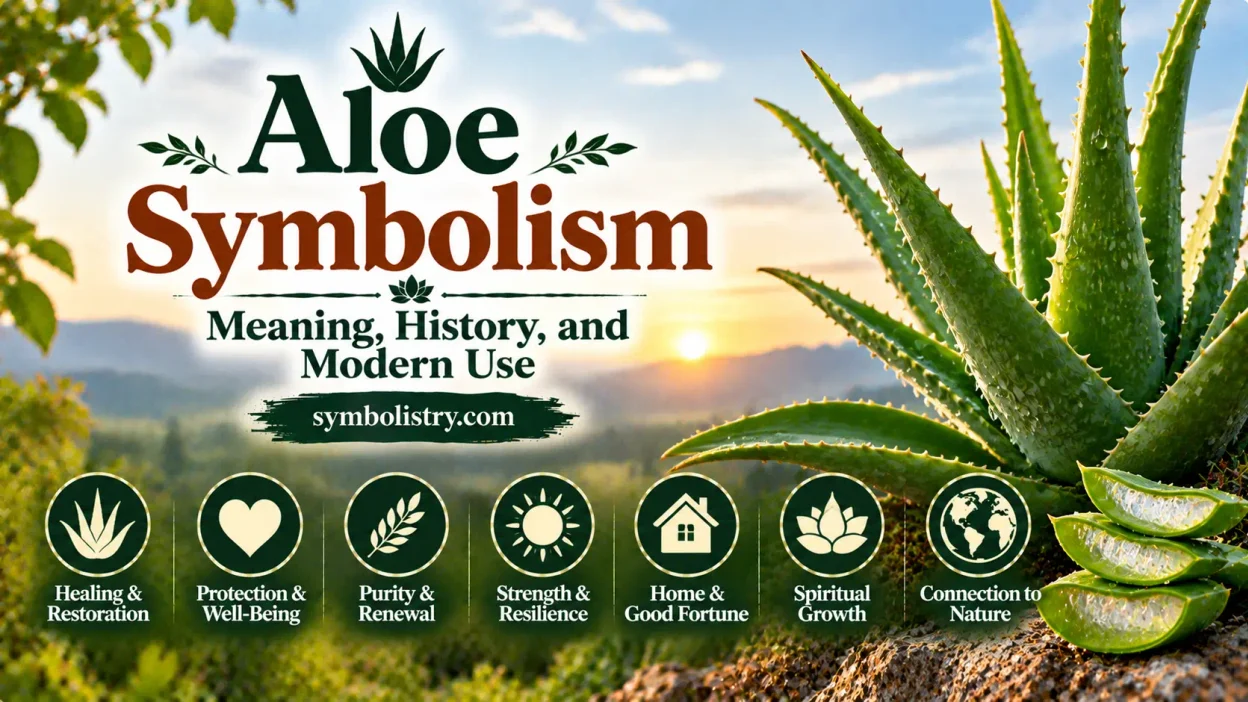
Aloe is widely recognized for its thick, fleshy leaves and the clear gel inside them, which has long been used in skin-care products and traditional remedies. In aloe symbolism, the plant commonly represents healing, protection, resilience, and renewal. Its ability to survive dry conditions while storing water makes it a natural image of endurance and self-preservation.
In the United States, aloe appears in homes, gardens, wellness products, and personal-care routines. Many people associate it with relief after sun exposure, soothing irritated skin, or maintaining a connection to nature. These practical associations also shape the plant’s symbolic meaning: aloe suggests care that is quiet, useful, and restorative.
Aloe’s story extends beyond contemporary skin care. Different societies have valued aloe species for their practical uses, and some traditions have connected the plant with protection, good fortune, and continued well-being. Understanding these associations requires separating documented historical practices from modern interpretations and popular spiritual beliefs.
Quick Answer
Aloe commonly symbolizes healing, protection, resilience, and renewal in modern American culture, especially through its association with skin care, wellness, and the ability to thrive in difficult conditions. Historically, aloe species have been valued for medicinal and household uses, while some cultural traditions have associated the plant with good fortune and protection.
TL;DR
- Healing: Aloe represents soothing care, recovery, and restoration.
- Resilience: Its water-storing leaves suggest endurance in difficult conditions.
- Protection: Some traditions associate aloe with safeguarding the home.
- Renewal: Fresh growth represents recovery and the beginning of a new phase.
- American culture: Aloe connects plant symbolism with skin care and everyday wellness.
- Modern use: People incorporate aloe into tattoos, gardens, gifts, and natural decor.
1. What Aloe Looks Like and Why Its Appearance Matters
Aloe is a genus of succulent plants best known for thick, fleshy leaves that grow in a rosette, spreading outward from a central point. Many varieties have pointed tips, toothed leaf margins, and a waxy surface that helps limit water loss. Depending on the species, the leaves may be green, gray-green, blue-green, or marked with pale spots.
The familiar aloe vera plant contains a clear gel inside its leaves. This gel has contributed substantially to the plant’s reputation for soothing and restoration. Its pointed exterior, however, creates an interesting visual contrast: the plant appears guarded while containing a soft, moisture-rich interior.
That contrast supports several modern interpretations:
- Strength with gentleness: A protective exterior can coexist with a caring nature.
- Self-preservation: Thick leaves represent the ability to conserve resources.
- Restoration: The gel suggests comfort and care after physical discomfort.
- Steady growth: The compact, enduring plant represents progress without constant attention.
These interpretations are symbolic readings of the plant’s physical characteristics, not universal meanings shared by every culture.
2. The Core Symbolic Meanings of Aloe
Aloe has several connected meanings, but healing is generally the most recognizable in contemporary American culture. Its reputation comes primarily from practical experience and the widespread presence of aloe-based skin-care products.
Healing and recovery
Aloe is associated with tending to the body, relieving discomfort, and allowing time for recovery. As a symbol, it can represent the decision to care for oneself after illness, disappointment, exhaustion, or a difficult personal experience.
Protection and security
The plant’s firm, pointed leaves can suggest boundaries and defense. In some folk traditions, aloe is also kept near entrances as a protective plant. This association combines its physical appearance with beliefs about safeguarding a household.
Resilience and endurance
Aloe stores water in its leaves, enabling it to survive periods of limited rainfall. This makes it a fitting emblem of resourcefulness, patience, and the ability to withstand challenging circumstances.
Renewal and fresh beginnings
New leaves emerge from the plant’s center as it grows. This pattern can represent gradual recovery, personal development, and the possibility of starting again without abandoning what has already been learned.
Good fortune and well-being
Some cultural and folk practices associate aloe with luck, prosperity, or a favorable home environment. These meanings vary by community and should not be treated as a universal belief about the plant.
Together, these associations make aloe a symbol of care that includes both protection and the capacity to recover.
3. Ancient Roots and Early Symbolism
Aloe has a long history of human use, although its precise origins and the identities of plants mentioned in ancient records can be difficult to establish. The genus includes many species, and historical writers did not always distinguish them using modern botanical classifications.
Records from ancient Mesopotamia and Egypt describe aloe or substances identified by that name in medicinal contexts. The Egyptian Ebers Papyrus, dating to approximately 1550 BCE, contains medical recipes that reflect the period’s extensive use of plant-based preparations.
Aloe also became known in Greek and Roman medical traditions. Ancient writers discussed preparations made from aloe in connection with bodily complaints, skin care, and other treatments. Its dried, bitter leaf exudate was also valued for uses distinct from those of the clear inner gel familiar today.
These practical applications help explain why aloe acquired associations with healing, health, and preservation. When a plant becomes part of a community’s approach to caring for the body, its importance can extend beyond its immediate function.
Claims that aloe was universally regarded as a sacred plant or a guaranteed symbol of immortality, however, require caution. Later accounts sometimes combine historical medical practices with legends and romanticized stories about ancient rulers.
The strongest historical conclusion is that aloe’s medicinal reputation developed over a long period and helped establish the foundation for its later symbolic associations.
4. Aloe in Ancient Egyptian Beliefs and Traditions
Ancient Egypt is frequently associated with aloe in popular accounts of plant history. Modern retellings sometimes call it the “plant of immortality,” linking it to beauty, preservation, and the afterlife.
Such descriptions should be distinguished from what historical evidence can establish. Aloe-related substances appear in ancient Egyptian medicinal traditions, but popular stories about particular pharaohs, royal beauty routines, and specific funerary customs are not equally well documented.
Nevertheless, the broader connection between plant-based preparations, bodily care, and preservation provides a useful context for understanding aloe’s symbolic development.
In a culture where preparation for the afterlife and the preservation of the body held religious importance, substances used for bodily maintenance could acquire associations extending beyond ordinary household care. Aloe’s reputation as a useful plant made it a natural subject for later stories about vitality and longevity.
Today, the Egyptian connection often appears in wellness writing, botanical illustrations, and historical discussions of natural remedies. It can enrich an understanding of aloe’s past, provided that modern interpretations are not presented as proven beliefs held by every ancient Egyptian.
5. What Aloe Symbolizes in the United States
In the United States, aloe is most commonly understood through everyday experiences rather than elaborate religious or mythological systems.
Many Americans encounter aloe in moisturizing lotions, after-sun products, cosmetics, household plants, and garden centers. The plant’s association with skin care has helped make it a recognizable image of comfort and practical wellness.
Its symbolism often appears in four settings.
Home life: A potted aloe can represent a calm, functional home and an interest in keeping useful plants nearby.
Personal wellness: Aloe-themed packaging and botanical imagery suggest gentle care, hydration, and a connection to natural ingredients.
Gardening: Its drought tolerance makes aloe attractive to people interested in low-water gardening, particularly in warm regions of the country.
Personal identity: Someone may choose aloe as a personal symbol because it represents recovery, independence, or a preference for quiet strength over dramatic displays.
The plant also fits contemporary American interest in houseplants as elements of interior design. A small aloe on a kitchen counter or sunny windowsill can make a room feel more connected to the natural world.
Unlike the rose, which often communicates romantic affection, aloe tends to suggest practical care. Its message is less about grand gestures and more about attending to what needs attention.
6. Aloe Symbolism Across Different Cultures
Aloe has traveled through trade, cultivation, migration, and the exchange of medical knowledge. As a result, its cultural associations are diverse rather than uniform.
| Context | Common symbolic association | Why it developed | Important distinction |
|---|---|---|---|
| Ancient Egyptian traditions | Care, preservation, and vitality | Connections with plant-based preparations and bodily care | Popular immortality stories are not all equally documented |
| Traditional Mediterranean medicine | Healing and bodily maintenance | Historical use of aloe-derived preparations | Historical treatment does not prove every claimed benefit |
| Some Mexican and border-region folk practices | Protection and good fortune | Household traditions involving aloe plants near entrances | Beliefs vary among families and communities |
| Modern American wellness culture | Healing and self-care | Aloe’s visibility in skin-care and personal-care products | Marketing language can overstate its effects |
| Contemporary gardening | Resilience and resourcefulness | Adaptation to dry conditions and relatively simple care | These are modern interpretations, not fixed cultural rules |
In some Mexican and Mexican American folk practices, aloe has been placed near shop or household entrances with the intention of attracting good fortune or protecting the space. Such customs demonstrate how an ordinary plant can become part of a family’s understanding of home, security, and prosperity.
The meaning should not be generalized to every Mexican household or treated as a single belief shared throughout Latin America.
Elsewhere, aloe’s importance may be primarily practical, medicinal, ornamental, or commercial. Its symbolism often develops from the role the plant plays in everyday life rather than from one shared international tradition.
7. The Emotional and Psychological Meaning of Aloe
Aloe can communicate a particular emotional message: recovery does not always require dramatic change. Sometimes it begins with small, consistent acts of care.
This makes the plant meaningful to people who have experienced demanding periods in their lives. A person recovering from burnout, adjusting to a major transition, or rebuilding confidence may see aloe as a reminder to protect personal resources and allow time for growth.
Its appearance contributes to that interpretation. The thick leaves hold water, while the plant can remain viable through dry periods. The visible structure offers a natural analogy for preserving energy during difficult circumstances.
Aloe may therefore represent:
- Emotional boundaries: Protecting one’s time, attention, and well-being.
- Patience: Accepting that recovery takes longer than expected.
- Self-reliance: Developing the ability to meet challenges with available resources.
- Gentleness: Recognizing that care can be effective without being forceful.
- Hope: Continuing to grow even when conditions are imperfect.
These associations are personal interpretations, not psychological diagnoses or scientifically established effects of looking at an aloe plant.
For some people, aloe simply evokes a familiar household remedy or a parent’s care after a minor injury. That ordinary memory can be more meaningful than any ancient legend.
8. Aloe in Spirituality, Folk Beliefs, and Home Protection
In contemporary spiritual and folk practices, aloe sometimes appears as a protective plant associated with good luck, household harmony, or the removal of unwanted influences.
A common practice in some traditions is to place aloe near a doorway or another prominent entrance. The plant’s presence can serve as a reminder of the intention to maintain a safe, welcoming home.
Some modern spiritual interpretations also connect aloe with cleansing, balance, and the restoration of personal energy. These ideas often draw on its associations with healing and its ability to survive in challenging conditions.
It is important to distinguish these beliefs from botanical facts. There is no established scientific evidence that placing aloe in a particular location prevents misfortune, removes supernatural influences, or guarantees prosperity.
People can still value such practices as expressions of culture, family tradition, or personal intention. A plant does not need to possess supernatural abilities to become meaningful within a household.
For readers interested in aloe’s spiritual associations, the most respectful approach is to understand the tradition behind a particular practice rather than assuming every aloe plant carries the same religious or magical meaning.
9. Why Aloe Represents Resilience and Survival
Aloe’s association with resilience has a clear botanical basis. Many aloe species are succulents adapted to environments where water availability can be unpredictable. Their fleshy leaves store moisture, helping them endure conditions that would challenge less-adapted plants.
The plant’s survival strategy offers a useful metaphor for human endurance.
Resilience does not always mean pushing harder. It can mean conserving energy, adapting to circumstances, and making careful use of limited resources. Aloe embodies that idea through its physical structure rather than through rapid growth or conspicuous movement.
This interpretation can be particularly relevant during periods of financial pressure, personal uncertainty, or major life changes. The plant suggests that survival often depends on preparation and adjustment, not simply determination.
Aloe is not indestructible, however. It can suffer from excessive watering, poor drainage, insufficient light, or unsuitable temperatures. Its resilience depends on conditions that support its growth.
That detail makes the symbolism more realistic. Strength is not the absence of vulnerability; it is the ability to respond to circumstances and maintain what is necessary to continue.
10. Aloe Symbolism in Tattoos, Jewelry, and Personal Style
Aloe is a less conventional tattoo subject than a rose, lotus, or sunflower, but its distinctive shape makes it suitable for botanical artwork.
People may choose an aloe tattoo to commemorate a period of healing, express independence, or represent a commitment to self-care. Someone who has recovered from a difficult chapter may prefer the plant because it conveys restoration without relying on familiar symbols such as butterflies or phoenixes.
The design itself can change the impression.
- A simple aloe outline suggests understated strength and appreciation for nature.
- A young aloe plant can represent a fresh start or developing confidence.
- A mature rosette may communicate stability, endurance, and self-sufficiency.
- Aloe combined with flowers can balance protective imagery with tenderness and growth.
- A potted aloe may reflect domestic comfort, personal roots, or the importance of everyday rituals.
In jewelry, aloe may appear in botanical pendants, engraved charms, or nature-inspired accessories. The wearer might connect it with recovery, a meaningful place, or a person who provided care during a difficult time.
As with any plant tattoo or accessory, there is no universal code. Its significance depends on the wearer’s experience, the design, and the context in which it is worn.
11. Aloe in Interior Design, Gardens, and Gifts
Aloe works well as a symbolic gift because it combines an attractive form with a familiar practical purpose.
Giving someone a potted aloe can express a wish for well-being, encourage a new hobby, or mark a transition into a new home. It may also be a thoughtful choice for someone who appreciates plants but prefers varieties that generally require less frequent watering than many tropical houseplants.
The message changes with the occasion.
For a housewarming, aloe may suggest a wish for a comfortable and secure home. For someone beginning a new job or moving to another city, it can represent adaptability and steady growth. As a gift after a difficult period, it may communicate encouragement without requiring a long or emotional explanation.
In interior design, aloe suits natural materials, neutral colors, desert-inspired spaces, and minimalist rooms. Its structured leaves add texture without overwhelming a small space.
Aloe is also a practical choice for many warm-climate gardens, although local temperatures and growing conditions matter. In colder regions, containers allow gardeners to bring frost-sensitive plants indoors when necessary.
When giving aloe, it is worth considering the recipient’s pets. Aloe vera can be toxic to cats and dogs if ingested, so placement should be chosen carefully.
12. Aloe in Wellness Marketing and Popular Culture
Aloe’s modern image has been shaped heavily by the personal-care industry. The plant appears on packaging for lotions, cleansers, shampoos, moisturizers, and products marketed for use after sun exposure.
Its recognizable leaves and clear gel create an immediate visual association with freshness and skin care. Companies often use aloe imagery to communicate gentleness, botanical ingredients, or a more natural approach to personal maintenance.
This commercial visibility has reinforced aloe’s symbolism in American life. A plant that once required familiarity with traditional remedies can now be recognized by consumers through supermarket shelves and pharmacy aisles.
However, the presence of aloe on a label does not establish that a product will deliver every benefit suggested by its marketing. Product formulations vary, and scientific evidence differs depending on the preparation and intended use.
The same caution applies to online wellness content. Claims that aloe can solve a wide range of unrelated health problems often exceed what reliable evidence supports.
Its symbolic association with healing remains understandable, but the symbol should not be confused with a guarantee of medical effectiveness. Aloe’s place in popular culture reflects both its real history of use and the commercial stories built around it.
13. Common Misunderstandings About Aloe Symbolism
Several misconceptions arise when aloe’s history, botanical properties, and modern spiritual interpretations are treated as though they were interchangeable.
Misunderstanding 1: Aloe has one universal spiritual meaning.
There is no single interpretation shared by every culture. Healing and resilience are common modern associations, while protection, good fortune, and other meanings depend on particular traditions or personal beliefs.
Misunderstanding 2: Ancient people used aloe exactly as we do today.
Historical preparations differed from modern commercial products. Ancient records sometimes refer to substances that may have come from different aloe species or different parts of the leaf.
Misunderstanding 3: Aloe is a cactus.
Aloe resembles a cactus because both can have thick leaves or stems adapted to dry conditions. However, aloe is a succulent in the family Asphodelaceae, not a cactus in the family Cactaceae.
Misunderstanding 4: Natural ingredients are automatically safe.
Natural origin does not guarantee safety. Aloe gel, yellow latex, and whole-leaf preparations differ, and some forms can cause adverse effects. Symbolic associations with healing should not replace careful decisions about health products.
Misunderstanding 5: Every aloe plant near a doorway has a spiritual purpose.
Aloe may be placed near an entrance for cultural or spiritual reasons, but it may also be there for sunlight, convenience, or decoration. Appearance alone does not reveal the owner’s beliefs.
Separating these misunderstandings from the plant’s actual history makes its symbolism more useful and culturally responsible.
14. How Aloe’s Meaning Has Evolved Over Time
Aloe’s symbolic development reflects changes in how people encounter plants and understand their value.
In ancient societies, aloe was known largely through its practical applications and its place in medicinal traditions. The plant’s usefulness helped establish associations with bodily care and well-being.
As aloe and aloe-derived products moved through trade networks, knowledge of the plant spread across regions. Different communities incorporated it into their own practices, while botanical names and historical descriptions sometimes became confused.
In the United States, commercial cultivation expanded during the twentieth century. Aloe became increasingly visible in skin-care products, household remedies, and eventually mainstream wellness marketing. This made healing and personal care central to its contemporary image.
Modern interpretations have broadened further. Gardeners may associate aloe with drought tolerance, design enthusiasts with minimalism, and people who use plants as personal symbols with resilience or recovery. Spiritual communities may retain or develop associations with protection and good fortune.
The result is not a replacement of one meaning with another, but an accumulation of meanings shaped by use, culture, and individual experience.
Aloe’s story illustrates how symbolism often develops: people first recognize what a plant does, then build emotional and cultural associations around what it has come to represent.
Frequently Asked Questions
1. What does an aloe plant symbolize spiritually?
Aloe is often associated with healing, protection, resilience, and well-being in contemporary spiritual interpretations. Some folk traditions connect it with good luck or safeguarding a home, but these beliefs are not universal.
2. Is aloe a symbol of healing?
Yes, healing is one of aloe’s most recognizable modern associations, particularly in the United States. Its longstanding use in traditional remedies and its presence in skin-care products help explain this connection, although symbolism does not establish the effectiveness of a particular treatment.
3. What does an aloe tattoo mean?
An aloe tattoo may represent recovery, emotional boundaries, independence, or the ability to endure difficult circumstances. Its precise meaning depends on the person’s experiences and the details of the artwork.
4. Does aloe bring good luck when placed near a front door?
Some cultural and folk practices associate aloe near an entrance with protection or good fortune. There is no scientific evidence that its placement changes a person’s luck, but the practice may hold cultural, personal, or decorative significance.
5. What does a gift of an aloe plant mean?
An aloe plant can express wishes for health, resilience, and a comfortable new beginning. It may be especially appropriate for a housewarming, a new job, or a period when someone is rebuilding their routine.
6. What is the difference between aloe’s historical and modern meanings?
Historical associations developed partly from medicinal and household uses, while modern meanings also reflect wellness culture, gardening, interior design, and personal expression. Protection and good fortune appear in some traditions, but neither meaning applies to every culture or individual.
7. Is aloe associated with immortality?
Aloe is sometimes described in popular accounts as an ancient symbol of immortality, particularly in stories connected with Egypt. This label simplifies a complicated history; documented medicinal uses provide firmer evidence than broad claims that all ancient Egyptians regarded aloe as a universal emblem of eternal life.
Conclusion
Aloe symbolizes healing, protection, resilience, and renewal because its physical qualities and practical uses have made it an enduring part of human life. From traditional plant-based remedies to modern American skin care and home gardening, it represents the value of preserving well-being and adapting to difficult conditions.
The meaning of aloe is not fixed. One person may see a reminder of recovery, another may value its connection to family traditions, and someone else may simply appreciate its ability to grow with relatively little water. Its spiritual associations also vary, reflecting the different communities and personal experiences that have shaped its use.
Ultimately, aloe symbolism is most compelling when understood through the relationship between usefulness and meaning. The plant does not promise a life without hardship; it offers a grounded reminder that care, patience, and adaptability can help sustain growth.