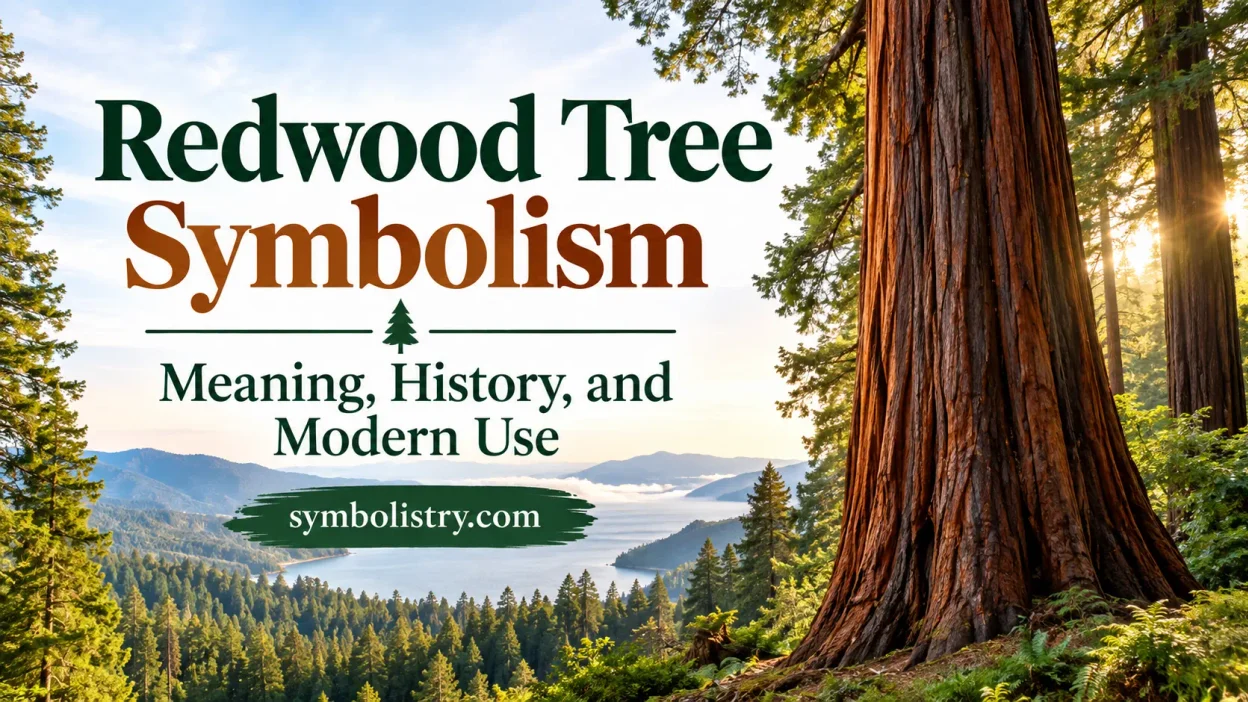
Few American trees carry as much cultural weight as the coast redwood. Towering above California’s North Coast, these trees are associated with longevity, endurance, protection, connection to nature, and continuity between generations. Redwood tree symbolism matters because the meaning attached to these forests comes from several overlapping histories: Indigenous traditions, the American logging era, conservation movements, and the modern desire to preserve places that outlast individual human lives.
The redwood is also unusual because its symbolism is closely tied to its physical reality. A tree that can live for centuries, rise hundreds of feet, survive fire and environmental stress, and regenerate after damage naturally invites ideas about endurance and renewal. Yet its cultural meaning is more complicated than simply calling it a “tree of strength.”
For Americans today, a redwood can represent both what has endured and what nearly disappeared. Its story includes Indigenous stewardship, violent displacement, commercial exploitation, conservation activism, public parks, and ongoing restoration. That history gives the tree a distinctive place in American environmental culture.
Quick Answer
Redwood tree symbolism commonly represents longevity, endurance, resilience, connection to nature, and continuity in modern American culture, especially in conservation, memorial, and personal-growth contexts. Historically, redwoods also carried spiritual and cultural significance for Indigenous peoples of California’s North Coast, while later Americans associated them with both industrial prosperity and the need to protect ancient forests.
TL;DR
- Redwoods commonly symbolize endurance, longevity, resilience, and connection to nature.
- Indigenous North Coast cultures developed distinct relationships with redwood forests.
- American logging transformed redwoods from natural resources into conservation symbols.
- Their enormous size encourages associations with perspective, stability, and lasting memory.
- Modern uses include memorials, tattoos, artwork, landscaping, and environmental identity.
- Redwood symbolism can mean both survival and responsibility for preservation.
What the Redwood Represents Physically
The symbolism begins with the tree itself.
Coast redwoods are among the tallest trees on Earth. Their enormous trunks, reddish bark, high canopies, and ability to live for many centuries create an immediate impression of permanence. They do not look temporary or fragile. Standing beneath one can make ordinary human measurements—height, age, and individual lifespan—seem comparatively small.
That physical scale explains why redwoods are often associated with stability and endurance.
Their bark also contributes to their cultural image. The reddish-brown surface gives the tree a distinctive appearance unlike the pale trunks of many other forest species. Thick bark provides substantial protection against fire, while mature trees can survive environmental damage that would destroy smaller plants.
The trees also reproduce and regenerate in ways that reinforce the idea of continuity. New growth can emerge from existing root systems and damaged trees can sometimes remain alive and productive after losing major portions of their structure.
For symbolic purposes, the redwood therefore represents more than simply being old. It suggests remaining rooted while adapting to change.
What It Commonly Means in the United States
In contemporary American culture, several meanings consistently fit the image of a redwood.
Longevity is perhaps the most immediate. A person who chooses a redwood image for a memorial, tattoo, or piece of artwork may be expressing a desire for a legacy that extends beyond one lifetime.
Resilience is another common association. The tree’s ability to withstand environmental pressures makes it an appealing metaphor for surviving difficult periods without losing one’s foundation.
Groundedness comes from the contrast between enormous roots and enormous height. The symbolism works particularly well for people who want to express ambition without losing connection to family, place, or personal values.
Connection to nature is especially strong in the United States because redwoods have become closely associated with national and state parks, hiking, conservation, and environmental education.
There is also a quieter meaning: perspective. Standing beside a giant redwood can make everyday concerns seem smaller without suggesting that they are unimportant. The tree simply places an individual life within a much longer natural timeline.
Ancient Roots and Indigenous Relationships
Redwood symbolism cannot be understood accurately without recognizing the Indigenous cultures of California’s North Coast.
Yurok, Tolowa, Hupa, and other Indigenous peoples have longstanding relationships with the redwood landscape. These communities were not simply inhabitants of a forest; their cultures developed through detailed knowledge of its rivers, plants, animals, coastlines, and trees.
Redwood was used for practical purposes including houses, canoes, and other essential materials. Importantly, traditional use often involved fallen trees or trees washed onto beaches rather than treating the ancient forest as an unlimited supply of timber.
In some North Coast traditions, redwood was understood through spiritual relationships involving beings who existed before humans. The National Park Service records traditions in which redwood used in plank houses was associated with Spirit Beings and teachings about how people should live.
These traditions should not be reduced to one generic idea of “Native American redwood symbolism.” Different Indigenous nations have their own languages, histories, beliefs, and relationships with the landscape.
The broader lesson is that redwood symbolism in California predates American conservation culture by many centuries. For Indigenous communities, the tree was part of a living cultural landscape rather than merely an object representing an abstract virtue.
Why Redwoods Became Symbols of Longevity
The association between redwoods and longevity became particularly strong as Americans learned more about their age and geological history.
Redwood forests are remnants of a much broader ancient lineage. Fossil evidence shows that relatives of modern redwoods once occupied regions far beyond their present range.
This gives the trees an unusual relationship with time. They are living organisms, but they also seem to connect contemporary people with landscapes and ecosystems that existed long before modern California.
That quality makes the redwood a natural symbol of continuity across generations.
A memorial tree, for example, can communicate an idea that a photograph cannot. A photograph preserves an image of someone who lived; a tree continues growing after that person’s death. The symbolism shifts from remembrance alone toward continuation.
This is one reason trees are frequently planted in memory of loved ones, while redwoods are particularly suited to the idea of a legacy intended to last.
The Redwood and American Expansion
The meaning of redwoods changed dramatically during the nineteenth century.
After the discovery of gold in California, Euro-American settlement expanded rapidly. The enormous trees became valuable sources of lumber because their wood was durable, workable, and useful for construction.
Redwood forests consequently became part of America’s economic expansion.
This history complicates the modern image of the redwood as purely a symbol of environmental protection. For much of American history, the trees were also viewed as an economic resource.
The logging era transformed landscapes and reduced old-growth forests on a massive scale. The redwood therefore came to symbolize two competing American ideas: using nature to build prosperity and recognizing that some natural resources cannot simply be replaced.
That tension remains important today.
From Timber Resource to Conservation Symbol
By the late nineteenth and early twentieth centuries, concern over the loss of old-growth redwoods helped create organized conservation efforts.
California conservationists, writers, photographers, scientists, and civic leaders increasingly argued that some of the giant trees had value beyond their lumber.
The creation of organizations dedicated to saving redwood forests helped change public perception. Instead of seeing a giant tree primarily as timber, Americans increasingly encountered it as a historic and ecological treasure.
State parks were established to protect surviving forests, followed by the creation of Redwood National Park in 1968. Redwood National and State Parks are now managed cooperatively and preserve significant examples of the coastal redwood ecosystem.
This history gave the redwood a new symbolic role: conservation through collective responsibility.
The tree became evidence that preservation was not merely about admiring scenery. It was about deciding which parts of the natural world should remain available to future generations.
Redwood Symbolism in American Identity
Redwoods occupy a distinctive place in American environmental identity because they combine regional identity with national recognition.
They are strongly associated with California, especially the northern coastal counties, yet their cultural image reaches far beyond the state.
A redwood image can suggest California without showing a city, landmark, or flag. The tree’s silhouette is enough to evoke misty forests, coastal highways, hiking trails, and public lands.
At the same time, redwoods participate in a broader American tradition of celebrating large landscapes. They fit alongside national parks, wilderness areas, mountains, rivers, and other places that have become part of the country’s environmental imagination.
For some people, the tree therefore symbolizes place-based identity: a connection to California, the Pacific Coast, or the outdoors.
For others, it represents a more general American ideal of protecting landscapes that belong to the public rather than treating every valuable resource as something to be consumed.
Emotional and Psychological Meaning
People often respond emotionally to redwoods before they consciously attach symbolic meaning to them.
Their height creates a strong sense of scale. Looking upward requires changing the body’s posture, while the surrounding forest can reduce visual distractions and create a feeling of enclosure.
This experience can encourage several psychological associations:
- Stability: the tree appears firmly anchored.
- Perspective: human problems are viewed against a much larger timescale.
- Calm: forest settings can encourage slower attention and contemplation.
- Continuity: an ancient tree suggests that life extends beyond individual generations.
- Resilience: survival after environmental stress can become a metaphor for personal endurance.
These are interpretations rather than universal psychological laws. A person may experience a redwood as peaceful, intimidating, sacred, nostalgic, or simply beautiful.
The symbolism works because the physical characteristics of the tree provide a concrete foundation for those interpretations.
Redwood Symbolism in Memorials and Remembrance
The redwood is particularly suitable for memorial symbolism.
Its long life allows it to represent a person whose influence continues after death. Planting or dedicating a tree can transform remembrance into something living and ongoing.
In this context, the redwood may communicate:
“This life mattered, and its memory should continue.”
It can also represent ancestry. An old tree standing among younger trees creates a natural image of generations existing together.
For families, a redwood can therefore symbolize the relationship between grandparents, parents, children, and future descendants. The tree does not represent a specific religious doctrine; instead, it provides a broadly accessible image of continuity.
This makes redwood imagery suitable for secular memorials as well as personal spiritual reflection.
Redwood Symbolism in Tattoos and Personal Style
Redwood tattoos often appeal to people who want nature imagery with a specific connection to endurance and place.
A solitary redwood may symbolize independence, longevity, or personal resilience. A grove can suggest family, community, or generations growing together.
Roots are another important design element. A tattoo showing both roots and canopy can communicate a balance between where someone comes from and where they are going.
Some people choose redwoods because they have a personal connection to California, hiking, camping, national parks, or the Pacific Coast. In those cases, the image can function less as a universal symbol and more as a visual reminder of a particular place or period of life.
That distinction matters. Not every redwood tattoo has a fixed symbolic meaning. The personal story attached to it can be more important than any traditional interpretation.
How Redwoods Compare Across Symbolic Contexts
| Context | Meaning in the USA | Common Associations | Notes |
|---|---|---|---|
| Memorials | Continuity and lasting memory | Legacy, remembrance, generations | Often connected to living-tree memorials |
| Tattoos | Resilience and personal identity | Roots, growth, California, endurance | Meaning is usually highly personal |
| Conservation | Protection of irreplaceable nature | Stewardship, preservation, responsibility | Closely connected to American environmental history |
| Home Decor | Calm and connection to nature | Forests, grounding, natural beauty | Often used without historical symbolism |
| Personal Growth | Staying rooted while changing | Strength, maturity, perspective | A modern metaphor rather than an ancient doctrine |
| California Identity | Connection to place | Coast, wilderness, parks, heritage | Particularly strong on the West Coast |
Cross-Cultural and Religious Interpretations
Redwood symbolism does not belong to one worldwide religious tradition.
Trees are important symbols in many cultures and religions, but meanings associated with a sacred tree in one tradition should not automatically be transferred to redwoods.
For example, Christianity has traditions involving trees, gardens, and the Tree of Life; Buddhism has the Bodhi tree; Norse mythology includes Yggdrasil; and many Indigenous cultures have distinct teachings involving particular trees and forests.
These traditions demonstrate why trees frequently become symbols of life, connection, knowledge, or continuity. But the coast redwood has its own regional history.
In the United States, its strongest culturally specific symbolism comes from the Indigenous histories of California’s North Coast and the later American conservation movement.
That distinction prevents a common mistake: treating every tree symbol as though it carries the same meaning across all cultures.
Modern Uses in Art, Design, and Digital Culture
Today, redwood imagery appears in a wide range of visual settings.
Landscape photography frequently uses towering trunks and high canopies to create a sense of scale. Graphic designers may use a redwood silhouette to represent California, wilderness, environmental responsibility, or outdoor recreation.
Home decor can use redwood imagery more simply, emphasizing natural textures and forest aesthetics.
In tattoos and jewelry, the tree is often simplified into a recognizable outline. Social media users may associate photographs of redwoods with hiking, travel, conservation, mindfulness, or outdoor identity.
The symbolism has also become useful in environmental communication. A redwood can communicate the idea of protecting something ancient without requiring a long explanation.
In this sense, the tree has become a visual shorthand for nature that should outlive the present generation.
Common Misunderstandings About Redwood Symbolism
One common misunderstanding is that redwoods have a single universal symbolic meaning. They do not. Symbolism changes according to culture, historical period, personal experience, and context.
Another mistake is treating Indigenous redwood traditions as though every Native nation shared one belief system. The North Coast contained numerous communities with distinct identities and traditions.
It is also misleading to describe redwoods solely as symbols of untouched wilderness. Their landscapes have long been shaped by human relationships with forests, and the modern redwood region contains evidence of Indigenous life, settlement, logging, conservation, and restoration.
Finally, resilience should not be interpreted as invulnerability. Redwoods have survived for extraordinary lengths of time, but old-growth forests were dramatically reduced by logging, and modern ecosystems continue to face environmental pressures.
The most accurate symbolism therefore includes both survival and vulnerability.
How Redwood Meaning Has Evolved
The redwood’s American symbolism has changed substantially over time.
For Indigenous peoples, the tree belonged to a cultural and ecological system that connected materials, homes, waterways, food, ceremony, and spiritual teachings.
During nineteenth-century American expansion, redwoods became valuable commercial resources. Their symbolism was increasingly tied to construction, industry, settlement, and economic development.
During the conservation movement, the same trees became evidence of what industrial expansion could destroy. Their great age and rarity helped transform them into icons of preservation.
Today, the redwood combines all of these layers.
It can represent ancestry, economic history, environmental loss, conservation, personal resilience, California identity, and long-term responsibility.
That layered meaning is what makes the tree especially interesting as an American symbol. Its story is not frozen in one historical period.
Why Redwood Symbolism Still Matters Today
The modern appeal of the redwood comes partly from the contrast between human time and ecological time.
People move, change careers, build cities, raise families, and pass through different stages of life. A redwood may remain in essentially the same place for generations.
That makes it a useful symbol when people want to express something that exceeds a single moment.
In an era dominated by rapid communication and constant change, the redwood can represent patience without requiring a mystical explanation. It stands for the value of things that take a long time to grow.
Its symbolism also raises an ethical question: if something existed before us and could potentially survive long after us, what responsibilities do we have toward it?
That question connects personal symbolism with public conservation.
FAQ: Redwood Tree Symbolism
What does a redwood tree symbolize spiritually?
A redwood can symbolize connection, continuity, reverence for nature, and a sense of belonging to something older than an individual life. Specific spiritual meanings vary by Indigenous nation and personal belief, so there is no single universal religious interpretation.
What does a redwood tattoo symbolize?
A redwood tattoo commonly represents resilience, longevity, personal growth, roots, or a connection to California and the outdoors. A grove may emphasize family or community, while visible roots can represent ancestry and foundations.
Why are redwoods associated with strength?
Their extraordinary height, massive trunks, long lifespans, thick bark, and ability to regenerate contribute to the association with strength. Symbolically, their strength is often understood as endurance rather than aggression or dominance.
Do redwoods symbolize family?
They can. A mature tree surrounded by younger growth provides a natural metaphor for generations, ancestry, and family continuity. However, family symbolism is a modern personal interpretation rather than a universal traditional meaning.
Are redwoods a symbol of California?
Yes, redwoods are strongly associated with California, particularly its northern coast. Their forests have become important representations of the state’s natural landscape, parks, conservation history, and outdoor culture.
What is the difference between redwood symbolism and sequoia symbolism?
Coast redwoods and giant sequoias are different species and grow in different environments, although both belong to the broader redwood family. Their symbolic meanings overlap around longevity and scale, but the cultural histories and landscapes associated with each are distinct.
Can a redwood symbolize healing or recovery?
It can serve as a personal metaphor for recovery because people often associate its survival and regeneration with resilience. This is a contemporary symbolic interpretation, not a universal historical or religious meaning.
Conclusion
The meaning of the redwood comes from an unusual combination of physical reality and American history. Its immense size and long life naturally suggest endurance, while Indigenous relationships with North Coast forests add cultural and spiritual dimensions. The later history of logging and conservation transformed the tree into a symbol of both environmental loss and collective responsibility.
Today, redwood tree symbolism can represent longevity, resilience, roots, remembrance, California identity, and respect for the natural world. Its most interesting meaning may be the connection between those ideas: a redwood survives by remaining rooted while continuing to grow and adapt.
That makes the redwood a fitting symbol for a culture still deciding what should be carried forward—and what should be protected for people who have not arrived yet.