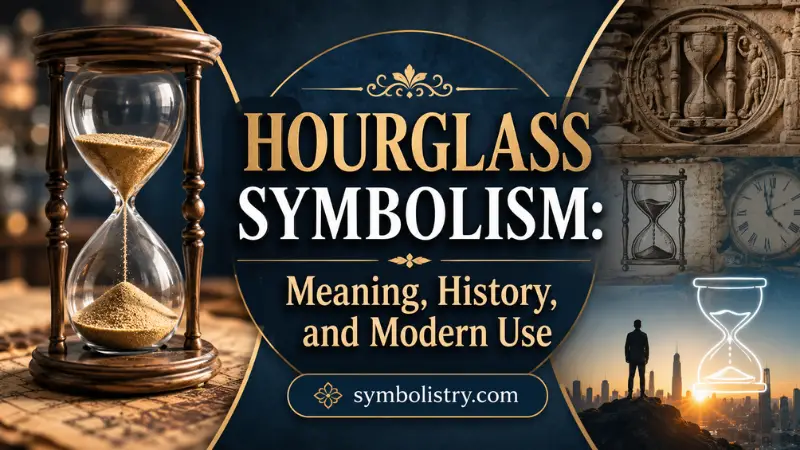
An hourglass is a simple object: two glass chambers joined by a narrow neck, with sand or another fine material passing from one chamber to the other. Yet hourglass symbolism goes far beyond measuring minutes. In American culture, the image most often represents passing time, mortality, deadlines, and the need to use life wisely.
Unlike a clock face, an hourglass makes time visible. You can actually watch the amount remaining shrink. That physical experience helps explain why the object became such an effective image for limited time and human life.
Today, hourglasses appear in tattoos, jewelry, memorial designs, artwork, home decor, logos, apps, and social media graphics. Their meaning can shift with the setting, but time remains at the center.
Quick Answer
Hourglass symbolism commonly represents the passage of time, mortality, limited opportunity, and the importance of using time wisely in modern American culture. Historically, the hourglass also became associated with temperance, human impermanence, and reminders of death in European art and moral traditions. (Google Arts & Culture)
TL;DR
- The hourglass primarily symbolizes passing and limited time.
- Its falling sand often represents human mortality.
- Medieval imagery connected it with temperance and self-control.
- Tattoos may represent remembrance, urgency, change, or second chances.
- Balance and renewal are common modern interpretations.
- Not every historical culture used the hourglass symbolically.
What an Hourglass Looks Like and Why Its Design Matters
A traditional hourglass has two chambers connected by a narrow opening. When one chamber is placed above the other, gravity pulls the sand downward at a controlled rate. Once the upper chamber empties, the hourglass can be turned over and used again. (Merriam-Webster)
That structure gives the object much of its symbolic force.
The upper chamber can suggest time remaining. The falling grains create a visible present moment. The lower chamber holds what has already passed. Although this past-present-future interpretation is partly metaphorical, it feels natural because the device literally moves material from one side to another.
The narrow center is equally important. Everything must pass through one restricted point. In modern symbolism, that can suggest a decisive moment, pressure, transition, or an experience that cannot be avoided.
Unlike the hands of a clock, the sand cannot move upward on its own. That one-way movement makes an hourglass especially suited to ideas about aging and irreversible change.
What the Hourglass Commonly Means in the United States
For most Americans today, the hourglass is first understood as a symbol of time passing. Other meanings usually develop from that central idea.
| Context | Common U.S. Meaning | Associations | Important Note |
| Everyday imagery | Passing time | Deadlines, waiting, urgency | Usually neutral |
| Memorial art | Mortality | Life, death, remembrance | Often reflective |
| Tattoos | Limited time | Purpose, change, resilience | Meaning is personal |
| Jewelry and decor | Awareness of time | Balance, mindfulness | Often positive |
| Skull imagery | Death | Memento mori, impermanence | Draws on older Western art |
| Winged hourglass | Time flies | Speed, aging, fleeting life | A traditional visual metaphor |
The same design can therefore communicate either anxiety or motivation.
A nearly empty hourglass may suggest that time is running out. A freshly turned hourglass may suggest another opportunity. An hourglass beside a skull clearly emphasizes mortality, while one surrounded by flowers may focus more on beauty, growth, and the temporary nature of life.
Context matters more than the object alone.
How a Practical Timekeeper Became a Symbol
The exact invention of the hourglass is uncertain, and claims that modern hourglasses were widely used in very ancient civilizations should be treated cautiously. Ancient peoples did use other timekeeping methods, especially water clocks, but clear European evidence for the familiar sandglass emerges much later. (Wikipedia)
One of the earliest unambiguous medieval images appears in Ambrogio Lorenzetti’s Allegory of Good Government, painted in Siena in the 1330s. There, the personification of Temperance holds an hourglass. (Google Arts & Culture)
By the 14th century, sandglasses were also being used aboard European ships. They offered sailors a practical way to measure repeated periods of time, and later examples were used in churches, workshops, cooking, and other activities. (Wikipedia)
As mechanical clocks improved, the hourglass became less important as a primary timekeeping device. Its usefulness as a visual metaphor, however, remained.
That shift is important: once people no longer depended on hourglasses for everyday timekeeping, the recognizable shape could increasingly function as an image about time itself.
Medieval Temperance and the Meaning of Self-Control
The medieval connection between the hourglass and Temperance adds an older meaning that modern interpretations often overlook.
Temperance traditionally concerns moderation, discipline, and control over excess. In Lorenzetti’s 14th-century civic fresco, Temperance holds an hourglass among the virtues associated with good government. (Google Arts & Culture)
Why would a timekeeper fit this virtue?
Measured time encourages limits. Tasks begin and end. Actions must be regulated rather than allowed to continue without restraint. In that setting, an hourglass could support ideas of proper measure, order, and discipline.
This is somewhat different from today’s familiar “life is short” interpretation.
The medieval image was not simply warning that death was coming. It could also suggest that a responsible person recognizes limits and acts with restraint.
That historical connection helps explain why modern hourglass designs can communicate patience, discipline, and intentional living as well as mortality.
Mortality, Memento Mori, and Vanitas Art
The hourglass became especially important in European images dealing with death and the brevity of life.
It frequently appears in memento mori imagery—art intended to remind viewers that death is unavoidable.In 17th-century vanitas still lifes, artists combined objects such as skulls, books, extinguished candles, flowers, clocks, and hourglasses to emphasize that wealth, beauty, pleasure, knowledge, and status do not stop time. (Tate)
The hourglass was particularly effective because its message required little explanation: the sand was visibly disappearing.
An example in the collection of the J. Paul Getty Museum pairs an hourglass with a skull, book, compass, and abandoned eyeglasses. Together, these objects evoke the temporary nature of life and human accomplishments. (Getty)
American viewers still recognize much of this visual language. A skull beside an hourglass in a tattoo, poster, or illustration normally does not mean “time management.” It points more directly toward mortality.
Why Falling Sand Represents Irreversible Time
The sand itself is a major part of the symbol.
Each grain is small, but together the grains represent a measurable portion of time. Once they have dropped into the lower chamber, they cannot return without someone turning the entire device over.
That creates several modern interpretations.
The falling sand can represent years passing, aging, memories accumulating, or opportunities disappearing. It can also encourage attention to the present because the viewer sees that the available amount is decreasing.
This symbolism does not require a pessimistic reading.
For some people, awareness of limited time is motivating. The hourglass may encourage someone to spend more time with family, finish meaningful work, leave an unhealthy situation, or stop postponing an important decision.
The symbol says time is limited. What a person does with that fact determines whether the message feels frightening or constructive.
Balance, Reversal, and the Two Chambers
Balance is a popular modern hourglass meaning, although it is not as historically central as time and mortality.
The shape is visually symmetrical. Two chambers meet at a narrow center, and the entire device repeatedly shifts between full and empty. That makes it easy to associate the form with opposing states:
- beginning and ending
- past and future
- gain and loss
- life and death
- action and patience
Turning an hourglass can also suggest resetting or beginning another measured period.
For that reason, some people interpret it as a symbol of renewal or second chances. This should be understood as a modern personal interpretation rather than a universal historical meaning.
The sand does not literally return to its earlier state. The object must be reversed before a new cycle begins. Symbolically, that distinction can make the hourglass useful for representing change: moving forward may require a deliberate shift in direction.
Urgency, Deadlines, and Limited Opportunity
Modern American culture often uses the hourglass without any reference to death.
Instead, it means time is running out.
Countdown graphics, advertisements, games, productivity tools, and digital interfaces use hourglass imagery to signal waiting, limited availability, or a deadline. The familiar ⌛ and ⏳ forms also carry the concept into digital communication.
This is a more practical version of the older mortality symbolism.
A deadline is simply a limited amount of time on a smaller scale. The person watching an hourglass knows that eventually the upper chamber will empty.
Because of that association, an hourglass can communicate urgency more effectively than an ordinary clock. A clock tells you what time it is. An hourglass emphasizes how much is left.
Hourglasses in American Memorial and Funeral Imagery
In memorial contexts, an hourglass generally represents the limited span of human life.
This meaning comes largely from older European funerary and memento mori traditions that influenced later Western visual culture. Hourglasses have appeared alongside skulls and other reminders of mortality in art and memorial imagery for centuries. (National Gallery of Art)
In a modern American memorial design, however, the message does not have to be grim.
An hourglass may represent the years a person lived, the value of shared time, or the idea that every life has boundaries. A personalized design might include names, dates, flowers, birds, or a short phrase.
The surrounding symbols change the emotional tone.
An hourglass with a skull emphasizes death. One with flowers can emphasize the beauty and brevity of life. One beside a loved one’s dates may function primarily as remembrance.
Why Hourglass Tattoos Are Popular
Hourglass tattoos work well because they can express several related ideas without requiring text.
One wearer may choose the design as a reminder to stop wasting time. Another may use it after surviving an illness, addiction, dangerous experience, or major life transition. Someone else may connect it with grief or a person who died.
The amount of sand can alter the message.
A nearly empty upper chamber can suggest urgency or the end of a chapter. An evenly divided hourglass may emphasize balance. A shattered glass may represent an attempt to escape limits, interrupt an old pattern, or reject the idea of living according to someone else’s schedule.
Additional tattoo elements create more specific readings.
Hourglass and skull: mortality and remembrance.
Hourglass and roses: beauty, love, and life’s temporary nature.
Hourglass with wings: the familiar idea that time flies.
Broken hourglass: interruption, liberation, loss, or defiance of time.
Hourglass with a date: remembrance of a personal turning point.
There is no fixed tattoo dictionary. The wearer’s reason is ultimately more authoritative than a generic interpretation.
Jewelry, Decor, Fashion, and Digital Culture
In home decor, an hourglass often has a quieter meaning than it does in memorial art.
Decorative sand timers can suggest patience, focus, simplicity, or awareness of time. They are sometimes used as visual reminders to work, read, meditate, or pause for a fixed period.
Hourglass necklaces and rings may similarly function as personal reminders: make the day count, accept change, or remember that difficult periods eventually end.
Fashion also uses the hourglass shape independently of its time symbolism. The adjective “hourglass” commonly describes a silhouette with a narrower middle between broader upper and lower areas. (Merriam-Webster)
That usage should not automatically be mixed with symbolic interpretations involving death or mortality. Sometimes an hourglass shape is simply a shape.
Digital culture strips the symbol down even further. An hourglass icon often means waiting, processing, a countdown, or an expiring period rather than philosophical reflection.
Religious and Spiritual Interpretations
An hourglass can carry religious meaning, but it is important not to treat it as a universal sacred symbol.
In Christian-influenced European art, images of time, decay, skulls, and hourglasses were often used to encourage reflection on mortality and the temporary nature of worldly possessions. Vanitas imagery could place earthly success beside reminders that death makes material achievement temporary. (National Gallery of Art)
For a modern Christian, an hourglass might therefore represent humility, wise use of one’s life, preparation for death, or awareness that earthly life is temporary.
However, the hourglass is not a central Christian emblem comparable to the cross.
Modern spiritual interpretations sometimes connect it with cycles, destiny, transformation, or the relationship between past and future. Those meanings can be personally useful, but they should not be presented as ancient universal doctrines unless a specific tradition supports them.
Cross-Cultural Meaning and Its Limits
Time, aging, death, and change are human experiences found in every culture. That does not mean every culture historically used the hourglass to symbolize them.
The familiar hourglass tradition documented in late medieval and early modern European art developed within particular technological and cultural settings. Its later spread helped make the image internationally recognizable. (Wikipedia)
Today, global media allows people from many backgrounds to understand an hourglass as a countdown or representation of passing time.
Still, broad claims such as “the hourglass has represented reincarnation in all ancient cultures” should be treated skeptically.
A useful distinction is:
The idea of time is universal. The symbolic history of one specific timekeeping object is not.
That distinction prevents modern interpretations from being falsely presented as ancient traditions.
Positive and Negative Meanings of the Hourglass
The hourglass has no single emotional tone.
Its negative meanings usually come from scarcity:
- time running out
- aging
- death
- missed opportunities
- pressure
- irreversible change
Its positive meanings come from awareness:
- living intentionally
- valuing the present
- patience
- discipline
- accepting change
- beginning again
This tension is one reason the symbol remains useful.
An hourglass does not tell the viewer whether limited time is good or bad. It simply makes the limit visible.
For someone grieving, that may feel painful. For someone making a major change, the same image can become motivational.
Common Misunderstandings About the Symbol
Several hourglass interpretations are often repeated too confidently.
One is the claim that the familiar hourglass was an important symbol in ancient Egypt. Ancient Egyptians used sophisticated timekeeping methods, including water clocks, but that does not establish the later glass sand timer as a major ancient Egyptian symbol. The origins of the hourglass itself remain uncertain, and the clearest medieval European evidence comes much later. (Wikipedia)
Another misconception is that it automatically symbolizes reincarnation. Turning an hourglass over can inspire a modern interpretation of renewal or cycles, but that is different from proving an established historical connection with reincarnation.
The same caution applies to claims about infinity, karma, or fate.
Those ideas may fit a personal design, but the strongest historically grounded meanings remain time, impermanence, mortality, measured limits, and—in some medieval imagery—temperance.
How the Meaning Changed Over Time
The hourglass passed through an unusual cultural transition.
It began primarily as a functional tool. Its ability to measure a limited interval then made it useful in allegorical art. Medieval imagery linked it with measured behavior, while later memento mori and vanitas traditions strengthened its connection with mortality and fleeting worldly achievement. (Google Arts & Culture)
As mechanical and electronic clocks replaced sand timers for most practical purposes, the object’s symbolic role became increasingly prominent.
Modern Americans now encounter hourglasses in contexts that range from serious memorial art to casual phone graphics.
The meanings have therefore expanded.
A 17th-century viewer might have encountered an hourglass as a warning about death and earthly vanity. A person today may encounter almost the same image in a tattoo about surviving hardship—or as an icon telling them a digital process is still loading.
The underlying connection remains remarkably consistent: something is moving forward, and the available time is limited.
FAQs
Is an hourglass a symbol of life or death?
It can represent both. Falling sand symbolizes the span of a life, while an emptying chamber naturally suggests mortality and the eventual end of that span.
What does an hourglass tattoo usually mean?
Most hourglass tattoos relate to time, mortality, change, remembrance, or the desire to live more intentionally. Additional elements such as skulls, flowers, wings, dates, or broken glass usually make the personal meaning more specific.
What does an hourglass with wings symbolize?
A winged hourglass commonly represents the idea that time flies. It emphasizes how quickly life, youth, opportunities, or particular moments can pass.
Does the hourglass have a Christian meaning?
It has appeared in Christian-influenced European traditions concerned with mortality, humility, and the temporary nature of worldly life. However, it is better viewed as a moral or memento mori image than as an official Christian emblem. (Tate)
Does an hourglass symbolize balance?
It can in modern symbolism. Its symmetrical chambers and narrow center make balance an intuitive interpretation, although historically the symbol’s strongest associations are with measured time, mortality, and impermanence.
What does a broken hourglass symbolize?
A broken hourglass may represent interrupted time, liberation from pressure, a life-changing event, loss, or rejection of imposed limits. It is mainly a modern design interpretation, so its exact meaning depends on the wearer or artist.
Is the hourglass a positive symbol?
It can be. Although it reminds people that time is limited, that message may encourage gratitude, patience, discipline, and attention to what matters rather than simply representing fear of death.
Conclusion
The hourglass remains recognizable because it turns an invisible idea into something people can see. Sand falls, the amount remaining decreases, and eventually the chamber empties. From medieval images of temperance to vanitas paintings and modern tattoos, that simple process has supported meanings involving time, mortality, restraint, urgency, remembrance, and change.
In modern American culture, hourglass symbolism is therefore neither purely negative nor purely positive. It can warn that life is short, honor time already shared, or encourage someone to use what remains more deliberately.
Its clearest message is also its simplest: time moves forward, and knowing that can change how we choose to spend it.