
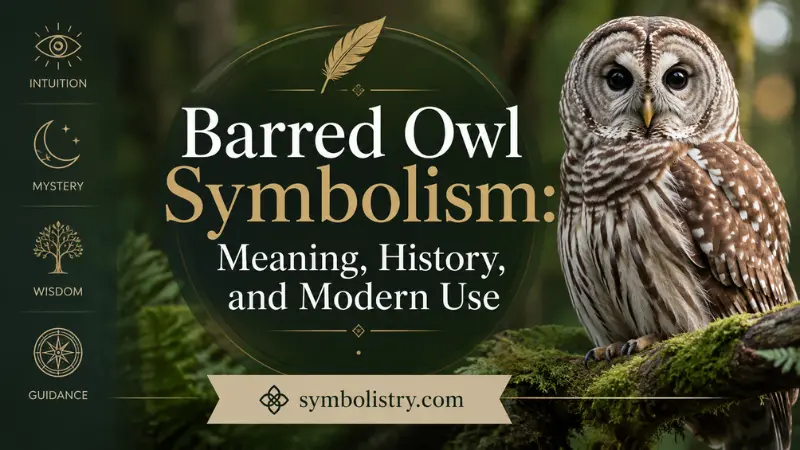
Barred owl symbolism often centers on awareness, quiet intelligence, intuition, and the ability to recognize what remains concealed. The bird’s dark eyes, camouflaged feathers, nearly silent flight, and unmistakable nighttime call make it a natural image for careful observation.
For many Americans, hearing a barred owl creates a mixture of curiosity and unease. Its call may come from a forest, wetland, suburban park, or wooded backyard long before the bird itself becomes visible. That unseen presence helps explain why people connect it with hidden knowledge, warnings, transitions, and messages from beyond ordinary awareness.
Yet not every interpretation comes from an ancient tradition. Many meanings associated specifically with the barred owl are modern extensions of broader owl imagery. Understanding that distinction keeps the symbolism accurate while leaving room for personal interpretation.
Quick Answer
Barred owl symbolism commonly represents awareness, quiet wisdom, intuition, and the ability to notice what others miss in modern American culture. Older owl traditions also connect it with night, omens, protection, and the uncertain boundary between the known and unknown.
TL;DR
- The barred owl commonly represents observation, patience, intuition, and adaptability.
- Its nighttime habits connect it with secrecy and unseen knowledge.
- Western wisdom symbolism comes partly from ancient Greek imagery.
- Its call can suggest communication, warning, or emotional recognition.
- Indigenous owl traditions differ widely and should not be generalized.
- Western conservation conflicts have added a complicated environmental meaning.
What a Barred Owl Looks and Sounds Like
The barred owl is a large North American woodland owl with a rounded head, no visible ear tufts, dark brown eyes, and a pale facial disk. Horizontal brown bars cross its upper chest, while longer vertical streaks appear on the lower body. Its common name refers to these banded feather patterns rather than to a barrier or enclosure.
Its coloring allows it to blend into trunks, branches, and shadowed foliage. A person may look directly toward a perched barred owl without recognizing it until the bird turns its head or changes position. That physical camouflage supports associations with concealment, discretion, and truths that are present but difficult to see.
The species is also known for an eight- or nine-note hooting sequence often represented by the phrase “Who cooks for you? Who cooks for you-all?” Mated birds may answer one another with hoots, cackles, caws, and gurgling sounds, producing surprisingly animated nighttime exchanges. (All About Birds)
Because the voice travels through the woods while the bird remains hidden, the barred owl often feels less like a visible object and more like an unseen presence. That experience has shaped much of its modern meaning.
What It Commonly Means in the United States
In contemporary American culture, the barred owl usually carries several related meanings rather than one fixed definition. The interpretation depends on whether the bird appears in wildlife art, a tattoo, a dream, a nighttime encounter, or a conservation discussion.
| Context | Common U.S. Meaning | Main Association | Important Note |
| Personal reflection | Awareness and intuition | Noticing overlooked details | Usually psychological, not supernatural |
| Nighttime encounter | Mystery or warning | An unseen presence nearby | Meaning depends on the observer’s emotions |
| Tattoo or jewelry | Wisdom and independence | Quiet confidence | May also commemorate change |
| Home decor | Woodland calm | Nature, stillness, observation | Often chosen for visual appeal |
| Environmental debate | Adaptation and conflict | Range expansion and competition | Especially relevant in the Pacific Northwest |
| Folklore-inspired art | Omens and transition | Boundaries between worlds | Drawn from broader owl traditions |
The most common positive interpretation is perceptiveness. A barred owl watches from a concealed position, listens carefully, and acts without unnecessary display. As a personal emblem, it can represent someone who gathers information before speaking or making a decision.
A second meaning is adaptation. The species has expanded far beyond much of its historically recognized eastern range and can live in several kinds of mature woodland, including forests near human development. This adaptability can be admired as resilience, although its westward expansion has also created serious ecological consequences. (All About Birds)
Why Its Nighttime Presence and Call Shape the Meaning
Many symbolic interpretations begin with a simple human response: darkness limits what people can perceive, while an owl remains capable of hunting, navigating, and communicating.
That contrast turns nighttime vision into a metaphor. The owl appears able to recognize what human eyes miss, so it becomes associated with insight, intuition, and seeing beneath appearances. The meaning does not depend on the bird possessing supernatural knowledge. It comes from the difference between human vulnerability at night and the owl’s natural competence.
Silent or nearly silent flight adds another layer. The bird may move through the trees without drawing attention, encouraging associations with discretion, restraint, and effective action that does not require public recognition.
Its voice creates a different emotional effect. A hoot emerging from darkness can feel conversational because the rhythm resembles a question. People may interpret it as a call to pay attention, reconsider a decision, or acknowledge something they have avoided.
In symbolic language, therefore, the barred owl combines two complementary qualities:
- It watches without announcing itself.
- It speaks with a voice that is difficult to ignore.
This combination makes the bird especially suitable as a symbol of truths that remain quiet until they demand recognition.
Historical Roots and the Ancient Greek Wisdom Connection
There is little evidence of a single ancient symbolic tradition devoted specifically to the barred owl. The species belongs to North America, while many familiar owl meanings developed in societies that would not have encountered it.
Its modern symbolism therefore draws heavily from the broader cultural image of the owl.
One major influence comes from ancient Greece. The owl was associated with Athena, the goddess connected with wisdom, strategy, civic order, and skilled judgment. Owl images appeared on Athenian coins, pottery, sculpture, and public objects. Its ability to see at night supported ideas of prudence and clear perception under difficult conditions. (Acropolis Museum)
Later Western art and education preserved this connection. Owls became familiar decorations in libraries, schools, graduation materials, bookplates, and academic logos. Children’s stories often portray them as teachers, advisers, or elderly figures who understand more than the other characters.
When Americans call a barred owl wise today, they are usually drawing from this inherited Western convention rather than from any documented behavior showing that owls possess unusual philosophical intelligence.
The bird’s actual traits nevertheless make the inherited meaning feel convincing. Its forward-facing eyes resemble an attentive human gaze, its movements appear deliberate, and its quiet posture looks contemplative. Appearance and cultural tradition reinforce each other.
American Folklore, Unease, and the Idea of an Omen
The barred owl does not always represent wisdom. In American folklore influenced by European traditions, nighttime birds may also signal danger, death, approaching change, or contact with an unseen realm.
Several natural features help explain this darker interpretation. Owls are active when most people are sleeping. Their voices carry through darkness, their faces can appear suddenly humanlike, and their movements are difficult to hear. Before modern wildlife education made owl behavior widely understood, such encounters could easily produce fear.
Stories sometimes describe an owl calling near a home before an illness, death, storm, or family crisis. These accounts belong to folklore rather than reliable prediction. People tend to remember a strange event when it occurs near an emotionally important experience, while forgetting the many owl calls followed by nothing unusual.
The omen interpretation remains influential in horror films, seasonal decorations, gothic art, and supernatural fiction. A barred owl placed in a dark forest scene can indicate that a character is being watched or that an ordinary setting is about to become unfamiliar.
Its meaning is not automatically negative, however. An omen can simply mean a sign that demands attention. In that sense, the bird may represent preparation rather than disaster: notice the situation, consider what has changed, and respond carefully.
Indigenous Traditions Require Cultural Specificity
Claims about a universal “Native American owl meaning” are inaccurate. Indigenous nations have distinct languages, environments, ceremonial systems, oral histories, and relationships with animals. An owl may be connected with protection in one community, danger in another, specialized ceremonial responsibilities elsewhere, or no single fixed meaning at all.
Museums hold owl-related figures and carvings associated with particular Pueblo traditions, including Hopi owl katsina representations. Katsinam belong to an active religious and community system rather than to a generic collection of animal symbols. Their meanings cannot be reduced to commercial labels such as “owl spirit,” “wisdom animal,” or “death messenger.” (National Museum of the American Indian)
The most respectful approach is to name the specific nation and rely on information shared or approved by that community. Broad online lists often combine unrelated traditions and present them as though all Indigenous peoples held the same beliefs.
This distinction is especially important in tattoos, jewelry, and home decor. A naturalistic barred owl design does not automatically borrow from Indigenous culture. Problems arise when sacred terminology, ceremonial imagery, or nation-specific designs are copied without understanding their origin.
The barred owl can still hold personal meaning for someone living in North America. That meaning should simply be described as personal, ecological, artistic, or spiritual rather than falsely presented as a universal Indigenous teaching.
Emotional Meaning, Dreams, and Personal Encounters
An encounter with a barred owl can produce several emotions at once. The bird may appear calm, but its steady gaze can feel intense. Its call may sound familiar and rhythmic, yet the darkness around it creates uncertainty.
Because of this emotional mixture, the bird often represents alert stillness: remaining calm while paying close attention.
For someone facing a complicated decision, it may serve as a reminder to observe before acting. A person who identifies with privacy may appreciate the owl’s ability to remain present without seeking attention. Someone recovering from a difficult period may interpret its nighttime activity as the ability to function during uncertainty.
Dream meanings are similarly personal. A barred owl in a dream does not carry a scientifically fixed message, but its behavior and setting can help explain the dreamer’s associations.
A silent owl watching from a tree may reflect self-awareness, scrutiny, or the feeling of being observed. A calling owl may represent a message the dreamer feels unable to ignore. An injured owl could express neglected judgment or loss of confidence, while a flying owl may suggest gaining perspective on a confusing situation.
The dreamer’s reaction matters more than a universal dictionary definition. Fear points toward anxiety or uncertainty. Comfort may indicate trust in one’s judgment. Curiosity can suggest readiness to examine something previously overlooked.
Wildlife encounters should also remain grounded in natural behavior. Seeing a barred owl during the day is unusual enough to feel memorable, but it does not necessarily predict an event. The bird may be resting, hunting, responding to disturbance, feeding young, or moving between locations.
Why It Appears in Tattoos, Jewelry, Art, and Decor
Barred owls work well in visual design because their faces are immediately recognizable and their feather patterns provide natural texture.
In tattoo culture, the bird often represents observation, independent thinking, survival through uncertainty, or the ability to remain composed under pressure. A front-facing owl emphasizes watchfulness. An owl in flight suggests action or transition, while one perched on a branch conveys patience and self-control.
Additional elements can change the design’s message:
- A moon emphasizes night, cycles, and uncertainty.
- A key suggests access to knowledge or private truth.
- A clock may represent time, mortality, or an important life stage.
- Forest trees connect the image with wilderness and belonging.
- Flowers can soften the design and add renewal or remembrance.
- An open book strengthens the familiar association with learning.
Owl jewelry tends to communicate intelligence, attentiveness, or affection for wildlife. It may also serve as a memorial object when the wearer connects an owl call or sighting with a deceased relative. That association is personal rather than a universal tradition.
In American interiors, barred owl prints and sculptures appear frequently in rustic, woodland, cottage, and cabin decor. Their neutral brown-and-cream coloring works naturally with wood, stone, and earth-toned settings. Halloween imagery presents a darker version, using the same bird to create suspense or an atmosphere of being watched.
Social media has added another modern use. Videos of barred owl calls, close encounters, and expressive head movements often present the species as curious, dramatic, or unexpectedly humorous rather than solemn.
The Environmental Conflict Behind Its Modern Meaning
The barred owl now carries an ecological meaning that differs sharply between regions.
In the eastern United States, it is generally understood as a native woodland predator and a valued part of forest ecosystems. Its presence may indicate suitable trees, nesting cavities, prey, and connected habitat.
During the twentieth century, however, barred owls expanded northward and westward across areas that had once limited their movement. Tree planting, changing land use, and fire suppression increased forested pathways across the Great Plains, helping the species reach the Pacific Northwest. (All About Birds)
There, barred owls compete with northern spotted owls for habitat and food. They are more flexible in their diet and habitat use, reproduce effectively, and can occupy areas formerly used by spotted owls. Federal wildlife authorities identify this competition, together with habitat loss, as a major threat to northern spotted owl survival. (U.S. Fish and Wildlife Service)
A federal management strategy adopted in 2024 authorizes the reduction of barred owl populations in selected areas of Washington, Oregon, and California to protect northern and California spotted owls. The policy has generated ethical disagreement because it requires killing members of one native North American species to prevent severe losses in another. (U.S. Fish and Wildlife Service)
This conflict has changed what the barred owl can represent. It may symbolize successful adaptation, but also ecological imbalance, unintended effects of human landscape change, and the difficulty of choosing between individual animal welfare and species conservation.
Calling the bird “evil,” “aggressive,” or morally responsible for the decline is misleading. It is responding to habitat opportunities and biological competition. Human land use helped create the conditions that allowed the expansion.
Common Misunderstandings About the Symbol
One misunderstanding is that every owl represents exactly the same thing. Wisdom is common in Western imagery, but different owl species create different impressions. A barn owl may appear ghostlike, a great horned owl may suggest strength, and a barred owl is especially associated with dense forests, resonant calls, camouflage, and watchful stillness.
Another mistake is treating symbolic interpretation as prediction. Hearing an owl does not reliably forecast death, misfortune, or a supernatural visit. Folklore can explain why an encounter feels emotionally charged without turning natural behavior into evidence of a future event.
It is also inaccurate to assume that the bird has a single biblical meaning. The barred owl is North American, and ancient religious texts did not refer to the modern species by that common name. Biblical translations use various owl or night-bird terms, often in descriptions of desolate places, but these passages should not be presented as species-specific teachings.
Likewise, the bird is not automatically a “spirit animal.” That expression is frequently used in modern self-help language, but it can flatten or imitate Indigenous religious concepts. “Personal symbol,” “animal emblem,” or “meaningful wildlife encounter” usually communicates the intended idea more clearly.
Finally, the word “barred” does not imply imprisonment. It describes the alternating bands or stripes visible across the owl’s plumage. (Merriam-Webster)
How the Meaning Has Evolved
The bird’s meaning has developed through several overlapping stages.
Early interpretations grew from direct experience. People heard a strong voice in dark forests, saw a face emerge from camouflage, and created stories that explained the encounter. Depending on the community, those stories could emphasize warning, danger, protection, hunting knowledge, or communication with an unseen world.
Western education later strengthened the wisdom association inherited from Athena’s owl. Illustrators and storytellers increasingly portrayed owls as thoughtful teachers, bookkeepers, judges, and advisers.
Wildlife science then changed public understanding again. Field guides, recordings, documentaries, and backyard birding helped Americans recognize the barred owl as an identifiable species rather than an anonymous nighttime omen. Its famous call became a source of enjoyment and a practical identification tool.
More recently, tattoo culture and digital media have personalized the symbol. The owl can now represent introversion, discernment, resilience, self-trust, or an important private memory.
The Pacific Northwest conservation debate has added the newest and most difficult layer. A bird once interpreted mainly through wisdom and mystery can now signify ecological trade-offs, human responsibility, and the limits of simple moral categories.
FAQs
Is seeing a barred owl a good sign?
Many people consider the encounter positive because the bird can represent awareness, patience, and careful judgment. It is not an objective prediction of luck, so the most useful meaning comes from the setting and your emotional response.
What does a barred owl tattoo symbolize?
A tattoo commonly represents observation, intuition, independence, or calm decision-making. Forest, moon, clock, key, or floral elements can add meanings such as belonging, transition, mortality, knowledge, or remembrance.
Does a barred owl have a biblical meaning?
The species has no distinct biblical symbolism because it is North American and was not identified in ancient biblical cultures. References translated as owls or night birds generally concern wilderness, ruins, isolation, or desolation rather than this particular species.
Does hearing its call mean someone will die?
No reliable evidence connects an owl’s call with an approaching death. The belief comes from folklore shaped by nocturnal behavior, unfamiliar sounds, and the human tendency to connect memorable encounters with later emotional events.
What does a barred owl mean in a dream?
It may represent observation, an ignored message, privacy, uncertainty, or the need to examine a situation more carefully. The owl’s actions and the dreamer’s feelings provide better clues than a fixed symbolic definition.
Can I call the barred owl my spirit animal?
“Personal symbol” or “animal emblem” is generally more culturally respectful unless you are discussing a specific tradition to which you belong. The bird can still represent qualities you value without borrowing sacred terminology from another community
Conclusion
The barred owl represents quiet awareness, patient observation, adaptability, and the ability to function when circumstances are unclear. Its nighttime voice also explains its older associations with warning, transition, secrecy, and the uneasy feeling that something nearby remains unseen.
Modern barred owl symbolism includes more than wisdom or mystery. It also reflects personal resilience, attachment to American forests, respect for wildlife, and difficult questions about ecological change.
The bird’s most grounded lesson comes from its behavior: pay attention, remain composed, and recognize that what is hidden is not necessarily absent.

[…] is a modern interpretive meaning rather than a single ancient doctrine. Because the bird moves between forests, farms, streets, […]