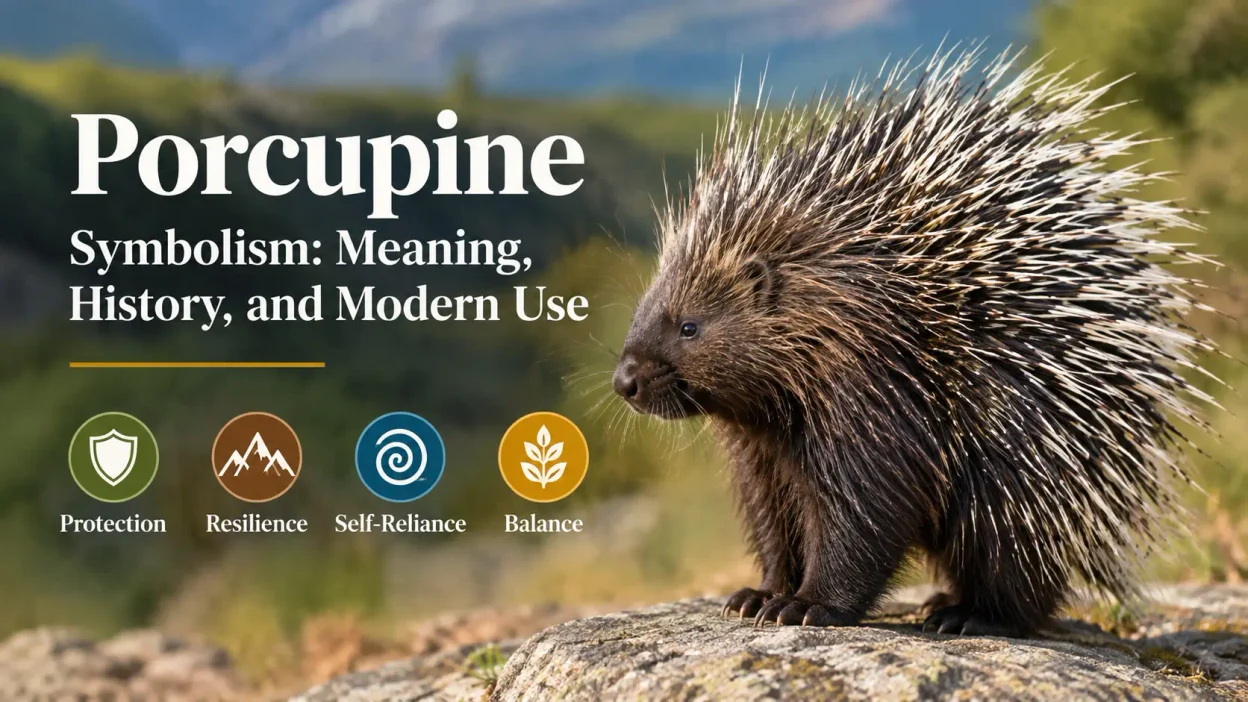
Porcupines are easy to recognize: a slow-moving mammal covered with thousands of sharp quills, usually encountered in forests, wooded areas, and wildlife settings across much of North America. Porcupine symbolism often centers on protection, boundaries, self-defense, independence, and the idea that something that looks vulnerable can still possess an effective way to protect itself.
The animal’s appearance naturally invites symbolic interpretation, but its real behavior makes the symbolism more interesting. A North American porcupine generally avoids confrontation and relies on its quills when threatened. That combination of peaceful behavior and strong defense has made the porcupine a useful image for thinking about personal boundaries and quiet resilience.
In the United States, the porcupine also has an important cultural history through Indigenous arts, especially the long-established practice of porcupine-quill decoration. Quills became an artistic material for many Native communities, particularly in the Plains and Eastern Woodlands, creating a cultural meaning that goes well beyond the modern idea of a “prickly” animal.
Quick Answer
Porcupine symbolism commonly represents protection, personal boundaries, independence, and quiet self-defense in modern American culture. Historically, porcupine quills also became important materials in Indigenous North American art, clothing, and decorative traditions, giving the animal associations with craftsmanship, identity, and cultural continuity.
TL;DR
- Porcupines commonly symbolize protection and strong personal boundaries.
- Their defensive quills represent preparedness without constant aggression.
- Indigenous quillwork gives porcupines important cultural significance in North America.
- In America, the animal can represent independence and self-protection.
- Tattoos often use porcupines to express resilience and individuality.
- Modern interpretations should not confuse symbolism with a single universal tradition.
What the Porcupine Represents at Its Core
The most recognizable meaning of the porcupine comes directly from its physical defenses.
A porcupine does not need to be the largest or fastest animal in its environment to discourage a predator. Its quills create a boundary that is immediately visible and difficult to ignore. Symbolically, that makes the animal a natural representation of knowing where to draw the line.
This is different from symbols based on domination or aggression. The porcupine’s defense is largely reactive. It does not need to chase an opponent to establish that it should be left alone.
That distinction explains several common interpretations:
- Protection — keeping yourself or others safe.
- Boundaries — communicating that certain limits should be respected.
- Self-reliance — possessing your own means of defense.
- Caution — approaching potentially difficult situations carefully.
- Resilience — continuing to function despite vulnerability.
- Individuality — being comfortable looking different from others.
The porcupine therefore tends to symbolize defensive strength rather than offensive power.
Why Quills Became the Animal’s Defining Symbol
A North American porcupine can have roughly 30,000 quills. Contrary to a familiar misconception, it cannot shoot them like arrows. The quills are loosely attached and can detach when a predator makes contact. If threatened, the animal may raise its quills, turn its back toward the attacker, and use its tail defensively.
That behavior gives the quill a useful symbolic distinction.
A sword, spear, or weapon generally suggests something actively wielded against another person. A porcupine’s quills suggest deterrence. They communicate, “Do not come closer,” rather than “I am coming after you.”
For this reason, porcupine imagery can appeal to people who see strength as the ability to protect themselves without seeking conflict.
The quills can also represent visible boundaries. In human relationships, boundaries are not necessarily hostility. They can simply define what a person will and will not accept. The porcupine offers an unusually clear natural metaphor for that idea.
Ancient Roots and Indigenous North American Traditions
One of the most important historical dimensions of porcupine symbolism in North America comes from Indigenous material culture.
Porcupine quills were collected, prepared, dyed, and worked into clothing, bags, ornaments, containers, and other objects. The Metropolitan Museum of Art describes quillwork as a longstanding Indigenous North American textile practice requiring considerable skill, with quills attached to materials such as animal hide, birchbark, and fabric.
This history matters because it is easy to make a misleading assumption that every Indigenous community shared one universal “porcupine meaning.” Native nations have distinct histories, languages, artistic traditions, and spiritual systems. The significance of quills could therefore differ according to community, object, maker, and context.
What can be said confidently is that porcupine quills became an important artistic material in numerous Indigenous communities.
The Smithsonian’s National Museum of the American Indian documents quillwork among Plains communities, including Lakota examples, and notes that quillwork guilds in some Plains societies were associated with specialized knowledge and respected positions.
That gives porcupine symbolism another dimension: skill, cultural knowledge, artistic identity, and continuity.
Porcupine Quillwork as Art and Identity
Quillwork was not simply a decorative technique.
Preparing quills required gathering them, cleaning them, sorting them, trimming them, and making them flexible enough to manipulate. Artists could dye the quills and arrange them into carefully designed patterns.
Historical objects show how widely this material was used. An Anishinaabe shoulder bag from around 1780, for example, incorporates porcupine quills through several distinct techniques.
The Smithsonian also preserves quillwork materials associated with Lakota and Arikara communities, demonstrating that the tradition existed across multiple regions and peoples rather than belonging to a single group.
This history makes “porcupine” an especially interesting symbol in an American context. The animal is not only an emblem of defense. Its quills became a means through which artists expressed design, expertise, belonging, and cultural memory.
Modern Native artists continue to adapt traditional materials and techniques rather than treating tradition as something frozen in the past. Museum collections demonstrate that Indigenous artistic practices have changed in response to new materials, markets, and circumstances while retaining connections to older traditions.
What Porcupine Symbolism Means in the United States
For a general American audience today, the porcupine is usually understood through its recognizable physical characteristics rather than through one established national tradition.
It can suggest a person who is:
- independent but not necessarily confrontational
- cautious about trust
- protective of personal space
- comfortable being unusual
- capable of defending themselves
- gentle until seriously threatened
This interpretation fits the animal’s actual behavior surprisingly well.
North American porcupines are generally not aggressive animals. They are herbivores that spend substantial time feeding, climbing, and moving through their habitats. When confronted, their quills provide an effective defensive mechanism.
That makes the porcupine an appealing modern metaphor for quiet strength.
Someone might identify with the animal because they are private, independent, or protective of their emotional space. In that context, the quills become a visual shorthand for boundaries rather than hostility.
Porcupine Symbolism and Personal Boundaries
Few animal symbols communicate personal boundaries as clearly as the porcupine.
Its body literally carries a defensive perimeter. The animal does not have to explain where the boundary begins. The quills make the message visible.
This can translate into human symbolism in several ways.
A porcupine image may represent learning to say no, protecting one’s privacy, recovering from difficult experiences, or refusing to tolerate unnecessary intrusion.
It can also represent the difference between being guarded and being hostile. Someone can be warm, caring, and peaceful while still maintaining firm boundaries.
That is an increasingly recognizable interpretation in contemporary American culture, where concepts such as personal space, emotional boundaries, privacy, and self-care are common parts of everyday language.
The porcupine works particularly well as a symbol because it does not suggest that vulnerability has disappeared. Instead, it suggests that vulnerability and protection can exist at the same time.
Independence, Resilience, and Self-Reliance
Porcupines are not usually associated with speed, social dominance, or aggressive hunting. Their symbolic strength comes from another source: they have an effective way to survive without possessing those characteristics.
That makes the animal a useful emblem of self-reliance.
The message is not necessarily “I need nobody.” A more accurate interpretation is, “I have ways of taking care of myself.”
This distinction makes porcupine imagery attractive to people who value independence while still maintaining relationships with others.
Resilience is another natural association. A porcupine’s defense does not eliminate danger, but it changes the animal’s position when danger appears. Symbolically, this can represent adapting to difficult circumstances rather than pretending that threats do not exist.
| Context | Meaning in the USA | Common Associations | Notes |
|---|---|---|---|
| Animal imagery | Protection | Quills, defense, caution | Usually based on visible physical traits |
| Personal identity | Independence | Boundaries, individuality | Often used positively |
| Tattoos | Resilience | Survival, self-protection | Meaning depends on accompanying imagery |
| Indigenous art history | Craft and cultural identity | Quillwork, design, tradition | Meanings vary by Native community |
| Home decor | Nature and character | Woodland imagery, humor | Often less formal or spiritual |
Emotional and Psychological Meaning
Psychologically, the porcupine can represent the tension between wanting connection and needing protection.
That makes it particularly relevant to emotional symbolism.
A person may care deeply about others while still having experiences that make them cautious about trust. The porcupine offers a visual metaphor for that position: the soft animal exists underneath the defensive exterior.
This does not mean that every porcupine tattoo or illustration represents emotional trauma. Symbolism depends on the individual.
For one person, the animal might mean independence. For another, it might represent surviving a difficult period. Someone else might simply choose it because they love wildlife or find the animal amusing.
The emotional interpretation becomes strongest when the porcupine appears alongside imagery such as shields, flowers, forests, broken chains, mountains, or protective phrases.
Positive and Negative Meanings
Porcupine symbolism can have both favorable and unfavorable interpretations.
On the positive side, the animal represents:
- healthy boundaries
- courage without aggression
- independence
- resilience
- careful judgment
- protection
- individuality
On the negative side, people sometimes interpret the quills as defensiveness, emotional distance, irritability, or unwillingness to trust.
The difference usually depends on context.
A porcupine standing peacefully in a forest can communicate self-possession and natural independence. A cartoon porcupine bristling at everyone around it might instead represent someone who is overly defensive or difficult to approach.
Neither interpretation is automatically correct. Symbolic meaning is created partly by the surrounding image and the intention of the person using it.
What a Porcupine Tattoo Can Symbolize
Porcupine tattoos are relatively uncommon compared with symbols such as wolves, snakes, roses, or butterflies, which can make the animal attractive to people looking for something less conventional.
A porcupine tattoo may represent personal protection, individuality, resilience, independence, or the ability to defend one’s boundaries.
Some people may choose the animal because it reflects their personality: friendly but private, calm but difficult to push around.
The design can change the meaning considerably.
A realistic North American porcupine may emphasize a connection to wildlife and nature. A stylized porcupine surrounded by plants may emphasize the forest. A porcupine with geometric patterns can shift attention toward design and artistic identity.
A tattoo using actual Indigenous quillwork motifs requires greater cultural awareness. Native designs should not be treated as generic decorative symbols simply because they look attractive. Specific patterns and artistic traditions have their own histories and cultural contexts.
Porcupines in Jewelry, Fashion, and Home Decor
The porcupine is less common in mainstream American jewelry than animals such as birds, butterflies, snakes, and bears, but it has a distinctive visual advantage.
Its silhouette is immediately recognizable.
Jewelry featuring a porcupine can communicate individuality, humor, nature appreciation, or a preference for unconventional animal symbolism. In home decor, porcupine imagery often fits woodland, rustic, cabin, or wildlife themes.
Because the animal is somewhat quirky, it can also be used playfully.
A porcupine illustration on a child’s room decoration may have little to do with protection or boundaries at all. It may simply communicate curiosity and affection for wildlife.
This is an important reminder that symbolism does not have to be solemn. Animals can become symbols through humor, affection, fashion, and personal taste as much as through traditional belief.
Cross-Cultural Interpretations
Porcupines occur in different parts of the world, but it is important not to combine every tradition involving a porcupine into one universal symbolic system.
North American porcupines have a particularly strong place in Indigenous material culture because their quills were available as an artistic resource. In other regions, different porcupine species and local traditions produce different associations.
Even within North America, symbolism varies among communities.
Some interpretations found online present “Native American porcupine symbolism” as though all Native peoples traditionally believed exactly the same thing about the animal. That is too broad. Indigenous North America includes hundreds of distinct nations and communities, and cultural meanings cannot responsibly be reduced to one formula.
The safest approach is to distinguish documented artistic and cultural practices from modern generalized spiritual interpretations.
Common Misunderstandings About the Porcupine
One of the most persistent misunderstandings is that porcupines can shoot their quills.
They cannot.
The quills detach when contact occurs, making the animal’s defense effective without requiring it to fire anything.
Another misunderstanding is that porcupines are naturally aggressive. Their appearance can create that impression, but their defensive behavior is better understood as protection than a desire to attack. Smithsonian educators specifically note that porcupines are often gentle and generally are not aggressive unless provoked.
There is also a cultural misunderstanding worth avoiding: assuming that every object decorated with porcupine quills carries one fixed spiritual message.
Quillwork is an artistic tradition with different forms, techniques, communities, and histories. Museums document porcupine-quill objects associated with many Native nations and regions, illustrating the diversity of the practice.
How the Meaning Has Changed Over Time
The porcupine’s symbolic history has shifted from material and cultural significance toward increasingly personal interpretations.
In Indigenous North American contexts, porcupine quills were not simply representations of an animal. They were practical artistic materials incorporated into objects with cultural and aesthetic importance. Quillwork could require specialized knowledge and extensive craftsmanship.
Later American popular culture increasingly emphasized the animal itself: its quills, unusual appearance, and defensive behavior.
Today, that visual identity dominates many informal interpretations. The porcupine becomes a metaphor for boundaries, self-protection, independence, and being comfortable with one’s unusual qualities.
The underlying theme has remained remarkably consistent, even though the context has changed: the porcupine represents the ability to remain yourself while protecting what matters to you.
Why the Porcupine Still Works as a Modern Symbol
The porcupine has an advantage that many abstract symbols lack: its symbolism can be understood almost immediately from its appearance.
You do not need extensive cultural knowledge to understand why an animal covered in quills might represent protection.
At the same time, the animal offers more nuance than simple toughness. Porcupines are not predators. They do not need to dominate their surroundings. Their defenses allow them to occupy the world without constantly fighting it.
That combination makes the porcupine relevant to modern ideas about individuality and boundaries.
In American culture, where personal independence is often valued, the porcupine can represent someone who wants to live according to their own nature while maintaining clear limits around themselves.
Frequently Asked Questions
What does a porcupine symbolize spiritually?
A porcupine may be interpreted spiritually as a symbol of protection, boundaries, resilience, and careful self-preservation. However, there is no single universal spiritual meaning, and interpretations differ among cultures and individuals.
What does a porcupine tattoo mean?
A porcupine tattoo commonly represents independence, self-protection, resilience, individuality, or strong personal boundaries. The surrounding design can change the message, so a forest setting, flowers, geometric patterns, or other imagery may add different associations.
Is the porcupine a symbol of strength?
Yes, but its symbolism usually reflects defensive strength rather than aggression. The animal’s quills allow it to discourage threats without being a predator, making it a useful symbol for quiet confidence and self-protection.
What does a porcupine symbolize in Native American culture?
There is no single Native American interpretation because Indigenous nations have distinct cultures and traditions. Porcupine quills, however, have a documented and important history in Indigenous North American quillwork, including Plains and Eastern Woodlands artistic traditions.
Is porcupine symbolism positive or negative?
It can be either. Positive interpretations include protection, independence, resilience, and healthy boundaries, while negative interpretations can include defensiveness, isolation, or being difficult to approach.
What does a porcupine symbolize in dreams?
In modern symbolic dream interpretation, a porcupine may represent boundaries, caution, vulnerability, or the need for self-protection. Dream symbolism is highly personal, so the animal’s behavior and the dreamer’s feelings are usually more informative than a fixed dictionary definition.
Why are porcupine quills important in Native American art?
Porcupine quills became an important material for decorative and artistic work among numerous Indigenous communities in North America. Artists prepared, dyed, and stitched the quills into clothing, bags, containers, and other objects, creating highly skilled forms of quillwork.
Conclusion
The meaning of porcupine symbolism begins with a simple observation: an apparently quiet animal can have an extremely effective defense. That makes the porcupine a natural representation of protection, boundaries, independence, and resilience without requiring aggression.
Its American history adds another layer. Porcupine quills became important artistic materials for numerous Indigenous communities, contributing to traditions of quillwork, craftsmanship, identity, and cultural continuity. Modern Americans often encounter the animal through wildlife imagery, tattoos, art, decor, and personal symbolism, where its quills have become a familiar metaphor for protecting one’s space.
The most useful way to understand the porcupine is not as a symbol of hostility, but as a reminder that strength can sometimes look like restraint: knowing when to stay peaceful, when to create distance, and when a boundary needs to be unmistakably clear.